Root Rot on Ficus Audrey: Causes, Checks & Fixes
Quick answer
Root rot on Ficus Audrey starts when fibrous roots sit in waterlogged soil and lose oxygen. Stop watering immediately, lift the pot to confirm a heavy wet mix, and unpot to inspect-firm pale roots mean you caught it early; mushy brown roots and a soft trunk at the soil line mean rescue surgery is urgent.
Root Rot on Ficus Audrey: Causes, Checks & Fixes
This guide covers root rot on Ficus Audrey. See also the general Root Rot guide, watering, and light pages for this plant.
Root Rot on Ficus Audrey: Causes, Checks & Fixes
Quick answer
Root rot on Ficus Audrey (Ficus benghalensis) is almost always a drainage and watering-frequency failure, not a random fungal curse. Audrey is an upright tree-form fig with a thick fibrous root system and a single light-colored trunk-not a rosette succulent. When soil stays saturated, those roots lose oxygen, fine tips die, and pathogens like Phytophthora thrive in waterlogged, low-oxygen soil.
First step: stop watering and lift the pot. A heavy container with wet mix days after the last drink, combined with yellow lower leaves or a musty smell, is enough to justify an unpot inspection. Healthy Audrey roots are firm and whitish or tan; rotted tissue is brown, black, or gray and dissolves when touched. Full species context: Ficus Audrey overview. For early wet-soil triage before roots fail, see overwatering on Ficus Audrey.
Why Ficus Audrey gets root rot
Ficus Audrey evolved in monsoon climates with heavy rains followed by real dry-down under strong sun. Indoors, growers often misread that rhythm and keep the mix faintly damp all the time-especially in dim winter rooms where evaporation slows to a crawl.
Fibrous roots and oxygen starvation
Audrey’s roots store water efficiently in thick fibrous tissue, which gives tolerance for brief dryness. The same architecture suffocates quickly when pores stay full of water. Roots in waterlogged soil cannot absorb oxygen and begin to decay; the longer saturation persists, the greater the damage. By the time yellow leaves or a sour smell appear at the surface, underground loss is often well underway.
Low light, winter slowdown, and oversized pots
Three indoor traps stack on the same species:
Calendar watering through winter. Continuing a midsummer weekly pour in October keeps mix waterlogged when shorter days and cooler rooms slow transpiration. NC State Extension notes root rot can occur from overwatering on Bengal fig houseplants-and lists fungus gnats as a companion signal of persistent moisture.
Low light in dim corners. A tree that is not using water at summer rates still receives the same drink. Surface soil may look acceptable while the center stays soggy for weeks. See not enough light on Ficus Audrey when stretchy growth pairs with a heavy pot.
Oversized containers. A pot much wider than the root ball holds a ring of wet, unused mix that cannot dry at the same rate as the center. Growers often upsize “to give room” and accidentally create a rot incubator around sparse fig roots.
Heavy peat mixes without perlite, blocked drainage holes, and decorative cachepots that trap runoff create the same oxygen-starved environment regardless of season.
What root rot looks like on Ficus Audrey
Root rot on an upright ficus presents differently than on a compact rosette plant. Watch the trunk base, pot weight, and soil smell-not just individual yellow leaves.
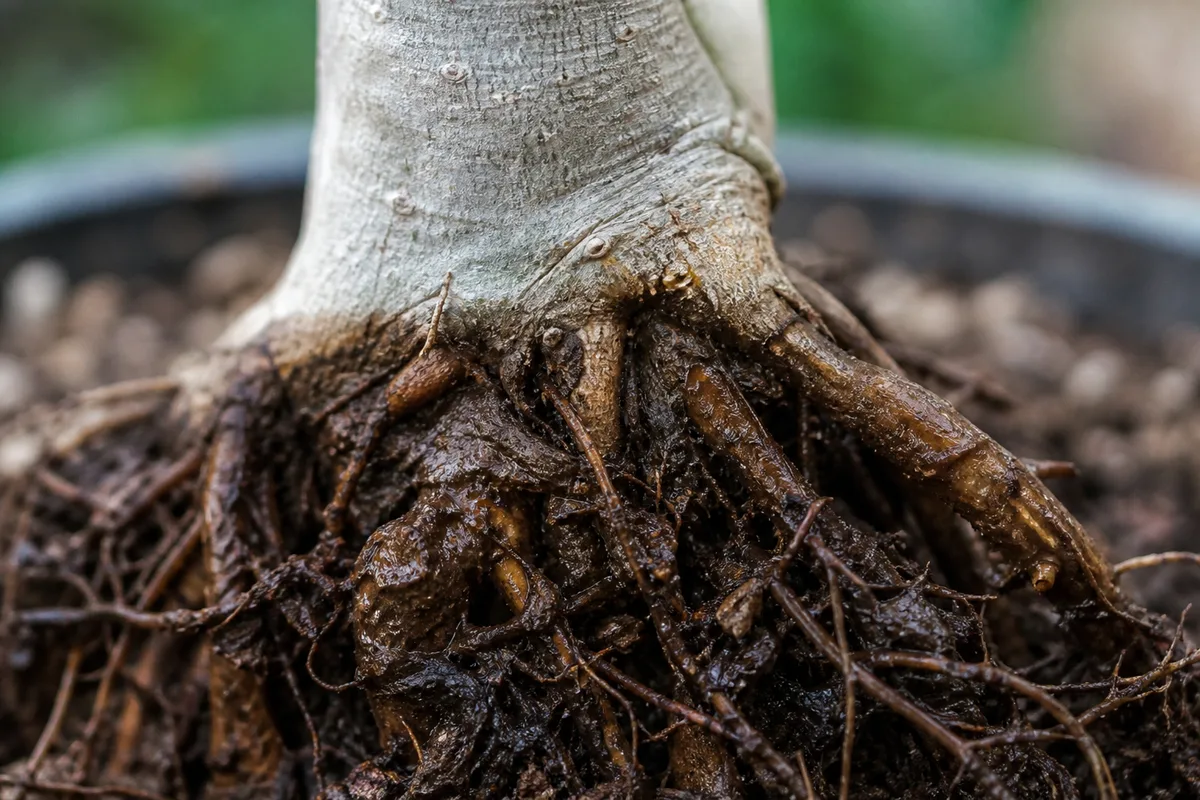
Root Rot symptoms on Ficus Audrey - compare with healthy tissue on the same plant.
Soft dark stem, musty smell, and fungus gnats
Early to moderate rot:
- Yellow lower leaves while soil stays damp-not crisp drought yellow
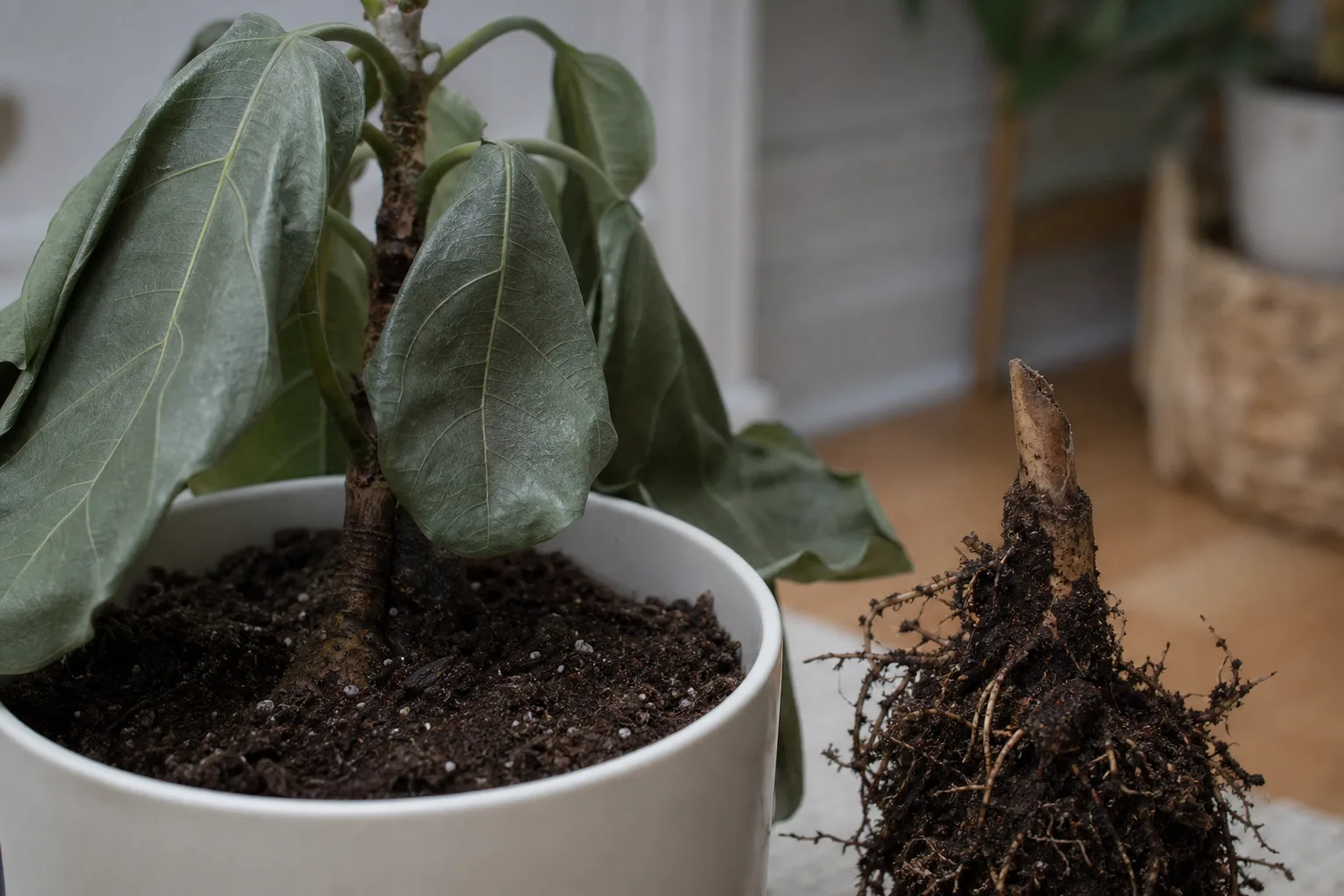
- Limp, velvety gray-green foliage despite wet mix (wilt paradox: damaged roots cannot absorb water)
- Pot feels heavy days or weeks after watering; surface stays dark and cool
- Musty or sour smell when you probe near the trunk or lift the plant slightly from the pot
- Fungus gnats hovering at the soil surface-NC State Extension lists them among common problems on Ficus benghalensis when moisture persists too long
Advanced rot:
- Soft, darkened tissue at the soil line on the otherwise pale trunk
- Cluster leaf drop while the container still feels waterlogged
- Stem collapse or inward give when you gently press the base
- White or gray mold on the soil surface in severe cases
Lookalikes: underwatering vs. relocation leaf drop
| Signal | Root rot | Underwatering | Relocation stress |
|---|---|---|---|
| Pot weight | Heavy, wet | Light, dry | Normal to slightly light |
| Soil smell | Sour, musty | Neutral, dusty | Neutral |
| Stem at soil line | Soft, dark | Firm, pale | Firm |
| Leaf pattern | Yellow + limp on wet soil | Crisp edges, wilt on dry soil | Scattered drop, stable moisture |
| Timing | Builds over weeks of wet soil | After missed checks | Days after move or repot |
| Roots (if checked) | Mushy, brown | Dry but firm | Firm, pale |
Underwatering on a light dry pot is the opposite fix-see underwatering on Ficus Audrey. Mass green leaf fall within days of a furniture shuffle with otherwise normal moisture usually points to leaf drop from relocation stress-not rot. Always cross-check pot weight before repot surgery.
How to confirm the cause
Work through these checks in order. One unpot inspection beats weeks of guessing from foliage alone.
- Pause all watering - Do not add water because leaves look wilted when soil is already wet.
- Pot weight and smell - Lift the container. Heavy heft plus sour odor strongly supports rot over drought.
- Surface moisture timeline - If mix stays wet more than ten days in an average indoor room after one thorough watering, roots are likely struggling.
- Stem firmness test - Gently press the trunk at the soil line. Spongy give is a red flag; firm pale bark is reassuring.
- Unpot inspection - Tip the plant out gently. Shake away loose mix and examine the root mass.
Healthy Audrey roots: firm, whitish, tan, or light brown; resilient when tugged.
Rotten roots: dark brown to black, translucent, slimy, or hollow; break apart with gentle pressure; may smell foul.
Wilting with moist soil often means roots cannot function even though water is present-a classic overwatering symptom on houseplants.
If more than roughly one-third of the root mass is mushy, or the lower trunk is soft, treat as confirmed advanced rot and move to rescue steps immediately. Mild cases with mostly firm roots and only a few brown tips may recover with corrected dry-down alone-see the mild path below.
First fix for Ficus Audrey
Your first action is always stop watering. Everything else follows severity.
Mild cases: stop watering, trim rot, callus dry, repot with perlite
When stems are still firm, smell is mild, and only peripheral roots are brown:
- Stop watering and move the plant to Ficus Audrey light guide with good air movement-not a dim corner where soil will never dry.
- Let the existing mix dry until the top 2 to 3 inches feel dry if roots are mostly intact. This alone may stabilize early rot.
- If leaves keep yellowing or smell worsens, unpot and trim all soft brown or black roots with clean, sharp scissors. Sterilize blades between cuts with rubbing alcohol.
- Air-dry cut surfaces on newspaper for 24 to 48 hours in bright indirect light.
- Repot into fresh, dry, well-draining mix-roughly 70 to 80 percent quality houseplant mix plus 20 to 30 percent perlite-in a clean pot with a drainage hole sized to the trimmed root ball, not dramatically larger.
- Wait 24 to 48 hours after repot before the first modest thorough watering. Drain completely and empty the saucer.
- Hold fertilizer until new firm gray-green leaves appear at branch tips.
If you removed more than half the root mass, prune top growth proportionally so remaining roots can support the canopy.
Advanced cases: when trunk softness limits salvage
When the lower trunk collapses, feels hollow, or most roots dissolve on inspection, recovery is unlikely regardless of Ficus Audrey repotting guide. Honest assessment saves weeks of nursing a specimen with no viable vascular tissue left.
Salvage may still be possible when:
- Softness is limited to outer root tissue and the trunk above the soil line stays firm
- You find a core of firm white roots after aggressive trimming
- New tip growth was firm within the last few weeks before decline accelerated
Treat as likely fatal when:
- Trunk pinches inward at the base with wet soil
- Stem tissue is dark and mushy several inches above the mix
- More than roughly two-thirds of roots are gone and crown leaves collapse daily
In borderline cases, repot once with aggressive trim and commit to minimal water for four to six weeks-judge by firm new leaves, not old yellow ones re-greening.
Recovery timeline
Early rot caught at firm-stem stage: stabilization often begins within one to two weeks after watering stops and soil dries. New firm leaves at tips may appear in three to six weeks if root damage was limited.
Moderate rot after trim and repot: expect some continued leaf drop while the plant reallocates energy-normal on ficuses. Meaningful new growth in four to eight weeks is a realistic success signal.
Advanced rot with major root loss: recovery, if it happens, runs two to three months and may never restore full canopy density. Old yellow or limp leaves will not re-green; judge only by firm new gray-green blades and stable trunk tissue.
Fatal progression: daily crown collapse, spreading stem softness, or complete root loss within days to two weeks despite dry repot-stop investing once structural tissue fails.
What not to do
Do not keep watering because leaves look wilted when soil is already wet. Watering a plant with rotting roots worsens oxygen loss.
Do not repot into dense garden soil, a pot without drainage, or a larger container hoping extra soil will “absorb moisture”-that deepens saturation around Audrey’s fibrous roots.
Do not fertilize a rotting plant. Salt load on damaged roots accelerates decline.
Do not assume leaf drop alone means rot-check moisture and roots first.
Do not leave the plant in a cachepot full of runoff. Standing water at the bottom mimics chronic overwatering within days.
Do not trim all foliage immediately. Remove only leaves that stay yellow and limp after the root zone stabilizes.
How to prevent root rot next time
Prevention aligns with the Ficus Audrey watering guide-this page covers rescue; that guide owns daily rhythm.
Water when the top 2 to 3 inches of soil are dry-not on a calendar, not when only the surface quarter-inch is dry. NC State Extension recommends that dry-down for Bengal fig houseplants with good drainage and empty trays after every drink.
Use airy mix with perlite in a pot with an open drainage hole. Water thoroughly until runoff, then empty saucers within thirty minutes.
Avoid oversized pots. Size up one inch at repot time, not three.
Reduce winter frequency when growth slows in low light-many medium pots need fourteen to twenty-one days between checks in cool months, but always confirm dry-down depth before pouring.
Keep the tree in bright indirect light so the wet-dry cycle runs predictably. Dim corners plus summer watering habits are the most common rot trigger on indoor ficuses.
Cross-link early triage: if soil is wet but roots still feel firm, fix habits on the overwatering page before rot advances.
Pet safety during root rescue (latex sap)
Ficus Audrey is toxic to cats and dogs because of milky latex sap in stems and roots. The ASPCA lists Ficus species as toxic to pets. Root surgery exposes more sap than routine care.
During trim and repot:
- Wear gloves if you have sensitive skin; sap can irritate skin on contact
- Keep pets out of the work area until cleanup is complete
- Bag and discard trimmed rotten tissue promptly
- Wash tools and hands after handling cut roots
- Do not compost diseased root material where pets might investigate
If a pet ingests foliage or sap during cleanup, contact your veterinarian or the ASPCA Animal Poison Control Center at (888) 426-4435. This page is not veterinary advice-see Ficus Audrey overview for full toxicity context.
When to worry
Treat root rot as urgent when the trunk softens at the soil line, leaves collapse daily despite wet mix, or more than half the roots are mushy on inspection. Those patterns narrow the salvage window to days-not weeks.
Also escalate quickly when fungus gnats are heavy, smell is sharply sour, and multiple lower branches yellow at once-rot is likely advancing faster than a simple dry-down can reverse.
Lower urgency: one yellow lower leaf on an otherwise firm tree with soil drying normally at the 2-inch depth may be senescence or early overwatering correctable without repot-confirm with pot weight first.
Related tool
Use the Root Rot Risk Checker to narrow causes for root rot on this plant before changing multiple variables at once.
Related guides
- Ficus Audrey overview - species biology, toxicity, and care hub
- Ficus Audrey watering - top 2–3 inch dry-down and seasonal rhythm
- Overwatering - early wet-soil triage before roots fail
- Drooping leaves - wilt paradox and moisture checks
- Leaf drop - relocation stress vs. rot-driven shedding
When to use this page vs other Ficus Audrey guides
- Ficus Audrey watering guide - Use for routine moisture checks before assuming root rot is the main issue.
- Ficus Audrey problems hub - Browse all 17 common issues on this species.
- Overwatering on Ficus Audrey - Different entry point when symptoms overlap with root rot.
- Yellow Leaves on Ficus Audrey - Different entry point when symptoms overlap with root rot.
- Wilting on Ficus Audrey - Different entry point when symptoms overlap with root rot.