Spider Mites on Ficus Audrey: Causes, Checks & Fixes
Quick answer
Spider mites on Ficus Audrey show as fine stippling on matte gray-green leaves and webbing at velvety undersides-often after winter heating drops humidity below 30%. First step: isolate the plant and rinse fuzzy leaf undersides with lukewarm water during daylight so pubescent foliage dries before evening.
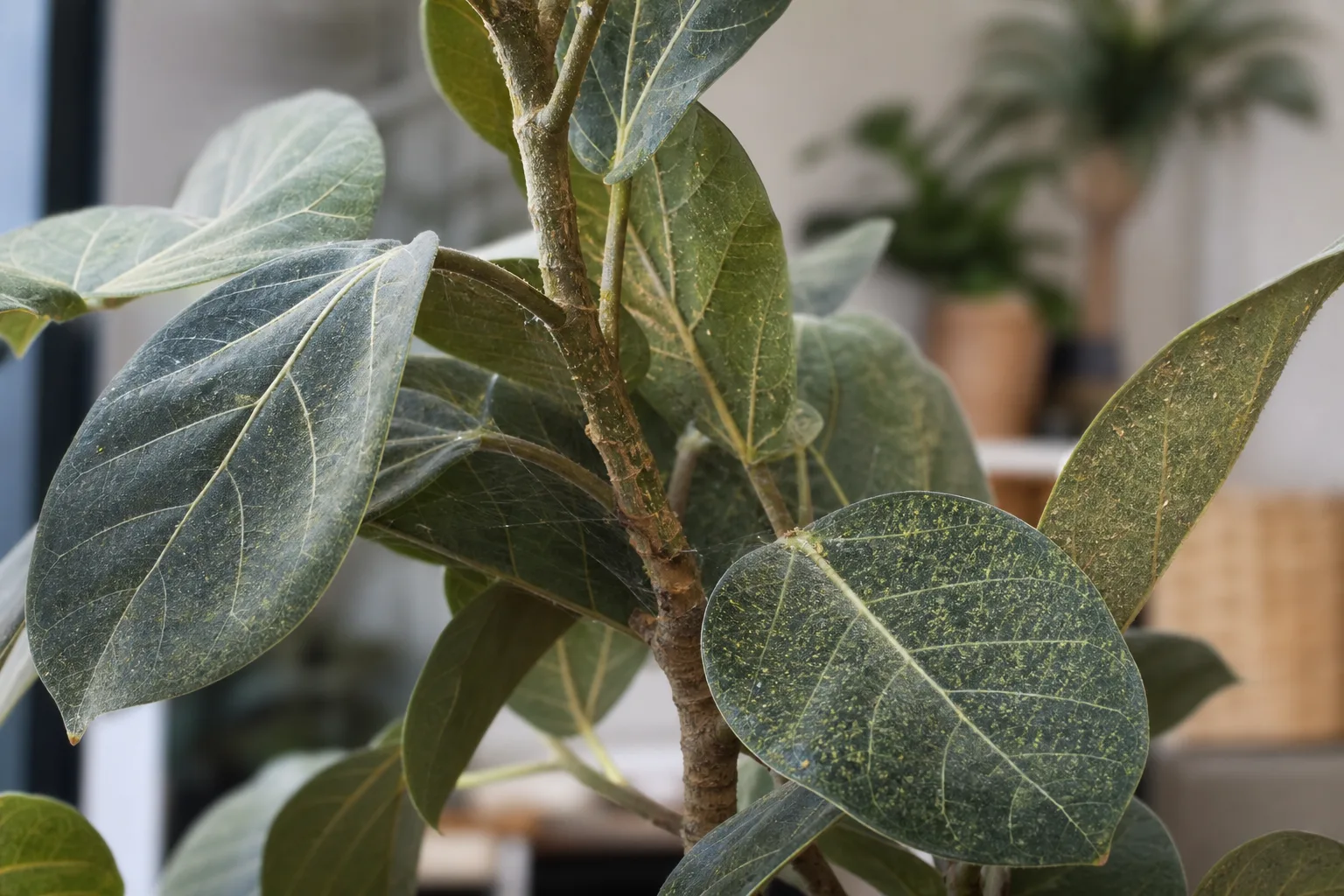
Spider Mites on Ficus Audrey: Causes, Checks & Fixes
This guide covers spider mites on Ficus Audrey. See also the general Spider Mites guide, watering, and light pages for this plant.
Spider Mites on Ficus Audrey: Causes, Checks & Fixes
Quick answer
Spider mites on Ficus Audrey (Ficus benghalensis) are tiny sap-feeding arachnids that explode when indoor air turns hot and dry-classic winter-heating territory for a floor tree beside a south window or radiator. On this banyan-form species, damage shows as fine yellow-white stippling on matte gray-green oval leaves (typically 3 to 6 inches long indoors) and delicate webbing tucked into velvety pubescent undersides and leaf axils along the upright trunk.
First step: isolate the plant and rinse fuzzy leaf undersides with lukewarm water during daylight hours. Mites feed on the underside; pubescent texture hides early colonies until stippling bronzes the upper surface. Do not start sprays until you confirm live pests with the paper-tap test and move Audrey away from neighboring ficuses.
Pet and sap note: Ficus Audrey is toxic to cats and dogs because of milky latex sap. Wear gloves if sap irritates your skin during rinsing, keep treated plants out of pet reach, and ventilate the room when applying horticultural oil indoors.
Why Ficus Audrey gets spider mites in dry winter rooms
Spider mites are not caused by a single watering mistake-they are environmental pests that favor warm, dry conditions on stressed foliage. NC State Extension recommends monitoring Ficus benghalensis for spider mites indoors, alongside mealybugs and scale.
Why this species is vulnerable:
- Velvety undersides trap dust. Fine pubescence on Audrey leaves collects household dust faster than glossy fiddle-leaf panels. Dusty fuzzy foliage loses vigor and gives mites protected crevices at petiole bases-exactly why our Ficus Audrey overview recommends monthly gentle wiping without leaf shine.
- Winter heating strips humidity. Central heat often pushes rooms into the 20–30% RH band, well below the 50 to 80% range NC State lists for Bengal fig houseplants. Dry air weakens margin tissue and favors mite reproduction simultaneously-see our low-humidity guide for the brown-edge pattern that precedes many mite outbreaks.
- Hot microclimates on large trees. A tall Audrey beside a west window or above a radiator sits in warmer, drier air than the thermostat reading. Plants under heating vents are especially susceptible to spider mites.
- Indoor collections without predators. Homes lack lady beetles and predatory mites that control populations outdoors. One missed cluster on a fuzzy underside can spread to neighboring ficuses when pots touch or leaves overlap.
Overwatering and cold drafts cause other Audrey problems-yellow leaves, leaf drop, wilting-but those issues do not create spider mites. If you see stippling plus webbing, treat pests first; do not repot or overhaul watering until you confirm infestation level.
What mite damage looks like on fuzzy gray-green leaves
Healthy Ficus Audrey leaves feel firm and slightly leathery despite soft velvety undersides. Mite feeding disrupts that matte gray-green surface in a pattern distinct from humidity crisping or stress shedding.
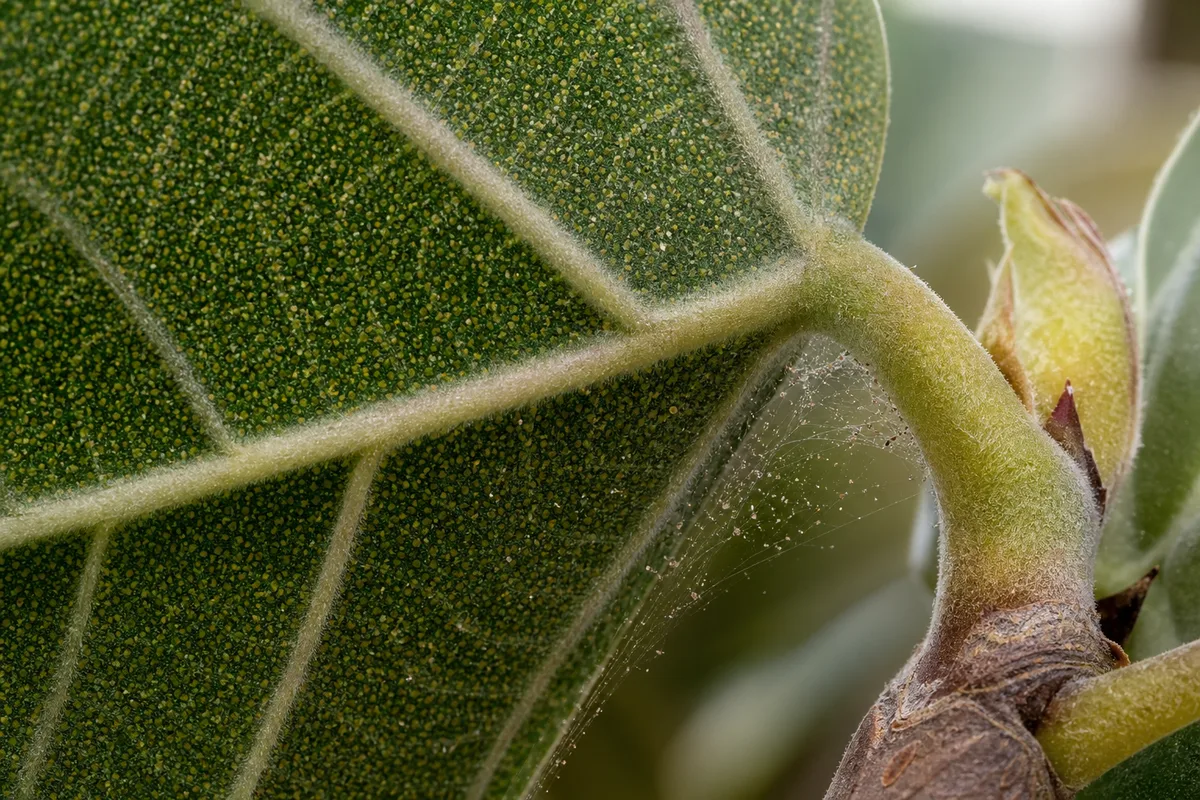
Spider Mites symptoms on Ficus Audrey - compare with healthy tissue on the same plant.
Typical mite pattern on Audrey:
- Fine yellow or white pinprick stipples scattered across the upper leaf blade-easier to see on matte gray-green than on glossy ficuses
- Bronzing or dulling as feeding continues; severely infested leaves look bleached before they crisp
- Delicate silk webbing at leaf bases, petiole axils, and along branching nodes on the light-colored trunk-not the dense cottony wax of mealybugs
- Black fecal specks and cast skins on velvety undersides when you inspect with magnification
- Premature leaf drop on heavily fed branches-feeding can yellow leaves and cause leaf drop-sometimes mistaken for relocation stress
Because stippling starts on undersides hidden by pubescence, owners often notice bronzing on the upper surface first-by then colonies may already span several leaves. Early detection means inspecting fuzzy undersides and leaf axils, not just the flat leaf face visible from across the room.
Unlike thrips, mites produce webbing. Unlike scale, they move when disturbed. Unlike low-humidity brown edges alone, mite damage includes speckled tissue across the blade center, not just crispy margins on otherwise firm leaves.
Spider mites vs. low humidity, thrips, and stress leaf drop
Misdiagnosis wastes weeks. Use this quick reference before treating:
| What you see | Likely cause on Ficus Audrey | Key differentiator |
|---|---|---|
| Crispy brown margins, firm gray-green centers, no speckling | Low humidity | Uniform edge burn; hygrometer below ~40% at canopy; no webbing |
| Fine stippling + webbing on velvety undersides | Spider mites | Paper-tap specks crawl; silk at leaf axils |
| Silvery streaks, distorted new leaves, no webbing | Thrips | Rasping damage; insects visible with magnification |
| Immobile brown bumps on trunk or veins | Scale | Does not crawl; lacks stipple pattern |
| Sudden shed of older leaves after a move, no stippling | Stress leaf drop | Timing matches relocation; stems firm; no pest signs |
| Yellow soft leaves on wet mix | Overwatering | Soil soggy at depth; may attract fungus gnats |
When margin crisping and stippling appear together, dry air often came first and mites followed-raise humidity and treat the pest. Humidity alone rarely clears an established colony.
How to confirm spider mites (six-step checklist)
Work through these checks before committing to sprays:
- Inspect velvety undersides and leaf axils. Trace every petiole from the lower trunk upward. Mites colonize fuzzy crevices where each leaf meets the branching stem-on tall specimens you may need a step stool.
- Look for stippling on the matte upper surface. Yellow-white pinpricks that spread outward from the midrib suggest active feeding, not old mechanical damage.
- Search for fine webbing. Silk threads at leaf bases and branching nodes distinguish mites from thrips or mineral spray residue.
- Run the paper-tap test. Hold white paper under a suspect leaf and tap firmly. Slow-moving specks confirm live spider mites; static dust does not crawl.
- Magnify if unsure. Phone camera zoom or a hand lens reveals amber eggs, cast skins, and eight-legged mites on pubescent tissue.
- Survey neighbors and recent purchases. Check ficuses within a metre and any plant added in the last month. Shared mite pressure means isolation is non-negotiable.
Confirmed: stippling plus webbing, crawling specks on white paper, and mites visible on velvety undersides.
Suspected but not confirmed: random pale flecks with no webbing, no movement on paper, and no return after a single wipe-recheck in three days before treating.
First fix: isolate neighbors, rinse fuzzy undersides, and treat on a schedule
Move Ficus Audrey away from other plants and rinse every velvety leaf underside with lukewarm water during daylight hours.
This is the safest opening move because it knocks down live mites without soaking pubescent foliage overnight-a key difference from generic “shower the plant” advice that ignores Audrey’s water-spot risk on fuzzy leaves.
Isolation and rinse technique
- Place the tree where leaves cannot touch neighboring ficuses. UMN Extension advises isolating infested plants when pests are detected.
- Work in morning or midday so fuzzy leaves dry fully before evening. Overnight wet velvety pubescence can leave permanent marks on Audrey foliage.
- Support each leaf from underneath so you do not snap petioles on the upright trunk while directing water at undersides and leaf axils.
- Use a sink sprayer, shower wand, or spray bottle with enough pressure to dislodge mites but not tear soft tissue.
- Bag and discard rinse water if it collects visible specks; wash hands before touching other plants.
Wear gloves if you are sensitive to Ficus latex sap, which can irritate skin on contact. Keep treated plants off floors where pets might chew dropped leaves.
Spray cadence after the first rinse
Once foliage is dry, apply horticultural oil or insecticidal soap labeled for spider mites on ornamentals. UF/IFAS notes that soaps and oils are effective against mites and among the least toxic options for indoor use-but contact products do not reliably kill eggs, so you need multiple applications.
Plan three rinse-plus-spray cycles at five- to seven-day intervals before judging success. Mississippi State Extension recommends treating two to three times at five-day intervals for spider mites on houseplants. Coat undersides thoroughly; mites hide on velvety tissue the flat upper surface misses.
Ventilate when spraying indoors. Enclose the plant in a loose plastic bag with a spray hole if the label allows, or treat near an open window. Audrey is toxic to cats and dogs-keep pets away until foliage is dry and the room has aired out.
Do not use insecticides labeled only for insects-many do not control mites. Systemic imidacloprid products do not control spider mites and can reduce natural predators.
Recovery timeline and what clean new growth looks like
Stippling stops spreading within one to two weeks of consistent rinse-and-spray cycles when humidity improves and isolation holds. Existing stippled tissue does not fully green up-damaged leaves do not recover their original color-judge recovery by new gray-green leaves emerging clean at branch tips.
Positive signs:
- No new webbing after the second treatment cycle
- Paper-tap test shows fewer or no crawling specks
- New leaves expand without pinprick damage
- Canopy regains matte gray-green color on fresh growth
Warning signs:
- Webbing returns within days of each rinse
- New leaves emerge already stippled
- Widespread bronzing and crisping despite treatment
- Mites appear on previously clean neighboring ficuses
Most moderate infestations on firm-trunk Audrey specimens clear in three to four weeks with disciplined cadence. Heavy outbreaks on multi-foot trees may need a fourth cycle or predatory mite release in enclosed rooms-consult extension guidance before combining biological and chemical controls.
What not to do
- Do not assume insecticides kill mites. Mites need miticides, horticultural oils, or insecticidal soaps labeled for spider mites-not generic “houseplant bug spray” unless the label lists mites.
- Do not let velvety leaves stay wet overnight. Daytime rinsing respects Audrey’s pubescent texture; evening soaks invite water spots and fungal spotting in stagnant air.
- Do not use leaf shine products during or after treatment. Leaf shine clogs fuzzy foliage and interferes with gas exchange-our overview recommends gentle wiping only.
- Do not mist as your primary humidity fix. Brief misting does not replace a humidifier in heated winter rooms and can wet velvety leaves without sustained RH improvement.
- Do not skip isolation. Mites crawl short distances and spread on tools, hands, and overlapping foliage between grouped ficuses.
- Do not fertilize during active infestation. Stressed Audrey should recover pest-free before you resume feeding per our fertilizer guide.
Prevention: humidity, dust wipe, and weekly fuzzy-underside scouting
Long-term mite prevention on Ficus Audrey ties directly to fuzzy-leaf maintenance from the overview page:
- Run a humidifier targeting 50 to 80% RH at canopy height when winter heating drops air below 40%. A humidifier outperforms pebble trays for a floor tree with a wide canopy.
- Wipe velvety undersides monthly with a soft damp microfiber cloth during watering checks. Dust removal doubles as early mite scouting on pubescent leaves.
- Inspect leaf axils weekly November through March-the heating season when spider mites thrive in dry, warm conditions.
- Avoid hot drafts from radiators, forced-air vents, and unfiltered south-window summer sun that desiccates fuzzy foliage.
- Quarantine new plants two to three weeks before placing them near your Audrey.
When to escalate or call it quits
Escalate when webbing covers most of the canopy after three full treatment cycles, when root mealybugs or rot complicate recovery, or when mites keep spreading to your entire ficus collection despite isolation.
Consider discarding when:
- Webbing and stippling persist after four weeks of diligent rinse-and-oil treatment
- The tree has lost most functional leaves and shows no clean new growth
- Protecting neighboring plants matters more than saving one heavily infested pot
A mature Audrey with a firm trunk and healthy roots can often be cut back to reduce mite harborages-prune webbed tissue over a tarp to contain sap drips, then restart the treatment cadence on the remaining canopy.
Closing note
Spider mites on Ficus Audrey are a dry-air plus fuzzy-foliage problem, not a mystery disease. The velvety undersides that make this tree distinctive also hide the first colonies-so weekly axil checks and monthly dust wipes belong in the same routine as watering. Match treatment to daytime rinsing, isolation, and repeated oil or soap cycles, raise humidity toward the 50–80% band, and judge success by clean new gray-green leaves, not by expecting old stippling to vanish. For the full care context-light, watering, and fuzzy-leaf maintenance-see our Ficus Audrey overview.
Related Ficus Audrey guides
- Ficus Audrey overview - species biology, fuzzy-leaf care, toxicity, and care hub
- Low humidity - brown margins without stippling or webbing
- Leaf drop - stress shedding vs. mite damage
- Wilting - watering stress lookalike
- Yellow leaves - overwatering vs. pest damage
- Mealybugs - alternate sap-sucking pest on velvety foliage
- Fungus gnats - pest overlap on overwatered ficuses
- Ficus Audrey watering - top 2–3 inch dry-down during recovery
Related tool
Use the Pest Identifier Tool to narrow causes for spider mites on this plant before changing multiple variables at once.