Mealybugs on Ficus Audrey: Causes, Checks & Fixes
Quick answer
Mealybugs on Ficus Audrey hide in leaf axils, stem forks, and unfolding leaf sheaths on the upright trunk. First step: isolate the plant and dab every visible insect with 70% isopropyl alcohol on a cotton swab before adding sprays.
Mealybugs on Ficus Audrey: Causes, Checks & Fixes
This guide covers mealybugs on Ficus Audrey. See also the general Mealybugs guide, watering, and light pages for this plant.
Mealybugs on Ficus Audrey: Causes, Checks & Fixes
Quick answer
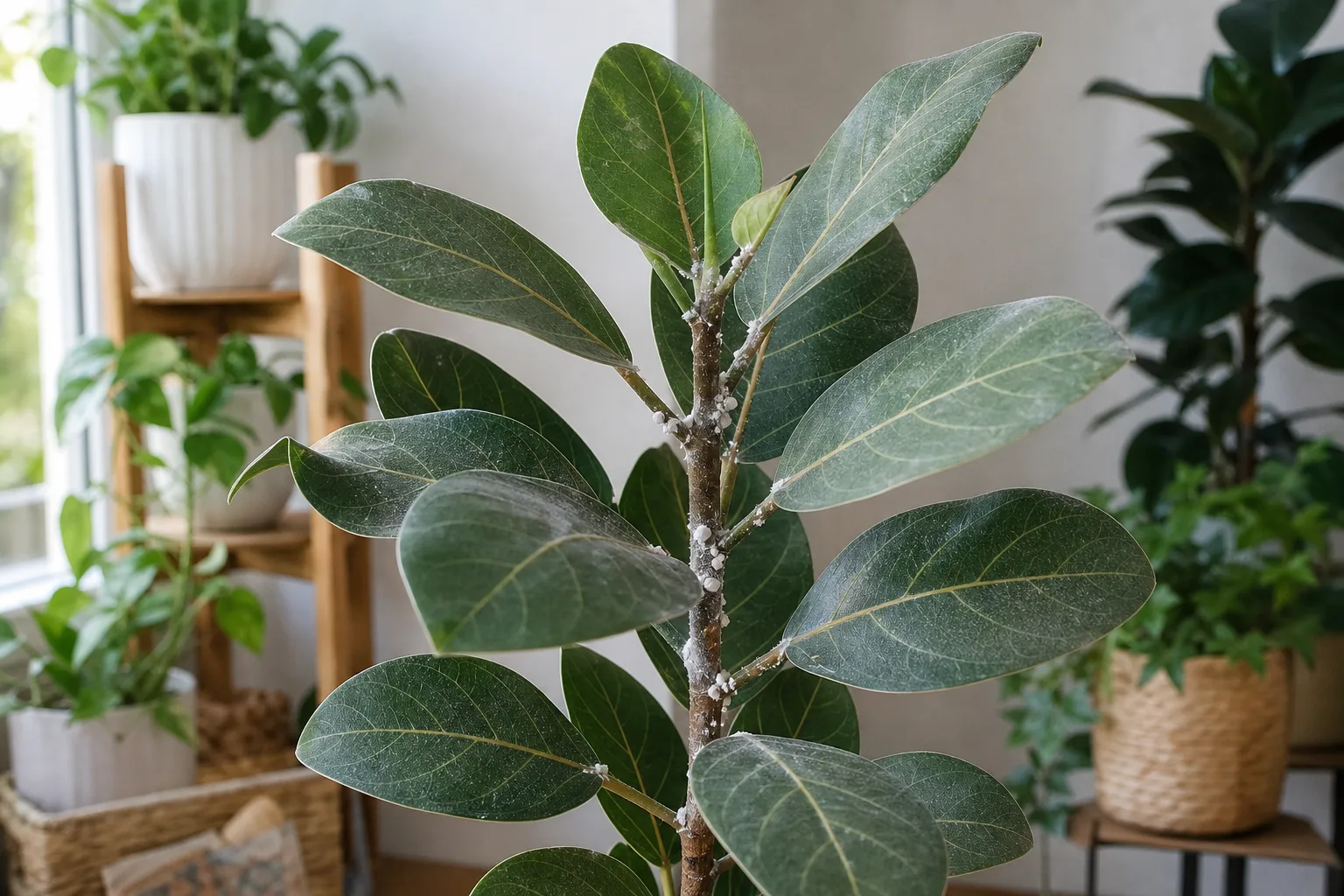
Mealybugs on Ficus Audrey (Ficus benghalensis) are sap-sucking insects that look like tiny white cotton balls tucked into leaf axils, stem forks, and the newest unfolding leaf sheaths along the upright trunk. On this banyan-form indoor tree, colonies often stay hidden at branching nodes until honeydew drips onto lower velvety leaves or the pot rim-easy to miss from across the room during a quick water check.
First step: isolate the plant and dab every visible mealybug with 70% isopropyl alcohol on a cotton swab. Direct contact kills adults on the spot. Do not start with a broad spray until you have removed what you can see and confirmed the pest is mealybug, not scale on the light-colored trunk or harmless dust on fuzzy leaf undersides.
Pet and sap note: Ficus Audrey is toxic to cats and dogs because of milky latex sap. Keep treated plants out of reach, wear gloves if sap irritates your skin, and wash hands before touching other plants or pets.
What mealybugs look like on Ficus Audrey
On Ficus Audrey, mealybugs stand out against matte gray-green, velvety oval leaves-but only if you inspect the right spots. Healthy foliage feels soft and slightly fuzzy on the undersides; white cottony patches at leaf bases, petiole joints, and stem forks are the classic sign, not a uniform change in leaf texture.
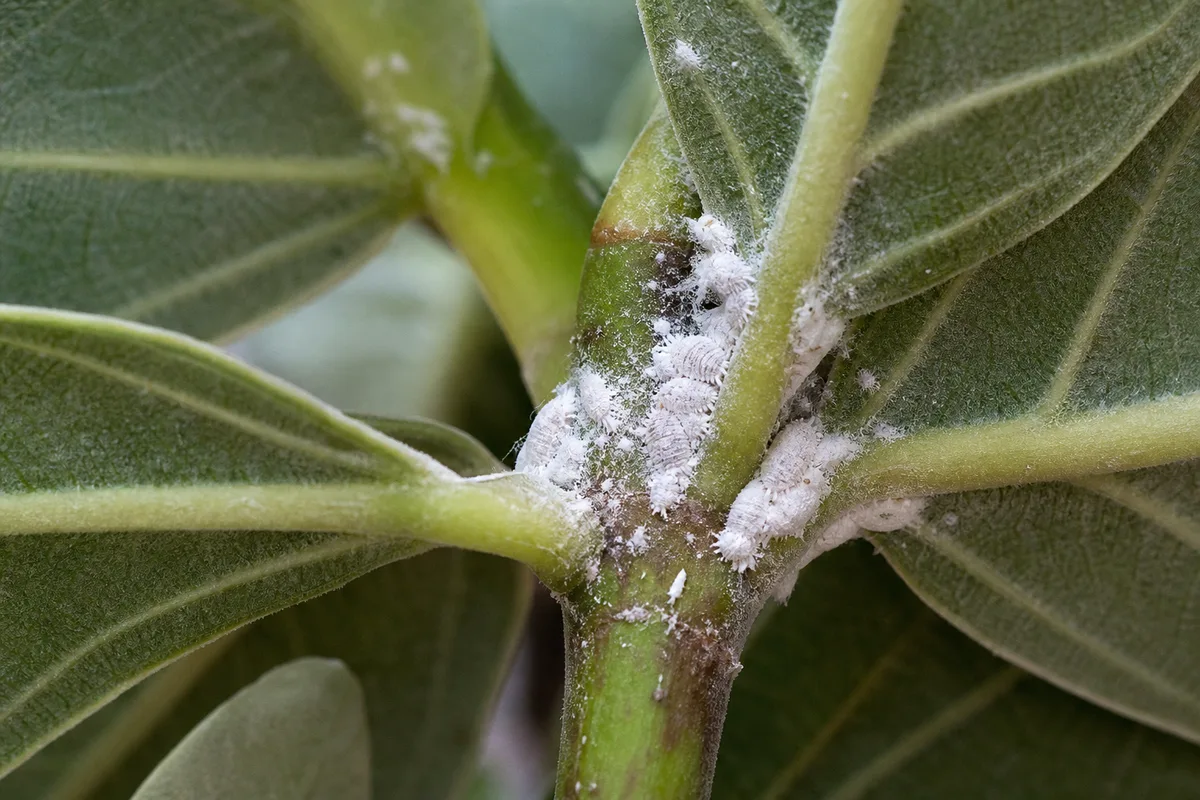
Mealybugs symptoms on Ficus Audrey - compare with healthy tissue on the same plant.
Typical patterns on this tree-form ficus:
- Cottony white clusters in leaf axils where each petiole meets the branching stem
- Flat white ovals along veins on velvety leaf undersides, especially on lower, older leaves
- Sticky, shiny residue on leaf surfaces or the pot rim from honeydew excreted while feeding
- Black sooty mold growing on honeydew if the infestation has been active for weeks
- Yellowing or curling on heavily fed leaves, sometimes mistaken for overwatering-mealybug feeding can yellow foliage
- Stunted new leaves at branch tips when mealybugs colonize unfolding sheaths
Unlike spider mites on Ficus Audrey, mealybugs do not produce fine webbing. Unlike scale, they lack a hard brown shell-you can crush them with a swab. The waxy coating also makes them resist sprays unless alcohol or soap reaches the insect body directly.
Because Audrey’s leaves are velvety rather than glossy, natural pubescence can look like pale dust when backlit. Mealybugs stay put in discrete clusters and smear pink when crushed; velvety hairs and mineral dust wipe away cleanly without clustering at stem joints.
Why Ficus Audrey gets mealybugs
Mealybugs are common indoor pests that arrive on new plants, hitchhike on tools, or spread from an infested neighbor. They are not caused by your watering schedule alone, though stressed plants can be easier targets once pests are present.
Why this species is vulnerable:
- Sheltered branching nodes. Ficus Audrey grows as an upright tree with a light-colored trunk and forking stems. Mealybugs often live in protected areas such as branch crotches and stem bases near soil-exactly the spots owners skip when wiping only the flat leaf face.
- Velvety leaf axils. Fine hairs on undersides trap dust and give wax-covered insects a textured surface to cling to. Colonies at petiole bases are easy to miss against the fuzzy background.
- Soft new growth. Active top growth in spring and summer gives mealybugs tender tissue in unfolding leaf sheaths. Heavy nitrogen fertilizer in dim light pushes pale, soft leaves that pests colonize quickly.
- Indoor conditions without predators. Homes lack the lady beetles and parasitic wasps that control mealybugs outdoors. A single missed cluster can repopulate the plant in weeks.
- Collection proximity. Ficus Audrey is often grouped with other large-leaved ficuses. Crawlers walk short distances and spread when pots touch or leaves overlap.
NC State Extension recommends monitoring Ficus benghalensis for mealybugs, scale insects, and spider mites indoors. University of New Hampshire Extension notes that mealybugs tend to prefer ficus among houseplants and are almost always introduced on infested plants. The trigger is almost always introduction plus missed early detection, not a mysterious failure of Audrey care.
Overwatering, cold drafts, and low light weaken ficuses in other ways-yellow leaves, leaf drop, leggy stems-but those issues do not create mealybugs. If you see white cottony insects, treat pests first; do not repot or overhaul watering until you confirm the infestation level.
How to confirm the cause
Work through these checks before committing to sprays:
- Magnify the white patch. Use a phone camera zoom or hand lens. Mealybugs look like tiny segmented insects under the wax; scale looks like immovable brown disks on the light trunk; velvety pubescence is uniform across the blade.
- Crush test. Dab the cluster with a dry cotton swab, then crush it. Mealybugs leave a pink or orange smear. Chalky mineral deposits and natural leaf fuzz leave no color.
- Check movement. Young crawlers are pale and mobile. Tap a heavily infested leaf over white paper-specks that wander confirm live insects.
- Follow the stickiness. Honeydew feels tacky on velvety leaves and may drip onto the pot rim or floor. No insects plus no stickiness points away from mealybugs.
- Inspect branching nodes and the crown. Trace every leaf base from the lower trunk upward. On tall Ficus Audrey specimens, upper axils and newest leaf sheaths hide colonies that never show from across the room-you may need a step stool.
- Check the soil line. Look for white wax at the base of the trunk and on surface roots-root mealybugs persist when stems look clean.
- Survey the room. Check plants within a metre of the affected pot, especially other ficuses. Shared mealybug pressure means isolation is non-negotiable.
Confirmed: white cottony clusters that smear when crushed, plus honeydew or repeated reappearance after wiping.
Suspected but not confirmed: random white flecks with no clustering at stem joints, no stickiness, and no return after a single wipe-recheck in three days before treating.
First fix for Ficus Audrey
Move the plant away from others and dab every visible mealybug with 70% isopropyl alcohol on a cotton swab.
This is the safest opening move for Ficus Audrey because it targets insects directly without soaking large velvety leaves in chemicals on day one. UC IPM recommends dabbing mealybugs with a 70% or less alcohol solution on houseplants, testing a small leaf area first if you are unsure about sensitivity.
How to do it on this tree:
- Work in good light so gray-green foliage does not hide white clusters at stem forks.
- Support each leaf from underneath so you do not snap the petiole while swabbing tight axils on the upright trunk.
- Dip a fresh swab in alcohol for each cluster-reusing a dirty swab spreads crawlers.
- Wipe honeydew off velvety leaf surfaces with a damp cloth after killing visible bugs.
- Bag and discard swabs; wash hands before touching other plants.
Wear gloves if you are sensitive to Ficus latex sap, which can irritate skin on contact. Audrey is toxic to pets; keep treated plants off floors where animals might chew dropped leaves or lick residue.
After the first pass, wait 24 hours and repeat. Eggs hatch on a cycle, so one session rarely clears the plant.
Step-by-step recovery
Escalate only if alcohol dabs do not reduce new clusters within one week.
Light infestations (few isolated clusters)
- Isolate at least two metres from other plants.
- Dab insects with alcohol every three to four days for three weeks.
- Wipe velvety leaf undersides monthly as part of normal Audrey care-dust blocks light and hides pests on fuzzy foliage.
- Monitor branching nodes each time you water.
Moderate infestations (multiple stems, sticky leaves)
- Complete two full alcohol dab passes first.
- Shower the plant with lukewarm water, angling the spray to hit leaf undersides and axils. Let foliage dry in bright indirect light-not hot direct sun, which can scorch wet velvety leaves.
- Apply insecticidal soap or horticultural oil labeled for houseplants, covering axils and undersides. Colorado State Extension notes these are contact sprays with no residual effect-they work only where they touch the insect.
- Repeat soap or oil every five to seven days for at least three cycles to catch newly hatched crawlers-UC IPM advises repeating alcohol treatment weekly until the infestation is gone.
- Inspect neighboring plants weekly.
Heavy infestations (cotton on most axils, widespread honeydew, repeated failure after a month)
- Decide whether the plant is worth saving versus risking your collection. University of Maryland Extension states that heavily infested houseplants should be discarded when control fails.
- If you continue, combine alcohol dabs, thorough soap sprays, and possible repotting only if you find white masses on roots or at the soil line-root mealybugs persist when stems look clean.
- Prune only heavily colonized branches you can spare-see the Ficus Audrey pruning guide for safe removal limits. Do not strip the tree bare unless necessary. New growth tells you whether treatment is working.
Do not fertilize during active treatment. Stressed Ficus should recover on stable light and normal watering rhythm before feeding resumes.
Recovery timeline
Expect a three- to four-week minimum of repeated treatment before calling the plant clear. Mealybug eggs hatch on staggered schedules; missing one generation restarts the cycle.
Signs treatment is working:
- Fewer white clusters at each inspection
- No new honeydew on leaf surfaces or the pot rim
- Clean, firm new leaves emerging from branch tips
- Insects turn light brown after alcohol contact
Signs the problem is worsening:
- Cottony masses spreading to previously clean stems along the trunk
- Sooty mold covering large leaf areas
- New leaves opening already infested in their sheaths
- Mealybugs appearing on plants that sat near the Audrey
Old leaves with yellowing or distortion may drop or stay blemished-Audrey sometimes sheds lower foliage during stress. That is normal. Recovery on Ficus Audrey is judged by clean new growth at branch terminals, not perfect older foliage on the lower trunk.
Lookalike symptoms
| What you see | Likely cause | How to tell apart |
|---|---|---|
| White fuzzy patches in axils | Mealybugs | Cottony clusters; smear pink when crushed; sticky honeydew |
| Brown raised bumps on light trunk | Scale | Hard shell; does not smear; scrape off with fingernail |
| Fine stippling, tiny webs | Spider mites | Mites move on white paper; no cottony wax - see spider mites |
| Uniform velvety texture on undersides | Natural leaf pubescence | Even across blade; no clustering at stem joints; no stickiness |
| White chalky dust on leaf face | Mineral deposits or hard-water residue | Wipes dry; no clustering in axils |
| White dried sap spots | Latex from recent pruning or damage | Only at cut sites; no insects underneath |
| Single yellow lower leaf | Normal senescence | One old leaf on firm tree - see yellow leaves |
On Ficus Audrey specifically, owners often confuse mealybugs with natural velvety undersides or dried latex after trimming. Always check the leaf base and stem fork, not just the blade.
Mistakes to avoid
- Spraying before isolating. Crawlers spread while you treat.
- One alcohol session and done. Eggs survive; schedule repeats.
- Soaking velvety leaves in alcohol. Full-leaf saturation can burn fuzzy foliage. Dab insects, do not dunk the tree.
- Treating in direct hot sun. Wet or alcohol-treated leaves scorch easily on window-facing Audrey specimens.
- Assuming pesticides work through wax. Mealybugs’ coating blocks many sprays unless soap or alcohol breaks it down.
- Repotting on day one. Only repot if root mealybugs are confirmed or soil is clearly infested.
- Composting pruned infested leaves indoors. Seal and trash material that held live insects.
- Returning the plant to the group too soon. Two weeks with zero new clusters is a safer minimum than a few clean days.
- Ignoring pet toxicity during treatment. Keep Audrey out of reach; do not let animals access alcohol-treated foliage.
Ficus Audrey care cross-check
Mealybug treatment works better when baseline care is stable. After isolation:
- Light: Bright indirect light supports recovery. Weak light slows new growth and makes it harder to see when the plant is truly clean. Details: light guide.
- Watering: Water when the top 2–3 inches of mix are dry-roughly every 7–10 days in summer, longer in winter. Soggy soil does not cause mealybugs but stresses roots while the tree fights pests. Details: watering guide.
- Humidity: 50 to 80% supports velvety leaves; very dry winter air favors mites more than mealybugs but still stresses recovery.
- Leaf wiping: Monthly dusting on fuzzy undersides is both normal care and early pest detection.
- Temperature: Keep in the 65 to 80°F (18 to 27°C) range and away from cold drafts that trigger leaf drop unrelated to pests.
Do not change pot size, fertilizer, and placement all at once while fighting an infestation. Stabilize, treat, then adjust.
How to prevent mealybugs next time
- Quarantine new plants for at least two to three weeks before placing them near your Audrey. Iowa State Extension recommends rejecting infested plants at purchase and isolating new arrivals.
- Inspect branching nodes weekly during watering-especially the crown and lowest axils on the trunk.
- Wipe velvety undersides regularly so white colonies cannot hide against dust and fine hairs.
- Space plants so leaves do not touch; crawlers bridge gaps easily between grouped ficuses.
- Clean tools between plants when pruning or propagating Ficus.
- Avoid soft, over-fertilized growth in low light-tender tips attract pests.
Early detection on a tall indoor tree is the entire game. A single swab at a stem fork today beats a month of sprays tomorrow.
When to worry
Treat as urgent if:
- Multiple plants show cottony clusters
- Sooty mold covers more than a few leaves
- New growth is consistently infested after three weekly treatment cycles
- Root or soil-line mealybugs appear despite clean stems
Consider discarding the plant when:
- Control fails after a month of diligent alcohol, soap, and isolation
- The tree was already weak from root rot, severe leaf drop, or repeated stress
- Protecting the rest of your ficus collection matters more than saving one pot
Ficus Audrey is generally resilient once pests are gone and care is steady. A mature plant with a firm trunk and active roots can outgrow moderate leaf damage. What it cannot do is recover while crawlers keep reinfesting new leaves at branch tips-persistence beats a single heroic treatment.
Related Ficus Audrey guides
- Ficus Audrey overview - species biology, toxicity, and care hub
- Ficus Audrey watering - top 2–3 inch dry-down and seasonal rhythm
- Spider mites - alternate sap-sucking pest on velvety leaves
- Leaf drop - stress response during and after treatment
- Light - baseline bright indirect exposure during recovery
- Pruning - safe removal of heavily infested branches