Low Humidity on Ficus Audrey: Causes, Checks & Fixes
Quick answer
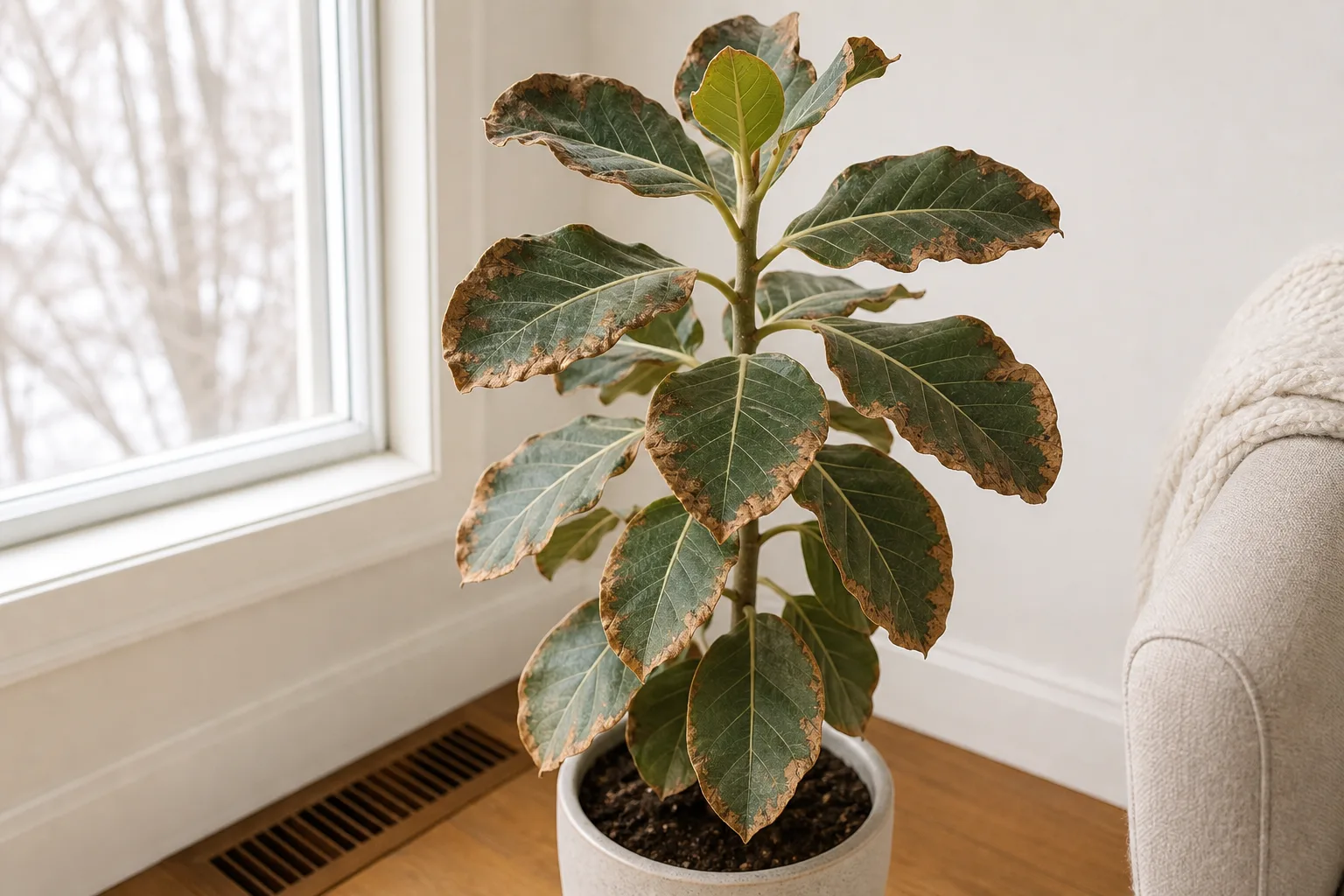
Low humidity on Ficus Audrey shows as crispy brown edges on velvety gray-green leaves when indoor air drops below about 40% RH-often under 30% with winter heating-while soil moisture stays normal. First step: read a hygrometer at canopy height; if RH is low and the pot is not light, run a cool-mist humidifier nearby targeting roughly 50–60% before you add water or trim leaves.
Low Humidity on Ficus Audrey: Causes, Checks & Fixes
This guide covers low humidity on Ficus Audrey. See also the general Low Humidity guide, watering, and light pages for this plant.
Low Humidity on Ficus Audrey: Causes, Checks & Fixes
Quick answer
Low humidity on Ficus Audrey (Ficus benghalensis) is dry indoor air stressing the leaf margins-not a leaf disease and not always a watering mistake. The species carries oval, gray-green leaves with velvety pubescence on the undersides; margin tissue is the farthest point from the roots, so it desiccates first when relative humidity (RH) drops while soil moisture stays adequate.
NC State Extension recommends 50 to 80% humidity for Bengal fig houseplants and notes that cracked leaves can occur if humidity is too low. Winter heating often pushes whole rooms into the 20–30% band-well under what fuzzy tropical foliage tolerates long-term. Audrey is more forgiving than a calathea but less drought-adapted than a succulent; dry air still shows on velvety edges before the canopy collapses.
First step: read a hygrometer at canopy height and probe the top 2 to 3 inches of soil. If RH reads below about 40% and the pot is not light with dry mix, run a cool-mist humidifier near the tree targeting roughly 50–60% at leaf height before you water again or trim brown tissue. Our Ficus Audrey watering guide explains why extra drinks do not fix dry air.
What humidity Ficus Audrey needs indoors
Ficus Audrey evolved in warm, humid tropical and sub-tropical forests on the Indian subcontinent. Indoors it behaves as a moderate-growing tree that accepts average home conditions better than many moisture-demanding foliage plants-but extension guidance still targets 50 to 80% RH during active growth, with stable temperatures between 65 and 80°F and protection from cold drafts.
Practical bands for diagnosis:
| RH at canopy height | What to expect on Ficus Audrey |
|---|---|
| 50–80% | Healthy range per NC State; velvety leaves stay firm with clean margins |
| 40–50% | Often tolerable short-term; watch new growth for early edge crisping in winter |
| Below ~40% | Widespread margin browning likely when soil moisture is normal |
| Below ~30% | High risk of brown edges and spider mites on fuzzy foliage |
Audrey is not a desert plant and not a rainforest floor dweller like some prayer plants. It sits in the middle: average apartment humidity may suffice in summer, but heated winter rooms are the usual failure point.
How low humidity shows up on velvety leaves
Healthy Audrey leaves feel firm and slightly leathery despite soft fuzzy undersides. Low humidity removes moisture from the leaf margin before the rest of the blade fails.
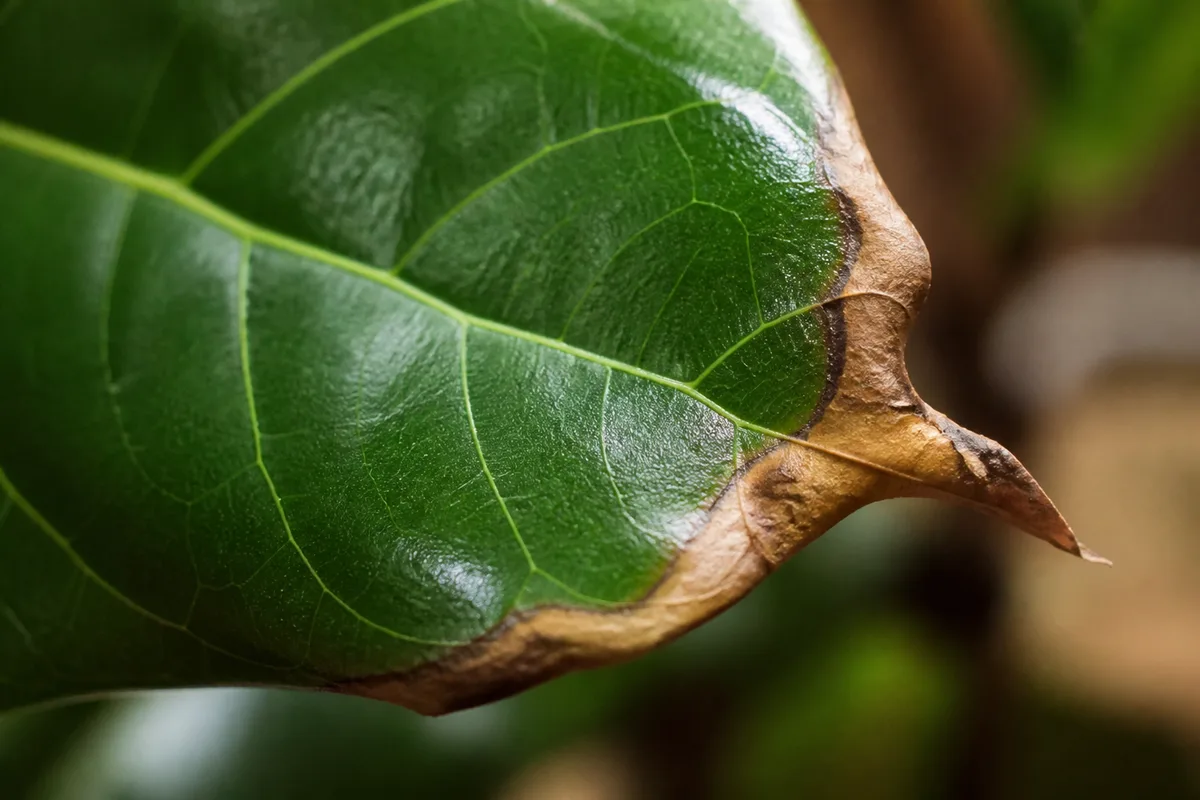
Low Humidity symptoms on Ficus Audrey - compare with healthy tissue on the same plant.
Typical dry-air pattern:
- Crispy brown edges and tips on otherwise firm gray-green leaves-often many leaves at once
- No limp wilt across the canopy; stems stay upright unless a second stress is present
- Soil moisture normal when you probe 2–3 inches down; pot weight moderate, not light
- Seasonal timing-symptoms accelerate after heat kicks on, near radiators, or above forced-air vents
- Velvety texture makes damage visible early; smooth-leaf ficuses may hide margin stress longer
Spider mites as a secondary dry-air problem:
Very dry air weakens fuzzy foliage and favors spider mites-monitor for spider mites on Bengal fig houseplants, with fine stippling, webbing on undersides, and dull matte leaves. If mites appear alongside margin crisping, raise humidity and treat the pest; humidity alone rarely clears an established colony.
Brown edges and tips in dry winter air
Central heating lowers RH for months. A tree beside a west window or radiator can sit in 20–25% air while the thermostat reads 70°F. Brown margins spread on new and old leaves because the air pulls water from exposed edge cells faster than roots replace it-even when you watered on schedule.
This pattern overlaps with brown tips when only margins are involved. Use this page when a hygrometer confirms dry air as the primary driver across multiple leaves; use the brown-tips guide when salt crust, hard tap water, sun scorch, or drought crisping is the main suspect.
How to confirm low humidity is the cause
Work through these checks before buying gear or changing your watering rhythm.
Hygrometer check and seasonal context
- Place a hygrometer at canopy height-not on the floor or across the room. RH beside a radiator can read 15% lower than at the leaves.
- Note the season-November through March heating is the classic trigger in temperate climates.
- Scan heat sources-forced-air vents, radiators, fireplace proximity, and winter glass that creates a dry microclimate.
- Read RH over a day-one morning snapshot can miss afternoon drops when heat cycles hard.
Low humidity is likely when RH stays below about 40% at leaf height, multiple leaves show widespread margin crisping, and soil moisture is adequate.
Rule out underwatering, salt burn, and pests
Low humidity is a diagnosis of exclusion on Ficus Audrey:
- Soil moisture and pot weight - Insert your finger 2–3 inches into the mix. A light pot with dry depth and slightly limp leaves points to underwatering, not dry air alone.
- Salt and fertilizer history - White crust on soil or pot rims, recent heavy feeding, or winter fertilizer on a slow tree suggests salt burn-margins brown even with good humidity. See brown tips for flush steps.
- Sun exposure - Crisping only on leaves pressed against hot afternoon glass is sun scorch, not whole-room dry air.
- Pest stippling - Mites leave fine dots and webbing; humidity stress alone does not.
- Root stress - Soft yellow lower leaves on a heavy wet pot mean overwatering or root failure; adding humidity will not fix that path.
| Pattern | Soil / pot | Air | Likely cause |
|---|---|---|---|
| Widespread crispy margins, firm centers | Moist, moderate weight | RH below 40%, winter heat | Low humidity |
| Crisp tips, limp canopy | Dry 2–3 inches, light pot | Any RH | Underwatering |
| Brown margins, yellow lowers | Wet, heavy, sour smell | Any RH | Overwatering / roots |
| Margin burn one window side | Normal | Normal room RH | Sun scorch |
| Stippling + webbing | Normal | Low RH common | Spider mites (+ dry air) |
First fixes for Ficus Audrey
Run a cool-mist humidifier near the canopy when the hygrometer confirms dry air and soil moisture is normal. That single step addresses the most common misread-watering a plant that is not thirsty because leaves look “dry.”
Position the unit 2–4 feet from the tree, aimed so mist drifts through the foliage zone without soaking velvety leaves continuously. Target roughly 50–60% RH at leaf height as a practical indoor goal within NC State’s 50–80% band. Run it during heating season consistently-a humidifier used only one night does not rehydrate margin tissue.
Do not increase watering to compensate for dry air. Wet soil on a tree that only needed humidity invites root stress on ficuses. Confirm dry-down per our watering guide before the next drink.
Humidifier placement and runtime
- Size for the room volume, not just the pot-large floor trees transpire into the whole space around the canopy.
- Cool mist is gentler on fuzzy foliage than hot steam right against leaves.
- Keep the reservoir clean-stagnant tanks spread minerals and microbes; refill with fresh water regularly.
- Avoid aiming constant spray at one leaf face-brief surface wetting is fine; continuous soaking in stagnant corners invites spotting.
- Group plants modestly after the humidifier is running-neighbors share the moist air pocket but do not replace the unit for a tall tree.
Pebble trays and plant grouping
Pebble trays and grouping raise humidity modestly in a small zone. They help a desk-sized Audrey more than a 6-foot indoor tree, where the evaporating surface area is tiny relative to the canopy. Use trays as a supplement, with the pot base above standing water so roots never sit wet.
Misting: optional limits on fuzzy foliage
Brief misting can temporarily raise RH at the leaf surface, but low humidity is a common cause of brown leaf tips on houseplants because winter rooms stay dry for hours between sprays. Misting does not substitute for a humidifier when a hygrometer reads in the 20s. On velvety Ficus foliage, wet leaves in poor airflow can invite fungal spotting-wipe dust monthly with a damp cloth instead of drenching the canopy daily.
Recovery timeline
Humidity corrections show on new growth, not old damage. Existing brown margin tissue will not re-green once cells are dead.
Days 1–3: RH at canopy should climb once a humidifier runs consistently; symptom spread usually stops if no other stress is active.
Weeks 1–3: Watch the newest unfolding leaves at the crown. Clean margins on fresh velvety blades mean the fix is working-even if older leaves still show crisp edges.
Weeks 3–6: A full flush of firm new foliage under stable 50–60% RH is strong recovery evidence. Trim fully dead margins for appearance only after new growth proves stable.
Worsening signs: Continued widespread browning despite verified RH above 50%, new webbing on undersides, soft yellow leaves on wet soil, or crown wilt-revisit watering, pests, and roots instead of only adding humidity.
What not to do
Do not water on schedule when the pot is still heavy and only margins are crisp-dry air is not thirst. Do not mist heavily as your only strategy in a heated room; RH drops again within an hour. Do not relocate the tree to a steamy bathroom as a permanent fix unless light there matches Audrey’s need for bright indirect exposure per NC State light guidance. Do not fertilize to green up browned edges-salts worsen margin burn. Do not trim deep into healthy green tissue; follow the natural leaf curve and leave a thin brown edge to avoid wounding live cells and exposing latex sap. Do not stack repotting, pruning, and pesticide the same week you add a humidifier-change one variable and read the response.
How to prevent dry-air damage next winter
Before heating season:
- Buy and test a hygrometer at the tree’s winter placement.
- Place the pot away from radiator ledges and direct vent blast-dry microclimates matter as much as whole-room averages.
- Plan a humidifier for the room or a dedicated zone around large ficuses; start it when RH trends below 40%, not after margins are already crisp on half the canopy.
- Keep watering tied to dry-down-see overview and watering for seasonal rhythm.
- Inspect fuzzy undersides monthly in dry months to catch spider mites early.
Stable Audrey in winter combines bright indirect light, even moisture with real dry-down, and moderate humidity near 50–60% at the leaves-not dramatic swings from dry heat to occasional misting.
Low humidity vs. brown tips - when to use this page
Use this guide when RH is the primary problem: hygrometer below about 40% at canopy height, widespread margin crisping on firm leaves, and normal soil moisture.
Use brown tips when damage is tip-focused and you need to separate salt burn, hard tap water, sun scorch, and drought from dry air-many real cases involve compound stress (dry heat plus west-window sun), and both pages may apply.
When to worry
Treat as urgent when mite webbing spreads, soft yellow leaves appear on wet soil, stems soften at the base, or the whole canopy wilts-those patterns point beyond humidity alone.
Lower urgency applies when a few older leaves show crispy edges in dry winter air while new growth stays firm and gray-green. Monitor two weeks after humidifier correction; if new margins stay clean, the tree is recovering.
Conclusion
Low humidity on Ficus Audrey is a seasonal air-moisture problem on velvety tropical foliage-not a mystery disease. Read RH at canopy height, confirm soil is not dry, then run a humidifier toward 50–60% before you water more or trim half the canopy. Judge success by unblemished new leaves, not re-greening old brown edges. Cross-link your routine with the overview humidity section, brown tips for lookalikes, spider mites when dry air invites pests, and watering so moisture fixes stay separate from air fixes.
Related Ficus Audrey problems
- Brown tips - margin burn from salts, sun, drought, and hard water
- Spider mites - dry-air pest that often follows low RH
- Underwatering - light pot and dry mix with limp or crisp foliage
- Wilting - canopy collapse from water-pathway failure, not dry air alone
- Ficus Audrey overview - species biology, 50–80% humidity targets, and baseline care