Caterpillars on African Violet: ID, Hand Removal & Btk
Quick answer
You found ragged holes and dark pellets in the crown after porch summer or an open window-that is caterpillar damage on African violet. Pick every larva off by hand first; do not soak fuzzy foliage to spray.
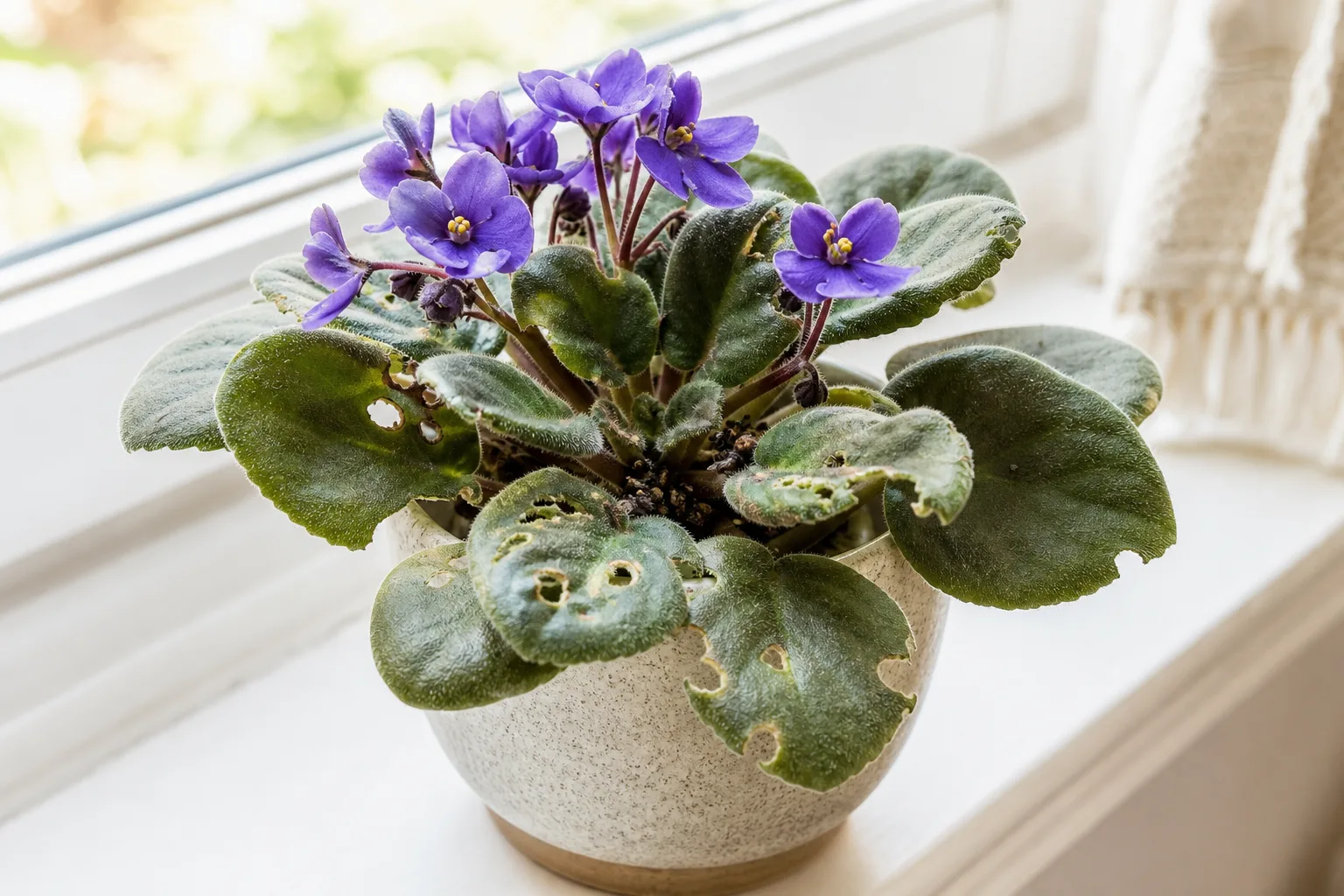
Caterpillars on African Violet: ID, Hand Removal & Btk
This guide covers caterpillars on African Violet. See also the general Caterpillars guide, watering, and light pages for this plant.
Caterpillars on African Violet: ID, Hand Removal & Btk
Quick answer
You brought a porch-summered Saintpaulia back inside and found ragged bite marks plus dark pellet-like frass tucked in the crown-that pattern points to caterpillars, not thrips or a watering mistake. The compact rosette hides larvae between overlapping leaf rows, so damage can look sudden even from one or two insects.
First fix: pick off every caterpillar by hand with tweezers or gloved fingers and drop them into soapy water. Work leaf by leaf from the outside in without wetting the foliage. African violet leaves spot easily when cold or standing water touches them, so manual removal beats a foliar soak for small infestations.
By sai-ananth · Reviewed by LeafyPixels Review Board · Last expert review: June 2026
What caterpillars look like on African violet
Caterpillars are moth or butterfly larvae that chew through velvety leaf tissue. On African violet, expect these signs:
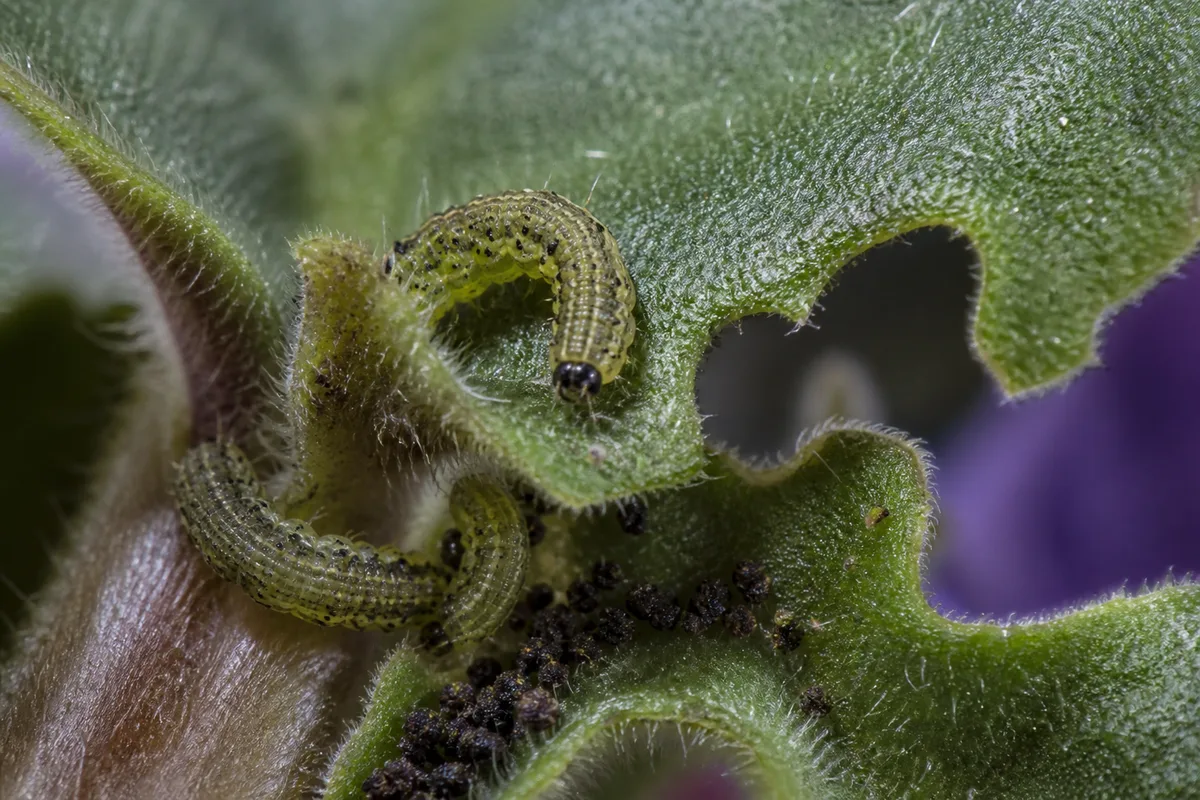
Caterpillars symptoms on African Violet - compare with healthy tissue on the same plant.
Irregular margin holes on velvety leaves
Damage appears as uneven bites along leaf edges, not neat round punctures. Tissue looks cleanly eaten rather than mushy or spotted. Buds and young center leaves can be scarred if larvae feed before flowers open.
Dark frass pellets in the crown and leaf axils
Pellet-like droppings on fuzzy leaves or tucked in the crown confirm active chewing insects even when the larva hides during the day. Frass is the single most reliable field mark-holes alone on an old leaf are not enough to diagnose caterpillars.
Larva tucked in overlapping rosette rows
The rosette architecture gives larvae a sheltered feeding site at the crown-exactly where new growth and buds form. Use a flashlight and lift each leaf row; caterpillars often rest in leaf axils near the center.
Silk threads near chewed tissue
Fine silk near damaged margins points to caterpillars rather than thrips (silvery streaks, pollen dust) or leaf miners (pale winding trails inside tissue).
Visual inspection guide (what to photograph)
If you are documenting damage for your own records or an extension ID request, capture four views:
| View | What to show | Why it matters |
|---|---|---|
| Crown close-up | Dark pellets nestled where petioles meet the center | Frass confirms chewing insects, not old tears |
| Margin damage | Ragged edge on one velvety leaf with a coin for scale | Shows fresh chewing vs. mechanical abrasion |
| Larva in axil | Caterpillar tucked under an overlapping inner leaf (flashlight angle) | Proves active infestation before you treat |
| Shake-test result | Dislodged larva on white paper after tapping the pot rim | Catches small larvae that hide in the crown |
Why African violet gets caterpillars (and why it is uncommon indoors)
Indoor African violets are not a primary host. Many caterpillar species prefer other plants but will feed on African violet when a better food source is unavailable. Armyworms, loopers, and fruitworms are among the species reported on violets.
Accidental entry routes
Caterpillars usually arrive as accidental pests:
- Moths that laid eggs on a plant summered on a porch or patio
- Larvae hidden in potting media when a plant returns indoors
- Open windows near outdoor lights during warm months
- Fresh cut flowers on the same windowsill
- Hitchhikers on clothing after outdoor gardening
Change clothes before working with indoor plants-caterpillars can travel on fabric until they reach your violets. Moths trapped indoors near plant shelves may also be carrying eggs.
Rosette architecture shelters larvae
Once eggs hatch, overlapping leaf rows give larvae a protected feeding site at the crown. That is why a single larva can produce surprising damage on a compact miniature rosette before you notice it from above.
Strictly indoor collections - low risk, different chewers
If your violets never go outdoors, windows stay screened, and you do not bring in cut flowers from the garden, caterpillars are unlikely. When you see chewing in that setup, work through lookalikes first:
- Thrips - pollen dust on petals, silver streaks, no frass pellets
- Leaf miners - internal pale trails, not margin chewing
- Mealybugs - white cottony clusters; sap-sucking, not eaten tissue
- Water spots - yellow or white rings where cold water touched leaves; sharp edges, no frass
- Old mechanical tears - single damaged leaf without repeat pattern, frass, or silk
Year-round indoor violets that develop caterpillars almost always trace back to an open window episode, a new plant from an outdoor grower, or a hitchhiker on clothing-not a spontaneous indoor outbreak.
Confirm before you treat
Work through these checks before reaching for any spray:
- Flashlight crown pass - Lift each leaf row and inspect the center where larvae often rest.
- Shake test - Hold the pot over white paper and tap the rim; dislodged caterpillars confirm an active infestation.
- Frass search - Dark pellets on fuzzy leaves or in leaf axils confirm chewing insects even if no larva is visible.
- Soil surface check - Larvae sometimes drop to the mix overnight; scan the top layer and saucer.
- Rule out lookalikes - Chewed leaves without frass or larvae suggest old mechanical tears or past pest scars.
Confirmed diagnosis requires frass or a visible caterpillar plus fresh chewing-not holes alone on an old leaf.
Caterpillar vs. thrips vs. mechanical damage on velvety leaves
| Sign | Caterpillars | Thrips | Mechanical tear / abrasion |
|---|---|---|---|
| Hole pattern | Irregular margin bites; may repeat on several leaves | Silver streaks; stippling; not large eaten sections | Single torn leaf; no pattern spread |
| Frass | Dark pellets in crown or on leaves | None | None |
| Flowers | Buds chewed; petals eaten at margins | Pollen dust; streaked, collapsed blooms | Usually unaffected |
| Insect visible | Larva in axil; shake test positive | Tiny fast movers on tap test | None |
| Silk | Fine threads near chewed tissue | None | None |
First fix: hand-pick without wetting foliage
Remove caterpillars by hand before reaching for sprays. If possible, remove caterpillars by hand as the first treatment step. Use tweezers to pick each larva from leaf undersides, stem joints, and the crown. Drop them into a cup of soapy water so none escape. Work systematically from outer leaves inward without spraying the plant.
Check again at night-some species feed more actively after dark.
Gesneriad-shelf quarantine workflow
African violet pests and diseases spread very easily among other violets, so isolate gesneriads on shared stands the day you find a larva:
- Move the affected violet to a separate room or closed shelf-do not leave it beside Streptocarpus, Episcia, or other gesneriads.
- Inspect every neighbor plant with a flashlight at the crown and leaf axils.
- Run shake tests on neighbors that summered outdoors or sit near the affected pot.
- Hold new plants in quarantine for two weeks before returning them to the main collection.
- Log the date you found frass and recheck daily for seven days before declaring the shelf clear.
If hand-picking is not enough
When larvae persist after two thorough hand-picking passes over one week, escalate to Bacillus thuringiensis kurstaki (Btk)-a bacterial insecticide that targets leaf-feeding caterpillars when ingested and does not affect adult insects.
Cotton-swab Btk on fuzzy leaves
On African violet, dab Btk on chewed leaf edges with a cotton swab rather than misting the whole rosette. Larvae must eat treated tissue for Btk to work. Shield the crown from runoff-moisture pooling in the rosette invites crown rot, a worse emergency than caterpillars alone.
- Use a product labeled for ornamental plants and follow label rates.
- Reapply at 7–10 day intervals if new chewing appears-Btk breaks down rapidly under light.
- Test one leaf first if the product contains surfactants or oils beyond Btk alone.
Neem and household spray cautions
Neem is sometimes suggested as an alternative that makes foliage less palatable; Optimara notes it should be sprayed where caterpillars cluster, but African violet foliage can react to spray additives. Test on one leaf and wait 48 hours before wider use.
Do not reach for broad household insect sprays first-many contain additives that damage fuzzy African violet leaves. Clemson HGIC lists cyfluthrin products for caterpillars on African violets, but foliar applications on velvety rosettes carry spotting risk; hand removal and targeted Btk swabs are safer first steps.
What not to spray on fuzzy African violet leaves
- Do not hose down or shower leaves to knock off caterpillars-cold or standing water on foliage causes spotting and raises crown rot risk.
- Do not apply insecticidal soap as a first-line treatment on fuzzy foliage without a one-leaf test-surfactants can mark leaves even when caterpillar damage is the target.
- Do not apply systemic pesticides casually on a blooming houseplant without reading labels for African violet sensitivity.
Step-by-step recovery
- Isolate the affected plant away from other gesneriads on the same shelf.
- Hand-pick every visible larva; check again at night when some species feed more actively.
- Remove heavily chewed outer leaves only after you confirm no larvae remain-less hiding space in the crown.
- Monitor daily for one to two weeks; new frass means you missed an egg or larva.
- Apply Btk via cotton swab only if hand removal fails after repeated inspections-follow label rates and avoid soaking leaves.
- Resume normal bottom-watering once feeding stops; keep foliage dry as always. See the watering guide for wick and self-watering routines that keep crowns dry.
Recovery arc: what to expect week by week
This timeline matches typical compact-rosette recovery after successful larva removal-not a guarantee, but a realistic checkpoint map:
| Week | What you should see | Action |
|---|---|---|
| Week 0 | Last larva removed; frass cleaned from crown with a dry brush | Isolate; daily flashlight pass |
| Week 1 | No new holes or frass; old chewed leaves unchanged | Continue monitoring; do not prune heavily yet |
| Week 2 | First clean center leaf nub emerging without fresh damage | Remove worst outer leaves if crown is clear |
| Week 3 | New leaves opening normally; buds may re-form if buds were not chewed | Return to stand only after seven larva-free days |
Chewed leaves never heal-the holes stay until you remove the leaf. Judge success by clean new center growth, not by repaired old tissue.
Blooming pause after bud chewing
Blooming may pause briefly if buds were chewed; new buds should open normally once the crown stays larva-free for several weeks. Do not fertilize heavily to force flowers while the plant is recovering from tissue loss.
What not to do
Do not hose down or shower African violet leaves to knock off caterpillars-cold or standing water on foliage causes permanent spots and raises crown rot risk. Do not apply systemic pesticides casually on a blooming houseplant without reading labels for African violet sensitivity. Do not ignore one small caterpillar; a single moth can leave multiple eggs in the crown. Do not return the plant to a crowded shelf before a week passes with no new holes or frass.
If you accidentally wet the crown while treating, let the rosette dry completely and watch for water-soaked lower tissue-crown rot from overwatering shows as a soft crown with sour-smelling mix, not caterpillar damage alone.
How to prevent caterpillars next time
Quarantine new violets for two weeks and inspect leaf axils weekly during every bottom-watering pass. Screen windows during warm months and check plants that spent summer outdoors before bringing them back inside. Change clothes after working in outdoor gardens. Watch for moths trapped indoors near plant shelves.
Align prevention with sound culture from the African violet overview and watering guide-healthy violets recover faster, but prevention here is really about catching hitchhikers before larvae reach the crown.
When to worry - and when to call extension
Escalate if multiple larvae are actively feeding on the center crown, buds are stripped faster than they recover, or new frass appears daily after hand removal and a labeled Btk application. At that point, combine isolation with a targeted Btk swab rather than repeated picking alone.
Contact your local cooperative extension office if:
- New larvae keep appearing on a violet that never goes outdoors (possible repeated egg-laying source in the home)
- Frass returns after two hand-picking rounds plus one properly timed Btk application
- The crown softens with wet soil during treatment-rule out crown rot before assuming the pest is the only problem
Discard the plant only if the crown is stripped to stubs and no healthy center leaves remain-rare on a caught-early infestation.
Related African violet problems
- Thrips - pollen dust and silver streaks without frass
- Leaf miners - internal trails, not margin chewing
- Mealybugs - cottony clusters, not eaten tissue
- Crown rot - soft crown after wet treatment attempts
- African violet overview - light, watering, and gesneriad culture basics
- African violet watering - bottom-water rhythm that keeps crowns dry
How this guide was reviewed: Written by sai-ananth and reviewed by the LeafyPixels Review Board on 2026-06-17. Caterpillar ID, Btk application constraints, and gesneriad isolation protocols cross-checked with Optimara Doctor Optimara, Clemson HGIC, Iowa State Extension, CDFA Btk factsheet, and Penn State Extension resources cited inline above. See methodology note in frontmatter.
When to use this page vs other African Violet guides
- African Violet watering guide - Use for routine moisture checks before assuming caterpillars is the main issue.
- African Violet problems hub - Browse all 52 common issues on this species.