Decorating With Monstera: Placement, Planters and Styling
Use Monstera as a statement houseplant with smart placement, planter choices, light-friendly styling and room ideas.
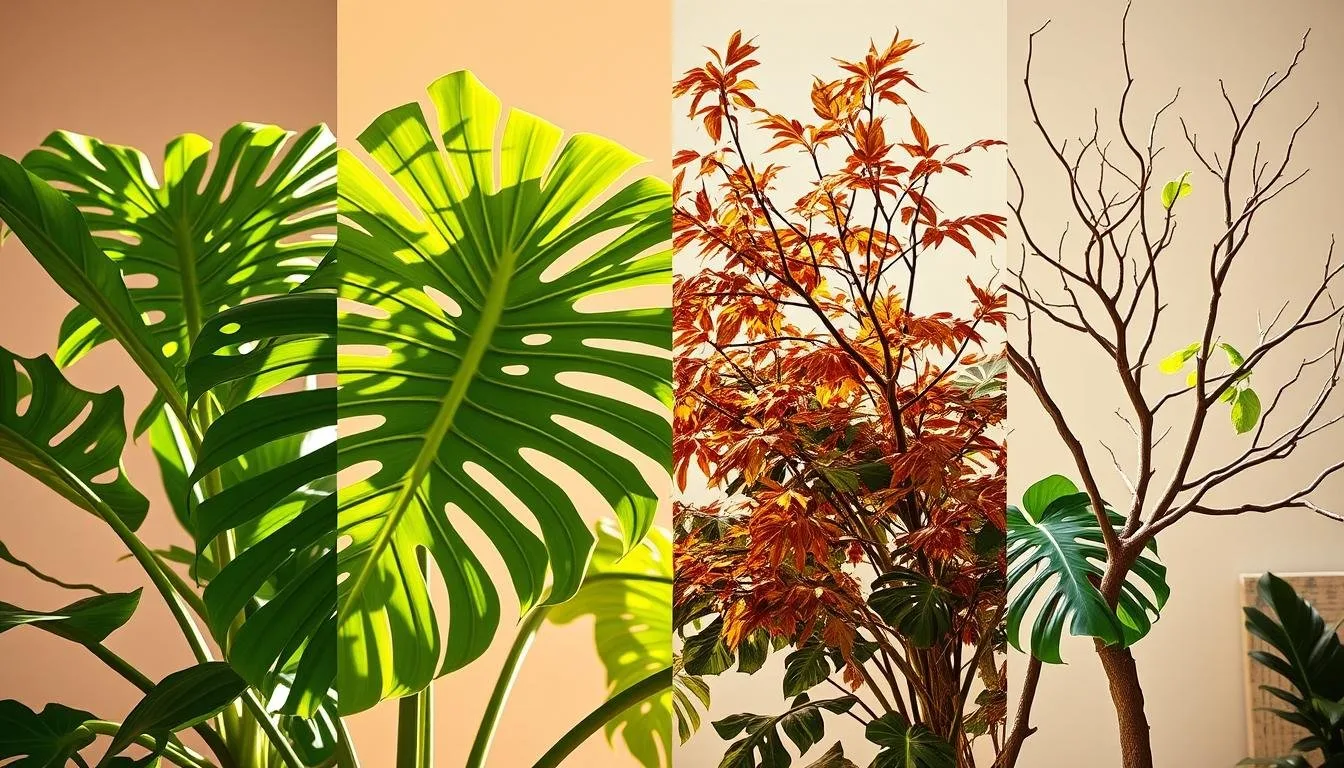
Decorating with Monstera works because the plant does two jobs at once: it fills space like furniture, and it softens a room like art. Its split leaves carry real visual weight, the silhouette reads as sculptural, and it can suit both restrained and lush interiors when you match species, scale, and placement to the room. Interior publications keep returning to Monstera as a statement plant for exactly that reason—not because it is trendy, but because it changes how a space feels when it is placed with intention. (Architectural Digest)
A badly placed Monstera looks like clutter. A well-placed one can make a room feel taller, calmer, and more finished. That difference comes down to placement, scale, and styling discipline—not buying another decorative object to hide in a corner. This guide focuses on decorating decisions: which Monstera to buy, where to put it, how to container it, and how to compose it with your furniture. For watering, humidity, propagation, and problem-solving, use the Monstera deliciosa care hub and the related guides linked at the end.
Caption: In this 10-foot corner, the floor planter’s outer diameter is roughly one-third the leaf span, and the tallest leaves sit about 15 inches below an 8-foot ceiling—both rules from the scale section below.
Why Monstera Works in Interiors
Monstera succeeds in interior design because it has architectural presence. The leaves are broad, glossy, and naturally dramatic. RHS describes Monstera as a plant known for big tropical leaves with irregular holes, forming impressively large, architectural specimens indoors. That explains why Monstera feels different from filler greenery: it does not disappear into a room. It shapes the room. (RHS)
Design-wise, Monstera also solves a common decorating problem: empty visual volume. A dead corner beside a sofa, a flat entryway, or a bathroom with clean finishes but no life—a Monstera fills vertical and horizontal space without adding another hard surface. House Beautiful notes that indoors Monstera deliciosa can reach up to eight feet tall, making it a strong choice for filling a spare corner or side table. (House Beautiful)
There is also style flexibility. In minimalist rooms, one bold plant can act as a single focal point rather than a dozen small distractions. Monsteras work especially well in that role because their multidimensional leaves add shape and depth without requiring a crowded display. The same plant can support a restrained room or a lush one, depending on what surrounds it.
Choose the Right Monstera for Your Space
You do not need to become a collector. You do need to know what you are buying. “Monstera” gets used loosely online, and that creates bad decor decisions—someone wants a dramatic floor plant and buys a vining adansonii, or someone wants something compact and ends up with a juvenile deliciosa that will outgrow the spot within a year.
The practical move is simple: match species and growth habit to the room, not just the leaf shape. For a full species breakdown, see types of Monstera plants. When you are ready to shop, buying a Monstera plant covers what to inspect at the nursery.
Monstera deliciosa
Monstera deliciosa is the classic choice. RHS identifies it as the most popular Monstera houseplant, originally from the tropical forests of southern Mexico and South America. It climbs by aerial roots, can become very large, and develops iconic split and perforated leaves as it matures. Mature leaves can reach up to 90 cm, which tells you this is not a tiny accent plant pretending to be dramatic. (RHS)
For decorating, Monstera deliciosa is best when you want one strong move: a reading corner, the side of a media console, a bright bathroom with floor space, or the empty edge of a dining area. It looks expensive because it occupies space with confidence. One is often enough unless you are deliberately building a jungle effect.
This is also the variety to choose when you want the plant to read as furniture-adjacent. With the right planter and support pole, it becomes part sculpture, part screen, part living material—which is why it works in modern interiors, warm minimalism, Japandi, organic contemporary spaces, and large boho rooms.
Monstera adansonii and mini monstera
Monstera adansonii is a true Monstera, but it behaves very differently from deliciosa. It is smaller, more vine-like, and better for shelves, trellises, or vertical training. NC State Extension notes it is smaller and fast-growing compared with Monstera deliciosa. (NC State Extension)
Then there is “mini monstera,” which usually refers to Rhaphidophora tetrasperma. NC State points out that mini monstera is not actually a Monstera, even though it looks like one and belongs to the same plant family. That detail matters because the decor role is different: mini monstera gives you the split-leaf look in a lighter, leaner, more vertical form. Better Homes & Gardens describes it as a plant that can be trained up walls, shelves, or moss poles, and quoted plant stylist Maryah Greene saying it looks like an art piece. (NC State Extension)
| Plant | Best For | Visual Effect | Decor Use |
|---|---|---|---|
| Monstera deliciosa | Floor styling, focal points, corners | Bold, lush, sculptural | Statement plant |
| Monstera adansonii | Shelves, hanging, trellises | Lighter, airy, playful | Softens vertical surfaces |
| Mini monstera | Small spaces, modern styling | Graphic, compact, climbing | Architectural accent |
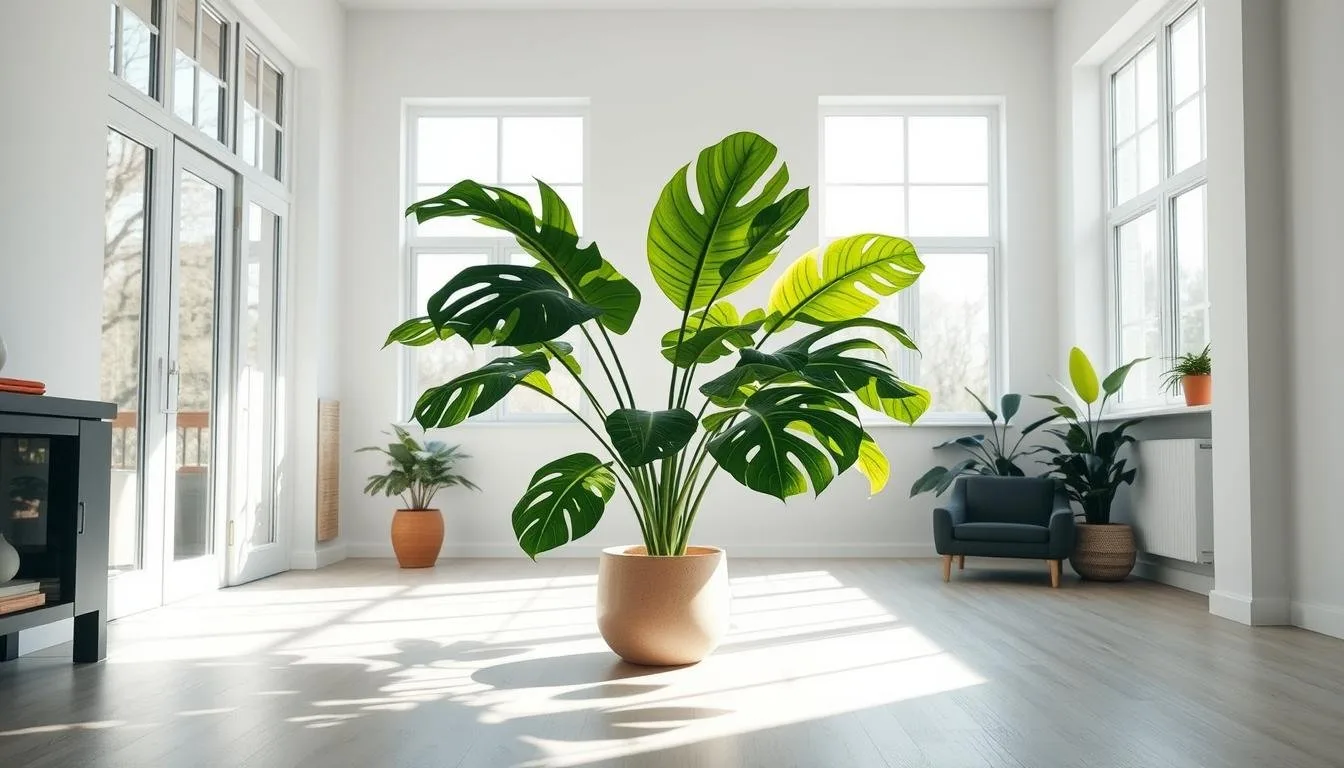
Caption: East-facing indirect light from the left keeps leaves glossy without harsh sun; the plant sits far enough from the sofa arm that mature leaves will not brush seating.
Where to Place Monstera by Room
The best place for a Monstera is a spot with bright, indirect light, enough room for the leaves to breathe, and enough visual importance that the plant feels intentional. RHS says Monstera prefers indirect light plus warm, humid conditions—which rules out two bad defaults: dark corners and random leftover spaces. (RHS)
Most people place a Monstera based on where it fits. Better move: place it based on where it can both look good and stay healthy. Those are not separate decisions. A struggling plant never improves a room. For light specifics beyond decorating, see Monstera light requirements.
Living rooms and entryways
Living rooms are the easiest win because they usually have a clear furniture hierarchy and enough floor space for a statement plant. If your room is minimal, Monstera can be the one high-drama organic shape that stops the room from feeling cold.
Use it beside a sofa, near a media unit, in a bright corner, or slightly off-center from a console—not jammed behind a chair or hidden between bulky furniture. The plant needs breathing room around the leaf shape, because the silhouette is part of the point.
Entryways can also work beautifully when they are bright enough. A large Monstera near the door adds life before visitors process the furniture. It softens hard flooring, balances mirror-heavy spaces, and adds scale where entry tables alone can feel flat. The key is not blocking circulation. Think visual anchor, not obstacle.
Concrete example: In a living room with an 8-foot ceiling and a 10-foot empty corner, a mature deliciosa on the floor usually reads balanced when the tallest leaf tips stay roughly 12 to 18 inches below the ceiling and the planter diameter is at least one-third the width of the leaf span. Push much taller than that in a low-ceiling apartment and the plant starts to feel like it is pressing down on the room.
Editorial styling note (June 2026): In a 9-foot-ceiling apartment living room, moving a floor deliciosa from a north wall to three feet inside a sheer-curtained east window—with the same terracotta cylinder planter—made the plant read as intentional within a week: glossier leaves, upright posture, and a sight line that framed the sofa instead of competing with it. The lesson was not “more sun everywhere.” It was matching the decor spot to usable light.
Bedrooms, bathrooms, and kitchens
Bedrooms work well if you want softness rather than drama. A Monstera near a dresser, window corner, or empty side of a wardrobe can make the room feel calmer and less boxy. Since bedrooms tend to be quieter visually, a medium-sized specimen often looks better because it supports the room instead of taking over.
Bathrooms are strong candidates only if they have light. Ideal Home quotes plant experts saying a bright bathroom can be ideal because Monstera likes warm, humid conditions. That means a bathroom with a window can be perfect, but a dark bathroom usually leads to weak growth and a worse-looking plant over time. Humidity helps. Lack of light still loses. (Ideal Home)
Kitchens can work for the same reason: warmth, humidity, and usually decent daylight. A Monstera can look great on the far end of a kitchen-diner or in a bright corner near a breakfast nook. Avoid placing it right next to heavy heat sources or in a path where leaves get brushed constantly.
North-facing rooms need extra honesty: Monstera can survive farther from the window than a cactus, but it will not look sculptural in dim light for long. If your best “decor spot” is a north corner, plan on a grow light or choose adansonii on a bright shelf instead of a floor deliciosa you will regret.
Window orientation and sight lines
Decorating and light are the same decision here. South- and west-facing windows deliver the strongest daylight; Monstera usually wants the plant inside the bright zone but out of direct sun that scorches leaves. East-facing windows are often ideal for living-room focal points: morning light is gentler, and the plant can sit in the primary sight line without harsh afternoon glare. North-facing windows can work for adansonii or younger plants close to the glass, but a large deliciosa will often look sparse unless you supplement with a grow light.
Sight-line test: stand at the room’s main entry point—the sofa, the bed foot, the kitchen island—and ask whether the Monstera frames the view or blocks it. The best placements read as intentional vertical mass, not a green obstacle. For window-specific foot-candles and grow-light fallbacks, see Monstera light requirements.
Quick Placement Checklist
Use this before you commit to a spot. It takes two minutes and prevents the “looks good for a month, then declines” trap.
| Step | Question | Pass? |
|---|---|---|
| 1. Room | Does this room get bright indirect light for most of the day, or will you add a grow light? | |
| 2. Species | Does deliciosa (floor focal), adansonii (shelf/vine), or mini monstera (compact vertical) match the space? | |
| 3. Scale | Will mature leaf tips stay 12–18 in. below the ceiling with headroom to grow? | |
| 4. Circulation | Can people walk past without brushing leaves or knocking the pot? | |
| 5. Planter | Is the outer pot diameter roughly one-third to one-half the widest leaf span? | |
| 6. Support | If the plant climbs, is there a moss pole or trellis so growth stays upright and styled? | |
| 7. Pets/kids | If chewers are present, is the plant elevated, barriered, or replaced with a safer species? |
If you fail step 1, fix light before buying a prettier planter. A beautiful pot cannot rescue a dim corner.
Match Size, Scale, and Growth Habit
Here is the mistake that makes many Monstera displays look awkward: the plant size does not match the room or the job. Small plant in a large corner? It looks accidental. Huge plant in a tiny room? It looks like you lost a fight with a rainforest.
Choose size by function. A small Monstera works on a side table, credenza, bathroom ledge, or shelf. A medium Monstera is flexible in bedrooms, offices, and apartment living rooms. A large Monstera deliciosa is for floor styling and should usually be treated as a focal point, not a background object.
Growth habit matters just as much. Monsteras are climbers, not naturally tidy tabletop sculptures. House Beautiful recommends a support pole to encourage vertical growth indoors, and recent styling content keeps returning to trellises and moss poles because support improves both shape and appearance. That is not just a care tip. It is a decor tip. A supported Monstera looks intentional. A collapsing one looks neglected. (House Beautiful)
If you live in a small apartment, do not force a giant deliciosa because you like the idea of it. Choose a younger plant, an adansonii, or a mini monstera trained upward instead of outward. Better Homes & Gardens highlighted mini monstera as a way to get the look without needing room for a giant plant. (Better Homes & Gardens)
Ceiling height and renter-friendly support
Scale is not only leaf size—it is vertical reach relative to ceiling height. In a standard 8-foot room, a deliciosa that has outgrown its moss pole can start to feel top-heavy unless you prune, extend support, or move it to a room with more headroom. In 9- to 10-foot spaces, the same plant reads dramatic instead of cramped.
Renters can still style climbing forms without drilling walls: a freestanding trellis behind the pot, a tension-mounted shelf with a trained adansonii, or a heavy floor planter with an anchored moss pole installed during repotting. See DIY moss pole for climbing houseplants for build dimensions and Monstera aerial roots for training without damaging stems.
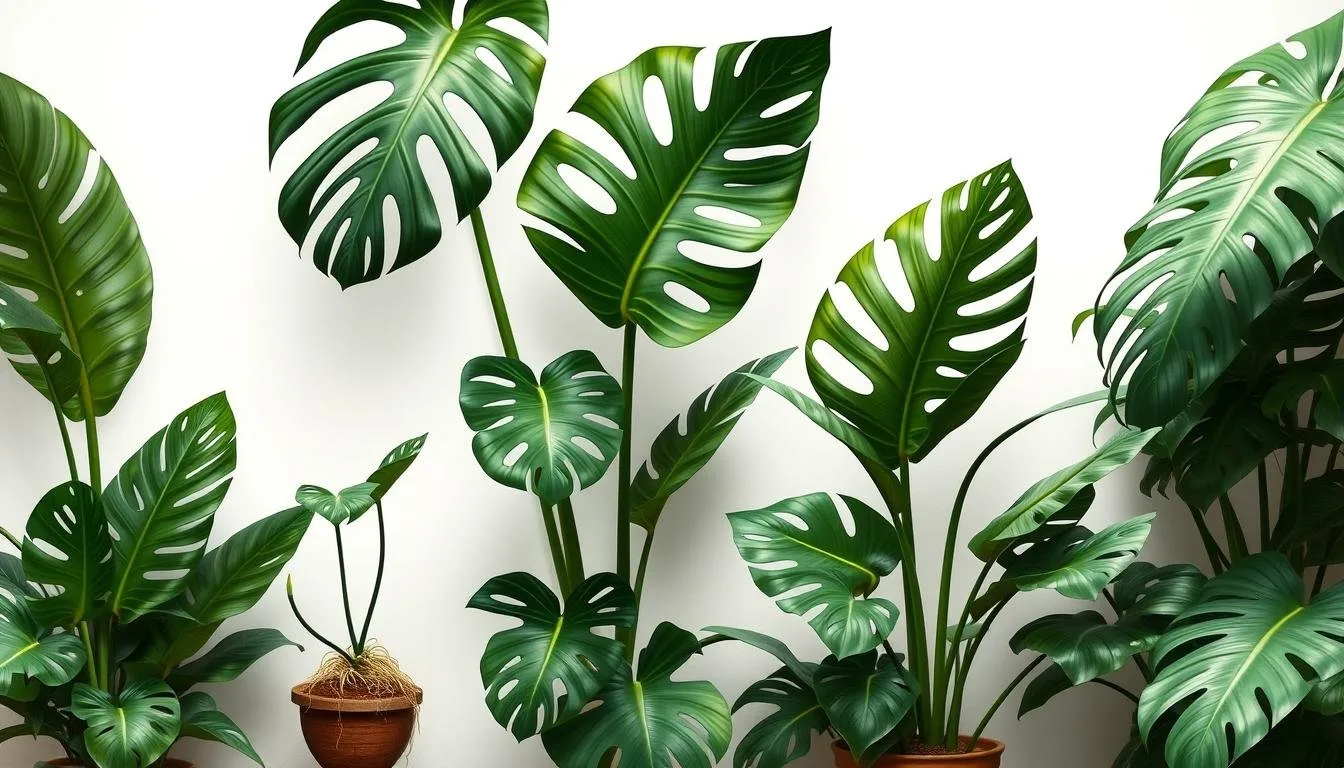
Caption: The moss pole keeps stems vertical so the plant reads as sculpture; the floor planter diameter is about 40% of the current leaf span, with 2 inches of clearance under the pot for saucer drainage.
Planters, Pots, and Stands That Elevate the Look
A Monstera can look premium or messy based on the container alone. The planter is part of the composition, not an accessory after the fact.
Start with proportion. The planter should visually ground the plant. If the leaves are broad and dramatic, a tiny lightweight pot underneath makes the whole thing feel unstable. A practical starting ratio: choose a floor pot whose outer diameter is roughly one-third to one-half the width of the widest leaf span, unless you deliberately want an oversized cachepot for drama.
Then think style match. For minimalist spaces, go with white, black, greige, stone, or muted clay. For boho rooms, terracotta, woven baskets, aged finishes, and warmer natural materials work better. For contemporary luxe, deeper tones, ribbed ceramics, or sculptural stands can sharpen the look. If the room already has a lot going on, the planter should be quieter than the plant.
Plant stands are useful when the plant is young or medium-sized and you need to lift the foliage into the visual field. They are less useful when the plant is already large and meant to occupy the floor plane. A big Monstera on a flimsy stand often looks nervous. A big Monstera in a strong floor planter looks settled.
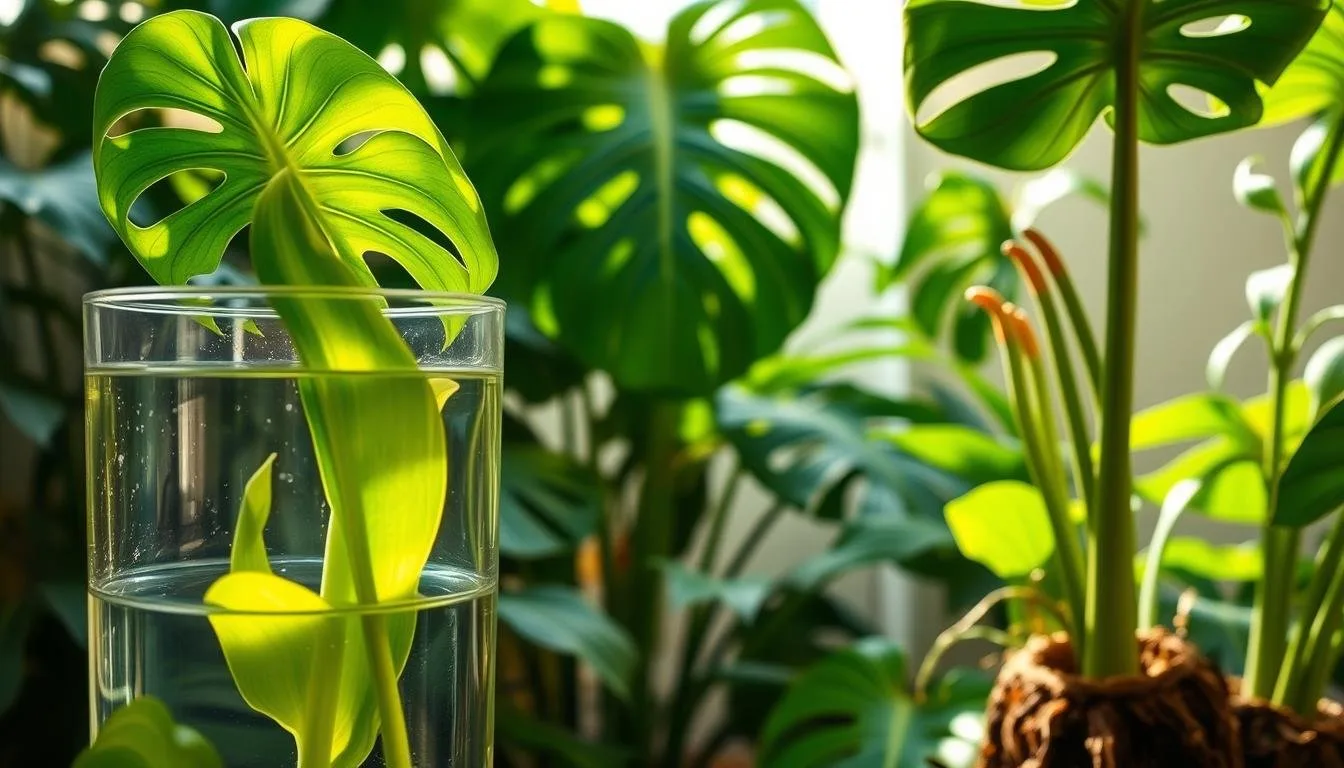
Caption: Decorative cachepot styling works when the inner grow pot sits above any standing water; leave at least 1 inch of air gap between pot base and saucer for drainage.
Style It for Your Aesthetic
Monstera is not locked to one aesthetic. The same plant can read sleek, relaxed, tropical, artistic, or slightly dramatic depending on the room around it. Style the whole relationship: plant, planter, furniture, wall space, and neighboring textures.
Minimalist and modern
Minimalist homes often benefit from one organic element with strong shape. Monstera is ideal because the leaf form is already expressive. You do not need decorative clutter around it—more decor usually weakens the effect.
In modern rooms, place one Monstera beside low-profile furniture, against a plain wall, or near a window with clean sight lines. Use a simple planter. Avoid combining it with overly busy plant stands, heavily patterned baskets, and five other small plants fighting for attention. Modern styling rewards restraint.
Monstera also works with warm minimalism because it prevents beige spaces from becoming lifeless. A room with soft oak, linen, plaster tones, and stone textures can feel finished once a single large green form enters the picture. You are not adding noise. You are adding contrast with purpose. For keeping foliage glossy in bright rooms, clean Monstera leaves covers the appearance side without repeating full care here.
Boho, tropical, and maximalist
This is where Monstera becomes part of a layered system. In boho and tropical spaces, you can use Monstera with rattan, woven textures, patterned textiles, warm woods, and grouped plants without losing the plot. Better Homes & Gardens highlighted Monstera as a fit for maximalist indoor jungle styling because its large leaves add texture and drama within layered greenery. (Better Homes & Gardens)
The risk is chaos. To avoid that, vary leaf size and texture. Pair broad Monstera leaves with finer foliage, trailing vines, or upright narrow plants so the room has contrast instead of one-note bulk. Architectural Digest advises looking for plants with striking silhouettes and sculptural movement for stronger displays. Every plant should contribute a different shape. (Architectural Digest)
If you want a tropical feel without turning the room into a greenhouse, let Monstera carry most of the “lush” signal and keep the rest controlled. One Monstera, one trailing plant, one upright companion, and a coherent set of planters often looks better than eight random plants in eight random finishes. Secrets to thriving Monstera plants covers the care habits that keep layered rooms from becoming a collection of struggling specimens.
Compose Monstera with Furniture and Other Plants
Decorating with Monstera is not just about where you put the plant. It is about what the plant is doing relative to everything else. A Monstera next to the wrong objects can look bulky or messy. Next to the right ones, it feels composed.
Color, texture, and scale
Color first. Monstera’s deep green leaves stand out best against quiet backgrounds: off-white walls, warm neutrals, charcoal, wood, stone, or soft earth tones. If your room is already colorful, use the plant as a stabilizer rather than another loud voice.
Texture matters because Monstera leaves are smooth and glossy. That pairs well with matte pottery, woven baskets, raw wood, boucle, linen, jute, or plaster. The contrast makes the plant feel richer. Too many shiny surfaces around it can flatten the effect.
Scale is where most people miss. Large leaves need nearby objects that either match the visual weight or intentionally contrast with it. A large Monstera beside a tiny side table can look unbalanced unless negative space is doing the work. A large Monstera beside a substantial armchair, bench, or console usually makes more sense because the room can hold the scale.
Grouping and the rule of three
If you are grouping plants, avoid making every plant the same height, texture, or personality. An odd number of plants and contrasting textures usually create a more dynamic display. That “rule of three” is simple and still useful.
A strong trio could look like this: a Monstera as the broad-leaf anchor, a trailing pothos or adansonii for movement, and a more upright plant such as a snake plant or palm for vertical contrast. That grouping gives you width, flow, and height. Each plant has a clear role.
What you do not want is three medium broad-leaf plants in similar pots at similar heights. That reads like inventory, not styling. Grouping works when it creates rhythm. Rhythm comes from difference, not duplication.
Keep It Looking Styled
A well-styled Monstera only stays beautiful if day-to-day habits protect the shape you designed around. This section stays decor-focused—not a repeat of the full care encyclopedia on the Monstera hub.
Light drives the look. If the plant sits in a dim spot, it will often get leggy, sparse, or underwhelming no matter how good the planter is. Place it where bright indirect light supports the silhouette you want, and read Monstera light requirements if leaves pale or the plant leans hard toward the window.
Support is a styling tool. A moss pole or trellis encourages upward growth and cleaner structure—especially for deliciosa that is starting to sprawl. A supported Monstera looks intentional; a collapsing one looks neglected. Build or upgrade support before stems become stiff enough to crack when redirected.
Surface care affects shine. Dusty foliage kills gloss and makes the whole plant look tired. Wipe leaves when they dull, prune yellow or damaged foliage promptly, and avoid rearranging the pot every week out of boredom. Good styling is usually quieter than that.
For humidity, watering, fertilizer, and troubleshooting brown tips or yellow leaves, use the hub and topic guides: Monstera humidity needs, watering Monstera deliciosa, and Monstera brown tips.
Common Decorating Mistakes
The first big mistake is choosing aesthetics over conditions. People put Monstera in a dark corner because the corner needs something. If there is not enough light, the plant will decline, and the decor win will be short-lived. See Monstera light deficiency when a “design spot” is also a dim spot.
The second mistake is using the wrong scale. A plant that is too small looks like an afterthought. A plant that is too large looks unruly. Match size to room and role. Statement plant means statement scale. Accent plant means accent scale.
The third mistake is overdecorating around the plant. Monstera already has a big visual voice. If you surround it with loud baskets, competing patterns, too many small objects, and unrelated greenery, the look gets muddy fast.
The fourth mistake is ignoring safety. Monstera deliciosa is toxic to dogs and cats if ingested, according to ASPCA, due to insoluble calcium oxalates. NC State Extension also notes low-severity toxicity to humans and skin irritation from sap in some cases. That does not mean you cannot own one. It does mean placement matters if you have curious pets or kids—style it higher when small, create barriers when large, or choose a different plant if nibbling is a recurring issue. If a pet ingests any part of the plant, contact your veterinarian or ASPCA Animal Poison Control at (888) 426-4435. (ASPCA)
The fifth mistake is buying into myths. Monstera is a beautiful houseplant. It is not magic. It will not transform a poorly designed room by itself, and it will not look “designer” unless the rest of the composition makes sense.
Related guides
- Monstera deliciosa care hub — year-round watering, light, soil, and problem guides
- Types of Monstera plants — species ID and collector varieties
- Buying a Monstera plant — what to inspect at the nursery
- Monstera light requirements — when placement and survival diverge
- Monstera humidity needs — bathroom styling vs. actual humidity targets
- Grow a giant Monstera deliciosa — long-term scale planning for large rooms
Conclusion
Treat Monstera like a design element with real weight: match species to the room, place it where light and sight lines both work, ground it in a proportional planter, and give climbing forms upright support. For everything beyond appearance, start at the Monstera deliciosa care hub.