Scale Insects on Zebra Plant: Causes, Checks & Fixes
Quick answer
Scale on Zebra Plant shows as immobile brown bumps along upright stems and leaf veins, often with sticky honeydew on striped foliage. First step: isolate the plant and wipe every visible bump with a cotton swab soaked in 70% isopropyl alcohol before any spray treatment.
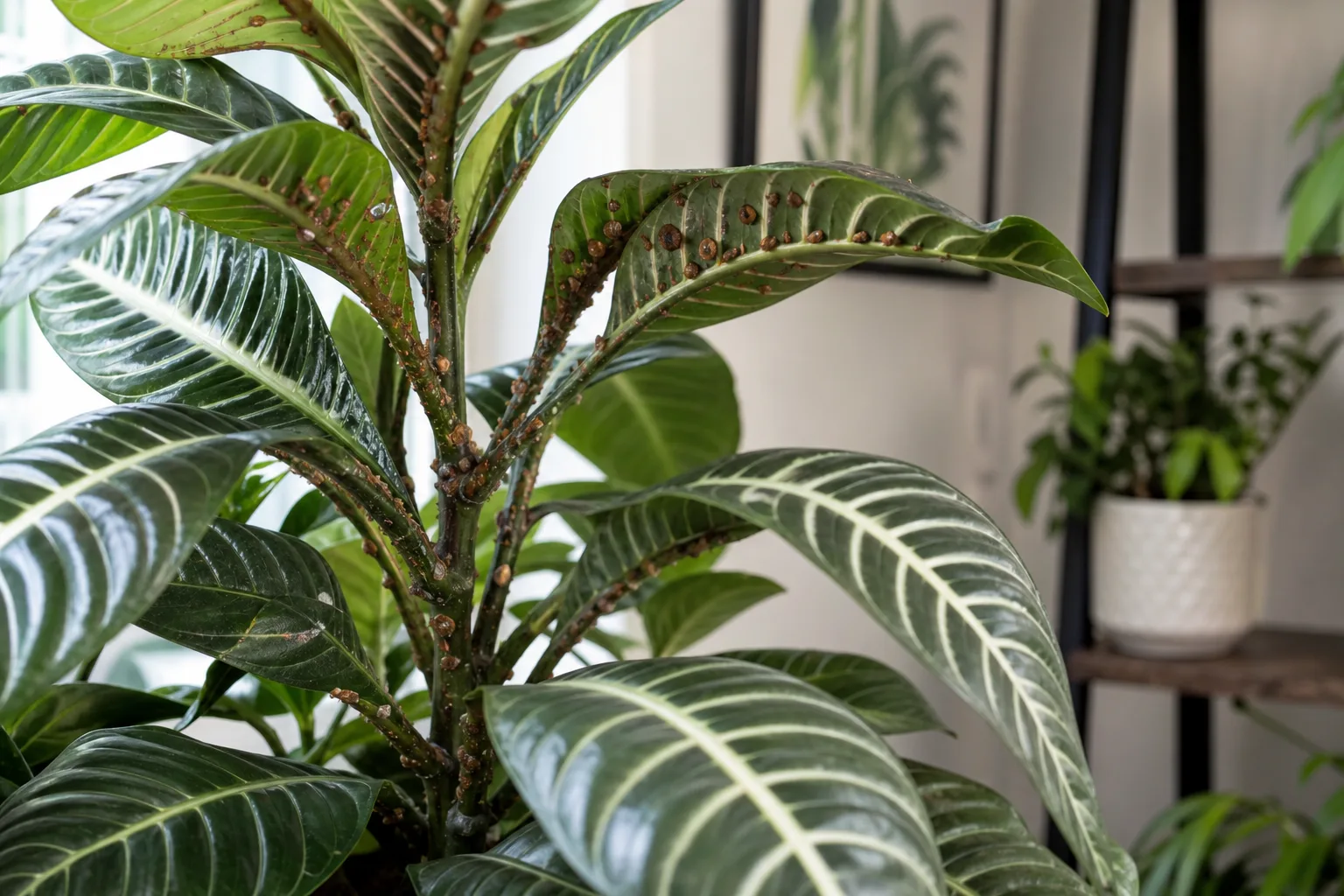
Scale Insects on Zebra Plant: Causes, Checks & Fixes
This guide covers scale insects on Zebra Plant. See also the general Scale Insects guide, watering, and light pages for this plant.
Scale Insects on Zebra Plant: Causes, Checks & Fixes
Quick answer
Scale insects on Zebra Plant (Aphelandra squarrosa) look like small brown or tan bumps glued to upright stems and leaf veins-not fuzzy, not moving, and easy to mistake for natural bark texture until you try to scrape one off. The plant’s glossy striped leaves often turn sticky and shiny from honeydew before you spot the insects themselves.
First step: isolate the plant and wipe every visible bump with a cotton swab soaked in 70% isopropyl alcohol. Scale adults sit under a hard shell that blocks most sprays; direct contact kills them. Only after manual removal should you follow with horticultural oil or insecticidal soap on repeat weekly cycles to catch newly hatched crawlers.
Routing check: Sticky striped leaves with no bumps yet usually belong on the sticky leaves guide first-confirm pests before you treat. White cottony clusters in axils point to mealybugs; soft insects on new shoots point to aphids. This page is for immobile brown or tan shells on upright stems.
Sticky leaves vs. scale bumps - which page to use
| Your first symptom | What to look for next | Start here |
|---|---|---|
| Shiny tacky leaves, no bumps found yet | Inspect axils, midribs, pot rim for ants | Sticky leaves on Zebra Plant |
| Brown or tan domes glued to stems | Scrape test; honeydew below | This page - scale insects |
| White cottony tufts in leaf axils | Wax dissolves with alcohol dab | Mealybugs on Zebra Plant |
| Pear-shaped clusters on new growth | Cornicles; insects move slowly | Aphids on Zebra Plant |
| Fine stippling and webbing, dry air | Tap test on white paper | Spider mites on Zebra Plant |
What scale looks like on Zebra Plant
Zebra plant grows as a compact tropical shrub with upright woody stems and dark green leaves marked by bold white veins. Scale colonizes the parts that stay still and hold moisture:
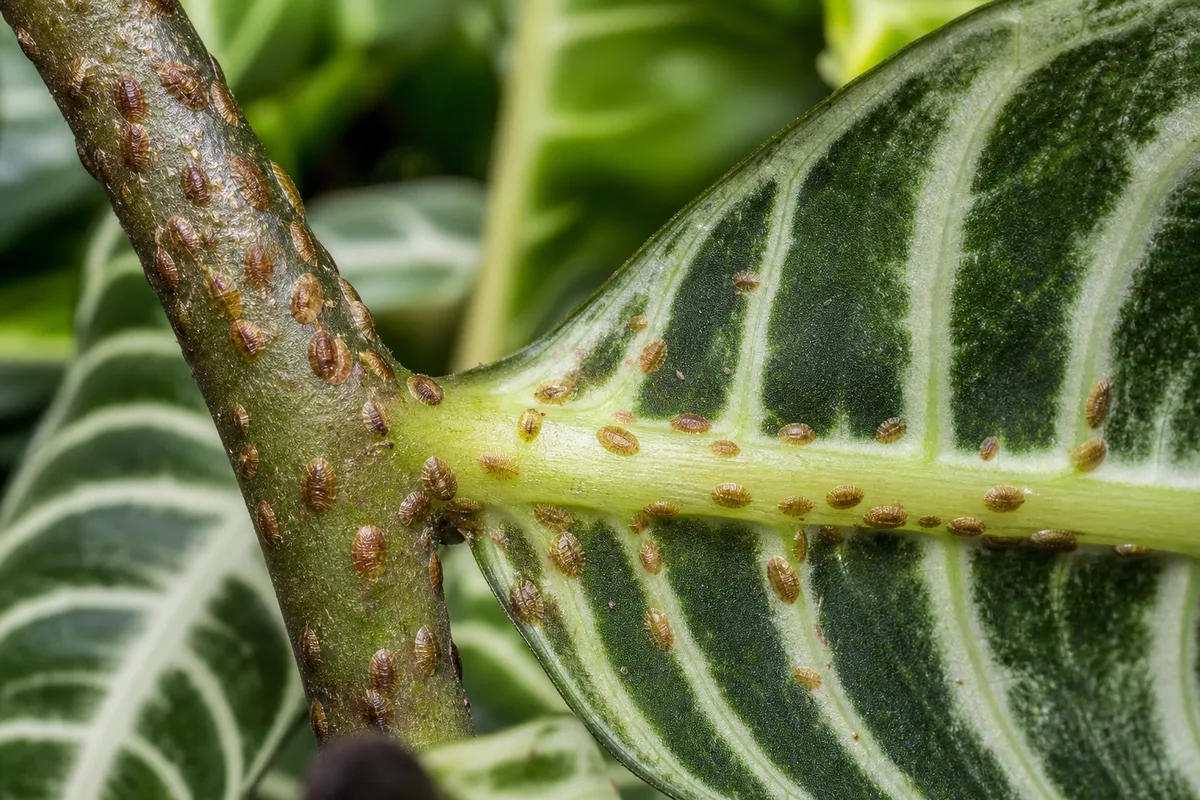
Scale Insects symptoms on Zebra Plant - compare with healthy tissue on the same plant.
- Brown, tan, or amber dome-shaped bumps on stems, especially at leaf axils where each striped leaf meets the stalk
- Flat or rounded scales along leaf midribs on the underside of older foliage
- Sticky, shiny residue on upper leaf surfaces-the honeydew scale excretes after piercing sap
- Black sooty mold growing on that honeydew, making the white stripes look dingy
- Yellowing leaves that drop from the bottom up when feeding is heavy
- Stunted new shoots or aborted yellow bract buds when sap loss stresses the plant
Armored vs. soft scale on woody Aphelandra stems
Indoor zebra plants most often host brown soft scale (Coccus hesperidum)-flat or domed tan bumps roughly 1/16 to 1/8 inch across that produce heavy honeydew. Armored scale forms harder, flatter shells that look more like bark scars; both scrape off with pressure and leave a moist spot, but armored species produce less honeydew and are harder to control with soap alone. On lignifying lower stems, either type can look like normal woody texture-the scrape test is mandatory before you dismiss a bump as bark.
Scale is immobile once settled. If a bump moves when you touch it, you are looking at a mealybug, aphid, or a crawler-not a mature scale shell. Mealybugs on zebra plant show as white cottony clusters in the same axils; aphids gather as soft green or black groups on tender new growth.
The scrape test is the fastest confirmation: pry a bump with a fingernail or knife point. Scale comes off and may reveal a soft insect or eggs underneath. Green tissue that cannot be removed is part of the plant.
Why Zebra Plant gets scale
Scale is not a disease of stressed soil-it is a sap-feeding insect that hitchhikes on new plants, cuttings, or pots moved between rooms. Missouri Botanical Garden lists scale among pests to watch on Aphelandra squarrosa, alongside aphids and whitefly. NC State Extension notes aphids, scales, white flies, spider mites, and mealybugs as the insects to watch on this Brazilian native.
Several zebra plant traits make infestations easy to miss and hard to stop once established:
Dense leaf axils. Each stem holds overlapping striped leaves close to the stalk. Scale hides in those tight joints where sprays rarely reach on the first pass.
High humidity preference. Zebra plant wants 60–70% humidity. Warm, humid indoor air without natural predators lets scale reproduce through multiple generations year-round. Sooty mold grows faster on honeydew when humidity stays high.
Upright stem architecture. Unlike trailing pothos, zebra plant concentrates scale along vertical stems you may not inspect during casual watering. Bumps on the lower third of the stalk can go unnoticed until honeydew drips onto furniture below.
Stress lowers resistance. Low humidity, cold drafts below 65°F, or alternating wet-dry watering weaken Aphelandra squarrosa and slow new growth-so the plant cannot replace leaves scale has damaged. Pest pressure plus environmental stress triggers the sudden leaf drop zebra plants are known for.
Scale rarely arrives from open windows alone. The most common route is an infested neighbor plant or a new purchase skipped through quarantine.
How to confirm scale on Zebra Plant
Work through these checks before you spray:
- Stem joint inspection - Run a cotton swab along every leaf axil on all stems. Brown bumps that snag the swab are scale.
- Scrape test - Lift one bump with a fingernail. Hollow shells, moist tissue, or visible eggs underneath confirm scale.
- Honeydew pattern - Sticky upper leaves with no uniform texture across the whole plant point to sap feeders, not normal leaf gloss.
- Sooty mold wipe - Black film that smears off with a damp cloth sits on honeydew and supports sooty mold growth; it is not leaf variegation damage.
- Ant trails - Ants on the pot, saucer, or nearby surfaces often farm honeydew from scale you have not yet seen.
- Neighboring plants - Check other tropicals within a few feet, especially recent additions. Scale crawlers are tiny but mobile for a short window after hatching.
- Rule out lookalikes - White cottony masses mean mealybugs. Fine webbing and stippled leaves mean spider mites in dry air. Neither leaves hard brown shells on stems.
If you find only one or two bumps and no stickiness elsewhere, you caught the infestation early. More than a dozen scales on a single stem, or sticky coating across multiple leaves, means the colony has been feeding for weeks.
First fix for Zebra Plant
Move the plant away from other houseplants and wipe every visible scale with a cotton swab dipped in 70% isopropyl alcohol.
This single step kills adults on contact and is the most reliable first treatment for armored bumps that block spray penetration. Work stem by stem:
- Support each leaf and swab the axil where it meets the stalk
- Wipe along the full length of every stem, top to bottom
- Flip older leaves and treat scales along midribs on the underside
- Discard swabs when they pick up multiple insects
Place the pot on a towel-alcohol and honeydew will drip from upright stems onto furniture below. Let foliage dry before returning the plant to its usual bright, humid spot. Do not shower the plant first; water runoff spreads crawlers to the soil surface and neighboring pots.
After manual removal, wait 24 hours, then apply insecticidal soap or horticultural oil to stems and leaf undersides per label directions. Scale life cycles include crawler stages that escape a single treatment; plan repeat applications every five to seven days for at least three cycles. Apply oil or soap in Zebra Plant light guide, not direct sun-glossy striped foliage can burn when wet spray sits on leaves in strong light.
Step-by-step recovery
Once isolation and alcohol wiping are done, follow this sequence:
Week 1 - Knock down adults
- Day 1: Alcohol swab every bump you can reach; prune only stems that are more scale than green tissue
- Day 3: Spray insecticidal soap or horticultural oil, covering stems and leaf undersides completely
- Day 7: Second alcohol pass for any new bumps you feel, then another soap or oil spray
Weeks 2–4 - Catch crawlers
- Repeat oil or soap sprays every five to seven days
- Wipe sticky leaves with a damp cloth to remove honeydew and limit sooty mold
- Monitor daily for new brown bumps at growing tips and upper axils
Ongoing - Confirm clearance
- Hold isolation until you see no new bumps for two full weeks after the last spray
- Inspect neighboring plants weekly for six weeks-crawler stages are easy to miss
If stems stay sticky, leaves keep yellowing, or new scale appears after three full treatment cycles, the infestation outpaced manual control. Heavily coated plants with thin, dropping lower leaves may not be worth saving if the upper growth point is also encrusted-see Zebra Plant propagation for stem-cutting salvage when the lower plant is lost but a clean upper tip remains.
Recovery case study - moderate infestation on a bathroom zebra plant
A six-stem Aphelandra squarrosa in a humid bathroom showed sticky white stripes and 14 brown bumps concentrated on the lower third of two upright stems-missed during top-only watering checks. Day 1: isolated on a towel, alcohol-swabbed every bump, wiped honeydew from striped upper leaves. Days 3–21: horticultural oil every six days on stems and leaf undersides; room held 68°F and roughly 65% humidity. Stickiness stopped by week 2; sooty mold wiped off by week 3. Week 5: first clean yellow bract bud on an upper stem with no new shells. Week 6: returned to the collection after two pest-free weeks. Key lesson: inspect vertical lower stems, not just glossy leaf tops-and route sticky-only symptoms to the sticky leaves guide before assuming scale is absent.
Recovery timeline and what to expect
Damaged leaves do not heal. Yellow or sooty-coated foliage will stay blemished until the plant drops it or you prune it off. Judge recovery by new growth, not old leaves:
- Within one week: Stickiness stops spreading after alcohol and first spray; live scale count drops
- Two to three weeks: No new bumps on upper stems; fresh leaves unfurl clean without stickiness
- Four to six weeks: Steady new striped foliage; bract buds hold if humidity and moisture stay stable
- Beyond six weeks with recurring scale: Crawlers are still hatching or you missed adults in protected axils-extend treatment or consider discarding a severely weakened plant
Zebra plant is slow to push replacement leaves when humidity drops or roots sit wet. Keep even moisture per our watering guide-water when the top inch of soil dries-but do not overwater a pest-stressed plant in soggy peat. Do not fertilize until new growth looks firm and pest-free for at least two weeks.
Bract-bud abortion vs. normal post-flowering drop
After a bloom cycle, zebra plants naturally cut back and may drop some lower leaves-that is cultural, not urgent. Scale-related bract abortion happens when developing yellow bract spikes are sticky, distorted, or coated in sooty mold before flowers open, often while upper stems still carry live scale shells. If buds abort with tacky residue and bumps on the same stem, treat as pest urgency, not normal rest.
Lookalike symptoms on Zebra Plant
| What you see | Likely cause | How to tell apart |
|---|---|---|
| Brown bumps on stems | Scale | Immobile; scrapes off; sticky honeydew below |
| White cottony clusters in axils | Mealybugs | Soft, fuzzy; alcohol dissolves the wax |
| Fine webbing, stippled leaves | Spider mites | Mites thrive in dry air; no hard shells on stems |
| Sticky leaves, no bumps | Aphids on new growth | Soft insects on shoot tips; ants often present |
| Black leaf patches, no stickiness | Leaf spot fungus | Spots do not wipe off; no insects on stems |
| Uniform leaf gloss | Normal foliage | No insects, ants, or spreading tackiness |
Sticky leaves on zebra plant often mean scale or aphids-start with the sticky leaves guide if honeydew is your first noticed symptom and bumps are not yet visible.
Mistakes to avoid
- Spraying oil or soap before manual removal - Shells block contact; adults survive the first spray and keep laying eggs
- Returning the plant to the collection too soon - Two pest-free weeks minimum after the last treatment
- One-and-done treatment - Scale crawlers hatch on staggered schedules; a single spray misses the next generation
- overwatering on Zebra Plant while treating - Stressed roots plus sap loss accelerate leaf drop; keep even moisture per watering, not soggy soil
- Fertilizing during infestation - New soft growth attracts more sap feeders; wait until pests are cleared
- Ignoring ants - Ants protect scale from predators; control ants or isolate the plant away from ant trails
- Heavy pruning without isolating - Cut stems can still harbor scale under remaining axils; treat before you trim
- Oil spray in direct sun - Wet horticultural oil on glossy striped leaves in strong light can cause burn; treat in bright indirect light
Zebra Plant care cross-check during treatment
Scale treatment works better when the plant is not fighting other stresses. While you treat, confirm baseline care per our Zebra Plant overview and watering guide:
- Humidity: Target 60–70% with a humidifier or pebble tray; dry air slows recovery and invites spider mites
- Temperature: Keep above 65°F; cold drafts cause leaf drop that masks whether pest treatment is working
- Light: Bright indirect light supports new growth; deep shade stalls replacement leaves
- Watering: Water when the top inch dries; never let the pot sit in a full saucer
- Airflow: Gentle circulation prevents sooty mold from spreading on honeydew-coated leaves
How to prevent scale next time
- Quarantine new plants two to three weeks before placing them near your zebra plant
- Inspect stems and axils during every watering-not just leaf tops
- Wipe dust from striped leaves monthly so bumps are visible against the white veins
- Check plants before bringing them indoors if they summered outside, where natural enemies may have masked low-level scale
- Treat honeydew early-sticky residue on one leaf is easier to fix than a stem coated in shells; see sticky leaves at the first tacky spot
- Avoid crowded plant shelves where crawlers can walk to the next pot during the mobile stage
Regular scouting catches scale when alcohol swabs still solve the problem in one sitting.
When to worry
Use this severity ladder before you panic-repot or discard:
| Severity | What you see | Response |
|---|---|---|
| Low | One to five bumps on one stem; firm growth | Isolate, alcohol swab, 2–3 oil or soap cycles |
| Moderate | Bumps on multiple stems; honeydew on striped leaves; ants present | Full swab plus weekly sprays; scout all neighbors |
| High | Lower third of stems coated; sooty mold on most foliage; bract buds aborting | Extend treatment; consider labeled systemic if oil fails |
| Discard threshold | Bare lower stems, encrusted upper growth point, rebound after three full cycles | Protect collection-discard or take propagation cutting from clean upper tip |
Escalate or consider discarding the plant when:
- More than half the stems carry visible scale after two weeks of treatment
- Growing tips are encrusted and new leaves emerge already sticky or distorted
- Mass leaf drop on Zebra Plant continues despite stable moisture and humidity
- Sooty mold covers most foliage and blocks light to remaining leaves
- Scale returns within days after three full spray cycles-hidden egg masses or a nearby reinfestation source
Aphelandra squarrosa can recover from light scale if you catch it before sap loss and sooty mold compound. A plant with bare lower stems, few remaining leaves, and scale on the upper growth point is often not worth the space and risk to your other tropicals-unless a clean upper stem can be salvaged through propagation.
Decision checklist before you close this case
- Live shells and crawlers - Inspect every leaf axil and lower woody stem with a hand lens. No new bumps means the active infestation is controlled; old honeydew alone does not count.
- New growth quality - Clean striped leaves and firm bract buds without stickiness signal recovery. Yellowed lower leaves may never re-green-judge by new tips.
- Neighbors and quarantine - Nearby plants are clean, ant trails are gone, and the zebra plant stayed isolated with zero new scale for two full weeks after the last spray.
If sticky leaves return but insects look different, route to mealybugs, aphids, or spider mites rather than repeating the same alcohol cycle.
This page was reviewed by the LeafyPixels Review Board against UMD Extension, UMN Extension, Colorado State Extension, Missouri Botanical Garden, and NC State Aphelandra squarrosa references, plus our Zebra Plant overview, watering, and sibling pest guides before publication. Author: sai-ananth. Reviewed: 2026-06-17.
Related guides:
- Overview - full indoor care hub
- Watering - even moisture during pest-stressed recovery
- Sticky leaves - symptom-first routing when honeydew appears before bumps
- Mealybugs - white cottony lookalike in leaf axils
- Aphids - soft clusters on new shoots and bract tips
- Spider mites - stippling and webbing without heavy honeydew
- Propagation - stem-cutting salvage when upper growth stays clean
FAQs
How can I confirm scale insects on Zebra Plant?
True scale scrapes off with a fingernail or swab and leaves a moist spot underneath-not part of the stem. Brown dome-shaped bumps clustered in leaf axils and along midribs, plus sticky residue on the glossy striped leaves, confirm sap-feeding scale rather than normal stem texture or leaf variegation.
What should I check first for scale on Zebra Plant?
Inspect stem joints, the undersides of leaves along midribs, and any sticky patches on upper leaf surfaces. Check nearby tropicals in the same room, especially if you recently bought or moved a plant. Ants on the pot rim often appear before you notice the bumps themselves.
Will Zebra Plant recover from scale insects?
Light to moderate infestations clear with weekly alcohol wiping followed by horticultural oil or insecticidal soap on repeat cycles. Heavily coated stems that stay sticky after three treatment rounds, plus yellowing and leaf drop across the whole plant, mean recovery is uncertain even if some tissue survives.
When is scale urgent on Zebra Plant?
Treat immediately when honeydew covers multiple leaves, sooty mold spreads across striped foliage, new bract buds abort, or the plant drops leaves while soil is evenly moist. Aphelandra squarrosa declines quickly when pest sap loss stacks with low humidity or cold drafts-do not wait for crawlers to spread to every stem.
How do I prevent scale on Zebra Plant next time?
Quarantine new plants two to three weeks before placing them near your zebra plant. Scout stems and leaf axils during weekly watering checks. Keep humidity steady at 60–70% with airflow so foliage stays healthy, and isolate at the first sticky leaf rather than treating only after colonies coat the stems.
When to use this page vs other Zebra Plant guides
- Zebra Plant watering guide - Use for routine moisture checks before assuming scale insects is the main issue.
- Zebra Plant problems hub - Browse all 32 common issues on this species.
- Sticky Leaves on Zebra Plant - Different entry point when symptoms overlap with scale insects.
- Yellow Leaves on Zebra Plant - Different entry point when symptoms overlap with scale insects.
- Mealybugs on Zebra Plant - Different entry point when symptoms overlap with scale insects.