Watermelon Peperomia Light Needs: Windows, Sun & Signs
Watermelon Peperomia Light Needs: Windows, Sun & Signs
Watermelon Peperomia Light Needs: Windows, Sun & Signs
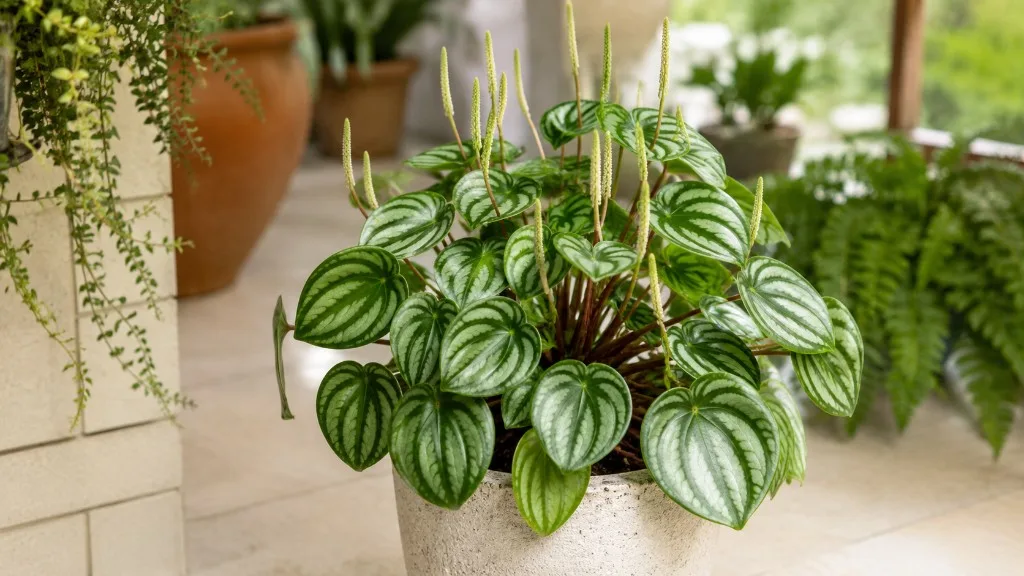
Watermelon peperomia earns its name from silvery-green bands that look painted across each round leaf. Those stripes are not decorative luck - they are a light-sensitive display on a plant built for filtered rainforest brightness, not blazing window glass at noon. Peperomia argyreia will hang on in a dim corner longer than many drama-prone tropicals, but “still alive” and “looking like the nursery photo” are different outcomes. Light is the variable that decides which one you get.
The practical target is bright indirect light: strong ambient brightness on the leaves without harsh direct sun beating on them for hours. Medium indirect light is a workable compromise - the plant grows more slowly, new leaves may be smaller, and the stripe contrast softens - but it beats chronic shade that produces stretched stems and floppy petioles. Harsh direct sun, especially hot afternoon rays magnified through south- or west-facing glass, is the mistake to avoid. Bleached patches, crisp edges, and washed-out patterning show up fast on these semi-succulent leaves.
Missouri Botanical Garden lists watermelon peperomia as a houseplant for bright indirect light locations and explicitly recommends avoiding direct sun. (Missouri Botanical Garden) That guidance matches the plant’s native habit: understory growth in South American forests where taller canopy trees diffuse the day’s brightest energy. Your job indoors is to recreate that filtered brightness, not desert exposure.
This guide covers how much light watermelon peperomia actually needs, why east windows are the easiest win, how south and west exposures can still work with distance and sheer curtains, what medium and low light really cost you, how to acclimate without scorching, when grow lights make sense, and how to read warning signs on new growth before a small placement error becomes a permanent ugly habit.
How Much Light Watermelon Peperomia Actually Needs
Watermelon peperomia is a compact, slow-to-moderate grower with a small root system and fleshy leaves that store some water - traits of an understory survivor, not a sun-hungry succulent on a south patio. In cultivation it performs best when leaves receive bright indirect light for most of the day: enough photons to keep internodes short and petioles firm, without the leaf-temperature spike that comes from unfiltered beams on glass.
“Bright indirect” is a placement description, not a vibe. It usually means the plant sits within roughly 12 to 36 inches (30 to 90 cm) of a sunny window but out of the direct beam for most hours, or in the direct path of a window that only receives gentle morning sun. You can sanity-check with a hand test: at the leaf level, a soft, diffuse shadow with a recognizable outline suggests bright indirect conditions. A sharp, dark shadow means direct sun is landing on foliage. Almost no shadow at leaf level means the spot is too dim for long-term quality growth.
Medium indirect light - typical of a bright room four to six feet back from a large window, or near a north or east window that never catches a sunbeam - keeps many plants alive. Watermelon peperomia tolerates this band better than light-starved ferns or calatheas, but growth slows, new leaves may lose some silvery punch, and the plant becomes easier to overwater because it uses less water in dimmer conditions. Treat medium light as a conscious compromise, not the ideal you forgot to provide.
Bright Indirect Light as the Default Target
If you want the classic compact rosette, firm red stems, and crisp watermelon striping, aim for bright indirect as your baseline. That often translates to an unobstructed east window, a sheer-filtered south or west window, or a very bright north window in a room with light walls and no outdoor obstructions. The pot should be close enough that light lands on leaves, not just on the floor in front of the sill.
Judge success by new leaves over two weeks, not by how photogenic the oldest foliage still looks. Old scorch marks never heal; old stretch never compacts. The youngest leaf and the next petiole after it tell you whether today’s placement is working. Firm texture, round shape, strong silver banding, and short gaps between leaves mean you are in the right band. If those signals are missing, adjust light before you change fertilizer, repot, or rewrite the watering calendar.
Bright indirect also keeps watermelon peperomia in sync with the rest of its care system. A plant in correct light dries its pot on a predictable rhythm, pushes steady seasonal growth in spring and summer, and recovers faster from the minor stresses of indoor life - dry air, occasional missed watering, a week of cloudy weather. Dim light hides problems until roots sit wet too long; harsh sun creates instant visible damage on leaves that cannot be undone.
Why Light Controls the Watermelon Stripe Pattern
The watermelon pattern is not ink. It comes from reflective air pockets inside the leaf tissue that scatter light and create silvery bands against greener zones. That structure evolved under dappled, moderate-intensity light where contrast helps the plant manage photon load without sacrificing photosynthetic area. When exposure swings too far in either direction, the optical effect - the reason you bought Watermelon Peperomia overview - is the first thing to degrade.
Too much direct sun bleaches those reflective zones. The leaf looks washed out, sometimes almost chalky on the sun-facing side, before crisp brown edges follow. Too little light pushes the plant toward etiolation: longer spaces between leaves, thinner petioles, smaller new foliage, and duller patterning as the plant prioritizes reaching for photons over maintaining display tissue. Both failures are light problems wearing different masks.
Because leaves are semi-succulent, they hold water and heat differently than paper-thin shade foliage. A watermelon peperomia leaf in direct afternoon sun can scorch even when the soil is moist - the damage is radiation and leaf temperature, not drought alone. That physiology is why “it likes bright light” never means “put it in the sunbeam for six hours” without acclimation and filtering.
How Reflective Striping Responds to Exposure
In bright indirect light, silver bands stay sharp and the green zones deep without looking muddy. New leaves open with the round coin shape and balanced pattern you expect from healthy Peperomia argyreia. As you slide toward medium light, the contrast softens - still attractive on a healthy plant, but closer to a muted print than a bold graphic. In chronic low light, the plant may produce smaller, paler leaves on elongated stems that lean hard toward the brightest corner of the room.
If stripes fade suddenly after a move closer to glass, suspect photobleaching from direct sun, not mysterious nutrient loss. If fade develops gradually with stretching, suspect insufficient light. The fix directions are opposite: pull back or diffuse for bleach; move closer or supplement for stretch. Fertilizer will not restore pattern on a plant sitting in the wrong exposure band.
Seasonal shifts matter for striping, too. Winter sun lower on the horizon can turn a previously safe south windowsill into a scorch zone by February, while the same plant in July might have been perfectly happy two feet back. Re-check leaf level exposure when you change clocks, when you wash windows, and when outdoor trees lose leaves that used to shade glass.
East-Facing Windows and Morning Sun
If you have one easy placement to remember, it is this: an east-facing window is watermelon peperomia’s best friend indoors. East exposures receive cooler, gentler morning sun for a few hours, then spend the rest of the day in bright indirect brightness without the furnace-like afternoon heat load that west and south glass can deliver. For a plant that wants strong light but fears harsh rays, that daily rhythm is nearly custom-built.
On many east sills, you can place the pot directly on the glass for most of the year without drama, especially if the window is not baking hot from exterior metal framing or reflecting off a neighboring wall. Watch the first new leaves after placement. If they open clean and firm, you have found a long-term home. If you see faint bleaching only on the outermost leaves in late spring when sun angle rises, pull the pot six inches back or add a sheer curtain during the brightest weeks - a small seasonal tweak, not a crisis.
East windows also forgive the common beginner error of judging light by how bright the room feels to human eyes. Humans adapt to dim interiors; plants do not. An east window delivers plant-usable brightness to leaves even when the rest of the room looks merely “adequate.” That is why moving a struggling peperomia from a coffee table to an east sill often produces visible improvement within one growth cycle.
Why Gentle Morning Rays Beat Harsh Afternoon Heat
Morning sun differs from afternoon sun in ways that matter on a windowsill. Lower air temperatures, lower leaf-surface heat, and shorter duration combine into a soft direct-light window that many rainforest understory plants can use when acclimated. Afternoon sun through clear glass can spike leaf temperature far above ambient room readings, especially on dark pots and metal sills, and watermelon peperomia’s reflective leaves are not built to dump that heat quickly.
If your only bright exposure is east, use it confidently. Rotate the pot a quarter turn weekly so growth stays even; east light is directional, and peperomias will lean. Pair the window with stable room temperatures - cold drafts on winter glass and hot air from a radiator below the sill both stress leaves that are already working hard to balance light and water.
East placement is also pet-practical. Watermelon peperomia is widely listed as non-toxic to cats and dogs by the ASPCA, which makes windowsill culture safer than many flowering plants when curious pets investigate greenery. (ASPCA) Good light on an east sill keeps the plant compact and less temptingly dangly than a stretched specimen reaching across a dim room.
South, West, and North Window Placement
Not every home has an east window free on the sill. South, west, and north exposures can still work when you treat direction as a starting hypothesis, then confirm with new-growth signals.
South-facing windows deliver the strongest indoor light in the Northern Hemisphere. They are excellent for watermelon peperomia only with management: set the pot two to four feet back from the glass, use a sheer curtain to diffuse direct beams, or place the plant to the side of the frame where it receives reflected brightness without sitting in the laser path. Clemson Extension recommends indirect light from east- or south-facing windows for peperomias generally. Unfiltered south sun on leaves is the fastest route to bleach and crisp edges.
West-facing windows are trickier than they look. Afternoon sun is hot, and west glass can scorch foliage that seemed fine all morning. Treat west like south with extra caution: distance, diffusion, or both. A few hours of filtered western light often produces beautiful compact growth; the same plant on an unshaded west sill can decline within days after a sudden move.
North-facing windows supply consistent indirect light without direct sun. A bright, unobstructed north window - no porch roof cutting off sky, no tall hedge outside - can sustain watermelon peperomia at the medium-to-bright edge of acceptable. Deep north rooms with small windows fall into medium or low territory; expect slower growth and softer striping, and monitor for stretch. In dark north setups, plan on a grow light rather than hoping patience alone will deepen color.
Distance, Sheer Curtains, and Seasonal Adjustments
Distance from glass is your dimmer switch. Moving a pot six to twelve inches changes exposure more than most beginners expect because window light falls off quickly away from the frame. When stripes bleach, step back or diffuse before you abandon the window entirely - the goal is filtered brightness, not retreat to a bookshelf.
Sheer white curtains are underrated tools. They knock down peak intensity while preserving the long hours of ambient brightness south and west windows provide. Linen or mesh blinds work similarly. Avoid tinted films that slash PAR dramatically unless you compensate with grow lights; you want softer sun, not a cave.
Seasonal adjustments keep a good placement from becoming a bad one. In summer, when days are long and sun is high, pull watermelon peperomia back from south and west glass or add diffusion. In winter, when sun is weaker and lower, move it closer to the same window to recover lost brightness - especially on east and north exposures. Plants do not read calendars; they read photons. A spot that was perfect in November may scorch in March if you forget to re-check.
Medium Light Tolerance and Low-Light Limits
Watermelon peperomia has a reputation for being more forgiving in medium light than many tropical foliage plants, and that reputation is mostly fair. It will persist on a bright side table, a desk a few feet from an east window, or a north room with a large skylight nearby. Persistence, again, is not the same as thriving.
In medium indirect light, expect slower growth, smaller new leaves, and less vivid striping. The plant may keep a pleasant shape for months if watering is disciplined and humidity is not brutal. For many homes, that is an acceptable trade - a pretty, low-drama desk plant that does not outgrow its pot every season. Know you are choosing ornamental compromise, not optimal conditions.
Low light - interior walls far from windows, hallways with borrowed fluorescence, bathrooms with frosted glass only - is a poor long-term setup. Watermelon peperomia may survive for a while, especially if overwatering on Watermelon Peperomia is avoided, but stems elongate, leaves shrink, and the plant becomes structurally floppy. Floppy stems on delicate petioles are not just ugly; they snap during routine handling and make the plant harder to hydrate safely because the root zone stays wet longer in dim conditions.
When Slower Growth Is an Acceptable Trade-Off
Medium light makes sense when aesthetics beat speed. Office desks, bedroom nightstands with east exposure across the room, and shaded living-room corners that still read “bright” to a human often land in this band. If the plant holds firm leaves, produces occasional new growth without dramatic lean, and stripe contrast still pleases you, stay put.
When medium light fails, the signals are consistent: visible lean toward the window, long gaps between leaves, small pale new foliage, and soil that stays wet past your expected dry-down window. Those symptoms mean move closer, add a grow light, or both - not more fertilizer, not a bigger pot, not extra water to “cheer it up.”
If you must keep a watermelon peperomia in medium light, tighten the care pairing: water only when the top of the mix is dry and the pot feels light for its size, reduce feeding to match slower growth, and rotate the pot weekly. Medium light plus heavy watering is how healthy-looking plants develop hidden root stress. Light sets the metabolic pace; watering must follow that pace, not a generic weekly schedule copied from a sunnier windowsill.
Direct Sun Risks and Acclimation Rules
Can watermelon peperomia take any direct sun? Sometimes, in small doses, when acclimated - typically early morning rays through an east window or a few filtered hours that do not coincide with peak heat. Can it take harsh direct sun? No, not without the bleaching and scorch pattern that ranking care pages and botanical institutions warn about. Missouri Botanical Garden’s direct-sun avoidance is not conservative boilerplate; it matches leaf structure and native ecology. (Missouri Botanical Garden)
Harsh direct sun shows up as sudden white or tan patches on the sun-facing leaf face, crisp brown margins, upward curling during midday, and sometimes sudden leaf drop after an unacclimated move to a hotter sill. Damage often appears on the leaves that were fully formed in gentler conditions - they had no reason to build sun-blocking chemistry. New leaves grown under harsh light may look smaller and stressed even before edges crisp.
Nursery plants grown under shade cloth are especially vulnerable. A big-box peperomia moved straight onto a south sill in June is a burn waiting to happen, even if the label says “bright light.” Bright light and direct sun are not synonyms. Always translate labels into filtered brightness plus optional gentle morning exposure.
How to Move a Plant Without Burning Leaves
Acclimation is a one-way ratchet done slowly. When increasing light, move the pot closer to the window over 7 to 14 days, or add one hour of early direct sun every few days while watching new leaves. When decreasing light after scorch, pull back immediately to bright indirect - no gradual step-down required; damage prevention beats pride.
During acclimation, change only light for the first observation window. If you simultaneously repot, fertilize heavily, and move sunward, you will not know which edit caused the next symptom. Water slightly more when moving brighter because transpiration increases; water less when moving dimmer. Do not interpret midday wilt on scorched leaves as thirst - check whether the leaf surface is hot or bleached before you soak an already moist pot.
If you want outdoor summer culture in warm zones, treat patio placement like a west window problem: morning sun, afternoon shade, and the same 7–14 day hardening from indoor brightness to outdoor dappled shade. Bring the plant in before cold nights, and expect some re-acclimation stress each direction. Outdoor success is possible; reckless jumps are not.
Grow Lights When Natural Light Falls Short
Windows are not the only valid light source. Full-spectrum LED grow lights let watermelon peperomia stay compact in basement offices, interior bedrooms, and north apartments where glass alone cannot deliver bright indirect at the leaf. The goal is not to blast the plant with purple panels; it is to supply steady, plant-usable photons across a reasonable photoperiod without cooking leaves from inches away.
Peperomias as a group tolerate medium to bright indirect indoor light and benefit from supplementation when natural light is weak. Clemson Extension notes that peperomias can tolerate somewhat lower light near a large north-facing window when the room is bright. Watermelon peperomia specifically rewards consistent brightness with firmer petioles and better striping - exactly what a well-placed LED can provide in winter.
Fixture Height, Hours, and Spectrum for Indoor Growth
A practical starting setup:
- Use a horticultural full-spectrum white LED, not a standard room bulb optimized for human lumens.
- Position the fixture 12 to 18 inches (30 to 45 cm) above the top of the canopy.
- Run 10 to 12 hours daily on a timer for maintenance growth; up to 14 hours in dim winter rooms if leaves show no heat stress.
- Combine overhead LED with a nearby window when possible so growth stays even and less leggy than a single sideways window alone.
After two weeks, read new growth. If stems stretch and stripes dull, lower the fixture two inches or add one hour - not both at once. If leaf edges lighten or curl only under the lamp, raise the fixture two to three inches or reduce hours. Small enclosed shelves trap heat; pass your hand at leaf level at midday lamp-on to check comfort.
Grow lights also solve the “bright room, dark plant” problem. A living room can feel sunny while the peperomia on the shelf receives medium light at best. Supplement the plant, not the room’s ego. For propagation trays of leaf cuttings, the same bright indirect standard applies: enough light for rootless cuttings to callus and root without desiccating, which usually means under a gentle grow light rather than a hot windowsill.
How Light Changes Watering and Care Rhythm
Light is the throttle for watermelon peperomia’s entire metabolism. Brighter correct light increases transpiration and speeds the dry-down cycle; dimmer light slows water use and lengthens the time soil stays moist. That link is why two plants in identical pots and mix can need different watering intervals on opposite sides of the same room.
When you move a peperomia brighter, check moisture more often for the first month. The old schedule will lag. When you move dimmer, extend the dry window and resist sympathy watering on a floppy stem - flop from low light plus wet soil is common and fixes with light, not another drink.
Fertilizer should track active growth, which light largely controls. In bright seasons with visible new leaves, a dilute balanced feed monthly is enough for this light feeder. In dim winter holding patterns, skip feed entirely. Chasing color with fertilizer while the plant starves for photons wastes money and salts the small root zone.
Temperature and humidity modulate the light equation at the margins. Hot, dry air near a south window increases scorch risk even when light levels look acceptable on paper. Cold glass in winter can chilling-damage leaves touching pane even when light is finally adequate. Aim for the comfortable indoor band most peperomias prefer - roughly 65–78°F (18–26°C) - and keep leaves from pressed contact with frosty glass.
Warning Signs Your Peperomia Has the Wrong Light
Watermelon peperomia reports problems on new tissue first. Make one placement change, then wait 10 to 14 days before also changing pot size, fertilizer, or watering philosophy. Overlapping edits turn clear symptoms into guesswork because wilt, fade, and crisp edges overlap across stress types.
Use the new-growth test every time: the youngest leaf and the next emerging petiole are the scoreboard. Old damage is history.
Too Little Light - Stretch, Dull Striping, Floppy Stems
Elongated spaces between leaves and visible lean toward the brightest corner mean the plant is escaping shade. Smaller, paler new leaves with softened silver banding confirm chronic deficit, not a single cloudy week. Floppy stems on delicate petioles make the rosette look collapsed even when roots are healthy - a classic low-light plus slight overwater pairing. Soil that stays wet beyond your usual interval in a cool dim room often couples low light to root-zone stagnation. Slow or absent new growth through spring and summer, when brighter windows would normally push leaves, is a seasonal red flag.
Fixes: move closer to glass, clear obstructions, shift to an east or filtered south/west window, add or lower a grow light, rotate weekly for even exposure, and tighten watering until dry-down matches the new slower metabolism if you must stay in medium light temporarily.
Too Much Light - Bleach, Crisp Edges, and Midday Curl
White or tan bleached zones on the sun-facing leaf surface indicate photobleaching of reflective tissue. Crisp brown margins appearing suddenly after a move to a hotter sill suggest scorch, not underwatering on Watermelon Peperomia, especially if soil is moist. Upward cupping or curling during peak hours is a protective response to excess radiation or leaf heat. Sudden leaf drop after an unacclimated jump to harsh sun is an acclimation failure, not a mysterious pest. Washed-out pattern contrast - the plant looks like a faded print - often precedes visible crisping.
Fixes: pull back from glass, add sheer diffusion, shift to east exposure, avoid dark pots on hot metal sills, and acclimate gradually when increasing light. Remove fully scorched leaves only for aesthetics; focus on protecting the next leaf.
Conclusion
Watermelon peperomia light needs boil down to a simple band with honest edges: bright indirect light is ideal, medium indirect light is acceptable if you accept slower growth and softer striping, and harsh direct sun - especially hot afternoon beams - should be avoided because semi-succulent leaves bleach and crisp faster than they recover. An east-facing window is the most forgiving way to hit that target indoors, delivering gentle morning sun plus steady brightness without the furnace effect of west and south glass.
Read new leaves, not nostalgia for older ones. Move exposure in small steps, diffuse before you retreat to a dim shelf, and pair every light change with an adjusted Watermelon Peperomia watering guide. When windows cannot carry the plant through winter or back-room placements, a 10–12 hour full-spectrum LED at modest height keeps petioles firm and pattern sharp. Get the light band right and watermelon peperomia becomes one of the easiest patterned foliage plants to keep compact and pet-safe; miss it and even perfect soil produces a stretched, dull impostor of the striped rosette you remember from the nursery bench.
When to use this page vs other Watermelon Peperomia guides
- Watermelon Peperomia overview - Start here for whole-plant context before deep-diving this topic.
- Watermelon Peperomia problems hub - Jump to symptom-specific fix guides when this care topic does not resolve the issue.
- Not Enough Light on Watermelon Peperomia - Escalate here when light adjustments are not enough.
- Leggy Growth on Watermelon Peperomia - Escalate here when light adjustments are not enough.
- Sunburn / Scorched Leaves on Watermelon Peperomia - Escalate here when light adjustments are not enough.
Related Watermelon Peperomia guides
- Watermelon Peperomia overview
- Watermelon Peperomia watering
- Watermelon Peperomia soil
- Watermelon Peperomia propagation
- Watermelon Peperomia fertilizer
- Watermelon Peperomia repotting
- Not Enough Light on Watermelon Peperomia
- Leggy Growth on Watermelon Peperomia
- Sunburn / Scorched Leaves on Watermelon Peperomia
- Watermelon Peperomia problems