Watermelon Peperomia Fertilizer: When, How, and Mistakes
Watermelon Peperomia Fertilizer: When, How, and Mistakes to Avoid
Watermelon Peperomia Fertilizer: When, How, and Mistakes to Avoid
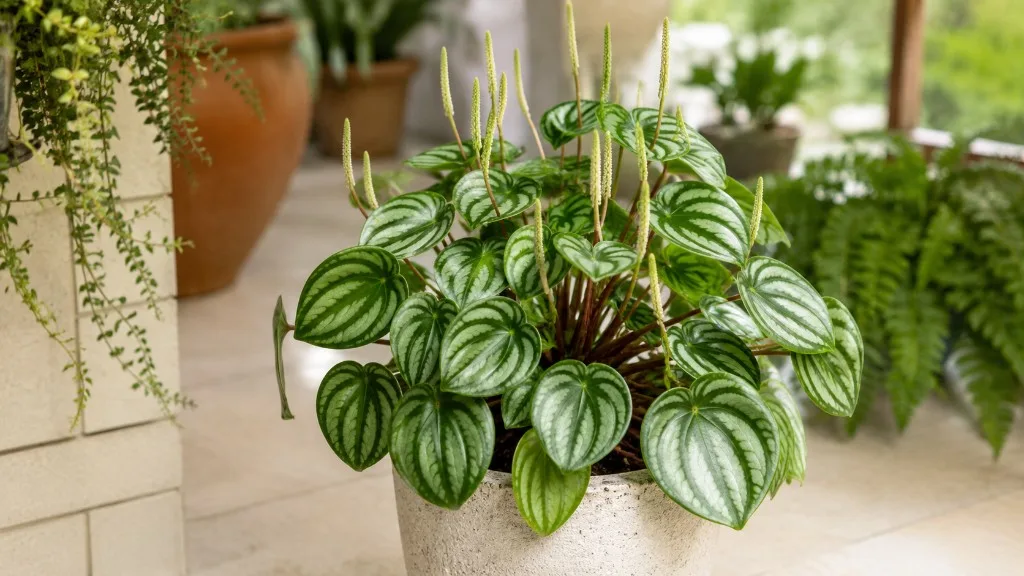
Watermelon peperomia shows fertilizer mistakes on its silver watermelon stripes before the whole leaf complains - brown crispy margins, white salt crust on a 4-inch terracotta rim, and new round leaves that unfurl with washed-out banding instead of crisp silver bands. Peperomia argyreia is a slow-growing South American understory shrub with a compact root system in small pots, not a heavy-feeding tropical. Nutrients support steady foliage during active seasons, but they cannot paint stripes onto leaves - bright indirect light does that job first. Feed too strong, onto dry soil, or through a dim winter when the plant is green but static, and salts concentrate fast in a root zone that was never built for rich, constantly fertilized soil.
This page is the deep-dive fertilizer guide for watermelon peperomia. For the full care map - light, water, soil, propagation - start with the Watermelon Peperomia overview. The overview recommends quarter- to half-strength balanced liquid every two to four weeks during active growth; this article uses monthly feeding (every four weeks) as the default center of that range, with every two to three weeks at quarter strength only in bright rooms with continuous new leaves, and every four to six weeks for salt-sensitive plants in moderate light - all reconciled in one place so both pages tell the same story.
Quick answer: quarter-strength feeding tied to new striped leaves
Feed watermelon peperomia with balanced water-soluble fertilizer at quarter to half the label strength while you see new round leaves unfurling with crisp silver striping and upright red petioles - typically once monthly (every four weeks) from mid-spring through late summer indoors. In very bright rooms with fast new growth, every two to three weeks at quarter strength fits the overview’s shorter end of the range; in moderate light or after past tip burn, stretch to every four to six weeks. Water onto moist soil per the moist-soil rule in our watering guide; never pour concentrate onto a dry root ball. Pause entirely from late fall through winter unless strong grow lights keep obvious new growth (then every six to eight weeks at quarter strength). Wait four to six weeks after repotting into fresh mix. If white crust appears or brown tips dull the silver bands, flush three times with plain water and skip feeds for four to six weeks. If new leaves are pale, elongated, and stripeless, open the light guide before increasing food.
Why Watermelon Peperomia Needs Light Feeding
Watermelon peperomia is not a heavy feeder. In habitat across parts of Brazil and neighboring regions, it grows as a compact understory plant where nutrients arrive slowly through decomposing leaf litter and rainfall filtered through canopy shade. NC State Extension classifies P. argyreia as a slow-growing houseplant reaching roughly 8 inches tall in containers - modest dimensions that reflect modest nutrient demand. Clemson HGIC notes that peperomia blooms are insignificant and care should focus on avoiding overwatering rather than aggressive feeding.
A mature plant in a 4- to 6-inch pot has a root volume measured in tablespoons, not cups. Every milliliter of concentrated fertilizer has a proportionally large effect. Full-strength liquid on dry soil is one of the fastest routes to osmotic root burn - roots lose water to concentrated solution at the root surface, damaging tissue before you see leaf symptoms. The practical goal is maintenance nutrition, not forced growth. Fix light, water, and soil drainage first, then add food on a conservative schedule.
South American understory biology and small root volume
Missouri Botanical Garden describes Peperomia argyreia as a low-growing perennial with fleshy leaves adapted to bright indirect light and well-drained soil in warm indoor conditions. The decorative peltate leaves - round blades attached at the center of the petiole - show stress on margins and stripe contrast before whole-leaf yellowing, which makes watermelon peperomia an unusually good visual reporter for salt buildup. When new tissue emerges with dull, washed-out silver banding or cupped edges despite moist soil, suspect salts or low light before hunger.
Does watermelon peperomia need fertilizer at all? Yes - during active growth, in most indoor setups. Fresh potting mix holds nutrients for several weeks after repotting, but watering leaches them over time. Without occasional replacement, growth slows and new leaves may emerge smaller or paler - though pale elongated leaves in a dim corner almost always mean not enough light long before they mean nutrient deficiency.
When to Fertilize Watermelon Peperomia
Timing follows metabolism and visible new growth, not a wall calendar alone. Feed when watermelon peperomia is actively producing new leaves and extending red petioles; stop when growth slows sharply. Indoors, that rhythm usually tracks warm weather and long days, though heated apartments and supplemental grow lights can extend the active window slightly. A plant that looks “alive” through winter - holding old leaves in a north window with no new tissue for weeks - is not growing enough to justify fertilizer.
Use new leaf silver-band crispness and red-petiole upright posture as a seasonal feeding gate independent of month labels. If the crown is building healthy round leaves with vivid striping, timing is right. If the plant is static, solve environment before adding food.
Spring and summer active growth window
Start feeding when you see fresh growth at the crown - new round leaves emerging with the characteristic watermelon pattern, petioles extending in bright conditions, and roots visibly active if you gently check the drainage hole. In most temperate homes, that active window runs from early spring through late summer, roughly March through August, though your exact dates depend on room temperature, light exposure, and whether the plant sits near a window or under grow lights.
During this period, quarter- to half-strength balanced liquid feed once monthly is the default. BBC Gardeners’ World recommends feeding watermelon peperomia once a month during the growing season with half-strength balanced liquid fertiliser and reducing watering in winter when growth slows. That monthly rhythm sits at the center of the overview hub’s every-two-to-four-weeks range: bright east or south windows with continuous new leaves can justify every two to three weeks at quarter strength; moderate light or salt-sensitive plants do better at every four to six weeks.
| Month (temperate climate, indoors) | Growth phase | Feeding guidance |
|---|---|---|
| January–February | Low growth, short days | No fertilizer for typical setups |
| March | Waking up, first new shoots | Start quarter- to half-strength when active growth visible |
| April–July | Peak foliage production | Monthly default; every 2–3 weeks at quarter strength in bright light only |
| August | Still active in bright rooms | Monthly or taper toward six-week interval |
| September | Slowing | Reduce frequency or one final half-strength feed if still growing |
| October–December | Rest phase | Pause entirely unless grow lights drive new leaves |
| Year-round under strong grow lights | Extended active growth | Every 6–8 weeks at quarter strength only if new leaves keep forming |
Watch the plant, not only the table. Static plants with no new tissue for weeks should not receive nutrients until you understand why growth has stalled - often slow growth traces to light or water before hunger.
Fall taper and winter pause
Taper feeding in early to mid-fall as day length drops and room temperatures cool. Give a final half-strength feed in early fall only if you still see new growth, then stop entirely from late fall through winter - typically November through February in most indoor setups. Most watermelon peperomia do fine with no fertilizer for three to four months while growth is minimal.
Winter rest is not full dormancy, but metabolic demand drops sharply. Unused nutrients accumulate as soluble salts - a common path to brown tips. University of Maryland Extension identifies excessive fertilizer use as a primary cause of high soluble salts in indoor plants, with symptoms including brown leaf tips and marginal necrosis.
Exception: plants under strong grow lights that keep producing new shoots can feed at quarter strength every six to eight weeks - watch closely for salt crust on the soil surface.
Best Fertilizer Type and NPK Ratios
The best watermelon peperomia fertilizer for most homes is a complete, water-soluble, balanced houseplant formula with nitrogen adequate for leafy growth, phosphorus at modest levels for root function, and potassium for overall vigor. Choose a product that dissolves cleanly, lists micronutrients on the label - iron, magnesium, manganese - and can be diluted precisely. Avoid shopping by the word “peperomia” on the bottle unless you already trust the brand’s dosing guidance.
Balanced liquid formulas and what to skip
A 10-10-10 or 20-20-20 water-soluble fertilizer diluted to quarter or half strength is the default recommendation across horticultural sources for watermelon peperomia. Equal ratios keep feeding simple when your main goal is steady foliage and compact habit, not flowers. The two numbers refer to the same proportional balance - 20-20-20 is simply more concentrated, so you use less product per gallon when mixing. After dilution, both deliver a similar nutrient profile.
A slightly nitrogen-leaning ratio such as 3-1-2 is reasonable for foliage at half strength. Skip high-phosphorus bloom boosters - watermelon peperomia is grown for leaves, and Clemson HGIC describes peperomia flowers as insignificant. Liquid formulas win for control in small pots: mix at quarter to half label strength, apply until a little drains, and discard saucer water.
Organic liquids - fish emulsion, compost tea, seaweed extract - work at half strength or weaker. Worm castings mixed into repotting soil provide gentle nutrition for months. Slow-release granules release unpredictably in small pots; if already in the mix, skip liquid feed for two to three months. Skip routine foliar feeding on decorative peltate leaves - salts on the blade surface can spot or dull the stripe pattern.
Pet note: The ASPCA lists watermelon peperomia (Peperomia argyreia) as non-toxic to cats and dogs. Concentrated fertilizer solution and crusty, salty soil are not safe for pets to ingest. Keep plants and runoff out of reach; contact your veterinarian or the ASPCA Animal Poison Control hotline at (888) 426-4435 if a pet drinks fertilizer runoff.
How Much Fertilizer to Use
If you remember one number, make it half strength - and for sensitive plants, first-time feeders, or hard tap water with visible mineral deposits, start at quarter strength. Never apply full label strength to a container-grown watermelon peperomia unless you have extensive experience leaching salts regularly and the plant sits in very bright light with fast-draining mix.
Cutting the label rate to one-half is the safest default; quarter strength suits moderate light, past tip burn, or plants that have shown salt crust before. If the label says one teaspoon per gallon, half strength is half a teaspoon, quarter strength is one-quarter teaspoon. Mix only what you need for the session - stored mixed solution can grow algae and lose nutrient balance.
How Often to Feed Watermelon Peperomia
How often should you fertilize watermelon peperomia? Once monthly at quarter to half strength during spring and summer is the standard answer for most indoor plants in 4- to 8-inch pots - that is every four weeks, which matches BBC Gardeners’ World monthly guidance and sits in the middle of the overview’s two-to-four-week range.
Every two to three weeks at quarter strength suits very bright rooms where new striped leaves keep forming steadily - the overview’s shorter interval, not an excuse for full-strength doses. Every four to six weeks suits moderate light, past salt sensitivity, or plants recovering from a flush. Alternate feed weeks with plain water weeks if you water weekly; constant low-dose feeding accumulates salts faster than a single monthly dose separated by plain-water irrigation. Never double up after a missed month.
Step-by-Step Safe Feeding
Feeding watermelon peperomia is a short routine once you have the right product and dilution. The entire process takes a few minutes and matters most for what you do before you open the fertilizer bottle.
Confirm active growth and moist - not dry, not waterlogged - soil. Mix balanced liquid at quarter to half strength in room-temperature water. Pour slowly over the soil until a little drains; avoid splashing the decorative leaves. Empty the saucer within 30 minutes and note the date. No foliar spray, no granules on dry soil, no full-strength drench.
Pre-feed checks and the moist-soil rule
Before every application, run through a short checklist. Is the plant growing? No new tissue for weeks means hold off. Is the soil moist? Dry soil plus fertilizer equals root burn - always water first per our watering guide. Is there white crust on the soil surface? That is salt buildup; flush with plain water and skip this month’s feed. Was the plant recently repotted? Fresh mix has nutrients; wait four to six weeks. Are leaves drooping, yellowing, or dropping? Stress overrides feeding - diagnose water and light first.
The moist-soil rule is non-negotiable: dry roots hit with fertilizer solution lose water by osmosis and burn. When unsure, water with plain water first, wait an hour, then feed at diluted strength.
Deficiency vs Burn vs Low Light vs Hard Water
Under-fertilizing is less common than over-fertilizing on watermelon peperomia, but symptoms overlap heavily with environmental stress. Use this matrix before changing your feeding schedule:
| Symptom pattern | Most likely cause | Soil / leaf clues | First action |
|---|---|---|---|
| Pale new leaves, smaller rounds, slow growth in a bright window | Possible deficiency or depleted mix | Soil very dry or unchanged 2+ years; firm crown | Half-strength monthly feed or repot; see soil guide |
| Pale elongated new leaves, dull stripes, long petioles | Low light - not hunger | Soil moisture normal; plant leans toward window | Move brighter per light guide |
| Brown tips and margins, white crust on soil, wilt despite moist mix | Over-fertilizing / salt buildup | White deposits on rim; tips on older leaves first | Stop feed, flush, pause 4–6 weeks; see brown tips |
| Crispy edges, no white crust, dry pot weight | underwatering on Watermelon Peperomia or low humidity | Very light pot; dry throughout | Water deeply; humidity check |
| Even brown tips, no crust, regular feeding, hard tap water | Mineral salts from water + fertilizer | Crust on pot exterior; tips on oldest leaves | Flush; consider filtered water |
Case study (March 2025, indoor grower): A 4-inch terracotta watermelon peperomia in a bright east window received half-strength 10-10-10 monthly May through August - crisp silver striping and upright red petioles throughout summer. In December, the owner fed once on a green-but-static north-window plant that had produced no new leaves for six weeks. Within two weeks, white crust ringed the pot and brown tips dulled the silver bands on older leaves. Three flush passes in the sink (each running three to four pot volumes of plain water through), salt crust scraped from the surface, and a six-week feed pause followed. Quarter-strength feeding resumed in late March when new round leaves emerged with clean edges - stripes on burned old tissue did not fully recover, but new growth showed vivid banding again. The lesson: calendar feeding without a growth gate causes more damage than skipping winter entirely.
Signs of Over-Fertilizing and Salt Buildup
Over-fertilizing is the most common fertilizer mistake on watermelon peperomia, and the symptoms are usually clearer than those of under-feeding. Because Watermelon Peperomia overview is a light feeder with a small root volume, excess nutrients accumulate quickly.
Watch for these signs:
- Brown or crispy leaf edges and tips, especially on older leaves first, often spreading inward and dulling the silver stripe pattern on new tissue
- White or yellowish crust on the soil surface or rim of the pot - visible salt crystallization
- Sudden leaf drop or wilting despite moist soil - roots damaged by salt stress cannot absorb water properly
- Stunted new growth - the plant stops producing leaves even in good light
- Leaf cupping or dulling of the silver stripe pattern on new round leaves
- Sour or musty smell from the pot - extreme cases involving root decline
Use the salt crust test: white deposits plus brown tips point to fertilizer; sour wet soil points to overwatering or drainage problems. Burned leaf tissue does not heal - recovery shows in new growth with clean edges and crisp striping.
How to Flush After Over-Feeding
If you suspect over-fertilization, act promptly but calmly. Watermelon peperomia usually recovers from moderate salt buildup if you stop feeding and leach the soil.
Stop all fertilizer for four to six weeks - do not feed within 24 hours of flushing; let roots recover. Flush thoroughly in a sink - run room-temperature water through until three to four times the pot volume has drained; repeat if crust was heavy. University of Maryland Extension recommends leaching container plants with repeated clear-water irrigations to flush excessive soluble salts. Remove salt crust from the surface and top-dress with fresh mix if needed. Resume normal watering without keeping soil soggy. Wait for clean new growth before resuming at quarter strength after six to eight weeks. If stems soften at the base, inspect roots, trim rot, and repot per the repotting guide.
Seasonal and Situational Adjustments
The monthly schedule is a baseline, not a rigid contract. In late summer, reduce to every six to eight weeks or skip the last feeds. In bright light, stay at monthly half strength rather than increasing concentration. In cool rooms below 18°C (65°F), extend the interval or pause.
After repotting, propagation, and low light
After repotting: Wait four to six weeks before the first fertilizer application. Fresh potting mix contains starter nutrients, and root disturbance needs time to heal. Feeding a newly repotted peperomia is a common source of post-repot decline - details in the repotting guide.
After stress events - leaf drop from underwatering, cold draft exposure, pest treatment, or a recent move - hold fertilizer until the plant shows stable new growth for two to three weeks. Nutrients do not repair damaged tissue; they support new tissue once the plant is ready to build it.
In low light: Reduce to quarter strength every six to eight weeks or skip feeding entirely. A plant that is not photosynthesizing aggressively cannot use nitrogen efficiently, and unused fertilizer becomes salt. Pale elongated leaves with dull stripes should trigger a light guide check before any feed increase.
After propagation: Rooted leaf cuttings and small divisions have tiny root systems. Wait until the new plant has filled its small pot and produced at least two to three new leaves before introducing any fertilizer - usually six to eight weeks after rooting. See the propagation guide for timing.
High humidity + stressed plant: Feeding a plant that is already struggling in cool, wet conditions can worsen edema - corky bumps on leaf undersides. Stabilize watering and temperature before feeding.
Common Watermelon Peperomia Fertilizer Mistakes
Most fertilizer problems on this plant fall into a handful of repeatable errors:
Feeding at full label strength. Watermelon peperomia is on the sensitive end. Half strength is the ceiling for most growers; quarter strength is wiser if you are unsure.
Fertilizing every time you water. Constant low-dose feeding accumulates salts faster than monthly half-strength doses separated by plain-water weeks.
Winter feeding on a slow plant. A plant that has not produced a new leaf in six weeks does not need nutrients - the December case study above is the classic trap.
Applying fertilizer to dry soil. Root burn in one session. Water first - always.
Using slow-release granules plus liquid feed without accounting for both. Double feeding stacks nutrients the small root zone cannot process.
Chasing pale leaves with more fertilizer when the real problem is low light. You end up with pale, stretched stems and salty soil.
Ignoring salt crust and continuing the monthly schedule. White deposits mean stop, flush, and pause.
Skipping a month is almost always safer than doubling up. Watermelon peperomia forgives neglect far more readily than it forgives enthusiasm.
When to use this page vs other Watermelon Peperomia guides
- Watermelon Peperomia overview - Start here for whole-plant context before deep-diving this topic.
- Watermelon Peperomia problems hub - Jump to symptom-specific fix guides when this care topic does not resolve the issue.
Related Watermelon Peperomia guides
- Watermelon Peperomia overview
- Watermelon Peperomia watering
- Watermelon Peperomia light
- Watermelon Peperomia soil
- Watermelon Peperomia propagation
- Watermelon Peperomia repotting
- Watermelon Peperomia problems
Conclusion
Set quarter- to half-strength balanced liquid on moist soil, once monthly during active striped-leaf growth, with a full winter pause unless grow lights keep new leaves coming. Watermelon peperomia’s silver bands are your early warning system - brown tips with white crust mean flush and hold, not feed harder. When stripes fade on elongated pale new growth, open the light guide before the fertilizer bottle. A skipped summer month hurts less than one over-strong dose on dry soil in a 4-inch pot ever could.