Tulsi Plant Care: Light, Water, Soil & Tips
Ocimum tenuiflorum
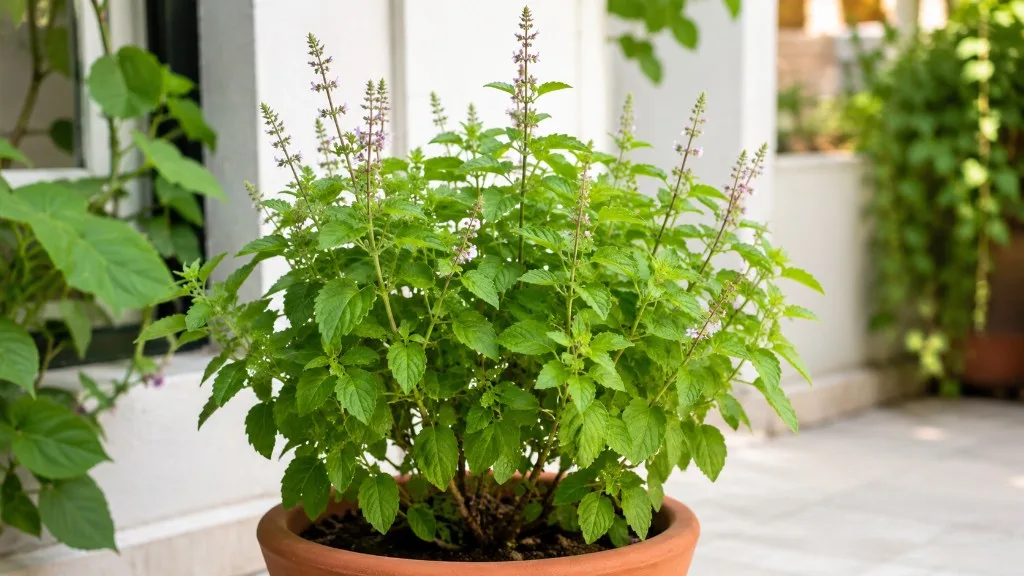
Tulsi grows best in full sun to bright indirect light with watering every 2–4 days when the top inch of soil dries out. A sacred herb in homes, it thrives on balconies and windowsills. Pinch tips regularly to keep it bushy and prevent early flowering.
Tulsi Plant Care: Light, Water, Soil & Tips
Start with wateringThe most common care mistake for TulsiWatering guide →Tulsi care essentials
Light
full sun to bright indirect light
Water
Water when the top inch of soil is dry; tulsi prefers consistent moisture but dislikes waterlogging.
Soil
Fertile, well-draining loam-based mix enriched with compost.
Humidity
40–60%
Temperature
20–35°C (68–95°F)
Fertilizer
About Tulsi
Tulsi is native to Indian subcontinent; widely cultivated throughout South and Southeast Asia, typically reaches 1–2 ft tall; bushy aromatic herb with oval serrated leaves indoors, with fast growth. Tulsi has a herbaceous growth habit and part of the Lamiaceae family. It is also known as Holy Basil, Sacred Basil, Vrinda, and Tulasi.
| Detail | Information |
|---|---|
| Also known as | Holy Basil, Sacred Basil, Vrinda, Tulasi |
| Native region | Indian subcontinent; widely cultivated throughout South and Southeast Asia |
| Mature size | 1–2 ft tall; bushy aromatic herb with oval serrated leaves |
| Growth rate | Fast |
| Growth habit | Herbaceous |
| Scientific name | Ocimum tenuiflorum |
| Family | Lamiaceae |
Tulsi Plant Care: Light, Water, Soil & Tips
What Is Tulsi?
Tulsi - also called holy basil - is one of the most culturally significant aromatic herbs in South Asia and one of the most rewarding fast-growing plants you can keep on a sunny balcony, terrace, or bright windowsill. The accepted scientific name is Ocimum tenuiflorum, though older books and seed packets often list the synonym Ocimum sanctum. Both names refer to the same species for practical care purposes, and the advice below applies regardless of which label is printed on your pot.
Indoors or in containers, tulsi typically reaches 12 to 24 inches (30 to 60 cm) tall and spreads 12 to 18 inches (30 to 45 cm) wide, forming a bushy mound of oval, serrated, aromatic leaves on square stems characteristic of the mint family. Growth is fast in warm, bright conditions and slows sharply when temperatures drop or light weakens. The leaves release a clove-like, peppery fragrance when crushed - stronger and sharper than sweet basil - and small white, pink, or purple flower spikes appear in warm months if you allow the plant to bloom.
If you are deciding whether tulsi fits your home, the honest summary is this: tulsi rewards Tulsi light guide outdoors, bright light indoors, warm temperatures, and regular pinching - and it punishes cold, waterlogged soil, and dim corners. It is easier than a finicky tropical foliage plant and harder than a snake plant. The payoff is continuous fresh leaves for tea, cooking, and fragrance, plus propagation so simple that a single healthy parent plant can supply backups for next season. Unlike many ornamental houseplants, tulsi is grown as much for use as for display: flavor, aroma, and regrowth speed matter as much as keeping old stems alive.
Botanical Background and Sacred Significance
Tulsi belongs to the family Lamiaceae - the mint family - which matters for care more than most buyers realize. Lamiaceae herbs share a few baseline patterns: they prefer well-drained soil with steady moisture, they dislike sudden cold, and many problems begin at the roots before they show clearly on the leaves. The square stems and opposite leaf arrangement you will notice on a mature tulsi plant are classic mint-family traits, as is the aromatic oil release when leaves are bruised or harvested.
The species is native to the Indian subcontinent and has been cultivated across South and Southeast Asia for centuries. In that warm, tropical climate, tulsi grows as a short-lived perennial or subshrub - a woody-based herb that can persist year-round where frost never arrives. In USDA Hardiness Zone 11, it survives outdoors as a permanent planting. Everywhere else, gardeners treat it as a warm-season annual or overwinter it indoors because sustained temperatures below about 50°F (10°C) cause leaf damage, stalled growth, and eventual decline, and any frost exposure is typically fatal.
Tulsi holds deep cultural significance in Hindu tradition, where it is revered as a sacred plant often kept near the home. That spiritual context does not change the biology - tulsi still needs the same light, water, and warmth as any tropical herb - but it explains why so many growers treat it as a long-term companion plant rather than a disposable seasonal crop. For care purposes, think of tulsi as a warm-climate aromatic herb first and a symbol second.
Do not confuse tulsi with sweet basil (Ocimum basilicum), the standard Italian-cooking basil. They are close relatives with overlapping common names in some markets, but they differ in fragrance, flavor, growth habit, and traditional use. Sweet basil has a sweeter, anise-forward profile; tulsi is sharper, clove-like, and more resinous. Care overlaps substantially - both want warmth, sun, and drainage - but tulsi is generally more heat-tolerant and more sensitive to cold than sweet basil, and it tolerates full direct sun outdoors more comfortably once acclimated.
Krishna, Rama, and Kapoor Tulsi Types
Most home growers encounter one of three common types, sometimes sold simply as “holy basil” without a cultivar name. Rama tulsi has green leaves and a milder aroma; it is the type most often recommended for beginners and indoor windowsills because it stays manageable and produces steadily under bright light. Krishna tulsi carries purple-green foliage with stronger color on stems and leaf veins; it is prized for its intense aroma and is often considered the most visually striking in containers. Kapoor tulsi (sometimes spelled Kapoor tulsi or sold as a compact holy basil line) tends toward a shorter, bushy habit suited to pots and frequent harvest.
A fourth type, Vana tulsi, is sometimes classified as Ocimum gratissimum rather than O. tenuiflorum. It has a wilder, taller growth habit and a sharper scent. If your plant came without a label, identify it by leaf color, stem tint, and growth form rather than assuming all “tulsi” pots are identical. Care differences between Krishna and Rama types are minor - both want sun, warmth, and pinching - but Krishna selections sometimes show slightly more stress in very low indoor light, where purple pigments fade and stems stretch faster.
Best Growing Conditions for Tulsi
Tulsi does best when your space approximates the warm, bright rhythm of its native range. The four variables that decide almost every outcome are light, water, soil, and temperature. Get those aligned and feeding, pinching, Tulsi repotting guide, and propagation become routine. Get one badly wrong - especially water or cold - and the plant declines faster than its tough appearance suggests.
Light Requirements
Tulsi needs strong light - full sun outdoors and the brightest window you can offer indoors. Outdoors, aim for 6 to 8 hours of direct sunlight daily on a south-facing balcony, terrace, or garden bed. Tulsi is not a shade herb. Dim exposure produces leggy, pale stems, thin leaves, and weak aroma - the plant survives for a while in partial shade but never performs like a plant in full sun.
Indoors, place tulsi at a south- or east-facing window where leaves receive strong ambient light for most of the day. East windows work well because morning sun is bright but gentler than harsh afternoon rays on glass that magnifies heat. A plant deep inside a room may look green for weeks and then collapse suddenly when root rot sets in because the soil never dries at the pace your watering habit expects. If you cannot give at least 5 to 6 hours of bright light daily indoors, supplement with a full-spectrum grow light on a 12–14 hour timer, positioned 12–18 inches above the canopy. Without adequate light, indoor tulsi becomes a tall, sparse specimen that produces fewer usable leaves.
The fastest diagnostic for incorrect light is new growth, not old leaves. Compact internodes, firm stems, and richly colored foliage mean the plant is probably happy. Long, floppy stems with small pale leaves mean the plant wants more light. Bleached patches, brown scorch on sun-facing leaves, or midday curling after a sudden move to stronger exposure mean it wants slower acclimation or brief afternoon protection in extreme heat. Acclimate gradually over one to two weeks when moving from a dim shop shelf to a full-sun terrace - leaves formed in low light burn easily if you jump straight into midsummer afternoon sun.
Outdoor growers in very hot, dry climates can provide light afternoon shade during heat waves above about 95°F (35°C) without sacrificing overall vigor. The goal is not to hide the plant from sun permanently but to prevent leaf scorch during the hottest hours while maintaining bright conditions the rest of the day.
Temperature and Humidity
Tulsi is a warmth-demanding tropical herb that grows best in consistently hot conditions and is damaged by cold. During active growth, target 65 to 85°F (18 to 29°C) - most homes sit comfortably in the lower half of that range, which is why tulsi often thrives on a warm kitchen windowsill. Growth slows noticeably below about 60°F (15°C) and stops or reverses below 50°F (10°C). Treat 55°F (13°C) as the practical floor for outdoor containers: when night temperatures start dropping toward that threshold, plan to bring pots indoors or take cuttings before cold weather arrives.
Frost is non-negotiable. Any frost event - 32°F (0°C) or below - kills tulsi outright in the garden or on an unprotected patio. In USDA Zone 10, sheltered microclimates may extend outdoor life, but for most readers overwintering means indoors or starting fresh from seed or cuttings next spring.
Humidity is helpful but secondary compared with light and water. Tulsi handles average home humidity in the 40 to 60% range reasonably well during active growth. Very dry winter air - below about 30% - can encourage spider mites on indoor specimens, especially if you place the plant directly above a heating vent. Grouping plants, using a pebble tray with the pot elevated above the water line, or running a small humidifier near the plant all help more than occasional misting, which raises humidity briefly and can leave wet foliage that invites fungal spotting if air circulation is poor.
Soil and Drainage
Use a fertile, well-draining loam-based mix enriched with compost. The principle matters more than a single branded recipe: the mix should hold moisture in the root zone without staying waterlogged for days, and it should retain enough air space that roots can breathe. A workable home blend is roughly two parts quality potting mix, one part compost or well-rotted manure, and one part perlite or coarse sand - add extra perlite if your balcony runs hot and bright, or slightly more organic matter if you struggle to keep moisture even in small pots.
Target a slightly acidic to neutral pH around 6.0 to 8.0. Hobbyists rarely need to meter pH precisely for tulsi; the bigger practical issue is compaction and salt buildup from hard tap water and over-fertilizing, which show up as crust on the soil surface and brown leaf margins. Always plant in a container with a drainage hole. Decorative cachepots are fine only if you empty runoff after every watering.
In garden beds, amend planting areas with compost before setting out transplants, and wait until evening temperatures stay consistently above 60°F (15°C) and soil has warmed before moving indoor-started plants outdoors. Cold, wet soil stalls tulsi more reliably than a single missed watering.
How to Water Tulsi
The general rule for tulsi is water when the top 1 to 2 inches (2.5 to 5 cm) of soil feel dry, then soak thoroughly until a small amount runs from the drainage hole. Tulsi prefers consistent moisture during active growth but is highly susceptible to root rot in waterlogged soil - the most common cause of failure for new growers. Outdoors in summer sun, that often works out to roughly every 2 to 3 days for small containers; indoors in bright but cooler conditions, every 4 to 7 days is a common starting range. Your calendar should be a reminder to check, not a rule to follow blindly.
Water thoroughly until runoff appears, then empty the saucer so roots are not standing in stale water. Check moisture with a finger, a wooden skewer, or by lifting the pot - a very light pot with dry surface soil means the plant is ready; a heavy pot with damp soil an inch below the surface means wait. Because tulsi grows quickly and leaf surface area is large in full sun, container plants outpace in-ground plantings in water use, and a small terracotta pot on a windy terrace may need daily checks at midsummer.
Tulsi watering guide During Active Growth
During active growth - usually the warm, bright months - tulsi uses water predictably. The pot dries on a steady rhythm and the plant shows clear signals when it is ready for the next drink. Wilting in midday heat on a sunny terrace often recovers within hours after watering, but repeated wilt-and-recover cycles damage fine roots and reduce leaf quality. Water in the morning when possible so foliage dries before cooler night air arrives, which reduces fungal risk in humid climates.
If you harvest frequently, remember that removing leaves slightly reduces transpiration - a heavily pinched plant in the same pot may dry more slowly than a full-canopy plant beside it. Adjust your rhythm to the actual pot, not to what worked last week on a different container.
Seasonal Adjustments
In cooler, dimmer months, tulsi slows. The same watering rhythm that worked in summer will overwater the plant in winter. Stretch the interval, check moisture more carefully, and do not feed a plant that is not actively growing. Resume the normal rhythm only when new growth is clearly visible and night temperatures stay above the low end of the comfort range.
Growers in monsoon-heavy climates face the opposite problem: excess rain keeps soil wet for days, and yellow leaves appear quickly. Move pots to slightly sheltered positions with stronger light, ensure drainage holes are clear, and withhold supplemental watering until the mix genuinely dries. In dry summer heat, the challenge reverses - small pots on concrete terraces can dry completely within 24 hours.
Common Watering Mistakes
The single most common cause of problems with tulsi is watering on a schedule instead of on the plant’s actual state. Other frequent mistakes: watering a little every day instead of deeply when needed, leaving the pot sitting in runoff, watering reflexively when leaves look stressed without checking whether the soil is already wet, and using a pot without drainage because tulsi “likes moisture.” Moisture and drainage are not opposites - tulsi wants moist roots in airy, free-draining soil, not roots submerged in stagnant water.
How to Feed Tulsi
Tulsi does not need heavy feeding, but it is a fast-growing harvest plant that depletes nutrients faster than slow ornamental houseplants. A modest, balanced fertilizer applied during active growth supports bushy foliage and stronger aroma. Strong doses, frequent feeding, and fertilizer on a dry or stressed plant are how people burn roots and accumulate salt.
A balanced water-soluble fertilizer at one-quarter to one-half of the label rate every 2 to 4 weeks during active growth is a safe starting point. Apply to already-moist soil so the solution moves through the root zone without burning. Organic options - compost tea, diluted fish emulsion, or a top dressing of compost scratched lightly into the surface - work well for growers who harvest leaves regularly and prefer slow-release nutrition. If your potting mix contains a starter charge, hold off on supplemental feeding for the first month.
Pause feeding during dormancy, after a major repot, while the plant is recovering from pests, and during the deepest part of winter when growth has stalled. Feeding a plant that cannot use the nutrients just adds salt to the mix. Resume when the plant is clearly in active growth and the pot is drying on a normal rhythm.
Harvesting, Pinching, and Regular Pruning
Tulsi is meant to be used, and regular harvesting is the best pruning strategy. Pinch the growing tips every 2 to 3 weeks once the plant reaches about 6 to 8 inches (15 to 20 cm) tall to encourage branching and prevent the single-stemmed, leggy look that happens when tulsi is left unpinched. Each pinch removes the top pair of leaves above a node, which signals the plant to produce two new shoots below the cut.
Harvest by snipping stems above a leaf node with clean scissors, taking no more than one-third of the plant at a time so it can recover quickly. Morning harvest, after dew has dried but before midday heat, preserves the strongest aroma in the leaves. If you want continuous production, treat tulsi like a cut-and-come-again herb rather than stripping entire stems bare - leave enough foliage to keep photosynthesis going.
Older woody stems produce fewer tender leaves. When a plant becomes tall and sparse at the base, restart from cuttings or hard-prune and wait for fresh basal shoots rather than nursing exhausted growth indefinitely. Tulsi grows fast enough that replacement is often easier than revival.
When to Allow Flowering
Flower spikes are attractive - small tubular blooms in white, pink, or purple - and they attract pollinators outdoors. For maximum leaf production, remove flower buds as they form. Flowering redirects energy away from foliage, and once tulsi commits heavily to bloom, leaf quality and quantity decline. Allow flowers only if you want seed for next season or you are keeping the plant primarily as an ornamental sacred specimen rather than a production herb.
If you save seed, let a few spikes mature fully on a healthy plant, then collect dry seed heads before they shatter. Store seeds in a cool, dry place. Note that tulsi seeds need light to germinate - surface sow without covering, keep warm and moist, and expect germination in 7 to 14 days at 70 to 85°F (21 to 29°C).
Repotting and Root Health
Repot tulsi roughly every one to two years, or whenever the pot dries much faster than it used to, roots circle the drainage holes, or water runs straight through without soaking in. The best time is at the start of the active growing season so the plant can recover quickly. Go up only one pot size at a time - a pot that is too large holds too much water for the root system to use, which is the most common cause of root rot after repotting.
Use fresh, well-draining mix, water lightly for the first week to let damaged roots heal, and hold off on fertilizer until you see new growth. The clearest signs it is time to repot are physical: roots at the surface, roots through the drainage holes, a plant that is top-heavy for the pot, or mix that has compacted or smells sour. If the mix has compacted, repot even if the calendar says otherwise - compacted soil suffocates roots faster than underwatering kills tulsi in bright light.
Propagation Methods for Tulsi
The simplest home propagation method for tulsi is stem cuttings - faster and more reliable than seed for most growers who already have a healthy parent plant. Seeds work well too if you need many plants at once or want a specific type from a trusted source.
For stem cuttings, take a 4 to 6 inch (10 to 15 cm) healthy stem with at least two or three leaf nodes, remove the lower leaves, and place the cut end in moist, well-draining mix or a jar of water changed every few days. Keep cuttings in bright indirect light - not full midday sun - with stable warmth around 70 to 80°F (21 to 27°C). Roots typically form in 1 to 2 weeks in water or 2 to 3 weeks in mix. Transplant when roots are 1 to 2 inches (2.5 to 5 cm) long and hold the potting mix gently.
For seeds, surface sow on moist seed-starting mix - do not cover tulsi seeds because they need light to germinate. Keep the surface evenly moist with misting, maintain warmth, and transplant seedlings when they have two true leaves, spacing or potting so each plant has room to bush out. Do not propagate a stressed, diseased, or heavily pest-infested parent - cuttings inherit the parent’s problems, and weak cuttings fail at a much higher rate than healthy ones.
Common Tulsi Problems
Most problems with tulsi are environmental, not mysterious. They show up as specific leaf symptoms that map to specific causes. The hardest part is usually patience: most problems take days to develop and weeks to resolve once you fix the underlying condition.
Yellow leaves are the most common complaint. They usually mean overwatering - especially in low light or during cool, rainy periods - but can also indicate underwatering in full sun, nutrient deficiency after heavy harvest, cold stress, or natural older-leaf shedding at the base. Check moisture first, then light, then inspect for pests along stems and leaf undersides.
Leggy, sparse growth almost always means insufficient light. Move the plant to a sunnier window, add a grow light, or shift outdoor pots to full sun with gradual acclimation. Pinching alone cannot fix light deficiency - it only redistributes growth on a weak frame.
Brown tips or edges often point to salt buildup, dry soil, or fluoride/chlorine in tap water. Flush the pot periodically with plain water until runoff is clear, and review your fertilizing rate. Pests to watch for include spider mites in dry indoor air, aphids on tender new growth, mealybugs in leaf axils, and fungus gnats if the surface of the mix stays wet. Catch infestations early by inspecting weekly. A strong shower, manual removal, and insecticidal soap handle most issues if you start before the population is large.
Sudden collapse after a move usually means transplant shock, cold draft, or scorch - not a mysterious disease. Stabilize temperature, adjust light gradually, and check that the root zone is moist but not saturated.
Using Tulsi Leaves Safely (Culinary and Traditional Use)
Fresh tulsi leaves are widely used in herbal tea, chutneys, and infused water across South Asia. A simple home preparation: steep 4 to 6 fresh leaves (or 1 to 2 teaspoons dried) in hot water for 5 to 10 minutes, strain, and drink. The flavor is peppery and clove-like - noticeably different from sweet basil tea.
Tulsi has a long history in Ayurvedic tradition, where it is described as an adaptogenic and spiritually significant herb. Research on holy basil’s potential health effects exists, including studies on stress and metabolic markers summarized in reviews from institutions such as the National Institutes of Health, but this article is a plant-care guide, not medical advice. If you are pregnant, nursing, managing a chronic condition, or taking medications - especially blood sugar or blood pressure medications - consult a qualified healthcare provider before using tulsi as a supplement or in medicinal quantities. Culinary amounts used as seasoning or occasional tea are a different context from concentrated extracts or daily therapeutic dosing.
For pet safety, the ASPCA lists sweet basil (Ocimum basilicum) as non-toxic to dogs and cats. Holy basil is a closely related species commonly described as non-toxic at normal household exposure in horticultural references, and excessive nibbling may cause minor digestive upset in pets rather than systemic poisoning. If your pet eats a large quantity or shows symptoms, contact your veterinarian or the ASPCA Animal Poison Control Center. Keeping plants out of reach still makes sense - not because tulsi is highly poisonous, but because pets and pots both fare better with boundaries.
Conclusion
The most useful thing to know about tulsi is that it is a fast-growing warm-climate herb from the Indian subcontinent that wants full sun outdoors, bright light indoors, fertile well-drained soil, and regular pinching to stay bushy and productive. If light, water, soil, and temperature fit that description, harvesting, propagation, and daily care become straightforward. If the plant stretches, yellows, or stalls, fix the environment first - almost always light or watering - before reaching for fertilizer or a new pot.
Treat tulsi as a working herb, not a static decoration. Pinch it, use the leaves, restart from cuttings when plants age out, and bring pots indoors before cold nights arrive. Done consistently, one sunny windowsill or balcony container can supply fresh holy basil through the warm season and a meaningful backup plant through winter - aromatic, useful, and far more satisfying than a generic houseplant that never asks to be harvested.
When to use this page vs other Tulsi guides
- Tulsi overview - Canonical hub for this species - care topics and problems branch from here.
- Tulsi problems - Symptom-first path when you already know something is wrong.
Related Tulsi guides
How to care for Tulsi?
How much light does Tulsi need?
full sun to bright indirect light
- full sun to bright indirect light - full sun to bright indirect light.
When should you water Tulsi?
Water when the top inch of soil is dry; tulsi prefers consistent moisture but dislikes waterlogging.
- Check the top inch of soil - Water when the top inch of soil is dry; tulsi prefers consistent moisture but dislikes waterlogging.
- tulsi wilts quickly when underwatered and recovers fast after watering - Water when the top inch of soil is dry; tulsi prefers consistent moisture but dislikes waterlogging.
- Drain excess water - Water when the top inch of soil is dry; tulsi prefers consistent moisture but dislikes waterlogging.
What soil works best for Tulsi?
Fertile, well-draining loam-based mix enriched with compost.
- garden loam or potting compost - Fertile, well-draining loam-based mix enriched with compost.
- coarse sand or perlite (20%) - Light white granules that keep soil airy and help prevent compaction.
- well-rotted compost or vermicompost - Fertile, well-draining loam-based mix enriched with compost.
Grower notes for Tulsi
What matters most with Tulsi
Tulsi is usually grown for harvest, so flavor, fresh shoots, and quick regrowth matter more than keeping old stems forever. Replace or restart tired plants instead of nursing woody, exhausted growth indefinitely. In practice, the care checkpoint is simple: full sun to bright indirect light. Pair that with fertile, well-draining loam-based mix enriched with compost, and avoid changing water, pot size, and placement all at once.
Best placement in a real home
Tulsi belongs where full sun to bright indirect light is realistic for most of the day, not only where the pot looks good. Water when the top inch of soil is dry; tulsi prefers consistent moisture but dislikes waterlogging. If the pot stays wet longer than expected, move the plant into better light or reassess the mix before watering again. Humidity target: 40–60%. Temperature comfort zone: 20–35°C (68–95°F).
Before you buy this plant
Choose Tulsi with firm new growth, clean leaf undersides, and soil that does not smell sour or feel compacted. Be cautious if you see yellow-leaves, sticky residue, collapsed crowns, or a pot that is wet in poor light. Cosmetic old-leaf damage is less worrying than weak roots or active pests.
First month after bringing it home
Do not repot Tulsi on day one unless the mix is failing or pests are obvious. Quarantine it, learn how fast the pot dries, and keep care boring while it adjusts. Watch especially for yellow-leaves, leggy-growth, and mold-on-soil. If problems appear, correct the condition first rather than stacking fertilizer, repotting, and pruning together.
Pet-aware note for Tulsi
Tulsi is best treated as low-risk but still unverified for routine pet chewing. Use shelf or room placement if pets shred herbs, and do not rely on this plant as confirmed safe forage without species-specific guidance.
How to tell Tulsi is settling in
Also sold as Holy Basil, Sacred Basil, and Vrinda, this plant should be judged by stable new growth rather than label names alone. If you plan to multiply it later, common methods include Seeds sown on the soil surface in spring, Stem cuttings in water, and Stem cuttings directly in moist soil. Repot only when you see Roots escaping drainage holes and plant wilting immediately after watering. If leggy-growth shows up early, inspect light, watering, and roots before assuming the plant is permanently weak.
Is it pet safe?
Tulsi is usually treated as low risk for cats and dogs, but the exact species is not clearly verified in major pet-toxicity databases.
Holy basil (Ocimum tenuiflorum) is closely related to culinary basil, but this review did not confirm a species-specific ASPCA listing for tulsi. Prevent routine chewing and confirm the exact plant if you keep pets that graze houseplants.
Watering Tulsi
For Tulsi, check the top inch of soil; tulsi wilts quickly when underwatered and recovers fast after watering and water every 2–3 days outdoors in summer; every 4–7 days indoors. Water more frequently outdoors in Indian summers (every 1–2 days); reduce in winter monsoon and post-monsoon seasons.
| Detail | Information |
|---|---|
| How often | Every 2–3 days outdoors in summer; every 4–7 days indoors |
| How to check | Check the top inch of soil; tulsi wilts quickly when underwatered and recovers fast after watering |
| Seasonal changes | Water more frequently outdoors in Indian summers (every 1–2 days); reduce in winter monsoon and post-monsoon seasons |
Signs of overwatering
- Yellow drooping leaves
- mushy stem base
- soggy soil with a sour smell
Signs of underwatering
- Wilting and drooping leaves
- dry, pulling-away soil
- leaves feeling slightly papery
Soil & potting for Tulsi
Use a mix of garden loam or potting compost, coarse sand or perlite (20%), well-rotted compost or vermicompost for Tulsi. Good drainage is essential; avoid waterlogging which causes root rot and leaf diseases. Target soil pH around 6.0–7.5. Repot as needed - tulsi grows fast; repot when root-bound or pot up seedlings as they grow, ideally in any time during the warm growing season.
| Detail | Information |
|---|---|
| Recommended mix | garden loam or potting compost, coarse sand or perlite (20%), well-rotted compost or vermicompost |
| Drainage | Good drainage is essential; avoid waterlogging which causes root rot and leaf diseases |
| Soil pH | 6.0–7.5 |
| Repotting frequency | As needed - tulsi grows fast; repot when root-bound or pot up seedlings as they grow |
| Best season to repot | Any time during the warm growing season |
Signs it needs repotting
- Roots escaping drainage holes
- plant wilting immediately after watering
- slower aromatic leaf production
Humidity & temperature for Tulsi
Tulsi prefers 40–60%, though normal home humidity is usually fine. Keep temperatures around 20–35°C (68–95°F).
| Detail | Information |
|---|---|
| Humidity | 40–60% - normal home humidity is fine. |
| Ideal temperature | 20–35°C (68–95°F) |
Fertilizer & pruning for Tulsi
Common problems on Tulsi
Leggy Growth
MediumLikely cause: Insufficient sunlight or lack of regular pinching causes long, sparse growth
Quick fix: Move to full sun; pinch growing tips regularly to encourage bushy dense growth
Full fix guide →Mold on Soil
LowLikely cause: Overwatering and poor air circulation cause soil surface mould around tulsi
Quick fix: Reduce watering, improve air flow around the plant, remove mouldy surface soil and top-dress with fresh mix
Full fix guide →Wilting
MediumLikely cause: Tulsi wilts quickly when underwatered (recovers within hours) but also wilts from root rot which does not recover
Quick fix: Check soil: dry soil - water immediately. Wet soil with wilting - check roots for rot and improve drainage
Full fix guide →Water Stress
MediumLikely cause: Oct 2, 2025 · Holy Basil—also known as Tulsi—is a sacred and healing herb used for centuries. Learn its many health benefits, how to grow it, and delicious tea and infused water recipes.
Quick fix: Confirm diagnosis on your Tulsi, then address the most likely care or pest factor described in current extension guidance.
Full fix guide →Yellow Leaves
MediumLikely cause: Overwatering, poor drainage, or nutrient deficiency (especially nitrogen) causes yellow leaves
Quick fix: Improve drainage; allow top inch to dry before watering; apply organic fertiliser
Full fix guide →Aphids
MediumLikely cause: Aphids on Tulsi cluster on soft new tips and leave sticky honeydew on holy basil leaves. First step: move the pot away from other herbs and blast stem tips and leaf undersides with a strong stream of
Quick fix: See plant-specific guide for step-by-step fixes.
Full fix guide →Brown Tips
MediumLikely cause: Brown tips on tulsi usually mean leaf margins dried out before roots could resupply water-often from a dry spell in a sunny pot, fertilizer salt buildup, or harsh sun after a move. First step: stick y
Quick fix: See plant-specific guide for step-by-step fixes.
Full fix guide →Drooping Leaves
MediumLikely cause: Drooping leaves on Tulsi usually trace to one of five stresses: dry soil, wet failing roots, cold below 50°F (10°C), heavy harvest, or weak light. First step: press your finger 2–3 cm into the mix and
Quick fix: See plant-specific guide for step-by-step fixes.
Full fix guide →Fungus Gnats
MediumLikely cause: Fungus gnats on tulsi mean the compost surface stays wet too long-common on daily-watered altar pots and winter indoor containers. First step: let the top inch of mix dry completely before the next wa
Quick fix: See plant-specific guide for step-by-step fixes.
Full fix guide →Low Humidity
MediumLikely cause: Low humidity on tulsi browns leaf margins on the side facing heating vents while soil stays evenly moist-common on overwintered holy basil in heated rooms below about 40% RH. First step: move the pot
Quick fix: See plant-specific guide for step-by-step fixes.
Full fix guide →Mealybugs
MediumLikely cause: Mealybugs on tulsi show up as white, cottony clumps in leaf axils and stem forks on holy basil. First step: move the pot away from other herbs and dab every visible cluster with 70% isopropyl alcohol
Quick fix: See plant-specific guide for step-by-step fixes.
Full fix guide →Not Enough Light
MediumLikely cause: Not enough light makes Tulsi stretch toward windows, thin its leaves, and lose aroma and purple tint. First step: move the pot to your brightest spot-full sun outdoors or a south or west window indoor
Quick fix: See plant-specific guide for step-by-step fixes.
Full fix guide →Overwatering
MediumLikely cause: Overwatering on tulsi keeps holy basil roots in soggy mix without dry-down time-often from a summer watering schedule applied in a cool winter room. First step: stop watering until the top inch of soi
Quick fix: See plant-specific guide for step-by-step fixes.
Full fix guide →Root Rot
MediumLikely cause: Root rot on tulsi means waterlogged mix has suffocated roots on this fast-growing holy basil herb. First step: stop watering, confirm the top inch is still wet while leaves hang limp on a heavy pot-th
Quick fix: See plant-specific guide for step-by-step fixes.
Full fix guide →Slow Growth
MediumLikely cause: Slow growth on Tulsi usually means insufficient light, over-harvesting, or cool room temperatures-not generic houseplant neglect. First step: move the pot to at least six hours of direct sun or very b
Quick fix: See plant-specific guide for step-by-step fixes.
Full fix guide →Spider Mites
MediumLikely cause: Spider mites on tulsi cause pale stippling and fine webbing on serrated leaves in hot, dry air. First step: isolate the pot and rinse every leaf underside with a forceful stream of lukewarm water.
Quick fix: See plant-specific guide for step-by-step fixes.
Full fix guide →Underwatering
MediumLikely cause: Underwatered tulsi wilts dramatically, feels light in the pot, and often shows soil pulling away from the pot wall. First step: water thoroughly until drainage runs free-or bottom-soak 20–30 minutes i
Quick fix: See plant-specific guide for step-by-step fixes.
Full fix guide →