Tulsi Light Needs: Full Sun, Window Placement, and Warning
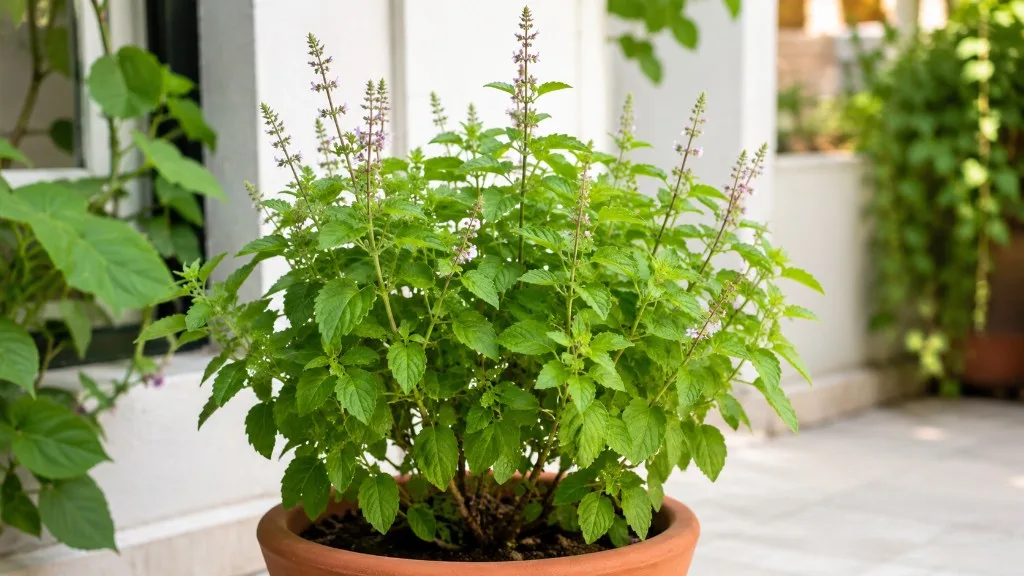
Tulsi Light Needs: Full Sun, Window Placement, and Warning Signs
Tulsi Light Needs: Full Sun, Window Placement, and Warning Signs
Tulsi will sit on a dim shelf and look alive long enough to make you feel guilty about moving it. That patience is misleading. Ocimum tenuiflorum - holy basil, tulsi - is a sun-loving tropical herb from the Indian subcontinent, and it measures light in a language most indoor rooms do not speak. A plant that survives in partial shade is not the same as a plant that stays compact, smells sharp when you crush a leaf, and pushes fresh side shoots after every harvest pinch.
The practical goal is straightforward: give tulsi enough bright light for firm new leaves, short internodes, and steady regrowth without scorching the foliage or baking the roots against hot glass. Outdoors, that usually means six or more hours of direct sun daily. Indoors, it means a bright window with direct or strong indirect light close to the pane - or a supplemental grow light when winter, room layout, or latitude cannot deliver real brightness. North Carolina State Extension classifies holy basil as a full-sun plant, defined as six or more hours of direct sunlight per day. (NC State Extension Plant Toolbox)
This guide focuses on placement decisions you can make today: how much outdoor sun, which window or balcony spot, when to add a grow light for winter, and how to read the plant’s own warning signs before vigor and aroma collapse into leggy, pale stems.
How Much Light Tulsi Actually Needs
Tulsi is not a shade-tolerant houseplant dressed up as a sacred herb. It is a fast-growing member of the Lamiaceae mint family, native to tropical and subtropical South and Southeast Asia, where it grows in open, bright conditions with warm nights and strong daily light totals. Outdoors, full sun means the leaves receive unfiltered direct sunlight for most of the day - not just a bright-looking corner of the terrace. Indoors, full sun is harder to replicate because window glass, distance, season, and competing objects all reduce the light that reaches the leaf surface.
Most reputable growing guides converge on 6 to 8 hours of direct sun outdoors as the productive target, with 4 hours as a rough survival floor that still produces weak, stretched growth over time. NC State Extension classifies holy basil as a full-sun plant requiring six or more hours of direct sunlight daily - a useful baseline when deciding whether indoor artificial light must run longer than outdoor sun hours.
For home growers, the usable shorthand is this: 6+ hours of direct outdoor sun, or bright direct-to-indirect light indoors with the pot within 12 inches (30 cm) of the glass on your best exposure, plus a grow light running 10 to 16 hours daily when natural light falls short - especially through winter.
The Short Answer for Busy Growers
If you only remember three rules, use these. Outdoors: place pots or beds where tulsi receives at least 6 hours of direct sun, with afternoon shade only if leaves bleach or crisp in peak heat. Indoors at a window: put the pot close to the glass on your brightest exposure - usually south or west in the northern hemisphere, east where afternoon heat is brutal - and rotate every few days. Indoors through winter or in dim rooms: add a full-spectrum LED grow light 4 to 12 inches (10 to 30 cm) above the canopy and run it 10 to 16 hours daily on a timer; shorter supplemental runs of 4 to 6 hours on top of some window light can work for maintenance, but leggy plants usually need the longer end.
Judge success by new growth, not old leaves. Within two to three weeks of better light, new stems should be shorter between leaves, color should deepen, and the plant should recover faster after you pinch or harvest.
Why Tulsi Demands Strong Light for Aroma and Growth
Tulsi did not evolve as a forest-floor plant. It is a soft-stemmed, rapid-growing herb that completes its most productive phase in strong light and warmth. That biology drives three practical consequences for your kitchen, balcony, or terrace garden.
First, tulsi prioritizes vertical escape when light is insufficient. Unlike woody herbs that simply slow down, tulsi stretches toward the brightest source, producing long internodes, smaller leaves, and weak stems. This is etiolation - a real physiological response, not a cosmetic flaw you can permanently prune away without fixing light. Leggy tulsi is the most common indoor complaint, and it is almost always a light problem before it is a fertilizer or soil problem.
Second, light intensity affects aromatic leaf quality, not just size. Tulsi is grown as much for scent and harvest as for appearance. Plants in weak light often produce pale, thin leaves with muted fragrance - the plant grows green tissue but invests less in the volatile compounds that make tulsi worth the counter space. You can still brew weak-leaf tea from a dim plant, but the difference between sun-grown and shade-stretched tulsi is obvious the moment you crush a leaf between your fingers.
Third, light sets the pace for water use and recovery after harvest. A bright plant photosynthesizes actively, dries its pot faster, and tolerates pinching better. A dim plant grows slowly, holds moisture longer, and is more vulnerable to root problems if you keep watering on a sunny-balcony schedule indoors. Light is not separate from the rest of tulsi care; it is the throttle that controls everything downstream.
Outdoor Sun Exposure for Tulsi
Outdoor tulsi is the simplest light scenario because the sun delivers intensity no windowsill fully matches. Choose an open site with 6 to 8 hours of direct sunlight and well-drained, fertile soil or potting mix. NC State Extension lists holy basil as preferring full sun in moist, well-drained soil - the combination of bright light and consistent moisture without waterlogging is what keeps the plant bushy through the warm season. (NC State Extension Plant Toolbox)
Unobstructed south- or west-facing beds, terrace railings, and patio tables usually outperform partially shaded borders. Avoid placing pots beneath deep overhangs, dense shrubs, or tall crops that will shade tulsi by midsummer unless you are deliberately using afternoon shade in a hot climate.
Full Sun Targets and Seasonal Adjustments
In spring, start tulsi outdoors only after frost danger passes and nighttime temperatures stay consistently above 50°F (10°C). Young seedlings started indoors under weak light need hardening off - gradual exposure to outdoor sun over 7 to 14 days - before they sit in full sun all day. Skipping acclimation is a common reason newly moved tulsi wilts, bleaches, or develops crisp patches even in a correctly sunny spot.
Through summer, aim for the full 6 to 8 hour direct-sun target. In cool northern summers, more sun is almost always better. In hot Indian plains, coastal, or continental climates, tulsi may still want bright conditions but can suffer if afternoon sun plus reflected heat from walls, tiles, or dark pots raises leaf temperature beyond what the plant can manage. Watch the plant, not only the calendar.
As days shorten in fall, outdoor tulsi slows naturally. Light reduction combines with cooler nights to push flowering. Regular pinching delays flowering and keeps leaf production going longer, but if you want indoor tulsi through winter, move the best pots inside before light collapses and plan on supplemental lighting immediately - not after the plant has already gone leggy.
When to Provide Afternoon Shade in Hot Climates
Tulsi can handle direct sun, but it cannot handle sudden intensity jumps or extreme leaf heat without damage. Provide partial afternoon shade when you see repeated scorch on sun-facing leaf surfaces, when pots on hot terrace tiles overheat, or when transplant shock coincides with a heat wave.
Afternoon shade is a stress reducer, not a permanent lower-light lifestyle. A tulsi plant that only ever receives gentle morning sun may grow adequately in spring and fail to stay compact in late summer when sun angles change. Use a sheer curtain indoors, shade cloth outdoors, or move containers to a bright east exposure when heat is the problem - not when the plant is simply leggy from too little total daily light.
In subtropical and tropical regions where tulsi grows as a short-lived perennial or self-seeding annual, full sun year-round is usually appropriate. The exception is reflected heat: dark pots on west-facing walls can scorch leaves even when the plant botanically “wants” sun.
Best Window Placement for Indoor Tulsi
Indoor tulsi fails most often because the pot sits where the room is bright rather than where the plant receives photons for enough hours. Window direction matters, but distance, glass type, outdoor obstructions, and season matter just as much.
Place tulsi on the sunniest unobstructed window or balcony opening available. In the northern hemisphere, that is often south or west for total daily brightness, east for gentler direct morning sun, and north only if you accept that a grow light will likely be necessary for compact growth.
Keep the pot close to the glass without pressing leaves against cold winter panes or scorching-hot summer glass. A plant on a dining table six feet from a south window is not getting south-window light; intensity drops sharply with distance.
South, East, West, and North Windows Compared
A south-facing window delivers the strongest winter sun in northern latitudes and is the default recommendation for sun-loving herbs - with caveats. Low winter sun angle can still fall short of tulsi’s needs, and summer afternoon sun through glass can overheat leaves. South works when the plant sits near the pane, receives several hours of direct sunbeams on clear days, and shows compact new growth.
An east-facing window is underrated and often ideal for indoor tulsi in hot climates. Morning sun tends to be bright but cooler than late-day sun. Many kitchens and balconies with east exposure produce excellent tulsi from spring through autumn without scorch. If east-window plants lean toward the glass or stretch, add hours with a small LED rather than moving to harsh west sun.
A west-facing window can be excellent in spring and fall and risky in midsummer heat. Late-afternoon sun carries heat. West is a strong choice when you monitor for bleached or crisp leaf edges and pull the pot back slightly or diffuse light with a sheer curtain during heat spikes.
A north-facing window rarely provides enough direct sun for compact tulsi on its own. North can sustain slow, leggy growth for a while, especially in summer at high latitudes, but treat north windows as grow-light-required if you want harvest-grade plants year-round.
Rotate the pot a quarter turn every two to three days so stems do not lean hard toward the glass. Leaning is the plant telling you the light source is directional - which all windows are.
Balcony and Patio Light in Indian and Subtropical Homes
Many tulsi plants in Indian and South Asian homes live on balconies, window ledges, and terrace corners rather than deep inside rooms. That is the right instinct - outdoor-adjacent light is almost always stronger than interior placement. The failure mode is not choosing a balcony; it is choosing the shaded side of one.
Evaluate balcony light by watching where direct sunbeams hit the pot, not how bright the open sky looks. A north-facing balcony in a dense urban block may receive reflected brightness without the direct hours tulsi needs. A west-facing railing may deliver excellent winter sun and brutal summer scorch on dark pots.
Rooftop and terrace placements often outperform enclosed balconies because obstructions are fewer. If your tulsi sits behind glass balcony panels, remember that glazing cuts intensity - treat enclosed balconies like windows and keep pots close to the brightest panel.
In warm climates where tulsi behaves as a short-lived perennial, outdoor full sun on a well-drained terrace is the gold standard. Bring pots to the brightest edge in winter if nights stay mild, or move indoors with a grow light if temperatures drop toward frost.
How Indoor Light Differs From Outdoor Sun
Human vision is a poor light meter. Your eyes adapt to dim rooms, so a windowsill that looks “perfectly bright” may deliver a fraction of outdoor photosynthetically active radiation. That gap explains the most common indoor pattern: the plant lives, stretches, and stops earning its space. Leaves may be pale green. Internodes lengthen. New growth after pinching is slow. Aroma weakens. These are light-deficiency signatures, not mysterious tulsi moods.
Why a Sunny Window Often Is Not Enough
Three structural reasons windows underperform compared with garden beds and open terraces. Glass filters and reflects part of the light spectrum and intensity. Day length shrinks in winter while tulsi’s appetite for daily light total does not shrink proportionally. Inverse-square distance means moving a foot away from the window can dramatically reduce intensity at the leaf surface.
A south-facing window in April through September at mid-latitudes may grow decent tulsi if the pot stays close and you harvest regularly. The same window from October through March commonly requires supplementation. This is the core winter problem: your plant does not hibernate like a deciduous tree, but the available light drops at exactly the moment indoor heating and shorter days already stress it.
If you are trying to decide whether your window is enough, trust the plant over the compass label. Window direction tells you where to start experimenting; new-growth quality tells you whether you have finished.
Winter Light Drop and Leggy Growth Indoors
Winter changes two variables at once: lower intensity and shorter photoperiod. Tulsi keeps metabolizing indoors, but growth slows when energy input drops. The classic result is leggy growth - stems stretch with wide gaps between leaves as the plant reaches for more light. You may also see yellowing lower leaves, smaller new foliage, and increased susceptibility to fungus gnats or root stress if soil stays wet in cool, dim conditions.
Do not compensate for weak winter light by overwatering or over-fertilizing. Fix light first. Move the pot to the brightest pane, add a grow light on a timer, and reduce watering frequency to match slower growth. If the plant is already woody, sparse, and exhausted from months in a dim corner, starting fresh cuttings under a grow light often beats rescuing a hopelessly etiolated parent plant.
This is where grow lights earn their place. Winter is not optional supplemental-light territory for serious indoor tulsi - it is the season when leggy growth becomes the default without intervention.
Grow Lights for Tulsi When Natural Light Falls Short
When a window or balcony cannot deliver enough daily light - especially through winter - a full-spectrum LED grow light is the most reliable fix. LEDs run cooler than older high-pressure sodium setups, use less electricity than many fluorescents for the same output, and fit on shelves, window ledges, and small stands.
Tulsi does not need exotic spectra for basic home production. A full-spectrum white LED rated for seedlings or herbs is sufficient. Blue-weighted light supports leafy growth; red contributes to overall biomass. Fancy “bloom” switches matter more for fruiting crops than for leaf harvests on tulsi.
Choosing the Right Fixture for Winter Maintenance
Pick a fixture designed for horticultural use or seed starting, not a standard room bulb. Room LEDs are optimized for human visibility, not photosynthetically active radiation at the leaf surface. Practical options include clip-on grow bulbs, bar lights, and small panel LEDs sized to cover the whole canopy.
Coverage matters. Light that reaches only the center of the plant creates a dense top and shaded, weaker lower stems. Position the fixture so light spreads across the pot, or rotate the plant under a smaller bulb every few days.
For a single potted tulsi through winter, a 20 to 40 watt full-spectrum LED positioned above the plant is usually adequate. Larger panels make sense when you are overwintering several pots or running a small indoor herb shelf.
Heat management is real but often overstated with modern LEDs. If leaf edges crisp only under the light and not at the window, raise the fixture or shorten the photoperiod slightly. If the plant stretches toward the LED, lower it incrementally or extend the timer - but not both at once.
Height, Hours, and a Simple Timer Schedule
A workable starting setup for indoor tulsi through winter: place a full-spectrum LED 4 to 12 inches (10 to 30 cm) above the top leaves, run it 12 to 16 hours per day, and keep night darkness for the remaining hours. Illinois Extension notes that basil-family herbs need strong light for compact growth - a reminder that indoor tulsi often needs supplemental hours when window light alone falls short.
If your plant already receives some window light, a shorter supplemental run of 4 to 6 hours on top of that window exposure can maintain a healthy plant without excessive electricity use - but only if the combined total produces compact new growth. If stems keep stretching, extend the photoperiod or move the light closer rather than accepting legginess as normal.
Use a timer. Consistency beats heroic weekend light binges. Tulsi responds to reliable daily totals the way outdoor plants respond to reliable sunrise.
Adjust using the new-growth test. After two weeks, if internodes are still long and leaves pale, move the light 1 to 2 inches closer or add one hour to the schedule. If leaves look bleached or tightly cupped, raise the light 2 to 3 inches or reduce hours slightly. Change one variable at a time so you can read cause and effect.
Combine overhead LED with a bright window when possible. Hybrid setups often produce the best aroma and the fastest recovery after harvest because the plant receives both intensity and natural spectrum shifts across the day.
Warning Signs Your Tulsi Is Getting the Wrong Light
Tulsi communicates light problems on new tissue first. Old scorched leaves will not green up again, and old stretched stems will not shorten. Watch the youngest leaves and the next node after a pinch.
Make one placement change, then wait 10 to 14 days before stacking additional changes to watering, fertilizer, or pot size. Light stress and water stress symptoms overlap; changing everything at once makes diagnosis guesswork.
Symptoms of Too Little Light
Leggy stems with long gaps between leaves are the classic under-lighting signal and the number-one indoor tulsi complaint. The plant is investing in height to escape shade. Pale or yellow-green new foliage suggests insufficient energy for normal chlorophyll development. Leaning hard toward the window or bulb shows directional starvation. Slow regrowth after harvest or pinching means the plant lacks the reserves to push side shoots quickly. Small, thin leaves on new growth confirm chronic deficit even if older leaves look acceptable. Weak or muted aroma when you crush a leaf is subjective but real - compare a dim windowsill sprig to outdoor sun tulsi and the difference is obvious. Premature flowering on weak stems can occur when a stressed plant tries to complete its life cycle.
Fixes: move closer to glass, remove obstructions, isolate the plant from taller companions that shade it, add or lower a grow light, and extend photoperiod on the timer. Pinch leggy tips after light improves so new branches emerge compact.
Symptoms of Too Much Light or Heat Stress
Bleached white or tan patches on sun-facing leaf surfaces indicate photodamage. Crisp, dry leaf edges that appear suddenly after a move outdoors or closer to hot glass suggest scorch or heat stress. Downward curling during the brightest hours can be a protective response to excess light or heat load. Wilting on moist soil in midday sun may mean root-zone heat, not drought - especially in dark pots on hot terrace tiles. Brown spots with dry texture, distinct from fungal brown patches, often follow intense afternoon exposure without acclimation.
Fixes: pull the plant back from the pane, add afternoon shade outdoors, use a sheer curtain, acclimate gradually rather than jumping from dim indoors to full terrace sun, and avoid dark containers that cook roots. If damage is severe on a small plant, pinch back to healthy tissue and reintroduce light slowly over a week or more.
Conclusion
Tulsi rewards bright, honest light with compact plants, stronger aroma, and faster regrowth after every harvest pinch. Outdoors, treat six or more hours of direct sun as the baseline and add afternoon protection only when heat and scorch - not convenience - force the issue. Indoors, put the pot where light actually lands on the leaves, recognize that many bright-looking rooms fall short, and use a full-spectrum LED on a 10 to 16 hour timer when windows and balconies cannot carry the plant through winter.
The plant will tell you the truth before any compass label will. Short internodes, deep green new leaves, upright sturdy stems, and quick side-shoots after pinching mean your light plan is working. Stretching, paleness, leaning, and weak recovery mean the current spot is a survival setting, not a production setting. Fix light first, read new growth for two weeks, then adjust water and feeding to match the brighter reality. That sequence is how a windowsill or balcony tulsi becomes a reliable harvest plant instead of a tall, pale reminder that winter came and nobody turned on the grow light.
When to use this page vs other Tulsi guides
- Tulsi overview - Start here for whole-plant context before deep-diving this topic.
- Tulsi problems hub - Jump to symptom-specific fix guides when this care topic does not resolve the issue.
- Leggy Growth on Tulsi - Escalate here when light adjustments are not enough.
Related Tulsi guides
- Tulsi overview
- Tulsi watering
- Tulsi soil
- Tulsi propagation
- Tulsi fertilizer
- Tulsi repotting
- Leggy Growth on Tulsi
- Tulsi problems
Related tool
Try the Plant Problem Diagnosis Tool with tulsi pre-selected to estimate needs for your setup.