Philodendron Pink Princess Care Guide: Light & Variegation
Philodendron erubescens 'Pink Princess'
Philodendron Pink Princess needs bright indirect light (essential for pink variegation), watering every 7–10 days when top 3–5 cm is dry, 55–70 % humidity, and a climbing support. Toxic to pets.
Philodendron Pink Princess Care Guide: Light & Variegation
Start with wateringThe most common care mistake for Philodendron Pink PrincessWatering guide →Philodendron Pink Princess care essentials
Light
bright indirect light, medium indirect light (pink fades)
Water
Every 7–10 days in summer - allow top 3–5 cm to dry. Every 10–14 days in winter.
Soil
Chunky well-draining aroid mix: potting mix + perlite + orchid bark. pH 5.5–6.5.
Humidity
Moderate to high humidity (55–70%)
Temperature
18°C to 29°C (65–85°F)
Fertilizer
Feed lightly during active growth. Use monthly in spring and summer..
About Philodendron Pink Princess
Philodendron Pink Princess has a upright growth habit.
| Detail | Information |
|---|---|
| Growth habit | Upright |
| Scientific name | Philodendron erubescens 'Pink Princess' |
Philodendron Pink Princess Care Guide: Light & Variegation
Philodendron Pink Princess is one of those houseplants people buy for a feeling - the dark green leaves splashed with bubblegum pink - and then spend the next year trying to keep that feeling alive. The care itself is not exotic. It is a climbing Colombian aroid with ordinary philodendron needs for drainage, warmth, and Philodendron Pink Princess light guide. What makes Pink Princess different is variegation economics: pink tissue has little chlorophyll, green tissue does the photosynthesis, and the plant will quietly choose efficiency over aesthetics whenever conditions push it that way.
This guide is written for the owner who already has the plant, or is about to pay collector prices for one. You will learn what Philodendron erubescens ‘Pink Princess’ actually is, how to set light and water so the pink stays in the mix, when reversion is a lighting problem versus a stem problem, how to prune without panicking, and what to inspect on the stem before you hand over money. By the end you should have a complete indoor routine - not a guarantee of half-moon leaves, but a realistic framework that serious collectors use.
What Philodendron Pink Princess Actually Is
Philodendron Pink Princess is a cultivated form of Philodendron erubescens, the species commonly called blushing philodendron or red-leaf philodendron. In the wild it is a climbing tropical perennial in the arum family (Araceae) native to Colombia, where mature plants can scramble dozens of feet up rainforest trees. Indoors, the North Carolina Extension Gardener Plant Toolbox notes that P. erubescens typically stays around three feet tall and roughly sixteen inches wide in cultivation - though a well-supported Pink Princess with good light can produce substantially larger individual leaves over time.
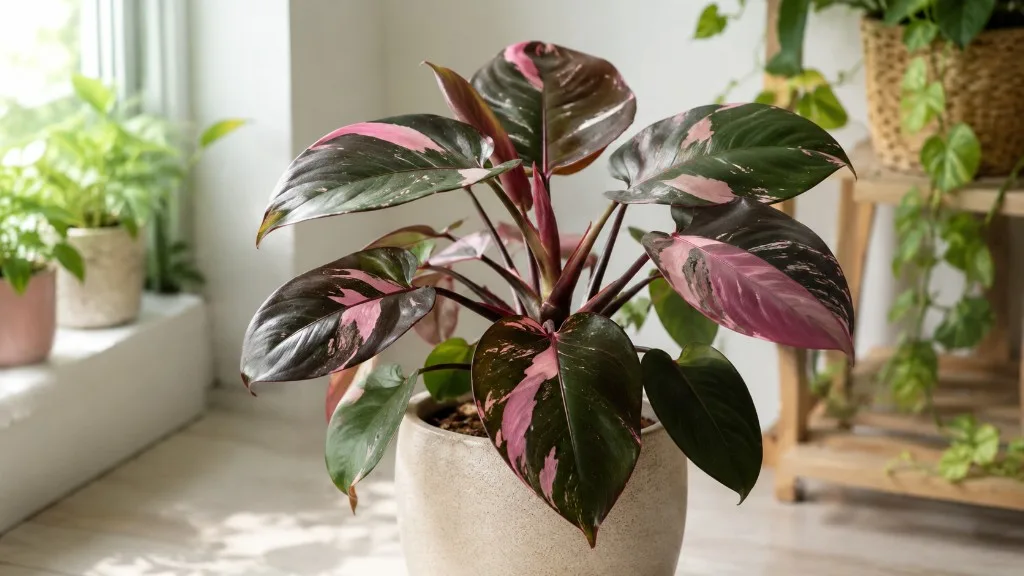
The species is defined by glossy, heart-shaped foliage and reddish-purple petioles and stems. Pink Princess adds pink variegation - splashes, streaks, or sectors of pink against deep green - caused by a genetic mutation that creates sectors of tissue with reduced chlorophyll. That mutation is the entire reason the plant became a collector icon. It is also the reason care advice that works for a plain green philodendron will keep the plant alive but may not keep it pink.
Philodendron erubescens and the ‘Pink Princess’ Cultivar
Botanically, Pink Princess is not a separate species. It is Philodendron erubescens ‘Pink Princess’ - a selected cultivar of a known species. The RHS lists P. erubescens as a stout evergreen climber with triangular-ovate leaves to about 40 cm and red-purple undersides; Pink Princess inherits that climbing architecture and leaf shape, then layers unstable pink patterning on top.
Do not confuse it with Philodendron ‘Pink Congo’, which has circulated in markets with temporarily pinked foliage from chemical treatment rather than stable genetic variegation. Real Pink Princess variegation emerges from the growth point and repeats (irregularly) on new leaves when conditions support it. Congo pink typically fades as new leaves mature. If you are buying, ask to see multiple new leaves and inspect the stem - not just the most photogenic mature leaf in the photo.
Pink Princess sits in the same collector conversation as White Princess, Birkin, and other variegated philodendrons, but its care profile is closer to a vigorous erubescens climber than to a slow self-heading hybrid. Expect moderate growth when healthy, faster when heavily green, slower when heavily pink.
Why Pink Variegation Is Unstable - and Why That Matters
Variegation in Pink Princess is chimeric - the plant contains both normal green cells and mutated pink/white cells, and the balance shifts as it grows. One leaf may be heavily marbled; the next mostly green; occasionally a leaf emerges all pink or nearly so. That unpredictability is part of the appeal. It is also what makes the plant a long-term project rather than a static decoration.
Pink sectors contain little to no chlorophyll, so they cannot photosynthesize. The green sectors carry the energy load. An all-pink leaf looks spectacular on Instagram, but it is functionally weak: the plant often aborts it, or it browns and collapses because it cannot sustain itself. Do not treat an all-pink leaf as proof that your plant is “maxed out” - it is often a warning that the next leaves need more usable green tissue.
Reversion means the plant starts producing stems or leaves with little or no pink. Sometimes that is environmental: low light pushes the plant toward greener, more efficient foliage. Sometimes it is structural: a stem section dominated by green cells outgrows variegated sections because it photosynthesizes faster. Left unpruned, green growth can take over. Understanding which situation you have determines whether you need a brighter window, a pair of sterilized shears, or both.
Best Light for Pink Variegation (Without Burning the Pink)
If you remember one rule, make it this: bright, indirect light is non-negotiable for maintaining Pink Princess variegation. Dim light does not usually kill the plant quickly - erubescens tolerates a surprising amount of neglect - but it reliably produces longer internodes, smaller leaves, and greener new growth. The plant is choosing survival over pink because green leaves capture more light per square inch.
The target is several hours of bright indirect light daily - think east-facing window light, or several feet back from a south- or west-facing window with a sheer curtain. Gentle morning sun is often fine; harsh midday or afternoon sun is not, especially on pink sections that lack chlorophyll to dissipate heat and UV stress. Scorched pink turns brown and crispy long before green tissue shows damage.
Variegated philodendron guides commonly cite roughly six to ten hours of bright indirect light, or supplemental grow lighting when natural light is insufficient. Because pink tissue is photosynthetically weak, Pink Princess often benefits from more light than a solid-green philodendron - but always filtered, never blazing.
Windows, Grow Lights, and Reading the Plant’s Signals
A practical indoor placement: within roughly 1–2 meters of an east window, or 2–3 meters from a filtered south or west window. Rotate the pot a quarter turn weekly so the plant does not lean hard toward one side; erubescens stems twist toward light, and uneven exposure makes variegation harder to read because you are always looking at different sides of the growth.
If new leaves arrive mostly green and internodes are stretching, increase light before you increase fertilizer. Move the plant closer to the window, clear obstructing curtains, or add a full-spectrum grow light. Many collectors run lights 8–10 hours daily in winter; aim for bright indirect intensity rather than blistering direct beam. Distance matters - start around 30–45 cm below a quality LED grow light and adjust based on leaf response.
If pink sections brown while green stays intact, pull back from direct sun or add diffusion. If the whole plant looks bleached or yellow-green, light may be too intense overall. Pink Princess talks in new growth: do not judge success by old leaves that were produced under different conditions. Judge the last two or three leaves and the color on the stem between nodes.
Watering Philodendron Pink Princess
Pink Princess wants the same watering philosophy as most climbing aroids: let the mix approach dryness, then water thoroughly - never sit the roots in stale water. Heavily variegated plants grow somewhat slower than all-green siblings because they have less photosynthetic tissue, which means they often use water more slowly, not faster. Overwatering is the more common killer.
A reliable starting rhythm in most homes: water when the top 3–5 cm of mix is dry, roughly every 7–10 days in active summer growth and every 10–14 days in cooler, dimmer winter. That interval is a starting point, not a rule. A small pot in bright light dries faster than a large pot in a dark corner. Always confirm with your finger or a chopstick before you pour.
When you water, soak until excess runs from the drainage holes, then empty the saucer within thirty minutes. If the pot stays heavy for days after watering, the mix is retaining too much moisture, the pot is too large, or light is too low for the root system to breathe properly. Fix the environment before you chase “better” fertilizer.
How to Check Soil Moisture Before You Water
Insert your index finger to the second knuckle - about 3–5 cm - or push a dry bamboo chopstick into the mix and leave it ten seconds. Cool, damp stick means wait. Dry, crumbly surface with cool-damp deeper mix means you are approaching the right window. Lift the pot occasionally; a dry pot is noticeably lighter.
Avoid the two classic mistakes: daily dribbles that keep the surface wet but never hydrate roots deeply, and watering on a calendar while the plant sits in a cold, dim room using almost no moisture. Pink Princess will tolerate a brief dry spell better than chronic soggy roots. root rot on Philodendron Pink Princess shows up as yellowing leaves on wet mix, soft petioles, and a sour smell - not as a problem you can fix by “giving it more love” with extra water.
Soil, Pots, and Drainage for Aroids
Use a chunky, well-draining aroid mix, not straight peat-heavy bagged soil that compacts into a wet brick after a few months. A proven home recipe: potting mix + perlite + orchid bark, roughly in equal parts by volume, adjusted slightly toward more bark if you tend to overwater. LeafyPixels plant data targets pH 5.5–6.5, which matches the slightly acidic conditions most aroid mixes already provide; hobbyists rarely need to micromanage pH unless persistent nutrient issues suggest a problem.
Drainage holes are mandatory. Decorative cache pots without drainage are where Pink Princess goes to rot quietly. Terracotta dries faster and forgives heavy-handed waterers; plastic holds moisture longer and suits attentive underwaterers in bright light. Choose based on your actual habits, not aesthetics alone.
Repot into fresh mix every one to two years, or when roots circle the pot and water runs straight through. Go up one pot size at a time. An oversized pot holds water the variegated root system cannot use, especially in winter - a common post-repot decline pattern on collector plants people baby too much.
Humidity and Temperature Indoors
Pink Princess prefers moderate to high humidity, roughly 55–70%, and temperatures around 18–29°C (65–85°F). Average indoor humidity near 50% is often acceptable if light and watering are correct; below that, watch for crispy leaf edges, especially on pink sectors that desiccate faster than green.
Raise humidity with a pebble tray, plant grouping, or a small humidifier - the humidifier wins in dry winter heating. Misting leaves is a poor substitute: the humidity spike lasts minutes, and wet foliage in low airflow can invite fungal spotting. Keep the plant away from cold window glass, radiators, and direct AC blasts; erubescens hates sudden temperature swings even when the average room temp looks fine.
Good air circulation matters as much as raw humidity percentage. Stagnant, damp, dim corners produce the overlap where root stress, fungal leaf issues, and spider mites thrive. A gentle fan in the room, not pointed directly at the plant, helps.
Fertilizer: Support Growth Without Forcing Reversion
Fertilizer does not create pink. Light and stable genetics express pink; fertilizer only fuels growth once the basics are right. Feed lightly during active growth - typically monthly in spring and summer with a balanced liquid fertilizer diluted to half strength on already-moist soil. Skip feeding in winter, after Philodendron Pink Princess repotting guide, during pest recovery, or whenever the plant is yellowing on wet mix.
High nitrogen pushes lush green growth, which on a variegated plant can mean more reversion on stems already leaning green. If your Pink Princess is stable but you want slightly fuller growth, half-strength balanced feeding is enough. If new growth is reverting hard, fix light and pruning before you chase color with nutrients.
Never fertilize a dry root ball; salts burn aroid roots quickly. If white crust builds on the mix surface, flush with plain water and pause feeding for a month.
Climbing Support and Why Upright Growth Matters
Philodendron erubescens is a climber, not a self-heading bush. Pink Princess inherits that habit. Without support, stems sprawl, leaves shrink, and nodes may not orient cleanly toward light - conditions that correlate with leggy, greener growth in many collector philodendrons.
Give the plant a moss pole, coir pole, or trellis early, while stems are still flexible. Secure petioles loosely with soft ties; do not strangle the stem. Climbing plants in good light produce larger leaves and more predictable internode spacing, which makes variegation patterns easier to assess over time. A mature Pink Princess on a pole, in bright indirect light, with balanced stem variegation is the reference image - not a tiny pot with one pink leaf dangling out of moss.
Pruning and Managing Reversion
Pruning Pink Princess is not primarily about aesthetics. It is variegation management. Green stems grow faster than variegated stems because they photosynthesize more efficiently. If you ignore an all-green runner, it can dominate the plant even when older leaves still show pink.
Use clean, sharp shears wiped with alcohol between cuts. Remove dead or fully brown leaves anytime. When addressing reversion, think in nodes - the small bumps on the stem where leaves and roots emerge - not individual leaf panic.
When to Cut Green Growth Back to a Variegated Node
If a stem produces multiple consecutive all-green leaves, trace it back to the last node that shows pink streaking on the stem or balanced marbling on a leaf. Cut about 0.5 cm above that node. The goal is to force new growth from tissue that still carries pink cells.
If an entire branch is green from base to tip, cut it back to the main stem or to a node you can verify still shows pink in the stem tissue - a faint pink line on the cataphyll or stem stripe counts. Do not leave all-green runners hoping light alone will pink them up; green-dominated stems often will not.
When a heavily variegated stem produces one random green leaf, some growers remove only that leaf to reduce the green tissue advantage; others wait for the next leaf if light was recently improved. Either approach is reasonable if the stem still shows pink and you corrected light first.
All-pink leaves should usually be removed once they begin browning or wilting - they drain energy without paying it back. Balanced marbled leaves are the gold standard: enough green to power the plant, enough pink to justify the cultivar name.
Repotting and Root Health
Repot Pink Princess every one to two years, or when roots emerge from drainage holes, water runs straight through, or the mix has broken down into fine, water-retentive muck. The best window is early active growth in spring, when longer days and warmer temps support recovery.
Slide the plant out, tease circling roots gently, and move to a pot one size larger with fresh chunky mix. Water lightly after repotting and keep the plant in bright indirect light without direct sun for a week while roots heal. Do not repot on day one after purchase unless the mix is clearly failing or pests are present - quarantine and observe first.
Root rot recovery follows the standard aroid protocol: unpot, trim black or mushy roots with sterile tools, repot into fresh airy mix, and withhold water briefly. Pink Princess with heavy variegation recovers slowly; patience beats repeated repotting.
Propagation from Stem Cuttings
The reliable home method is stem cuttings with at least one node, taken from healthy stems that show visible variegation on the stem, not just on a single old leaf. A cutting with pink on the node has a better chance of producing variegated offspring than a green tip cut from a reverting plant - though no propagation guarantees half-moon leaves.
Cut below a node with sterilized shears. You can root in water, sphagnum moss, or airy potting mix kept evenly moist but not wet. Bright indirect light and humidity around 60% speed rooting. Once roots are 2–5 cm, pot into the same chunky mix you use for the parent.
Collectors often propagate pruned variegated sections specifically to preserve genetics when a main plant pushes green growth. Label cuttings by stem pattern, not leaf charisma.
Buying a Pink Princess: What to Inspect Before You Pay
Pink Princess is a collector plant with prices driven by pattern, not just size. That market incentive produces shortcuts: single-leaf hype, unstable wet moss imports, and mislabeled Congos. Slow down.
Inspect the stem, not only the top leaf. Variegation travels through nodes; balanced pink streaking on the stem over several nodes is a stronger signal than one spectacular leaf above a green growth point. Avoid plants with mushy petioles, sour-smelling moss, or unrooted cuttings sold as established specimens unless you knowingly pay cutting prices.
Ask whether new leaves match the advertised pattern. One pink leaf on an otherwise green plant is a gamble. Firm new growth, clean leaf undersides, and roots visible at drainage holes (without circling wildly) are baseline health checks.
Be cautious of listings promising permanent half-moon leaves or 100% pink - biology does not work that way. Pay for healthy structure and stem pattern, not lottery tickets.
Pet Toxicity and Safe Placement
Philodendron Pink Princess is toxic to cats and dogs. Like other members of Araceae, it contains calcium oxalate crystals that cause oral irritation, drooling, pawing at the mouth, and difficulty swallowing if chewed. The ASPCA lists philodendron as toxic to pets; severity is generally moderate, but individual reactions vary, and pets that chew plants deserve safer alternatives.
Place Pink Princess out of reach - high shelves, wall-mounted planters, or rooms pets do not access - not on a coffee table because the pink looks cute. If ingestion is suspected, contact ASPCA Animal Poison Control at 888-426-4435 (US) and your veterinarian promptly.
The RHS notes that P. erubescens is harmful if eaten and can irritate skin and eyes; wear gloves if sap contact bothers you during pruning.
Common Problems and Real Fixes
Most Pink Princess problems are environmental, and the diagnostic order is always moisture in the pot, then light, then pests, then salts. Variegation complaints aside, erubescens is a straightforward houseplant once roots breathe and light is adequate.
Yellow leaves on wet mix usually mean overwatering or compacted soil - check roots before you assume hunger. Yellow leaves on very dry mix mean underwatering or root loss from past rot. Brown crispy edges on pink sections often mean low humidity, direct sun on variegated tissue, or fluoride/chloride buildup; flush the pot and review placement. Leggy stems with small green leaves mean insufficient light - move it or add a grow light before pruning, then prune if green runners persist.
Spider mites appear as stippling and fine webbing in dry air; shower the plant, raise humidity, and treat with insecticidal soap. Mealybugs hide in leaf axils; alcohol on a swab plus follow-up soap treatments work if caught early. Scale looks like brown bumps on stems; scrape and treat consistently over weeks.
Reversion is not a pest - it is the plant shifting cell balance. Improve light, prune green-dominated stems back to variegated nodes, and propagate the best marbled section if the main plant is mostly green. Existing green leaves will not turn pink retroactively; only new growth reflects your corrected conditions.
Conclusion
Philodendron Pink Princess is Philodendron erubescens with unstable pink variegation - beautiful, expensive, and manageable when you treat light and stem genetics as the main levers. Give it bright indirect light, a chunky aroid mix, watering when the top 3–5 cm dries, moderate humidity, warm stable temperatures, and a moss pole so it climbs like the species evolved to do. Feed lightly in growth season, repot every year or two, and prune green reverted stems back to the last node that still shows pink.
It is not a beginner plant if your home is dark or pets chew foliage. It is not a scam if you buy based on stem pattern rather than one Instagram leaf. And it is not a failure if a leaf comes in mostly green - read the next two leaves, fix light, prune if the stem goes green, and propagate the good section if you want insurance. That is collector care: less panic, more observation, and enough honesty to enjoy the pink when it shows up.
When to use this page vs other Philodendron Pink Princess guides
- Philodendron Pink Princess overview - Canonical hub for this species - care topics and problems branch from here.
- Philodendron Pink Princess problems - Symptom-first path when you already know something is wrong.
Related Philodendron Pink Princess guides
- Philodendron Pink Princess watering
- Philodendron Pink Princess light
- Philodendron Pink Princess soil
- Philodendron Pink Princess propagation
- Philodendron Pink Princess fertilizer
- Philodendron Pink Princess repotting
- Philodendron Pink Princess pruning
- Brown Tips on Philodendron Pink Princess
- Ants on Plant on Philodendron Pink Princess
- Leaf Spot Disease on Philodendron Pink Princess
- Leaf Miners on Philodendron Pink Princess
- Leggy Growth on Philodendron Pink Princess
How to care for Philodendron Pink Princess?
How much light does Philodendron Pink Princess need?
bright indirect light, medium indirect light (pink fades)
- bright indirect light, medium indirect light (pink fades) - bright indirect light, medium indirect light (pink fades).
When should you water Philodendron Pink Princess?
Every 7–10 days in summer - allow top 3–5 cm to dry. Every 10–14 days in winter.
- Check top 2 inches - Every 7–10 days in summer - allow top 3–5 cm to dry.
- Drain excess water - Empty the saucer after watering so the roots are not sitting in standing water.
What soil works best for Philodendron Pink Princess?
Chunky well-draining aroid mix: potting mix + perlite + orchid bark. pH 5.5–6.5.
- Well-draining mix - Chunky well-draining aroid mix: potting mix + perlite + orchid bark.
Grower notes for Philodendron Pink Princess
What makes Pink Princess different
Philodendron Pink Princess is a variegated climber where the balance of color matters more than the name on the label. Too little pink makes the plant visually ordinary; too much pink can weaken leaves because pale tissue photosynthesizes poorly. The best plant has mixed variegation across several nodes, not one spectacular half-moon leaf followed by all-green growth. Pruning decisions should be based on the stem pattern, not panic after a single green leaf.
Pink Princess light note
Give Pink Princess bright indirect light and enough support to keep the stem upright. Dim light pushes greener leaves and longer internodes, while harsh sun damages the pink sections first. Rotate carefully, because the plant will lean and twist if one side always faces the window. If color fades, change light before assuming the plant needs more fertilizer.
Pink Princess buying note
Inspect the stem, not only the most photogenic leaf. Variegation is carried through nodes, so a plant with balanced color along the stem is a better bet than a cheap cutting with one pink leaf and a plain green growth point. Avoid plants with mushy petioles, unstable wet moss, or fresh unrooted cuttings sold as established plants. This is a plant where patience beats chasing the loudest leaf.
What matters most with Philodendron Pink Princess
Philodendron Pink Princess is easiest to understand by its growth habit. Climbers need support for larger leaves, self-heading types need stable root moisture, and delicate velvet forms punish stale air faster than basic green philodendrons. In practice, the care checkpoint is simple: bright indirect light, medium indirect light (pink fades). Pair that with chunky well-draining aroid mix: potting mix + perlite + orchid bark; pH 5.5–6.5, and avoid changing water, pot size, and placement all at once.
Best placement in a real home
Philodendron Pink Princess belongs where bright indirect light, medium indirect light (pink fades) is realistic for most of the day, not only where the pot looks good. Every 7–10 days in summer - allow top 3–5 cm to dry. Every 10–14 days in winter. If the pot stays wet longer than expected, move the plant into better light or reassess the mix before watering again. Humidity target: Moderate to high humidity (55–70%).. Temperature comfort zone: 18°C to 29°C (65–85°F).
Before you buy this plant
Choose Philodendron Pink Princess with firm new growth, clean leaf undersides, and soil that does not smell sour or feel compacted. Be cautious if you see yellow-leaves, sticky residue, collapsed crowns, or a pot that is wet in poor light. Cosmetic old-leaf damage is less worrying than weak roots or active pests.
First month after bringing it home
Do not repot Philodendron Pink Princess on day one unless the mix is failing or pests are obvious. Quarantine it, learn how fast the pot dries, and keep care boring while it adjusts. Watch especially for yellow-leaves, brown-tips, and root-rot. If problems appear, correct the condition first rather than stacking fertilizer, repotting, and pruning together.
Is it pet safe?
Philodendron Pink Princess is toxic to cats and dogs.
Toxic - calcium oxalate crystals.
Watering Philodendron Pink Princess
Every 7–10 days in summer - allow top 3–5 cm to dry. Every 10–14 days in winter.
Soil & potting for Philodendron Pink Princess
Chunky well-draining aroid mix: potting mix + perlite + orchid bark. pH 5.5–6.5.
Humidity & temperature for Philodendron Pink Princess
Philodendron Pink Princess prefers moderate to high humidity (55–70%), though normal home humidity is usually fine. Keep temperatures around 18°C to 29°C (65–85°F).
| Detail | Information |
|---|---|
| Humidity | Moderate to high humidity (55–70%) - normal home humidity is fine. |
| Ideal temperature | 18°C to 29°C (65–85°F) |
Fertilizer & pruning for Philodendron Pink Princess
Use feed lightly during active growth. Use monthly in spring and summer.. for Philodendron Pink Princess.
| Detail | Information |
|---|---|
| Fertilizer type | Feed lightly during active growth. Use monthly in spring and summer.. |
Common problems on Philodendron Pink Princess
Brown Tips
MediumLikely cause: Low humidity
Quick fix: Increase humidity to 55%+
Full fix guide →Likely cause: Philodendron is a large genus of flowering plants in the family Araceae. As of September 2025, the Plants of the World Online accepted 625 species; [2] other sources accept different numbers. [3][4] …
Quick fix: Confirm diagnosis on your Philodendron Pink Princess, then address the most likely care or pest factor described in current extension guidance.
Full fix guide →Leaf Spot Disease
MediumLikely cause: Feb 21, 2024 · Philodendron Types with Pictures and Care Guide The green heartleaf Philodendron is a vining type of plant with dark-green leaves in a heart’s shape. This type of Philodendron can be …
Quick fix: Confirm diagnosis on your Philodendron Pink Princess, then address the most likely care or pest factor described in current extension guidance.
Full fix guide →Leaf Miners
MediumLikely cause: Feb 21, 2024 · Philodendron Types with Pictures and Care Guide The green heartleaf Philodendron is a vining type of plant with dark …
Quick fix: Confirm diagnosis on your Philodendron Pink Princess, then address the most likely care or pest factor described in current extension guidance.
Full fix guide →Leggy Growth
MediumLikely cause: Insufficient light causing reversion
Quick fix: Move to brighter indirect light
Full fix guide →Plant Leaning
MediumLikely cause: Philodendron is a large genus of flowering plants in the family Araceae. As of September 2025, the Plants of the World Online accepted 625 species; [2] other sources accept different numbers. [3][4] …
Quick fix: Confirm diagnosis on your Philodendron Pink Princess, then address the most likely care or pest factor described in current extension guidance.
Full fix guide →Root Rot
MediumLikely cause: Wet soil
Quick fix: Repot in fresh draining mix
Full fix guide →Thin Stems
MediumLikely cause: Feb 6, 2025 · If you are thinking of adding a philodendron to your indoor or outdoor garden, choosing the right variety can be a …
Quick fix: Follow extension or botanical guidance for Philodendron Pink Princess thin stems; adjust care before applying broad treatments.
Full fix guide →Yellow Leaves
MediumLikely cause: Overwatering
Quick fix: Allow top 3–5 cm to dry fully
Full fix guide →Aphids
MediumLikely cause: Aphids on Pink Princess cluster on soft new variegated leaves and stem nodes along climbing vines, leaving sticky honeydew that dulls pink sectors. First step: isolate the plant, rinse colonies off in
Quick fix: See plant-specific guide for step-by-step fixes.
Full fix guide →Drooping Leaves
MediumLikely cause: Drooping Pink Princess leaves usually mean roots are not supplying enough water-either the mix is dry, roots are failing in wet soil, or a long unsupported runner is hanging from gravity. Lift the pot
Quick fix: See plant-specific guide for step-by-step fixes.
Full fix guide →Fungus Gnats
MediumLikely cause: Fungus gnats on Philodendron Pink Princess almost always mean the soil surface stays too wet-often from overwatering, peat-heavy mix, decorative moss toppers, or low light slowing dry-down on a traili
Quick fix: See plant-specific guide for step-by-step fixes.
Full fix guide →Low Humidity
MediumLikely cause: Low humidity on Pink Princess browns leaf tips and pink patches first, especially in heated winter rooms. First step: measure humidity near the foliage with a hygrometer and run a humidifier toward 55
Quick fix: See plant-specific guide for step-by-step fixes.
Full fix guide →Mealybugs
MediumLikely cause: Mealybugs on Pink Princess hide as white cottony clusters in leaf axils, dried petiole sheaths, and along climbing vine nodes-not on flat pink variegation. First step: isolate the plant, dab visible b
Quick fix: See plant-specific guide for step-by-step fixes.
Full fix guide →Mold on Soil
MediumLikely cause: Fluffy white or gray mold on Pink Princess soil is usually harmless saprophytic fungus on wet organic mix-not root rot by itself. First step: scrape the visible mold, then pause watering until the top
Quick fix: See plant-specific guide for step-by-step fixes.
Full fix guide →Not Enough Light
MediumLikely cause: Philodendron Pink Princess needs bright indirect light to hold pink variegation and compact vining growth. In dim rooms it fades, stretches, and uses water poorly. First step: move it where leaves rec
Quick fix: See plant-specific guide for step-by-step fixes.
Full fix guide →Overwatering
MediumLikely cause: Overwatering on Pink Princess shows as yellow lower leaves, sour soil, and limp marbled foliage on a heavy wet pot-especially in dim display corners. Stop watering until the top 3–5 cm is dry, improve
Quick fix: See plant-specific guide for step-by-step fixes.
Full fix guide →Slow Growth
MediumLikely cause: Slow growth on Pink Princess usually means insufficient light for variegated tissue, wet roots, or winter rest-not a missing fertilizer dose. Confirm the season first, then move the plant to brighter
Quick fix: See plant-specific guide for step-by-step fixes.
Full fix guide →Spider Mites
MediumLikely cause: Spider mites on Pink Princess show as fine yellow stippling on green leaf tissue and silk webbing at vine nodes-especially near grow lights or heating vents in dry winter air. First step: isolate the
Quick fix: See plant-specific guide for step-by-step fixes.
Full fix guide →Underwatering
MediumLikely cause: Underwatered Pink Princess shows a light pot, dry mix 3–5 cm down, limp marbled leaves, and crispy pink sectors that often perk within hours after one deep soak. First step: lift the pot and probe soi
Quick fix: See plant-specific guide for step-by-step fixes.
Full fix guide →Wilting
MediumLikely cause: Wilting on Pink Princess means turgor collapse-usually dry roots or failing roots in wet mix. Lift the pot and probe the top 3–5 cm before you water. Light and dry gets a soak; heavy and wet with soft
Quick fix: See plant-specific guide for step-by-step fixes.
Full fix guide →