How to Propagate Philodendron Pink Princess
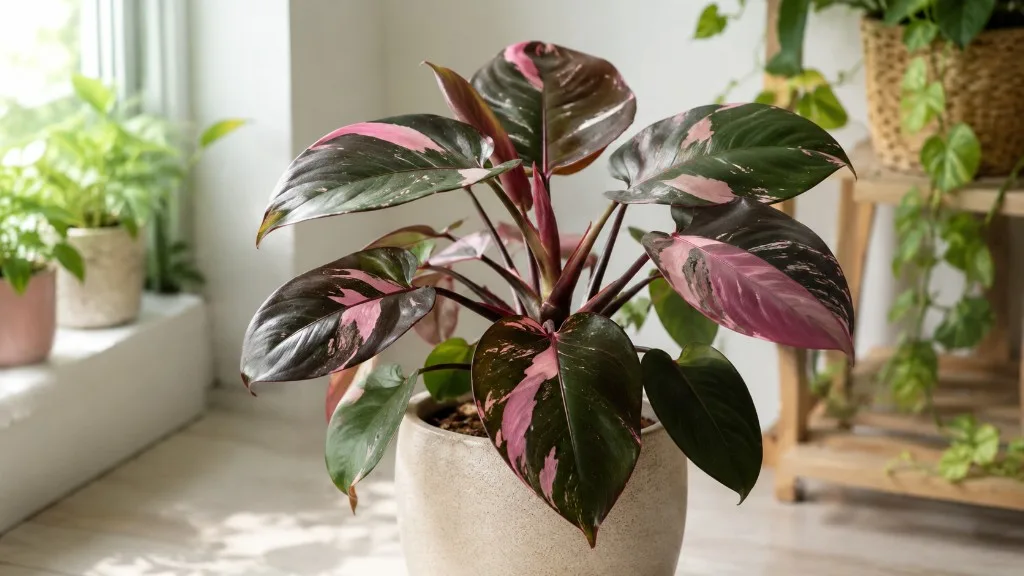
How to Propagate Philodendron Pink Princess
How to Propagate Philodendron Pink Princess
By Sai Ananth · Reviewed by LeafyPixels Review Board · Last reviewed 2026-06-15
Philodendron Pink Princess propagation at home means stem cuttings with at least one node - ideally from a stem that still shows pink variegation in the tissue at the bud - then rooting in water, sphagnum moss, or moist perlite before potting into chunky aroid mix. Philodendron erubescens ‘Pink Princess’ is a climbing Colombian aroid in the Araceae family, sold alongside compact erubescens cultivars like ‘Black Cardinal’ and ‘Prince of Orange’ per Iowa State Extension. Unlike a plain green heartleaf philodendron, every propagation decision on Pink Princess is also a variegation decision: the node you cut today largely determines whether the rooted plant stays marbled pink or quietly reverts to green.
The reliable home workflow: identify a healthy node with visible pink streaking on the stem, cut with sterile shears, root in bright indirect light at roughly 18–29°C (65–85°F) with humidity near 55–70%, change water before it clouds, and pot up when roots reach 2–5 cm (about 1–2 inches) into the same chunky aroid mix you use for the parent. Iowa State Extension confirms trailing philodendrons root readily from 3–6 inch stem sections with lower leaves removed, in water or perlite, changing water frequently until several-inch roots form before potting. Pink Princess adds one non-negotiable layer: chimeric variegation can shift cell balance toward green under stress, so node selection matters as much as rooting medium.
This guide covers tools and timing, node anatomy on vining erubescens stems, how to read pink streaks before you cut, three rooting methods plus optional air layering, decision tables for node and method choice, a rooting timeline table, pot-up rules, aftercare for the first month, chimeric cloning expectations, Pink Congo mislabel risks when buying cuttings, wet-stick recovery, and sap safety when pets share your workspace.
What You Need Before You Cut
Propagation succeeds when the parent plant is healthy, the season supports active growth, and your tools reduce rot and sap exposure. You are removing living tissue from a collector cultivar where weak cuttings rot fast and mislabeled purchases are common - set up like you mean it.
Tools, Sanitation, and Pet Safety
Gather before you cut:
- Sharp bypass pruners or floral snips - dull blades crush erubescens stems and invite infection at the node
- 70% isopropyl alcohol to wipe blades between cuts on the parent and between separate cuttings
- Clear glass jar or vase (water method), long-fiber sphagnum moss plus a clear cup or propagation box (moss method), or moist perlite in a small nursery pot (perlite method)
- Room-temperature filtered or dechlorinated tap water for water propagation and moss hydration
- Optional rooting hormone powder (0.3–0.8% IBA) for perlite method - Iowa State Extension notes it can accelerate rooting in perlite though many erubescens cuttings root without it
- Nitrile gloves - philodendrons contain insoluble calcium oxalate crystals; the ASPCA lists philodendron as toxic to cats and dogs with oral irritation, drooling, vomiting, and difficulty swallowing if chewed
- A stable surface away from pets and children - trimmings and jars look like toys
Sterilize blades, let them air-dry briefly, and work on a surface you can wipe down. Dispose of cut leaves in a closed bin pets cannot raid. Wash hands after handling sap. Call ASPCA Poison Control at (888) 426-4435 if a pet ingests tissue.
Parent Plant Health and Best Timing
Take cuttings only from firm stems with no active rot, pest webs, or widespread yellowing. If the parent is recovering from root rot or shipping shock, stabilize it first - propagation multiplies healthy plants; it does not rescue a drowning one.
Best timing is active growth: spring through early fall when bright indirect light and warmth support rooting. NC State Extension places Philodendron erubescens in the 65–85°F comfort band with moderate brightness without direct sun and high humidity for best performance - conditions that also speed cutting roots. Winter propagation works under grow lights and stable room heat, but expect slower progress and higher rot risk if water stagnates in a cold room.
Avoid cutting immediately after repotting, heavy pesticide sprays, or a long drought event. Wait until the plant pushes one clean new leaf or shows steady turgor in existing foliage. Collectors often time propagation with pruning reverted green runners - the trimmed variegated section becomes the cutting, and the parent redirects growth from a healthier node.
Understanding Nodes on a Vining Pink Princess Stem
A node is the slightly swollen joint on the stem where a leaf petiole attaches, aerial roots may emerge, and an axillary bud sits ready to activate. That bud holds the meristematic tissue that produces the next vine segment and new roots when a cutting is separated from the parent. Clemson HGIC notes philodendrons may be propagated from stem cuttings or by air layering - each requires node tissue, not leaf tissue alone.
On Pink Princess, nodes often show a reddish-purple cataphyll (the sheath wrapping new leaves) and may send aerial roots along the vine - bonus rooting tissue when submerged in water or pressed into moss. Iowa State Extension notes stem sections with aerial roots tend to root more reliably than bare internodes.
Leaf-only cuttings will not work. A spectacular pink leaf floating in a jar without stem node tissue may persist briefly on stored energy, then yellow and decline because leaves lack the meristem needed for new shoots. This is the single most expensive mistake on collector forums - and the reason “wet sticks” (node segments, sometimes without leaves) are sold separately from leaf charisma.
What to look for: On a healthy vining stem, the node appears as a slight ridge or ring where the leaf meets the stem; you may see a small brown or pink “eye” (the axillary bud) and white or tan aerial root nubs. Pink streaking through that ring is your best variegation signal - not the leaf alone.
Where to Cut Above and Below the Node
Plan two cuts - one for the cutting, one for the parent:
On the cutting: Cut approximately 1–2 inches (2.5–5 cm) below the node you want to root. That stub protects node tissue and gives stem to submerge without drowning the bud. Remove any leaf that would sit underwater.
On the parent: Cut about ¼ inch (0.5 cm) above the node below your take. The remaining node with its leaf often activates a new growth point, which helps the donor recover bushier form when you are shortening a leggy vine.
Single-node vs. two-node cuttings: A one-node, one-leaf cutting is standard for water jars and trades. A two-node section carries more energy reserves on long vines but is harder to stabilize in small containers; for most homes, one healthy node with one or two leaves is the sweet spot. Iowa State Extension recommends 3–6 inch sections - long enough to handle, short enough to fit a propagation box.
Choosing Cuttings That Preserve Pink Variegation
Node selection is the entire variegation game on Pink Princess. Two cuttings six inches apart on the same vine can produce radically different offspring - one marbled pink and green, one solid green - because chimeric cell balance differs at each bud. Ohio State BYGL explains that chimeric variegation arises when genetically distinct cell populations coexist in the shoot meristem; green cells photosynthesize faster, so under stress the plant often favors green tissue. UF/IFAS propagation science adds that chimeral meristems can revert toward all-green stems when green sectors outcompete variegated ones - exactly what Pink Princess collectors call reversion.
Before you sterilize scissors, walk the vine and evaluate both leaf pattern and stem tissue at every candidate node. The goal is balanced variegation: enough pink for the cultivar’s character, enough green to fuel rooting and early growth.
Reading Pink Streaks on the Stem
Start with the leaf - look for marbled pink and green on the blade, not a pale wash that mimics variegation in dim light. Then drop your eyes to the stem at the node, because experienced propagators trust stem tissue over a single photogenic leaf.
Variegated stem tissue shows pink streaks, flecks, or sectors running through the internode and into the axillary bud junction - the “eye” where the next shoot emerges. A beautifully pink leaf above a solid green stem at the bud is a poor bet: the leaf may be older output from a previously variegated tip while the bud below has already shifted green. Always propagate from nodes where pink is visible in the stem stripe at the bud, not only on the leaf blade.
Also read the vine above and below your target. If the stem section above has produced two or three consecutive all-green leaves, that growth point has likely reverted - move down to the last node that still shows pink streaking on the stem, the same logic as pruning reversion. Avoid all-pink or nearly all-pink leaves (sometimes called half-moons or ghost leaves) as propagation donors when you can: pale tissue photosynthesizes less efficiently than green sections, and those cuttings often root slowly or fail even when they look stunning in photos.
Label cuttings by stem pattern, not leaf drama. “Node 4 - pink stripe through bud, marbled leaf” beats “the pretty one.”
Pink Congo vs. Real Pink Princess Cuttings
When buying cuttings, inspect stem variegation, not one hot pink leaf. Philodendron ‘Pink Congo’ and similar market names have circulated with temporarily pinked foliage that fades as new leaves mature, without stable genetic variegation in the stem. Real Pink Princess variegation emerges from the growth point and repeats irregularly on new leaves when light is adequate. The Missouri Botanical Garden lists ‘Pink Princess’ as a cultivar of P. erubescens with dark purplish-green leaves irregularly blotched pink - a stable chimeric pattern, not a uniform flush that disappears on the next leaf.
If a seller shows one pink mature leaf but green stem at every node, you may be buying a reverting plant or a Congo mislabel - not a propagation failure on your part later, but a purchase problem now. Document stem photos at delivery if you paid collector prices.
Wet-stick recovery: If a purchased node arrives leafless but firm, treat it as a high-humidity project. Trim any blackened tissue, press the node into damp sphagnum in a vented propagation box at 65–80°F, and wait four to eight weeks for the first leaf - longer than a leafy cutting. Do not submerge a bare stick in standing water; moss or perlite with a humidity dome gives better odds. If the stick arrives mushy or odoriferous, photograph it and contact the seller before attempting rescue.
Avoid cuttings with mushy petioles, sour-smelling moss, or unrooted sticks sold as established plants at mature-plant prices. See the Pink Princess overview for fuller ID context.
Method 1: Water Propagation (Step-by-Step)
Water propagation is the most visible method: you watch roots form and catch rot early. Iowa State Extension lists water rooting for trailing philodendrons with the instruction to change water frequently until several-inch roots develop, then pot in regular potting mix.
Steps:
- Select a stem with at least one node showing pink streaking at the bud, plus one or two healthy leaves. Remove any lower leaf that would sit underwater.
- Cut with sterile shears 1–2 inches below the node. Include an aerial root if present.
- Fill a clean glass jar with room-temperature water. Submerge the node and aerial root; keep the leaf and upper stem above the waterline.
- Place in bright indirect light - not direct sun, which heats the jar, grows algae, and scorches pink leaf tissue first.
- Change water when it becomes cloudy, or on a weekly schedule as preventive maintenance. Rinse the jar if biofilm builds.
- Wait until roots are roughly 2–5 cm (1–2 inches) long and firm white or cream, then pot up (see pot-up section). Do not transplant at the first tiny nub.
Pros: Easy monitoring, minimal supplies, ideal for learning node anatomy on a vining erubescens stem.
Cons: Weaker root structure than moss for some growers, rot risk if water stagnates, top-heavy cuttings may tip small jars - use a heavier vase or soft tie to a stake.
Weekly Water-Rooting Care
| Week | What to check | Action |
|---|---|---|
| 1 | Node not blackening; water clear | Change water if cloudy; wipe jar |
| 2 | White root nubs at node/aerial root | Keep light steady; no fertilizer |
| 3–4 | Roots lengthening toward 2–5 cm | Prepare small pot and chunky mix |
| 4–6 | Roots firm, 2–5 cm | Pot up; begin aftercare rhythm |
Target 55–70% relative humidity if your room is dry - a clear bag loosely over the leaf (not sealing wet stem against plastic) or a propagation box helps. The priority is clean water at the node, not constant leaf misting that invites fungal spots on variegated tissue.
Method 2: Sphagnum Moss Propagation
Sphagnum moss suits Pink Princess when you want stronger roots before soil, when a cutting is too short to stabilize in a jar, or when you prefer not to leave valuable variegated tissue in stagnant water. Moss mimics how aerial roots grip bark on a climbing erubescens stem in habitat - moist, airy, and oxygenated at the node.
Steps:
- Hydrate long-fiber sphagnum moss in water, then squeeze until damp - not dripping.
- Place moss in a clear cup, propagation box, or vented zip bag with the cutting node pressed into the moss. Aerial roots should contact moss.
- Seal partially for humidity - a bag with air holes or a box with vents prevents mold while keeping the node moist.
- Keep in bright indirect light at 65–85°F (18–29°C).
- Open weekly to check moisture. Remist moss if it lightens; never let it stay soggy and anaerobic.
- Transplant when roots weave through moss and reach 2–5 cm - gently tease moss away rather than ripping.
Moss propagation shines for heavily variegated cuttings you want to watch closely, and for wet sticks (node-only segments) that need high humidity until the first leaf unfolds.
Method 3: Perlite and Airy Mix Propagation
Perlite - or a moist 50/50 perlite and potting mix - gives faster transition to soil because roots form in a solid medium from the start. Iowa State Extension recommends perlite or well-drained potting soil for philodendron stem sections, noting rooting hormone can accelerate root formation in perlite though many erubescens cuttings root without it.
Steps:
- Fill a small pot with drainage holes with moist perlite or airy aroid mix (see soil guide).
- Dip the cut end lightly in powdered rooting hormone (optional) - tap off excess; hormone is most useful on slow or leafless cuttings.
- Insert the cutting so the node sits just below the surface - bury the node, not the leaf petiole.
- Cover with a clear bag or propagation dome vented daily to maintain high humidity without cooking the cutting.
- Keep medium evenly moist - never waterlogged. Water when the top layer lightens.
- Check for resistance after three to four weeks by giving a gentle tug; firm anchoring means roots formed.
- Leave in place until roots fill the small pot or reach 2–5 cm visible through a clear cup, then pot up to a standard container if needed.
This method reduces water-to-soil shock but requires more attention to moisture balance - wet perlite packs anaerobic quickly in a cold room.
Air Layering for Long Intact Vines
If your Pink Princess still has a long healthy vine attached to the parent and you hesitate to sever a valuable tip, air layering roots a node while it remains on the plant - the same propagation format commercial growers use for nodal and air-layer formats on aroids. Air layering makes sense when the target node sits mid-vine with several leaves above it, when you want zero jar shock on an expensive marbled section, or when water propagation failed once and you need a second attempt without sacrificing more stem.
Steps:
- Select a node with pink stem streaking and, ideally, an aerial root nub.
- Make a shallow upward slit or remove a ¼-inch ring of outer stem just below the node - optional on erubescens but can speed rooting.
- Wrap the node in damp sphagnum moss, then cover with plastic wrap or a propagation ball sealed at both ends with twist ties.
- Keep moss moist - mist through a small opening weekly without unwrapping fully.
- Check roots through clear plastic after three to six weeks in warm bright conditions.
- Cut below the rooted node once roots are 2–5 cm and white, then pot into chunky aroid mix.
Air layering is slower to set up than a jar but preserves the parent vine’s photosynthetic capacity while roots form - useful on specimens you are still evaluating for variegation stability.
How Long Rooting Takes
Timelines vary with temperature, light, season, cutting vigor, and variegation balance. Use ranges, not guarantees - these are indoor home estimates, not greenhouse benchmarks.
| Method | First root nubs | Roots ready for soil | First new leaf after pot-up |
|---|---|---|---|
| Water | 7–14 days | 2–6 weeks | 4–10+ weeks |
| Sphagnum moss | 10–21 days | 3–6 weeks | 4–10+ weeks |
| Perlite/airy mix | 14–21 days | 3–7 weeks | 4–10+ weeks |
| Air layer | 14–28 days | 4–8 weeks | 4–10+ weeks |
Cuttings with existing aerial roots often root on the faster end. Heavily pink ghost-leaf cuttings may root slower or fail - another reason to favor marbled leaves with pink stem streaks. Cool winter rooms below 18°C (65°F) can double these ranges; warmth and consistent bright light are the cheapest accelerators.
In a typical 22°C east-window setup, a marbled one-node cutting with an aerial root often shows first white nubs in 10–14 days in clean water during spring - while a ghost-leaf cutting from the same vine may still be leaf-yellowing at week three with no roots.
When and How to Pot Up Rooted Cuttings
Pot up when roots are creamy white, firm, and roughly 2–5 cm (1–2 inches) long with some secondary branching - not merely a single translucent stub. Iowa State Extension describes potting after several-inch roots form in water; for Pink Princess, the 2–5 cm threshold balances transplant shock against leaving cuttings in jars too long.
Pot-up steps:
- Choose a 10–12 cm (4–5 inch) pot with drainage - oversized pots hold water the young root system cannot use.
- Fill with chunky aroid mix - potting soil plus perlite and orchid bark, matching the well-drained structure NC State Extension describes for erubescens.
- Plant the node just below the surface; do not bury the leaf petiole.
- Install a moss pole or bamboo stake if you want upright climbing habit early - erubescens is a climber by nature.
- Water thoroughly once, let drain, then follow the moist-first-weeks rhythm below.
If transitioning from water, plant directly into moist mix; some growers buffer the first week with a handful of damp moss around the root zone. Move before roots become only adapted to submerged life - long, unbranched water roots without secondary growth are a signal to pot up or refresh the cut.
Aftercare for New Rooted Plants
Newly potted Pink Princess cuttings need stability, not fertilizer pushes or repeated repotting.
Weeks 1–2: Keep mix evenly moist but not waterlogged - water in the sink until excess drains. No fertilizer yet. Maintain bright indirect light and 55–70% humidity if possible.
Weeks 3–4: Allow the top 2–3 cm of mix to dry between waterings as roots explore the pot. Follow the parent plant’s watering rhythm once turgor stabilizes - typically letting the top 3–5 cm dry between soaks on established erubescens.
Weeks 4–8: Shift toward normal care. First new leaf may appear smaller and less pink than mature foliage - judge stem stripe at the new node, not panic over one green leaf if light and stem pattern still look balanced.
Do not repot again immediately, do not move between rooms weekly, and do not fertilize until you see active new growth and roots have had four to six weeks in soil. When the plant outgrows the liner, follow repotting guidance - usually one pot size up every one to two years.
Signs Propagation Is Failing
Stop hoping and restart clean when you see:
- Black or mushy node - tissue is dead; cut higher above healthy green stem or discard
- Sour-smelling water or slimy moss - bacterial overload; replace medium, trim rot, retry with sterile tools
- Stem shriveling while medium stays wet - rot or lack of oxygen; improve drainage or switch method
- Leaf yellowing with firm node - often normal as the cutting redirects energy; alarming only if the node softens
- No roots after 8+ weeks in warm bright conditions - verify a true node was included, check temperature, or try moss instead of water
- All-pink new growth that collapses - insufficient chlorophyll; future cuttings should use more balanced marbling
A failed jar is not a failed grower - reset with cleaner material from a more variegated node.
When Not to Propagate
Do not propagate as a first response to every problem:
- Active root rot on the parent - stabilize or salvage clean nodes above rot only after triage
- Heavy pest infestation - treat pests before spreading hitchhikers to propagation boxes
- Immediately after shipping - let the plant acclimate two to three weeks
- Mid-winter in a cold dim room - wait for spring or add grow lights and warmth
- Because the plant is reverting - propagation from green-dominated stems produces green plants; fix light and prune first, then propagate the variegated section you removed
Propagation multiplies healthy, correctly identified Pink Princess tissue - it does not cure chronic overwatering or rescue mislabeled Congo cuttings.
Chimeric Variegation and What to Expect from Clones
Stem cuttings clone the chimeral composition at the chosen node - they do not guarantee half-moon leaves on every future leaf. UF/IFAS notes chimeral meristems can produce reversions to all-green or all-non-pigmented growth when one cell population outcompetes another; Ohio State BYGL describes the same instability in sectorial and periclinal chimeras. On Pink Princess, that means:
- A cutting from a pink-streaked node has the best odds of marbled offspring
- A cutting from a green node will almost certainly grow green, even if an older leaf above it was pink
- No method - water, moss, tissue culture, or wishful thinking - guarantees permanent pink on every leaf
- After rooting, bright indirect light and avoiding heavy nitrogen fertilizer help maintain balance; see fertilizer guidance for variegated erubescens
Collectors propagate pruned variegated sections as insurance when a main plant pushes green growth - label pots, photograph parent stems, and treat each rooted cutting as a genetic snapshot, not a lottery ticket.
For the full care picture after rooting, see the Pink Princess overview, plus guides on light, watering, soil, fertilizer, repotting, and pruning.
Frequently Asked Questions
Can you propagate Philodendron Pink Princess in water? Yes. Submerge the node and any aerial roots while keeping leaves above the water line. Use bright indirect light, change water weekly or when cloudy, and pot into chunky aroid mix once roots reach 2–5 cm. Iowa State Extension confirms trailing philodendrons root readily in water with frequent water changes until several-inch roots form.
Do Pink Princess cuttings need a node? Yes. A leaf without a node cannot produce a new plant. Every viable propagation requires at least one node - the joint where the leaf attaches, aerial roots may emerge, and the next growth point sits.
How long does Pink Princess take to root? Most cuttings show first root nubs in one to two weeks and reach pot-up size in two to six weeks during active growth. Aerial roots speed the process; ghost-leaf cuttings root slower. Cool winter rooms can extend rooting to eight weeks or more.
Will propagated Pink Princess stay variegated? Not guaranteed. The node’s chimeric cell balance determines offspring color. Pink stem streaks give the best odds; green nodes produce green plants. Bright indirect light and pruning reverted runners help after rooting.
Can I propagate a wet stick with no leaves? Yes, but use damp sphagnum in a vented propagation box rather than a water jar. Expect four to eight weeks for the first leaf - longer than a leafy cutting. Trim rot, keep humidity high, and document condition at delivery if you purchased the stick.
Node and Method Selection Tables
Use these before you cut - they compress the stem-stripe logic and method trade-offs into quick decisions.
Node selection
| Stem stripe at bud | Leaf pattern | Vine above node | Action |
|---|---|---|---|
| Pink streak visible | Marbled pink/green | Mixed or pink leaves | Propagate - best odds |
| Pink streak visible | Ghost/half-moon | Any | Propagate with caution - use moss; expect slower roots |
| No pink in stem | Pink on leaf only | Green leaves below | Avoid - likely reverted bud |
| No pink in stem | Green | 2+ consecutive green leaves | Prune first, propagate higher on variegated section |
| Unknown on wet stick | No leaf | N/A | Moss box - high humidity; document for seller if it fails |
Method selection
| Situation | Best method | Why |
|---|---|---|
| Beginner, leafy cutting, visible jar | Water | Easy rot monitoring |
| Wet stick or ghost-leaf cutting | Moss | High humidity without drowning node |
| Quick soil transition, cold room | Perlite | Less stagnant water than jars |
| Mid-vine node, parent still healthy | Air layer | Roots while attached; no jar shock |
| Failed water after 6+ weeks, firm node | Switch to moss | Often rescues slow erubescens cuttings |
| Blackened node | Discard | Tissue is dead; cut higher on parent |
When to Retry, Discard, or Dispute a Seller
Not every cutting deserves more patience - and not every failure is your fault.
Retry with a different method when the node is still firm and green, leaves are yellowing but not rotting, and you have fewer than eight warm weeks in the setup. Switch water to moss or add a vented humidity dome on perlite before declaring defeat. Trim any soft brown tissue with sterile shears and restart in fresh medium.
Discard and take a new cutting from the parent when the node is black or mushy, water smells sour despite weekly changes, or eight-plus weeks pass in 65–80°F bright indirect light with zero root nubs on a confirmed node. A dead node will not recover in a new jar.
Dispute or document with the seller when you received a wet stick that arrived rotting, the plant roots but pushes only green leaves from green stem nodes while the listing showed stable pink stem variegation, or new growth matches Pink Congo fade patterns (uniform pink flush reverting to solid green within a few leaves). Save delivery photos, stem close-ups, and message timestamps - propagation skill cannot fix a mislabeled purchase.
If your propagated clone loses pink after rooting, you can re-propagate from the highest node that still shows pink in the stem - the same chimeric rules apply. One green leaf on a new rooted plant is not automatic failure; three consecutive green leaves from a green stem stripe means move upvine or improve light before taking another cutting.
When to use this page vs other Philodendron Pink Princess guides
- Philodendron Pink Princess overview - Start here for whole-plant context before deep-diving this topic.
- Philodendron Pink Princess problems hub - Jump to symptom-specific fix guides when this care topic does not resolve the issue.