Philodendron Pink Princess Repotting: When, How
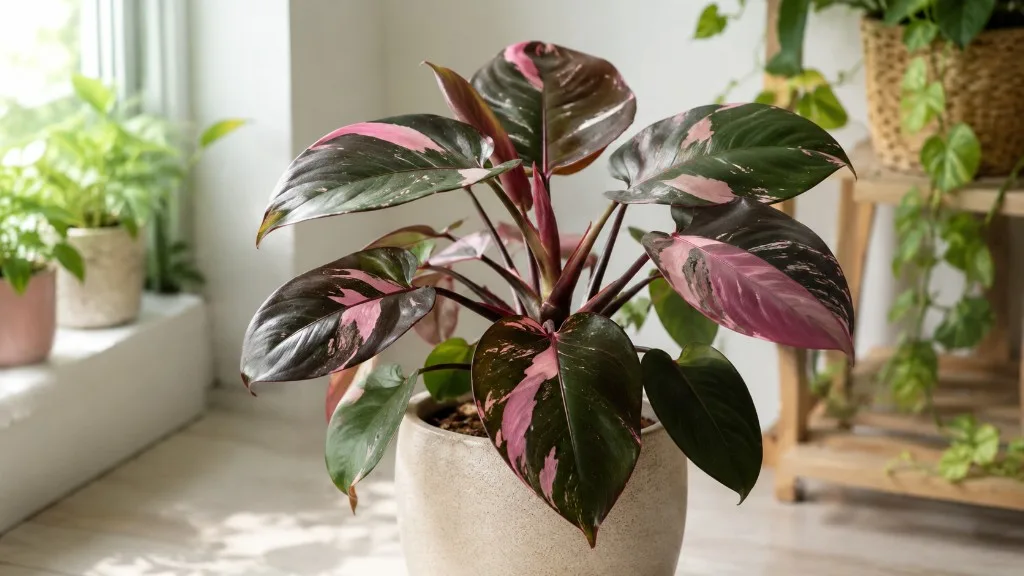
Philodendron Pink Princess Repotting: When, How, and Mistakes to Avoid
Philodendron Pink Princess Repotting: When, How, and Mistakes to Avoid
By Sai Ananth · Reviewed by LeafyPixels Review Board · Last reviewed 2026-06-15
Philodendron Pink Princess (Philodendron erubescens ‘Pink Princess’) is a variegated climbing aroid collectors pay a premium for - and repotting is one of the few routine tasks where a small mistake can cost you months of pink splashes on new leaves. Unlike a forgiving golden pothos in a hanging basket, Pink Princess combines a vining root mass that fills pots unevenly with pale variegated tissue that photosynthesizes less efficiently than solid green philodendron leaves. That pairing means repot timing, pot size, mix structure, and moss-pole placement all matter more here than on self-heading cultivars like Philodendron ‘Birkin’.
Done well, a spring repot restores drainage, replaces compacted peat, and gives adventitious roots along the stem room to anchor a moss pole. Done poorly - oversized pot, bare-rooted shock, or repotting during a dim winter stretch - you get wilting, green reversion on new leaves, and a plant that looks fine in photos but stalls for weeks below the soil line. This guide walks through when Pink Princess actually needs a new pot, how to execute an eight-step repot without stripping fine root hairs, and how to read pink variegation on the first new leaf as your clearest recovery signal.
Illustrative Scenario: A Typical Indoor Pink Princess Repot
The following walkthrough is an illustrative indoor scenario - a composite of common collector situations, not a photo-documented case study from a single repot session. Use it to see how the decision points in this guide connect before you read the quick-reference summary.
Imagine a Pink Princess in a 12 cm nursery pot on a bright east windowsill. New leaves have slowed despite consistent watering. Roots circle the bottom, water runs through in minutes without soaking the center, and the mix smells slightly sour. In mid-April, you choose a routine upgrade repot (not a rot rescue): slide into a 15 cm pot, refresh with chunky aroid blend from our soil guide, reset the moss pole with new sphagnum wrap, and skip fertilizer for one month. Mild wilt lasts about five days - normal transplant adjustment. At week four, a new leaf opens with a dark green base and clean pink splashes. That variegation pattern on firm new tissue tells you roots have reconnected; the repot succeeded.
If your plant matches only one symptom - say, a single yellow lower leaf - this scenario does not apply. Scroll to the routine vs rescue table below before you unpot.
Quick Answer - When to Repot Pink Princess
Repot Philodendron Pink Princess every one to two years, or sooner when roots circle drainage holes, water runs straight through without absorbing, or growth stalls despite good light and balanced feeding. Spring through early summer is the safest window because active growth helps roots colonize fresh mix faster. Choose a pot only 2–5 cm (1–2 inches) wider than the current one, refresh with a chunky aroid blend, anchor any moss pole during the same session, and skip fertilizer for four to six weeks after the move. Mild wilting for one to two weeks is normal; the first firm new leaf with stable pink splashing is your best sign that roots have reconnected.
Why Pink Princess Repotting Differs From Other Philodendrons
Pink Princess is not a generic philodendron with a color swap. Missouri Botanical Garden describes ‘Pink Princess’ as a slow-growing hybrid with colorful variegated foliage and an upright, vining habit that requires trellis support - the same climbing architecture as P. erubescens, not the short-stemmed rosette form of self-heading hybrids. That biology changes how repotting feels in your hands and how fast the plant recovers afterward.
Vining habit, moss poles, and root spread
Climbing philodendrons produce adventitious roots from nodes along reddish-purple stems. Indoors, those roots want to attach to a moss pole, trellis, or chunky bark - not sit in a dense peat cylinder with no air channels. When you repot, you are usually managing two root zones: the fibrous mass in the pot and aerial roots wrapped around support material. Self-heading philodendrons like ‘Birkin’ fill a pot more symmetrically from a central crown; Pink Princess often looks modest above soil while roots have already spiraled the entire bottom third of a nursery container.
That uneven fill is why Pink Princess can seem “fine” on the windowsill while the pot is secretly root-bound. Vining stems also add top weight once you install a pole. Repotting is the practical moment to reset pole placement, deepen the base anchor, and confirm the plant will not tip when the next leaf flush arrives. If you are transitioning from a hanging position to upright climbing, repot in spring and set the pole in the same session rather than disturbing roots twice in one month.
Pink variegation as your recovery benchmark
On a solid green philodendron, “new growth” alone signals recovery. On Pink Princess, you need to look closer. Heavily variegated leaves carry less chlorophyll than dark green sections (pale tissue photosynthesizes less efficiently), which means the plant already runs closer to its energy limit before any root disturbance. MBG notes that too much shade reduces variegation and produces leggy growth - repot shock plus dim light is a double hit on pink stability.
After repot, watch whether the first new leaf opens at normal size with mixed pink and green - not paper-thin all-pink tissue, not solid green reversion, and not stunted half-leaves. Variegation stability still depends primarily on bright indirect light, but damaged roots from soggy old mix or an oversized new pot remove the buffer that keeps pink stable through ordinary watering misses. Treat pink splashing on healthy new foliage as confirmation that the root zone is working again, not as proof that light and fertilizer can be ignored.
Routine Repot vs Rescue Repot: Which Session Are You In?
Not every unpotting is the same job. Matching your session type prevents the classic error of treating a rotting plant like a simple size upgrade - or delaying a rescue because the calendar says wait until spring.
| Signal | Routine upgrade repot | Rescue repot |
|---|---|---|
| Root color | Mostly white or tan, firm | Brown, mushy, or foul-smelling |
| Growth | Stalled but leaves still firm | Widespread wilt, collapse, or spreading yellow |
| Timing | Spring–early summer preferred | Any season if rot is active |
| Pot direction | One size up (2–5 cm) | Often same size or smaller after trimming |
| Root handling | Tease circling tips only; keep ball intact | Trim rot; may need propagation backup |
| Fertilizer | Wait 4–6 weeks | Wait until firm new growth; see root rot guide |
Penn State Extension notes that spring is the best time for houseplant repotting because roots grow into fresh mix as seasonal growth resumes - ideal for routine upgrades. When mushy roots or sour mix are present, treat it as rescue work even in winter, using a modest pot, temperatures above 18°C, and cautious watering until spring.
When to Repot Philodendron Pink Princess
Calendar reminders help, but root condition should drive the decision. NC State Extension notes that philodendrons prefer moist, well-drained soil rich in organic matter and should be repotted when root-bound - guidance that applies directly to Pink Princess containers. Iowa State Extension recommends well-drained potting soil and warns against letting philodendrons stand in water, which is exactly what happens when you delay repotting in compacted, hydrophobic mix.
Plan a full repot every one to two years for an actively growing indoor Pink Princess in a 12–18 cm grow pot. Fast growers in bright east or south-facing rooms may hit the one-year mark; slower specimens in cooler winter homes may sit comfortably for two. Repot sooner if you find mushy roots, a sour smell, or root rot symptoms - that becomes a rescue repot even outside the ideal season.
Do not repot just because one lower leaf yellowed. Yellow leaves often trace to overwatering, cold drafts, or natural aging on a long vine. Repotting an already stressed plant stacks variables and makes diagnosis harder. Confirm the root zone is the bottleneck - circling roots, fast dry-down, or salt-crusted mix - before you commit.
Do not repot a brand-new nursery plant on day one unless the mix is clearly failing or pests are visible. Quarantine, learn the pot’s dry-down rhythm for two to three weeks, then repot in the next active growth window if roots are already tight. The overview guide covers first-month stability in more detail.
Top-dress vs full repot
Not every spring soil refresh requires lifting the entire plant. Top-dressing - scraping the top 3–5 cm of depleted mix and replacing it with fresh aroid blend - works when roots are healthy, drainage is still acceptable, and the pot size is still appropriate. Choose full repot when two or more root-bound signals appear together, the mix smells sour, or water channels through a hydrophobic mat without wetting the center.
| Situation | Top-dress | Full repot |
|---|---|---|
| Roots white, not circling heavily | Yes | Optional |
| Roots through drainage holes | No | Yes |
| Water runs through in minutes | No | Yes |
| Mix sour or moldy surface only | Sometimes | Often yes |
| Same pot size, fresh structure needed | Yes | Yes |
If variegation has faded but roots and mix are sound, fix light before repotting. Repotting alone will not restore pink on new leaves in a dim corner.
Signs Your Pink Princess Is Root-Bound
The clearest visual signal is roots emerging from drainage holes or wrapping the surface when you lift the plant partway out of the pot. Less obvious but equally reliable: water that runs straight through without the mix absorbing, wilting hours after a thorough watering, and growth that stalls even though light and feeding have not changed. Penn State Extension lists these same patterns - fast dry-down, roots through holes, and stalled growth despite regular feeding - as signs a houseplant has become pot-bound.
When two or more of these show up during spring or early summer, schedule a repot. Pink Princess in a dense root mat often dries unevenly - the top looks ready while the core stays wet, or the opposite, where the center has gone hydrophobic and water bypasses roots entirely. That pattern mimics underwatering and overwatering at the same time, which confuses growers who only touch the surface. Sliding the plant out gently confirms the story: a pot-shaped root ball with little visible mix on the sides is classic root-bound architecture on vining aroids.
Root-ball inspection workflow
Work in this order before you choose a new pot:
- Water lightly one day ahead so the ball holds together but is not soggy.
- Lift and tilt the pot; look for roots at drainage holes.
- Slide the plant out halfway; check for circling white tips vs. brown mush.
- Smell the mix at the bottom - sour means anaerobic conditions, not just old peat.
- Measure pot diameter at the inner rim; record it before shopping.
- Note pole attachment - decide whether the pole moves with the plant or gets replaced.
Healthy roots are white to tan and firm. Trim brown, mushy tissue with clean scissors before replanting, and treat severe rot as a separate rescue protocol in our root rot guide. Keep as much of the original root ball intact as possible on variegated Pink Princess unless rot forces aggressive cleaning.
What You Need Before You Start
Gather everything before you unpot - Pink Princess stems snap easily when you hunt for a trowel mid-process. You will need:
- A new pot 2–5 cm wider with drainage holes
- Fresh aroid mix (ratios below; full recipe in our soil guide)
- Clean scissors or pruners for dead roots
- A hand trowel, chopstick, or pencil for settling mix
- Newspaper or a tray for the old root ball
- Moss pole or stake if the plant is climbing or you are upgrading support
- Soft ties for anchoring stems without cutting petioles
- Gloves if you have sensitive skin - philodendron sap can irritate cuts and eczema-prone hands (NC State notes skin irritation potential on related aroids)
Moisten the fresh mix lightly before repotting. Wayne County Extension recommends pre-moistening potting media so the root ball contacts damp soil immediately rather than drawing water away from stressed roots on the first pour.
Step-by-Step: How to Repot Pink Princess
Follow these eight steps in order. Cross-check against the illustrative scenario at the top if you want a worked timeline before you start.
- Water the day before so the root ball holds together. Avoid repotting bone-dry or dripping-wet extremes.
- Prepare the new pot with drainage mesh if you use it, then add 2–3 cm of moist mix at the bottom.
- Remove the plant by tipping the pot and supporting the base - never pull from the stem alone.
- Inspect and trim - tease circling roots at the bottom and sides; cut only mushy tissue. Do not bare-root a healthy Pink Princess.
- Position at depth so the top of the root ball sits about 2.5 cm below the rim - Penn State Extension recommends the rootball top sit slightly below the lip, roughly an inch, with room for water above. Do not bury stems deeper than before.
- Fill around the sides with fresh mix; tap the pot gently to settle - do not compact wet soil, which reduces air space.
- Install or reset the moss pole before the mix is fully firm so you do not stab roots afterward.
- Water thoroughly once, let excess drain, empty the saucer, and place in bright indirect light - not direct sun - for the first week.
Setting the moss pole during repot
Place the pole 2–3 cm from the main stem, deep enough that the base sits in the lower third of the pot where roots will anchor. Loosely tie the lowest node with an aerial root to damp sphagnum or coco mat on the pole. Clemson HGIC notes that climbing aroids benefit from support structures that aerial roots can attach to - the same principle applies when you reset a pole during repot. MBG recommends trellis support for Pink Princess and pruning stems that revert to solid green. Avoid forcing brittle stems; rotate the pole angle slightly instead of snapping the vine.
If the plant was hanging and you are switching to upright culture, expect temporary leaf orientation changes for one to two weeks. Do not prune heavily in the same session unless you are removing damaged tissue.
Best Soil Mix for Pink Princess After Repotting
Pink Princess needs the same chunky, well-draining aroid blend you would use at initial planting - not straight bagged houseplant mix that compacts within a year. NC State describes P. erubescens as preferring moist, well-drained soil rich in organic matter. The RHS philodendron guide recommends a loose, free-draining compost slightly acidic around pH 5–6, with orchid bark components for climbers - aligned with Pink Princess indoor culture.
Use this volume-based blend when repotting (full testing workflow in our soil guide):
- 50–55% quality peat- or coir-based potting soil
- 20–25% perlite or pumice
- 10–15% orchid bark or coarse coco chips
- 5–10% worm castings (optional)
A simpler 3:1 potting soil to perlite mix works for beginners in moderate humidity. The squeeze test: a handful should barely clump and fall apart when you open your hand. Replace all old mix if it smelled sour or contained fungus gnat larvae; reuse none of the degraded peat from a root-bound ball.
Target pH 5.5–6.5 - standard indoor mixes land close enough unless your tap water is extremely alkaline. Never repot into garden soil or unamended cactus mix alone; both fail the drainage-aeration balance Pink Princess roots expect.
Pot Size, Material, and Drainage
The most expensive mistake on collector Pink Princess is generosity with pot diameter. Jumping from 12 cm to 20 cm feels like future-proofing, but unused soil volume stays wet for days while roots catch up - the classic setup for root rot on aroids. Wayne County Extension advises a container no more than a few centimetres larger than the previous one; the RHS warns that much bigger pots keep compost wet longer and rot roots. Penn State Extension adds that a container too large may hold excess moisture and increase disease risk.
One-size-up examples:
| Current pot | Next pot |
|---|---|
| 10 cm nursery | 12–13 cm |
| 12 cm | 14–15 cm |
| 15 cm | 17–18 cm |
| 18 cm | 20–21 cm |
Every pot needs drainage holes. Decorative cache pots without holes are fine only if the plant stays in an inner grow pot you remove to drain after every watering.
Plastic retains moisture longer - helpful in dry, bright rooms. Terracotta dries faster - useful if you tend to overwater after repot. Glazed ceramic sits between the two and adds weight for pole-supported vines. Match material to your post-repot watering rhythm, not aesthetics alone.
Common Pink Princess Repotting Mistakes
Jumping two pot sizes is the headliner. Excess wet soil around a small root system causes yellow lower leaves that look like fertilizer deficiency but are really oxygen starvation at the root zone.
Bare-rooting healthy plants strips fine root hairs that absorb water and nutrients. Keep the original ball intact except where circling or rot demands teasing.
Repotting for yellow leaves alone without checking roots adds stress when the real issue is watering or light. Fix culture first when the root ball is still loose and white.
Burying the stem deeper to stabilize a wobbly pole invites stem rot. Anchor with ties and a deeper pole base instead.
Fertilizing immediately after repot burns tender new root tips. Wait four to six weeks unless you used only worm castings in the mix at low volume.
Repotting into dim light after shock pushes green reversion on new leaves because the plant prioritizes efficient chlorophyll production. Maintain bright indirect light without scorching pink sections - see leggy growth and reversion when color fades.
Skipping pet-safety cleanup - Philodendron contains calcium oxalate crystals; the ASPCA lists philodendron as toxic to cats and dogs (genus-level oxalate proxy for this cultivar). Bag trimmed roots and fallen leaves during cleanup.
Recovery from oversized pots and over-disturbed roots
If you already repotted too large, water less aggressively - let the top 3–5 cm dry further than before - and keep temperatures in the 18–29°C (65–85°F) range Pink Princess prefers indoors per NC State temperature guidance. Do not repot again immediately unless rot is active. If you bare-rooted and the plant collapsed, consider propagation backup from healthy nodes while the main plant recovers - our propagation guide covers stem cuts with variegated nodes.
When variegation washes out on new leaves after repot, raise light gradually before assuming the cultivar “reverted.” Pink Princess often produces greener leaves under stress; stable mixed variegation returns once roots and light align.
What to Expect After Repotting
Transplant shock on Pink Princess usually shows as mild wilting or paused growth for one to two weeks - a practical home-climate heuristic, not a laboratory measurement. Full root re-establishment often takes four to six weeks in warm, bright conditions; cooler rooms extend that timeline. These recovery windows are grower heuristics, not cultivar-specific extension data.
Damaged older leaves will not heal retroactively. Watch new leaves instead: firm texture, normal size, and pink splashing proportional to the stem’s variegation pattern mean recovery is on track. Wilting beyond three weeks, spreading yellowing, or a sour soil smell means inspect roots again rather than waiting indefinitely.
Compare recovery to self-heading philodendrons only cautiously - vining Pink Princess may produce its first new node slightly slower after disturbance because it is also reallocating energy to pole roots and longer internodes. Patience through one leaf cycle beats repeated repotting.
Fresh mix holds moisture differently than compacted year-old peat. Expect to water slightly less often at first because soil volume increased modestly and new perlite keeps more air in the profile. Follow the same top 3–5 cm dry checkpoint from our watering guide rather than a calendar.
Skip liquid fertilizer for four to six weeks after repotting so roots settle without salt stress. Resume light monthly feeding in spring and summer only after new growth looks stable. If you top-dressed with worm castings at repot, delay liquid feed an extra two weeks.
Keep humidity moderate to high (55–70%) if your home is dry - a target drawn from LeafyPixels Pink Princess plant-detail care data, not a repot-specific extension requirement. Transpiring leaves lose water faster while roots are limited. Avoid misting as a substitute for proper soil moisture.
Conclusion
Repotting Philodendron Pink Princess is less about calendar ritual than about restoring airy roots, modest pot volume, and stable support for a variegated climber that punishes soggy soil harder than it punishes waiting another month. Use the routine vs rescue table to choose your session type, check roots in spring, go one pot size up, use the chunky aroid blend from our soil guide, anchor the moss pole during the same session, and read pink quality on the first new leaf as your recovery scorecard. Hold fertilizer, adjust watering to the new mix, and keep light steady through the first month - then return to the normal Pink Princess routine once stems push firm variegated foliage again.
Related guides: Pink Princess overview · Soil mix · Watering · Light · Propagation · Root rot · Yellow leaves · Overwatering · Leggy growth
When to use this page vs other Philodendron Pink Princess guides
- Philodendron Pink Princess overview - Start here for whole-plant context before deep-diving this topic.
- Philodendron Pink Princess problems hub - Jump to symptom-specific fix guides when this care topic does not resolve the issue.
- Root Rot on Philodendron Pink Princess - Escalate here when repotting adjustments are not enough.
Related Philodendron Pink Princess guides
- Philodendron Pink Princess overview
- Philodendron Pink Princess watering
- Philodendron Pink Princess light
- Philodendron Pink Princess soil
- Philodendron Pink Princess propagation
- Philodendron Pink Princess fertilizer
- Root Rot on Philodendron Pink Princess
- Philodendron Pink Princess problems
Related tool
Try the Pot Size Calculator with philodendron-pink-princess pre-selected to estimate needs for your setup.