Yellow Leaves on Philodendron Pink Princess: Causes, Checks
Quick answer
On Pink Princess, fading pink and long internodes often appear before full yellowing when dim light slows water use and soil stays wet. First step: check soil moisture 3–5 cm deep and pot weight-stop watering if the mix is cold-damp on a heavy pot.
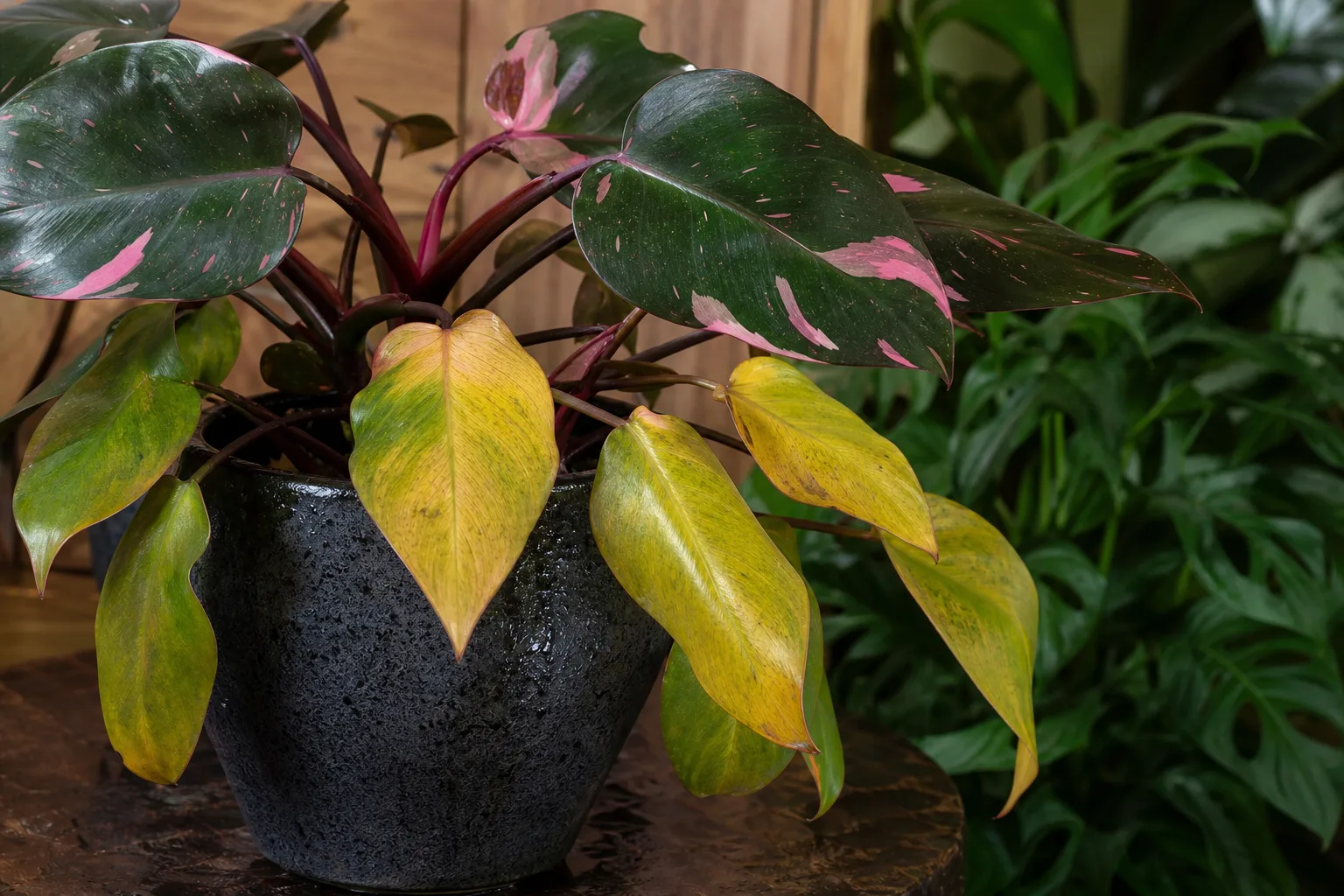
Yellow Leaves on Philodendron Pink Princess: Causes, Checks & Fixes
This guide covers yellow leaves on Philodendron Pink Princess. See also the general Yellow Leaves guide, watering, and light pages for this plant.
Yellow Leaves on Philodendron Pink Princess: Causes, Checks & Fixes
Quick answer
Yellow leaves on Philodendron Pink Princess (Philodendron erubescens ‘Pink Princess’) are rarely a fertilizer problem. On this variegated climber, the same yellow blade usually means wet roots in dim light, insufficient light slowing water use, normal aging of one old leaf, or-less often-a lookalike such as underwatering, cold drafts, spider mites, or nutrient-deficiency misdiagnosis on an expensive plant.
Read pink fade before full yellowing. Fading pink sections, long gaps between leaves, and a lean toward the window often appear days or weeks before lower blades turn fully yellow when light is too low and the pot dries slowly. That variegation–light–water trap is the signature Pink Princess pattern: pink tissue photosynthesizes less than green tissue, so the plant needs more bright indirect light than a solid-green philodendron-not less-while roots still need the mix to dry between drinks.
First step: check soil moisture 3–5 cm deep and lift the pot. If the container feels heavy and the mix is cold-damp while lower leaves yellow, stop watering until the top 3–5 cm is fully dry-see the overwatering guide for the wet-soil branch. If the pot is light with crispy brown edges, treat underwatering instead. If only one old leaf at the base fades on firm roots and predictable dry-down, aging is likely and no rescue is needed.
| Sign | Wet roots / overwatering | Low light (pink fade) | Normal aging | Underwatering |
|---|---|---|---|---|
| Which leaves | Lower, often several | Pale new + lower fade | One oldest at base | Lower; crispy edges |
| Pot weight | Heavy days after water | Normal to heavy in dim rooms | Normal | Light |
| Soil 3–5 cm | Cold-damp or soggy | Slow to dry in shade | Dry to slightly damp | Dry throughout |
| Pink pattern | May fade on stressed plant | Fading pink, long internodes | Stable on new growth | Edges brown first |
| Stem between nodes | Firm early | Firm; may lack pink streaks | Firm, pink may remain | Firm |
Use this page as the symptom entry for yellow foliage on Pink Princess. Confirmed wet-root cases escalate to root rot. Confirmed light stress with pink fade goes to not enough light. Routine prevention lives on the watering and light guides. General variegation and stem-reversion context is on the Pink Princess overview.
Why Pink Princess gets yellow leaves
Pink Princess is a variegated cultivar of Philodendron erubescens-a climbing tropical aroid that prefers partial shade and bright indirect light indoors with moist but well-drained soil. Yellowing follows how variegation changes the plant’s water and light economics, not generic “houseplant stress.”
The variegation–light–water trap. Pink sectors contain little chlorophyll, so the plant photosynthesizes less per leaf than an all-green erubescens. In dim display corners it uses water slowly while many owners keep a summer watering rhythm. Mix stays wet; roots lose oxygen; overwatering can cause root rot and yellow foliage from the bottom up. At the same time, insufficient light produces leggy growth with fewer, smaller leaves-fading pink, stretched internodes, and eventually yellow or pale blades. Two problems stack from one placement mistake.
Chronic overwatering alone still tops the list when soil stays damp for days. Wait until the top of the compost dries out before watering again; watering on a calendar while the root zone is still moist keeps climbing roots stressed. Dense peat-heavy mix in an oversized pot holds moisture around roots that need good drainage. Take care not to overwater or leave philodendrons standing in water, as saturated compost can eventually cause root rot.
Low light without wet soil yellows through pale, inefficient new growth and slow senescence of older leaves. Collectors sometimes mistake all-green new leaves for a watering crisis and add more water-deepening the trap. Iowa State Extension recommends checking soil moisture before watering rather than following a fixed schedule; intervals like every 7–10 days in active growth and every 10–14 days in winter are starting guesses for many homes, not rules-always confirm with your finger at 3–5 cm depth.
Normal aging yellows the oldest leaf one at a time near the base of a climbing stem while new marbled leaves look healthy. That pattern is fine when soil dries predictably, petioles stay firm, and pink splashes remain on recent growth.
Nutrient-deficiency misdiagnosis is common on collector plants. Lower yellow leaves on wet mix are not fixed by fertilizer. Salt buildup from overfeeding can yellow margins too-do not feed a stressed root zone.
Secondary wet-soil signals: fungus gnats hovering over perpetually moist organic mix and white mold on the surface often appear alongside overwatering yellowing. See fungus gnats on Pink Princess if adults persist after dry-down.
What yellow leaves look like on Pink Princess
Healthy Pink Princess holds glossy heart-shaped leaves with dark green and pink marbling along reddish-purple petioles. Yellowing shows distinct patterns depending on cause.
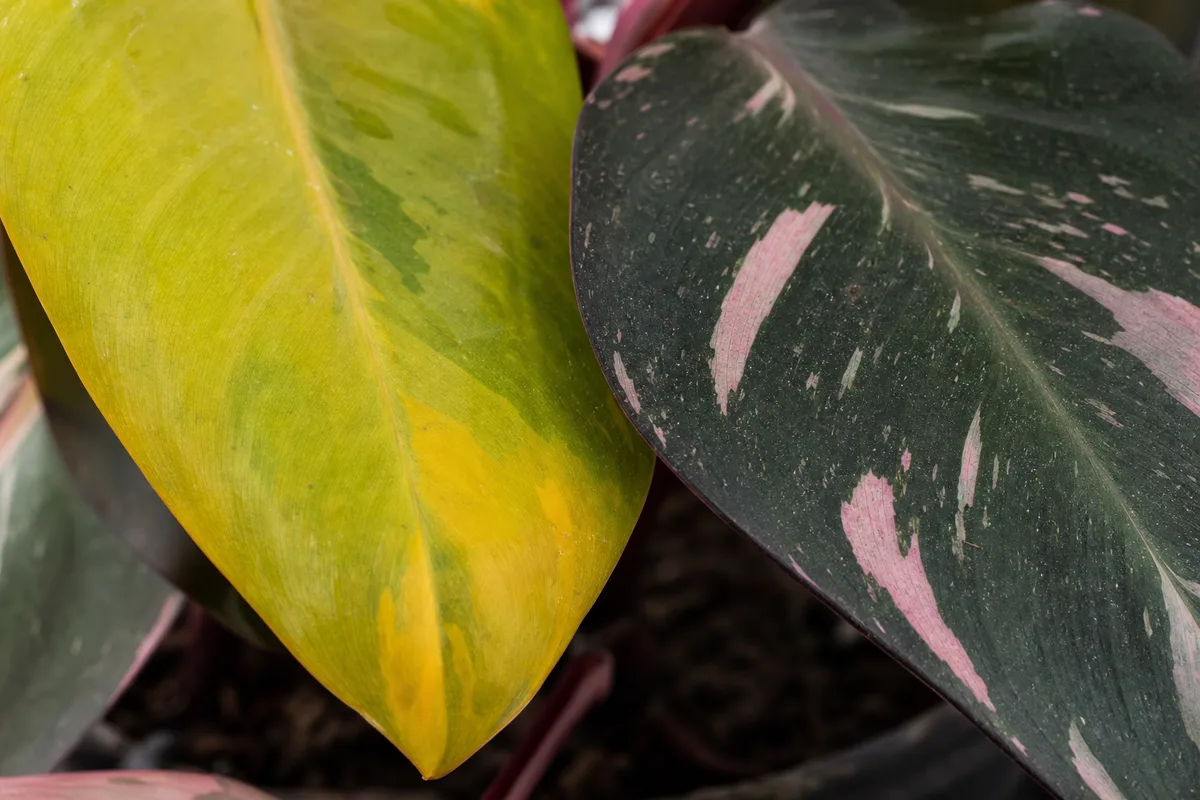
Yellow Leaves symptoms on Philodendron Pink Princess - compare with healthy tissue on the same plant.
Overwatering yellowing typically starts on lower, older leaves while the pot stays heavy. Veins may stay slightly green before the whole blade yellows. New growth may stall or emerge pale. Root rot adds soft petiole bases and a sour soil smell. Dull, light green or yellowing leaves with brown soft roots indicate overwatering damage.
Light-stress yellowing often follows fading pink sections, long internodes, and smaller new blades before full yellow. The plant leans toward the window. Soil may dry on a normal schedule, but the overall plant looks washed out. All-green new leaves on a firm stem with dry soil may be stem reversion (see below)-not the same as acute yellow-leaf stress on wet mix.
All-pink leaf collapse looks dramatic but is a separate warning: heavily pink leaves lack chlorophyll and often yellow, brown, or abort while green tissue on the same plant stays firm. Do not treat that as thirst.
Normal aging: one oldest leaf yellowing at the base over weeks while the top pushes healthy marbled foliage.
Stem reversion vs. light-stress all-green growth
Pink Princess variegation is chimeric-green and pink cell lines compete along the stem. Two situations produce all-green new leaves, and the fix differs.
Environmental (low light): new leaves emerge mostly green, internodes stretch, and pink fades on recent blades-but pink streaking often remains visible on the stem between nodes. Roots are firm, soil may dry normally or slowly. First fix: brighter indirect light per the not enough light guide and light guide-not more water.
Structural stem reversion: a stem section dominated by green cells outgrows variegated tissue because it photosynthesizes faster. Pink streaking disappears from the stem between nodes for several inches, and new leaves stay solid green even after you improve light. First fix: prune back to the last node that still shows pink on the stem or on a marbled leaf-details on the overview and pruning guide. Existing green leaves will not turn pink; only new growth after the cut reflects the change.
Yellow leaves from wet roots can also push all-green survival leaves while roots fail-check soil moisture and petiole firmness before assuming reversion.
Lookalike symptoms to rule out
| Pattern | Which leaves | Pot / soil | Leaf feel | Other clues | Likely cause |
|---|---|---|---|---|---|
| Wet-root yellowing | Lower, spreading | Heavy; cold-damp 3–5 cm | Soft on wet mix | Sour smell; gnats | Overwatering |
| Pink fade → yellow | New pale + lower fade | Normal to heavy in dim room | Thin, stretched | Long internodes; lean | Low light |
| One old leaf | Single oldest at base | Normal dry-down | Firm | Healthy new marbling | Normal aging |
| Crispy yellow edges | Lower | Light; dry throughout | Crisp | Wrinkled blade | Underwatering |
| Stippling + webbing | Speckled patches | Any | Dry spots | Underside webs | Spider mites |
| Sudden dark edges | Random | Any | Blackened margins | Draft or cold glass | Cold injury |
| Uniform pale + fed often | Older first | Any | Firm | White crust on soil | Salt / over-fertilizing |
Wilting with moist soil often means roots cannot absorb water because they are damaged-not that the plant needs another drink. For the full wet-wilt trap, see overwatering and wilting.
How to confirm the cause
Work through this inspection in order before Philodendron Pink Princess repotting guide, fertilizing, or heavy pruning:
- Soil moisture at 3–5 cm - Cold-damp or soggy mix plus yellow lower leaves points to overwatering. Dry throughout with crispy edges points to underwatering.
- Pot weight - Heavy days after watering confirms slow dry-down; light pot confirms drought direction.
- New growth quality - Fading pink, small leaves, and long internodes suggest light stress. All-green on firm dry soil with lost stem pink streaks suggests reversion.
- Petiole bases - Soft tissue at soil level means unpot and inspect within 48 hours-see root rot.
- Pattern and count - One old leaf over months on an otherwise healthy climber suggests aging. Several lower leaves yellowing together on wet mix suggests root stress.
- Stem between nodes - Pink streaking present = try light first. Pink absent for multiple nodes = consider pruning for reversion.
- Secondary signs - Fungus gnats, sour smell, or white mold on wet surface strengthen overwatering diagnosis.
If soil stays wet more than five to seven days after you stopped watering, unpot and check roots before the next soak.
The first fix to try
Match your first action to what soil and stem inspection show-not to leaf color alone.
Heavy wet pot, soft yellow lower leaves, firm stem (early overwatering): Stop watering until the top 3–5 cm is fully dry and the container feels noticeably lighter-often one to three weeks depending on pot size, mix, and light. Move to brighter indirect light if the plant sits in deep shade so the next dry cycle completes. Do not fertilize. Full branch: overwatering on Pink Princess.
Soft petiole bases, sour smell, or mushy roots on spot-check: Unpot, trim decayed roots, repot into fresh chunky aroid mix in a appropriately sized pot. Do not wait on saturated mix. Full branch: root rot on Pink Princess.
Pink fade, long internodes, pale new growth, firm roots, predictable or slow dry-down: Move to bright indirect light first-east window or filtered south/west-per not enough light and light. Reassess watering only after one dry-down cycle on the new placement.
One firm aging bottom leaf, healthy marbled new growth: Remove the spent leaf if you prefer; no watering change needed.
Light dry pot, crispy edges: One thorough soak when the top 3–5 cm is dry, drain completely, empty saucers. Branch: underwatering.
All-green new growth with no pink on stem for several nodes on otherwise healthy roots: Prune to variegated tissue after light and water are stable-see pruning.
Make one primary change at a time so you can read the plant’s response. Do not stack repot, fertilizer, and a window move on the same day.
Recovery timeline
Fully yellow leaves do not re-green or re-pink-they drop or can be snipped once spent. Judge recovery by the last two or three new leaves and pink streaking on the stem between nodes, not by repairing old blades.
After correcting mild overwatering with firm roots, yellowing often stops spreading within one to two weeks once soil oxygen returns. Confident new marbled growth typically appears within two to four weeks in warm bright conditions.
If root rot required trimming, expect four to eight weeks before the first stable post-rescue leaf-and some lost foliage may never recover. All-pink leaves that collapsed from weak chlorophyll may be replaced by more balanced marbling on the next nodes if light is adequate.
Improvement signs: yellowing stops spreading; petioles firm; mix dries predictably; new leaves show stable pink and green sectors.
Worsening signs: softening at soil line; sour smell; yellowing reaches upper growth; no new leaves for a month after corrected care-escalate to root rot protocol.
What not to do
- Do not fertilize yellow foliage on wet, stressed roots-fix dry-down and light first
- Do not increase watering because pink sectors look pale or floppy on a heavy wet pot
- Do not move directly into harsh sun to fix light-direct sunlight should be avoided and can scorch pink tissue that lacks chlorophyll to dissipate heat
- Do not prune heavily until you confirm the root cause and moisture is stable-stripping leaves from a stressed plant removes photosynthetic tissue it still needs
- Do not repot into a larger pot to “help drying”-oversized pots stay wet longer
- Do not assume nutrient deficiency on wet yellow lower leaves without a clear dry-down and feeding history
Pet safety: Pink Princess is a philodendron. Philodendron contains calcium oxalate crystals toxic to cats and dogs. Keep fallen yellow leaves out of reach; contact ASPCA Animal Poison Control at 888-426-4435 and your veterinarian if a pet chews foliage.
How to prevent yellow leaves next time
Water only when the top 3–5 cm is dry-confirm with finger, chopstick, and pot weight together. Intervals like every 7–10 days in summer and every 10–14 days in winter are home-practice starting points, not calendar rules; dim winter rooms need longer dry-down than bright summer setups. Full rhythm: Pink Princess watering guide.
Pair dry-down with bright indirect light so Pink Princess uses water efficiently and keeps pink variegation-see light guide. Use chunky well-draining aroid mix, avoid oversized pots, and empty saucers after every soak.
Watch for pink fade and internode stretch as early warnings before full yellowing. Refresh mix every one to two years. Remove spent lower leaves before pests hide in dense foliage.
When to worry
Escalate beyond simple dry-down when:
- Yellowing reaches new growth while mix stays wet
- Petiole bases soften at soil level
- Soil smells sour or stays wet more than a week after you stopped watering
- Roots are brown and mushy on inspection
- No new growth for a month after corrected watering and light
Those patterns need the root rot guide-not another week of hoping dry soil alone will fix mushy roots.
Conclusion
Yellow leaves on Pink Princess reward a habit collectors learn after one wet-soil scare: read pink fade, stem color, and soil moisture together. Fading pink in a dim corner is often the earliest signal that water use has slowed and roots are at risk-not proof the plant is hungry. Wet heavy pots need a dry-down pause; dry light pots need a soak; one aging bottom leaf on firm marbled growth needs nothing dramatic. Correct the branch that matches your inspection, then judge success by new variegated leaves-not by re-greening blades that have already yellowed through.
Related Pink Princess problems
- Pink Princess overview - Variegation economics, stem reversion, and general care hub
- Overwatering on Pink Princess - Wet-soil yellow branch in depth
- Root rot on Pink Princess - Mushy roots escalation
- Not enough light on Pink Princess - Pink fade and leggy growth
- Underwatering on Pink Princess - Crispy yellow lookalike
- Wilting on Pink Princess - Wet-wilt trap overlap
- Fungus gnats on Pink Princess - Wet-mix secondary signal
- Pink Princess watering - Dry-down rhythm and prevention
- Pink Princess light - Variegation maintenance
When to use this page vs other Philodendron Pink Princess guides
- Philodendron Pink Princess watering guide - Use for routine moisture checks before assuming yellow leaves is the main issue.
- Philodendron Pink Princess problems hub - Browse all 9 common issues on this species.
- Root Rot on Philodendron Pink Princess - Different entry point when symptoms overlap with yellow leaves.