Leaf Spot Disease on Philodendron Pink Princess: Causes
Quick answer
Leaf spot on Pink Princess follows wet foliage and poor airflow-not normal pink variegation. Isolate the plant, remove spotted leaves with clean scissors, water at soil level only, and improve spacing before considering fungicide.
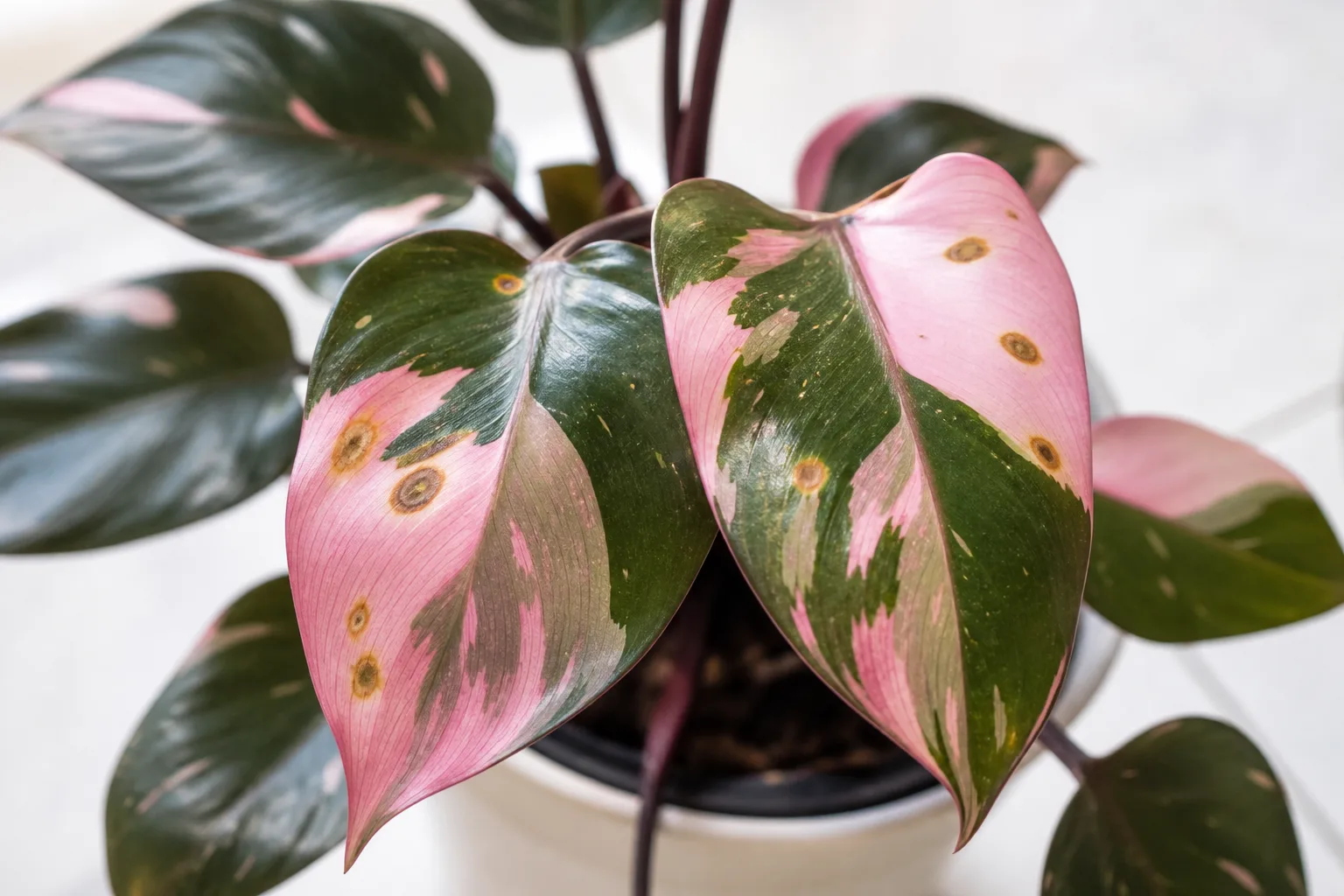
Leaf Spot Disease on Philodendron Pink Princess: Causes, Checks & Fixes
This guide covers leaf spot disease on Philodendron Pink Princess. See also the general Leaf Spot Disease guide, watering, and light pages for this plant.
Leaf Spot Disease on Philodendron Pink Princess: Causes, Checks & Fixes
Quick answer
Leaf spot disease on Philodendron Pink Princess (Philodendron erubescens ‘Pink Princess’) is almost always a fungal or bacterial infection favored by wet leaves and stagnant air-not part of the plant’s natural pink-and-green variegation. This upright climbing aroid has large heart-shaped leaves where pale pink sections show damage quickly, and NC State notes that Philodendron erubescens is susceptible to leaf spot diseases when water contacts foliage.
First step: move the plant away from neighbors, cut off leaves with active spots using sterilized scissors, and switch to soil-level watering so foliage stays dry. Improve airflow before reaching for spray products.
What leaf spot disease looks like on Philodendron Pink Princess
True leaf spots are localized lesions that enlarge or multiply over several days. They are not the stable pink splashes, burgundy undersides, or dark green zones that define a healthy Pink Princess leaf from unfurling onward.
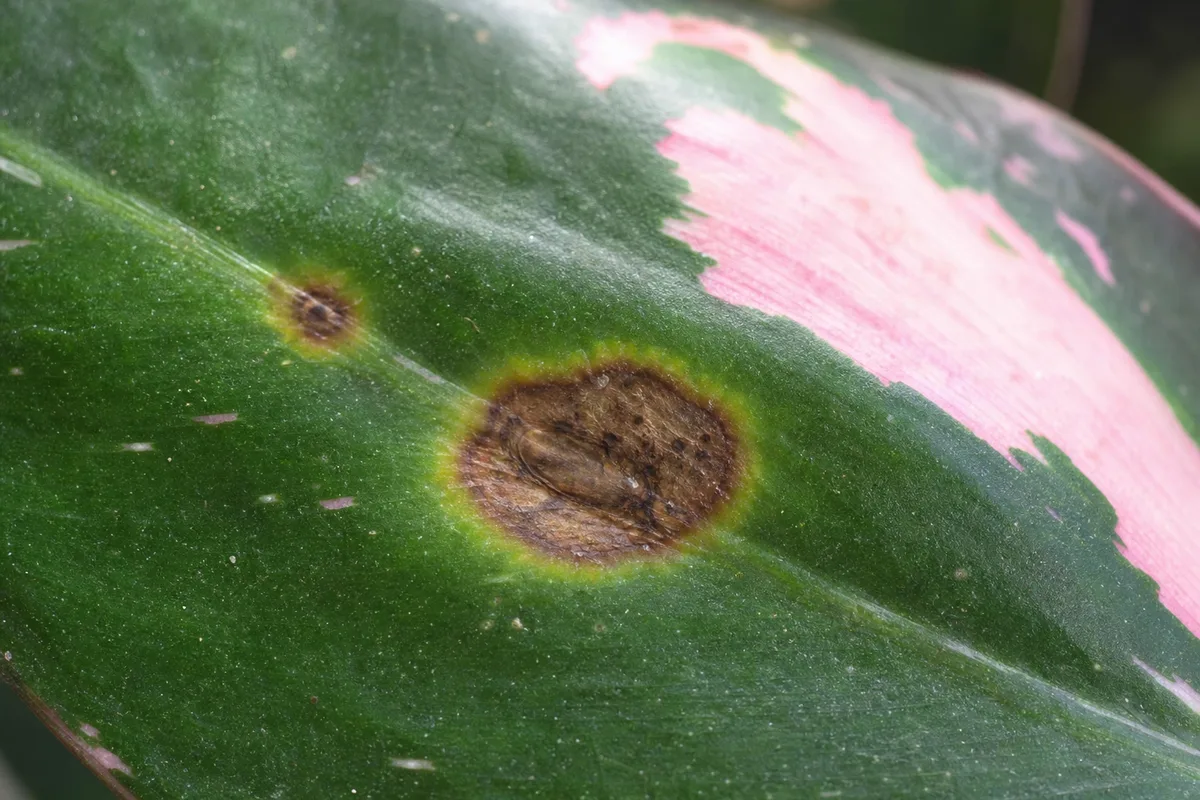
Leaf Spot Disease symptoms on Philodendron Pink Princess - compare with healthy tissue on the same plant.
Fungal leaf spots often appear as tan, brown, or black circular patches, sometimes with yellowish margins or a target-like ring pattern. Small black dots-the fruiting bodies of fungi-may appear inside dead tissue on older leaves. Lesions can merge until whole heart-shaped leaves brown and drop.
Bacterial leaf spots on philodendrons often start at margins. Penn State Extension describes translucent spots on leaf margins that become reddish-brown with yellow halos-a pattern Illinois researchers call “red edge” on heart-leaf philodendron. Tissue may look water-soaked at first, feel mushy in advanced cases, and smell rotten if bacterial blight spreads into petioles.
On Pink Princess specifically, spots often stand out sharply against pink variegation. A pale pink section may show a dark rim while neighboring dark green tissue stays clean-unlike sunburn, which usually scorches the pinkest tissue facing a hot window with crisp, dry edges rather than scattered circular lesions with halos.
Why Philodendron Pink Princess gets leaf spot disease
Pink Princess belongs to the Araceae family-a group where Xanthomonas bacterial leaf spot is a documented indoor problem on philodendrons. Several collector habits make infection more likely on this cultivar:
Wet foliage from care habits. Overhead watering, evening misting for humidity, and splashing when refilling saucers keep Pink Princess leaves damp for hours. Pathogens spread fastest when leaf surfaces stay wet and humidity is high.
Crowded climbing growth. Pink Princess is often grown on a moss pole or trellis with overlapping leaves trapping humid air between heart-shaped blades. Poor spacing slows evaporation-the same conditions extension guides cite for indoor leaf spot outbreaks.
Weak pink tissue. Pale variegated sections photosynthesize less than dark green tissue. When infection starts, pink zones may collapse or brown first-not because variegation failed, but because that tissue is thinner and more vulnerable once moisture stays on the surface.
Overwatered roots weaken resistance. Pink Princess needs the top 3–5 cm of mix to dry between drinks in Philodendron Pink Princess light guide. Chronic wet soil stresses roots while the canopy stays humid from stacked leaves shading the pot-two problems that overlap when lower leaves yellow and spot at once.
Infected debris in the pot. Fungi survive on fallen leaves and decaying matter on the soil surface. Leaving spotted foliage on the mix re-inoculates healthy leaves after every watering.
Shared tools and splash. Pruning multiple houseplants with one pair of scissors, or letting drain water splash between pots, moves bacteria and fungal spores plant to plant.
How to confirm the cause
Do not treat every brown mark as disease. Work through this order:
- Timeline - Do spots appear or spread over days? Static marks that never change are more likely physical damage, fertilizer burn, or old sun scorch on pink tissue.
- Pattern - Circular spots with halos suggest fungal infection. Reddish margin spots with yellow halos fit bacterial leaf spot on philodendrons. Uniform tip browning points to low humidity or salt buildup instead.
- Moisture history - Recent misting, overhead watering, or a humid closed corner strongly supports leaf spot over other causes.
- Leaf underside - Spider mites cause stippling and webbing, not discrete water-soaked lesions. Mealybugs leave white cottony clusters.
- Stem check - Soft, dark stems at the base suggest rot or bacterial blight overlapping with leaf symptoms. Firm purple-red petioles with surface spots alone are less alarming.
- Neighbor plants - Matching spots on nearby philodendrons or pothos confirm contagious disease rather than a one-off injury.
If only one lower leaf on an otherwise vigorous Pink Princess shows a small dry brown patch after a bump against a shelf, physical damage is more likely than epidemic leaf spot.
First fix for Philodendron Pink Princess
Isolate the plant and remove infected leaves-then keep foliage dry.
Move Pink Princess away from other plants until active spread stops. With clean, sharp scissors, cut each heavily spotted or mushy leaf at the base of its petiole. Bag and discard tissue in household trash-not indoor compost. Wipe blades with rubbing alcohol between cuts and before touching another plant.
Stop misting entirely. Water at the soil line until a small amount drains, then empty the saucer. Space vines on the pole so air can move between leaves. A low fan on indirect setting in the room helps, as long as the plant is not in a cold draft below 18°C (65°F).
Hold fertilizer until new growth looks clean. Stressed Pink Princess tissue does not need extra salts while recovering.
Step-by-step recovery
- Quarantine the affected plant at least arm’s length from other collections.
- Remove all leaves with active spots, yellow halos, or mushy tissue.
- Pull fallen debris off the soil surface; discard-it harbors spores.
- Switch permanently to soil-level watering; never wet leaves at night.
- Increase airflow by spacing plants and avoiding enclosed humid corners.
- Monitor daily for one week. Mark a reference leaf with a dot of tape and watch whether the spot enlarges.
- If fungal spots persist on new leaves after two weeks of dry culture, consider a houseplant-labeled copper soap or biofungicide per label directions-test on one leaf first because pink variegated tissue can be sensitive.
Trimming alone is often enough for mild fungal leaf spot once the environment dries. Bacterial infections that keep spreading despite dry conditions may require discarding the plant and restarting from a clean stem cutting with balanced node variegation-choose a section with mixed pink and green along the stem, not one spectacular half-moon leaf on an otherwise green vine.
Recovery timeline
Mild fungal leaf spot on a healthy Pink Princess often stabilizes within one to two weeks after you remove infected leaves and dry the foliage. New leaves should unfurl without fresh lesions and with stable variegation. Because Pink Princess grows more slowly than heartleaf types in dim conditions, you may wait two to three weeks before judging failure-give bright indirect light so recovery is not stalled by weak growth.
Spotted old leaves never green up or regain pink color in the damaged zone-judge success by clean new growth and halted spread, not by repairing spotted tissue.
Severe bacterial collapse with soft stems and foul odor rarely saves the whole plant. Take firm cuttings with visible nodes and balanced stem variegation above the affected zone as backup before discarding the base.
Lookalike symptoms
- Sunburn - Bleached or crispy patches on the pinkest tissue facing a hot window; usually not circular with yellow halos.
- Cold damage - Dark green to brown blotches between veins after cold exposure; often follows a draft event, not gradual spread.
- Fertilizer burn - Brown leaf margins and tips from salt buildup; rarely isolated round spots.
- Black spots from root rot on Philodendron Pink Princess - Yellowing from the base up with wet soil and sour smell; spots may follow systemic stress rather than surface infection.
- Natural variegation - Stable pink and green patterns present since unfurling; no enlarging margin or halo.
- Reversion stress - All-green new leaves from low light are a variegation issue, not leaf spot, unless discrete lesions appear on those leaves too.
Mistakes to avoid
Do not mist infected leaves hoping humidity will help-it keeps pathogens wet. Do not compost spotted foliage indoors. Do not apply fungicide to every brown mark before confirming disease and drying the plant first. Do not return Pink Princess to a crowded shelf while spots are still spreading. Avoid overhead showering unless you can dry leaves within an hour in bright airflow.
Wear gloves when handling cut tissue-Philodendron erubescens contains calcium oxalate crystals and is toxic to cats and dogs if chewed.
Philodendron Pink Princess care cross-check
Leaf spot prevention aligns with Pink Princess’s normal care: bright indirect light (essential for stable variegation), watering when the top 3–5 cm of mix dries, chunky well-draining aroid mix, and 55–70% humidity without wetting leaves. A Pink Princess in dim light with weekly overhead watering will stay vulnerable even after you remove spotted leaves.
Climbing pots that sit below other plants often catch splash from above-move them or water neighbors carefully. Slow winter growth can mask recovery; do not overwater while waiting for new leaves.
How to prevent leaf spot next time
Water early in the day at soil level so any accidental splashes dry quickly. Space plants for airflow. Sterilize pruning tools between specimens. Quarantine new philodendrons for two weeks before mixing collections. Remove fallen leaves from the soil surface promptly. Skip routine misting unless you run a dedicated humidifier without wetting foliage. NC State recommends watering at the base and keeping water off leaves to prevent leaf spot on Philodendron Pink Princess overview.
When to worry
Escalate if spots enlarge daily despite dry leaves, stems soften at nodes, leaves drop in clusters, or tissue smells rotten. Mild scattered spots on a few lower leaves usually respond to removal and cultural fixes. Systemic bacterial collapse with mushy stems may mean discarding the plant and propagating from unaffected cuttings with balanced stem variegation-Pink Princess is often salvaged from firm nodes when the main vine fails.
Conclusion
Leaf spot disease on Philodendron Pink Princess follows wet foliage, poor airflow, and contaminated debris-not normal pink variegation. Confirm spread over time, isolate, remove infected leaves, keep foliage dry, and judge recovery by clean new growth with stable color. Prevent recurrence with soil-level watering, spacing, clean tools, and quarantine for new plants.
When to use this page vs other Philodendron Pink Princess guides
- Philodendron Pink Princess watering guide - Use for routine moisture checks before assuming leaf spot disease is the main issue.
- Philodendron Pink Princess problems hub - Browse all 9 common issues on this species.