Leggy Growth on Mogra: Causes, Checks & Fixes
Quick answer
Leggy Mogra sends long whippy stems toward the brightest direction with sparse interior wood and blooms clustered at distant tips-usually from too little direct sun, sometimes from skipped post-flush pruning. First step: move the pot to 4–6 hours of direct sun daily (or add a grow light) before hard pruning; trim spent stems by up to one-third only after light stabilizes.
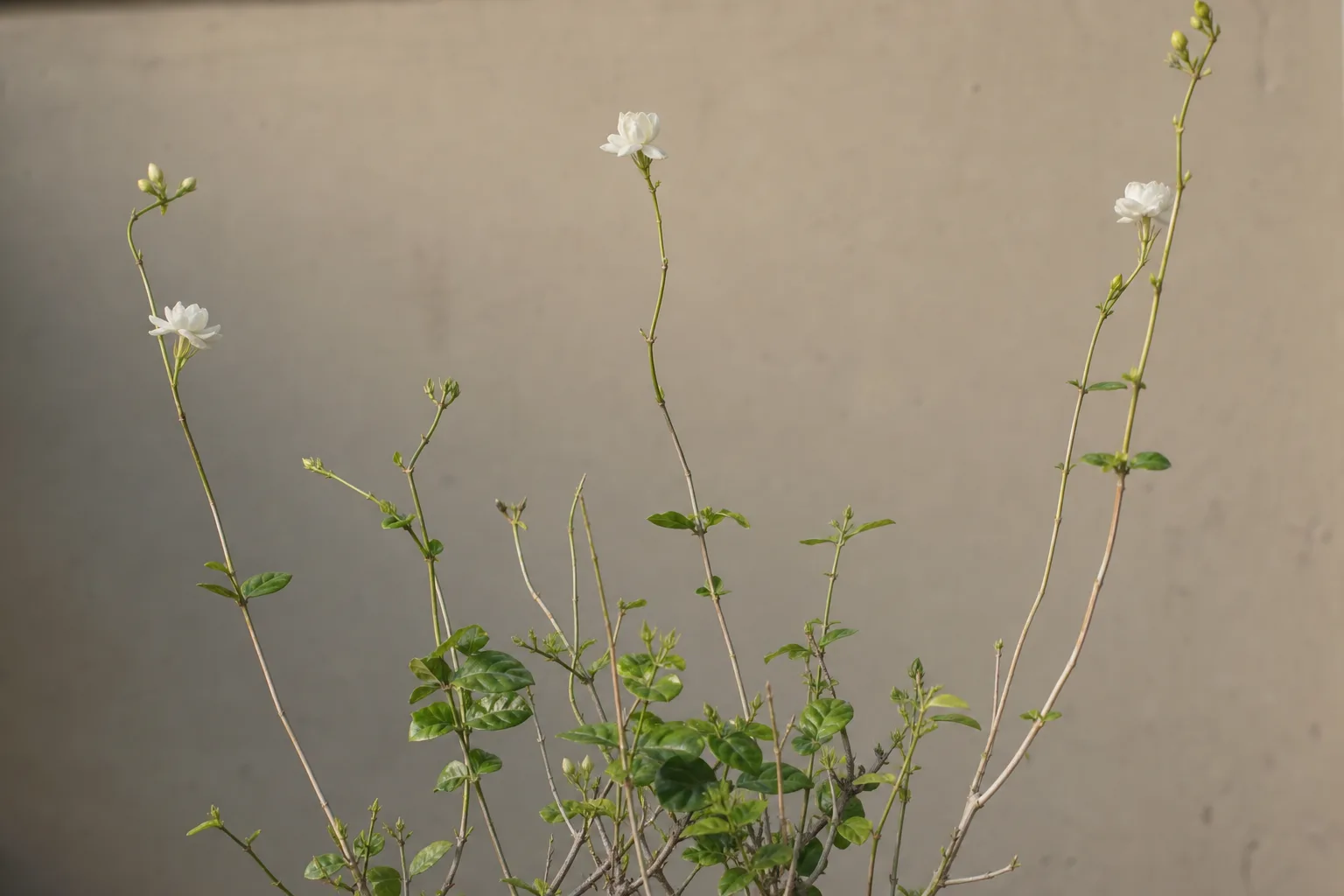
Leggy Growth on Mogra: Causes, Checks & Fixes
This guide covers leggy growth on Mogra. See also the general Leggy Growth guide, watering, and light pages for this plant.
Leggy Growth on Mogra: Causes, Checks & Fixes
Quick answer
Leggy growth on Mogra (Jasminum sambac, Arabian jasmine) is a form problem-long whippy stems, sparse interior wood, and flowers clustered at distant tips-not a sudden leaf disease. The shrub stretches toward photons when direct sun is weak, and it also races upward when post-flush pruning is skipped on an otherwise bright balcony.
First step: move the pot to a spot with 4–6 hours of direct sun on the leaves-south- or east-facing balcony, unobstructed west window, or a full-spectrum grow light 30–45 cm above the canopy for 12–16 hours daily. Acclimate shade-grown plants over five to seven days before full terrace sun. Do not hard-prune until brighter exposure has held for about two weeks and new shoots look firm.
This page covers leggy form-etiolation, tip-heavy flowering, and whippy stems after missed maintenance cuts. If your main symptom is dim placement, window lean, and empty bud tips with no blooms at all, start with the not enough light guide instead; pruning in deep shade cannot produce compact flowering wood.
What leggy growth looks like on Mogra
Leggy Mogra is structural stretch you can read from arm’s length-different from a single yellow leaf or a dropped bud cluster.
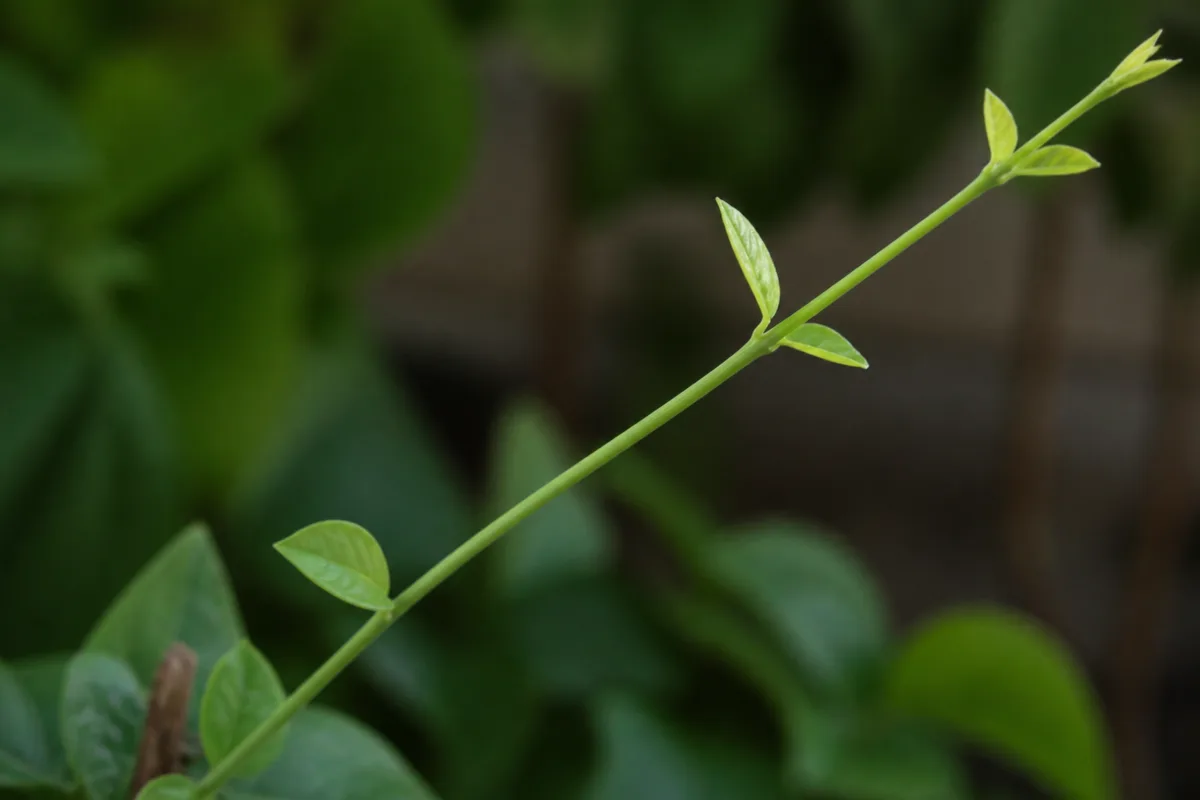
Leggy Growth symptoms on Mogra - compare with healthy tissue on the same plant.
Typical leggy-growth signs:
- Whippy, elongated stems with gaps of 4–6 cm or more between glossy leaf pairs on the newest growth
- Strong lean toward the brightest window, balcony edge, or neighboring pot
- Sparse interior-outer stems reach while inner branches stay bare or leaf-only
- Flowers only at stem tips-tight white cymes open on distant wood while shaded sections inside the canopy carry no buds
- Smaller leaves on stretched shoots compared with compact sun-grown side branches
- Soft upward growth that outpaces lateral branching when post-flush pruning stopped for a season
Compare with not enough light on Mogra: chronic shade usually adds empty terminal tips (no buds forming at all), uniform small pale leaves, and placement fewer than four hours of direct sun. Leggy form from missed post-flush pruning can appear on a reasonably sunny terrace-the plant simply sent long shoots after the last flush without shortening spent stems.
Mogra is a twining, shrubby evergreen-not a moss-pole vine. Leggy specimens show bare woody sections and tip-heavy bloom, not aerial roots searching for support.
Why Mogra gets leggy growth
Two causes stack on most balcony and indoor Mogra: insufficient direct sun (primary) and skipped post-flush pruning (secondary). Nitrogen excess and overwatering on Mogra in dim corners can worsen stretch but rarely create the classic whippy-tip flowering pattern alone.
Insufficient direct sun (primary cause)
Mogra evolved in tropical Asia as a sun-loving flowering shrub. It wants full sun to part shade-roughly four to six hours of direct sun daily for prolific flowering. In dim rooms, shaded courtyards, or bright-indirect-only windows, stems elongate to reach stronger light. Leggy growth and diminished flowering are classic when exposure falls below what the species needs for compact wood.
The biology is etiolation: weak light triggers longer internodes and thinner stems so leaves intercept more photons. Mogra may stay glossy green for months while bloom biology quietly fails-fragrance appears only on occasional blooms at the ends of stretched shoots.
Missed post-flush pruning (secondary cause)
Even well-lit Mogra sends long whippy stems toward the brightest edge if you skip maintenance after flowering. Left unpruned, the plant flowers at tips while the interior becomes a leafy shell with fewer buds-exactly the pattern described in the pruning guide. Mogra produces its main show on relatively young shoots made during warm active growth; without post-flush shortening, energy stays in vertical race rather than lateral flowering wood.
The Royal Horticultural Society jasmine guide recommends cutting back flowered stems to a strong side-shoot-standard practice for shrubby Arabian jasmine in pots. Waiting too long after a flush wastes warm weeks; pruning in deep shade without fixing light first produces more soft stretch, not buds.
When nitrogen or moisture add stretch
Heavy nitrogen feeding pushes soft vegetative growth at the expense of flowers. That pattern shows lush leaves with few buds-not always strong lean. Overwatering in a dim corner slows photosynthesis and can yellow lower leaves while upper stems still reach-confirm soil moisture before treating stretch as light alone.
Lookalike symptoms to rule out
- Not enough light (no buds at all) - Empty terminal tips, dim placement, strong window lean. See not enough light when sun hours are the main question.
- No flowers despite compact leaves - Buds never form; may be maturity, pruning timing, or potassium-not etiolation shape alone. See no flowers.
- Bud drop after buds form - Plump buds yellow and fall; stabilize moisture per bud drop before blaming legginess.
- Slow growth without strong lean - Uniform stalling may be cool temperatures, root-bound pot, or winter semi-rest. See slow growth if sun hours are already adequate.
- Overwatering in shade - Yellow lower leaves, sour soil, heavy pot; fix drainage before moving to full sun with soggy mix.
| Pattern | Likely cause | Key check |
|---|---|---|
| Long stems, empty tips, hard lean | Low direct sun | Fewer than 4 h sun on leaves |
| Blooms only at whippy tips, sunny site | Missed post-flush prune | Last flush ended weeks ago with no trim |
| Lush leaves, no buds, minimal lean | Nitrogen excess | Recent high-N fertilizer |
| Yellow leaves + wet soil in dim corner | Overwatering / root stress | Pot stays heavy for days |
How to confirm the cause
Work through these checks in order so you fix light before scissors when shade is the limiter:
- Direct sun hours on foliage - Count unfiltered sun on leaves between mid-morning and mid-afternoon. Fewer than four hours on most days confirms light-driven etiolation; four to six hours with tip-only blooms points toward missed pruning.
- Internode measurement - Mark a new shoot tip today. Measure the gap between two leaf pairs after two weeks of unchanged placement. Gaps lengthening beyond 4–5 cm on windowsill Mogra confirm active stretch; stable gaps after a sun move suggest the fix is working.
- Bloom distribution - Flowers clustered only on the longest outer stems while interior wood is bare fits leggy form plus pruning backlog. No buds anywhere fits not enough light or no flowers better.
- Pruning history - Note when the last bloom flush faded. If spent stems were never shortened and the plant sits in adequate sun, maintenance legginess is likely.
- Soil moisture and pot weight - Wet soil with soft lower stems in a dim pot suggests overwatering layered on stretch; very dry soil with wilt points to drought. Fix moisture if either is true before heavy pruning.
- Rotate test - Turn the pot 180° and watch new growth for one week. Strong one-sided lean toward the previous bright side confirms phototropism from marginal light.
Confirmed leggy growth from shade fits when long internodes, lean, and tip-heavy or absent blooms match fewer than four hours of direct sun. Confirmed maintenance legginess fits when sun hours are adequate, blooms appear only on distant tips, and post-flush pruning was skipped for one or more cycles.
First fix: increase direct sun before heavy pruning
Move the pot to the brightest location with 4–6 hours of direct sun on the leaves-south- or east-facing balcony, unobstructed west window with afternoon shade in peak summer heat, or the sunniest indoor sill available.
If Mogra lived in deep shade indoors or under dense tree cover, acclimate over five to seven days: add one to two hours of stronger sun per day, or pull back from harsh afternoon glass if bleached patches appear on glossy leaves. Plants already receiving partial balcony sun can usually move to a sunnier tier in one step.
No suitable outdoor or window spot? Add a full-spectrum LED grow light 30–45 cm above the canopy, on a timer for 12–16 hours daily. Limit total daily light to about 16 hours when combining artificial and natural exposure.
That single relocation or light upgrade is the first fix when shade drives stretch. Hold hard pruning until new shoots under brighter exposure look firm and green for about two weeks-cutting stressed shade wood before light improves often produces more soft elongation. Details on window direction and seasonal moves live in the Mogra light guide.
Pruning whippy stems after light improves
Once exposure is adequate-or if sun was never the limiter-reshape leggy Mogra immediately after a bloom flush fades:
- Remove dead, damaged, or diseased wood first - Cut back to the first node with firm green tissue before any cosmetic shortening.
- Shorten spent flowering stems by up to one-third, cutting 5–10 mm above a healthy outward-facing node with a strong side-shoot below the cut.
- Tip-pinching - On overly long soft shoots between flushes, remove the top 2–5 cm above a leaf pair to force lateral branches.
- Thin the interior - Take out weak, crossing stems that block light from the center.
- Step back - Mogra looks sparse right after a post-flush trim; pause before a second round in the same session.
Limit live-wood removal to about one-third per session on container plants. Split harder reduction across two post-flush windows rather than one mid-season scalping. Full technique, pest checks before cutting, and timing through winter rest are in the pruning guide.
Do not prune while buds are swelling on the next flush-wait until open flowers brown and drop. Emergency deadwood removal is the exception.
Recovery timeline
One to two weeks after brighter exposure: New tips should show slightly shorter internodes; leaning should slow once you rotate the pot weekly. Old elongated internodes do not shrink-only new growth compacts.
Two to four weeks: Side shoots break below pruned nodes on well-lit plants. The silhouette looks less one-sided. Faster on a summer balcony, slower indoors during winter short days.
Two to six weeks (warm active growth): Tight white bud clusters may appear on fresh lateral wood after post-flush pruning. Missouri Botanical Garden notes Arabian jasmine may be pruned as needed to maintain shape-for leggy recovery, that means repeating light post-flush work through the warm season.
Signs the fix is working: Shorter gaps on new nodes, upright side branches, firm dark green new leaves, and fragrant night-opening blooms on wood closer to the crown-not only at distant tips.
Signs the problem is worsening: Continued stretch despite verified 4–6 hours sun; yellowing lower leaves with wet soil in the same dim corner; soft stems at the base; no tighter growth four weeks after relocation and pruning. Those warrant root inspection or a return to the not enough light checklist-not assuming more time alone.
What not to do
Do not hard-prune in deep shade hoping for bushiness-Mogra responds with more soft stretch, not flowering wood. Do not fertilize heavily in a still-dim spot; nitrogen pushes floppy elongation when light was the limiter.
Do not expect old stretched internodes to shorten after sun improves; only new shoots compact. Avoid jumping from indoor shade to hot afternoon west glass in one day without acclimation.
Do not confuse leggy form with bud drop-if buds formed and fell, stabilize moisture per the bud drop guide before blaming stretch alone. Do not discard the plant after one week if only old stems look whippy; judge recovery on new growth after light and post-flush pruning.
How to prevent leggy growth next time
Match Mogra’s bloom-driven rhythm: adequate direct sun, post-flush pruning, and minimal disturbance during bud swell.
- Place outdoor pots in full sun to part shade-four to six hours of direct sun through the warm season. On Indian balconies, south and east exposures usually outperform shaded courtyards; adjust for afternoon heat in peak summer.
- Prune immediately after each bloom flush so flowers stay on reachable, well-lit wood rather than only at the ends of long stems-the pruning guide shows node placement.
- Rotate weekly when light comes from one direction so stems do not lean into a one-sided shell.
- Install a grow light before winter short days or monsoon overcast weeks-not after stretch is severe.
- Hold high-nitrogen feed when the plant is already pushing soft vegetative growth in marginal light; see the fertilizer guide after sun and pruning rhythm are stable.
When bringing container Mogra indoors for frost protection, move it to the brightest window or add supplemental light the same week. Cross-check ongoing placement with the Mogra light guide and the overview for seasonal rhythm.
When to worry
Leggy form alone rarely kills established Mogra quickly. Worry when soft stems, sour soil, and widespread yellowing appear together in a dim, wet corner-root decline progresses faster than stretch alone.
Worry when no tighter new growth appears within four weeks after verified 4–6 hours of direct sun, equivalent grow light, and one post-flush prune-inspect roots for mushy brown tissue before assuming the window is still too dim.
If better light and corrected pruning still fail to produce buds through a full warm season, review timing and feeding in no flowers-chronic bloom failure despite good sun may need division of the healthiest outer shoots rather than more tip pruning on shaded interior wood.
When to use this page vs other Mogra guides
- Mogra watering guide - Use for routine moisture checks before assuming leggy growth is the main issue.
- Mogra problems hub - Browse all 20 common issues on this species.
- Not Enough Light on Mogra - Different entry point when symptoms overlap with leggy growth.
- Slow Growth on Mogra - Different entry point when symptoms overlap with leggy growth.
- Yellow Leaves on Mogra - Different entry point when symptoms overlap with leggy growth.