Overwatering on Mogra: Causes, Checks & Fixes
Quick answer
Overwatered mogra sits in wet mix too long-lower leaves yellow, buds drop, and the shrub wilts despite damp soil, especially in cool indoor rooms. First step: stop watering until the top 2–3 cm of mix are dry and confirm drainage holes are open.
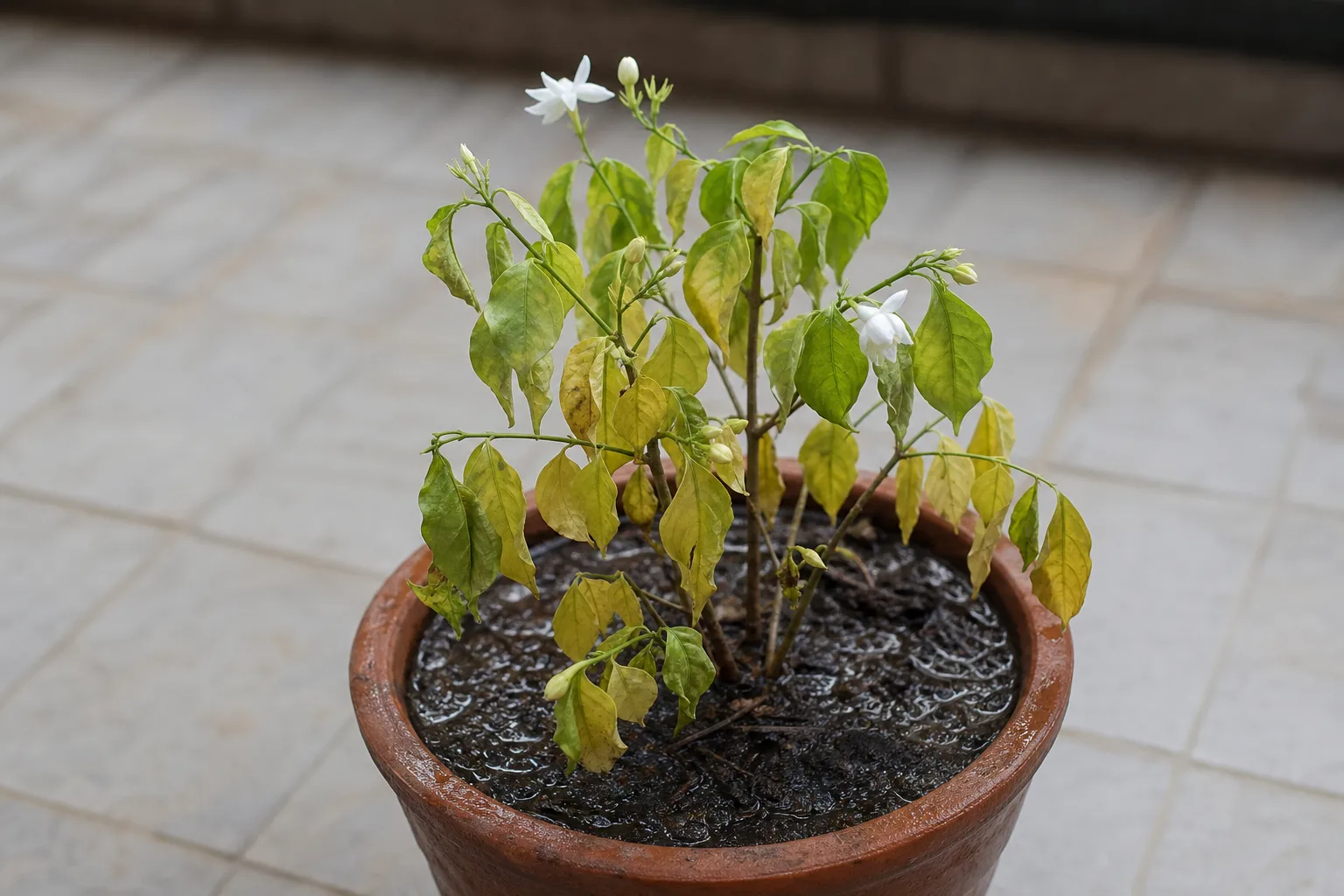
Overwatering on Mogra: Causes, Checks & Fixes
This guide covers overwatering on Mogra. See also the general Overwatering guide, watering, and light pages for this plant.
Overwatering on Mogra: Causes, Checks & Fixes
Quick answer
Overwatered mogra (Jasminum sambac - Arabian jasmine, Mallige, Motia) sits in wet mix too long. Fine roots lose oxygen, uptake fails, and the compact flowering shrub shows yellow lower leaves, dropped buds, and limp foliage-even though soil feels damp. The wilting paradox is the tell: damaged roots cannot drink, so the plant looks thirsty while the mix is wet. If that pattern sounds familiar, read wilting on mogra for the full dry-versus-wet wilt fork before you pour again.
First step: stop watering until the top 2–3 cm of mix are dry. Confirm drainage holes are open and no saucer or decorative cachepot is holding standing water. Mogra wants loose, humusy, evenly moist but well-drained soil-chronic saturation violates that pairing and is the fastest route to root decline on a container shrub grown for fragrance.
Overwatering vs. underwatering vs. related problems on mogra
These pages overlap in symptoms but answer different questions. Use this scope line before you chase the wrong fix.
This page (overwatering) owns the wet side: heavy pot, moist mix at 2–3 cm depth, soft yellow leaves, and limp stems on damp soil. Your first action is dry-down, not another soak.
Underwatering on mogra owns drought: light pot, dry mix throughout, crisp or curled leaves, and wilt between waterings. First action is one thorough soak, then resume finger tests.
Wilting on mogra handles acute collapse regardless of cause-the pot-weight decision path that separates thirst from root failure in hours, not days.
When lower leaves yellow on a heavy wet pot, stay on this page. When the pot is light and soil is crumbly, switch to underwatering. When mushy roots appear on inspection, escalate to root rot-dry-down alone is no longer enough.
What overwatering looks like on Mogra
Mogra does not always announce wet roots with a single obvious sign. Early overwatering is subtle; advanced cases overlap with root rot.
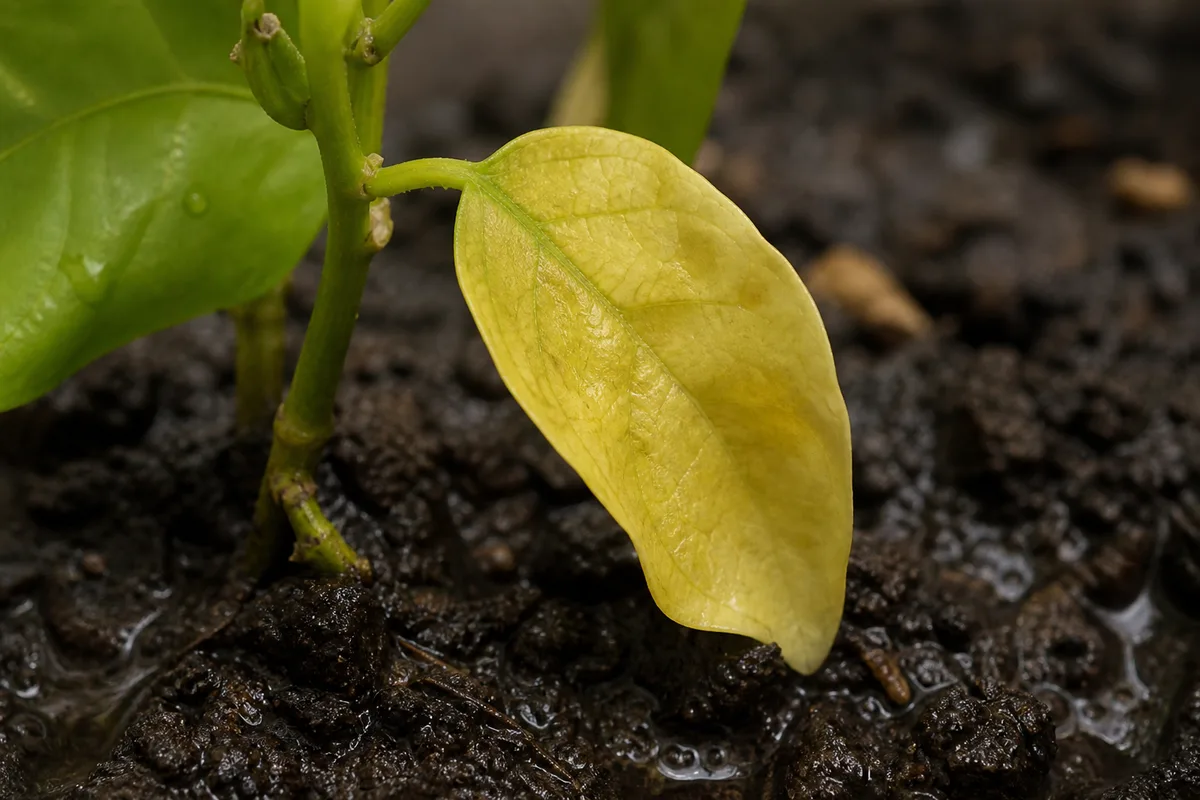
Overwatering symptoms on Mogra - compare with healthy tissue on the same plant.
Typical overwatering pattern on mogra:
- Yellow leaves, often starting on lower, older foliage but spreading when saturation is chronic
- Dropped buds before bloom, especially when wet mix pairs with cool temperatures and low light
- Limp, drooping stems and leaves even though mix at 2–3 cm depth is still moist
- Soft or darkening tissue at the crown on severe cases
- Soggy mix that stays wet for many days after one watering
- White mold or algae on the soil surface - see mold on soil
- Fungus gnats hovering near the pot-larvae thrive in constantly moist growing medium
- Sour or musty smell when you lift the plant or disturb the surface
Healthy mogra leaves are firm and deep green. Overwatered tissue often turns soft yellow rather than the crisp, papery yellow you see with severe underwatering.
The wilting paradox is the hallmark: roots can suffocate in waterlogged soil, so the shrub looks thirsty while the mix is wet. Watering again makes the problem worse.
Why mogra gets overwatered
Mogra is a tropical flowering shrub that growers often treat like a moisture-loving foliage plant-watering every two or three days year-round regardless of season, light, or pot size. That habit backfires indoors because evaporation depends on temperature, airflow, mix texture, and whether buds are actively swelling-not the day of the week.
Calendar watering vs. bloom-season demand
During active growth and flowering peak, mogra transpires heavily and may need water every two to three days on a sunny balcony when the top 2–3 cm of mix dries. The same pot in a cool, dim AC room in January may need only one drink every seven to fourteen days. A summer schedule applied through winter keeps roots saturated exactly when the Royal Horticultural Society advises watering sparingly for greenhouse-grown J. sambac during slower growth.
Bloom-season fear compounds the problem. Growers who lost buds to a dry weekend often pour again before checking depth-UCANR extension guidance on J. sambac notes the species does not tolerate too much moisture and recommends watering thoroughly, then allowing the mix to dry between sessions. Adding water when mix is already wet suffocates roots and drops buds anyway.
Cool rooms and slow evaporation
Low-light indoor mogra is the highest-risk profile for overwatering: the plant uses less water, but owners often maintain summer frequency out of habit. AC-cooled bedrooms pull moisture from leaves faster than soil dries in a glazed ceramic pot, which can trick you into watering wet mix because foliage looks stressed. If the pot stays heavy for five days while lower leaves yellow, pause watering and reassess light and drainage before adding another drink.
Oversized pots and heavy mix
Oversized pots surround a modest root ball with a large wet zone. Mix stays damp at the center long after the surface looks acceptable-a common trap for mogra recently moved into a “roomier” decorative container. Peat-heavy or moisture-retentive mixes without enough perlite or coarse grit hold water the shrub never reaches, violating the moist but well–drained loam baseline RHS lists for J. sambac.
Decorative cachepots and blocked drainage
Large decorative cachepots without drainage look beautiful but trap water at the bottom. Mogra roots rot faster when standing water re-saturates the lower root zone after every top watering. If your shrub sits inside an outer pot, lift the nursery container to water, drain fully, then return it-never let runoff pool in the cachepot.
Fear of bud drop from drought
Fragrance-focused growers often overcorrect after one dry spell. Bud drop can follow drought stress and soggy soil alike-but adding water when mix is already wet suffocates roots and drops buds anyway. The safer response is a moisture check at 2–3 cm depth, not another pour. For drought-only bud loss, see bud drop on mogra.
How to confirm the cause
Work through these checks before repotting or trimming. The goal is to separate wet wilt (overwatering) from dry wilt (underwatering) and advanced root rot.
- Soil moisture at depth - Press your finger 2–3 cm into the mix near the pot edge, not against the stem. Wet at that depth days after watering confirms saturation, not a one-time mistake. A wooden skewer to mid-pot depth confirms when the surface colour lies.
- Pot weight - Lift the container. A heavy pot with limp foliage points to waterlogged mix; a light pot with limp leaves suggests underwatering instead.
- Leaf pattern - Soft yellow on multiple leaves plus wet soil fits overwatering. Crisp, curled leaves with dry soil fits drought.
- Stem and crown firmness - Pinch lower stems near the soil line. Firm green tissue on wet soil still warrants stopping water; soft, hollow, or sour-smelling crown tissue means escalate toward root inspection.
- Drainage check - Water should exit holes within minutes. Saucer water sitting for hours means roots may be standing in liquid.
- Season and light - Note whether the shrub is in cool winter semi-rest or active summer flowering. Dim, cool conditions extend drying time and make your usual schedule excessive.
- Root spot-check (if unsure) - Slide the plant out gently. Healthy mogra roots are firm and white or tan. Brown, slimy roots that collapse between fingers confirm advanced damage-see the root-rot guide next.
Confirmation decision table
| What you observe | Most likely cause | First action | Urgency |
|---|---|---|---|
| Heavy pot, wet mix at 2–3 cm, soft yellow leaves, wilt on wet soil | Overwatering | Stop watering until dry-down target is met | Routine - dry-down path |
| Light pot, dry mix throughout, crisp yellow lower leaves, wilt between waterings | Underwatering | One thorough soak, then resume dry-down checks | Routine - soak path |
| Wet mix, wilt persists 24+ hours, sour smell, soft crown tissue | Advanced root rot | Unpot, trim mushy roots, repot into fresh well-drained mix | Same-day - root-trim path |
| Leggy shrub, small pale leaves, but mix dries normally within a week | Low light, not excess water | Improve light before increasing watering | Routine - placement fix |
| Bud drop on wet mix during cool winter rest | Chronic overwatering in semi-rest | Reduce winter frequency; wait for 2–3 cm dry-down | Routine unless crown softens |
| Every branch yellowing, mix wet 10+ days, mushy roots on unpotting | Severe rot | Root-trim repot or propagation salvage from healthy upper stems | Urgent - salvage path |
If the mix is dry throughout, the pot is light, and leaves are crispy, underwatering is more likely. Do not withhold water further without checking.
First fix for Mogra
Stop watering until the top 2–3 cm of mix are dry.
That single pause lets oxygen return to the root zone and stops the cycle of wet soil → failed uptake → “it looks thirsty” → more water. Move the pot to brighter indirect light if it has been in deep shade-faster photosynthesis uses water and helps the mix dry evenly without scorching tender mogra foliage.
Empty any saucer water. If the plant sits inside a decorative outer pot, pull the nursery pot out so air reaches the bottom holes.
Do not fertilize, mist heavily, or repot on day one unless the crown is already soft or roots are clearly mushy on inspection. Most early overwatering cases stabilize with dry-down plus better light alone.
Step-by-step recovery
If symptoms are mild (yellowing leaves, wet mix, firm stems):
- Hold water until the top 2–3 cm are dry, then water thoroughly once and pour off excess from the saucer within 30 minutes.
- Adjust placement - Bright light with some direct morning sun speeds recovery on flowering shrubs.
- Remove spent leaves - Yellow foliage will not re-green; snip at the base for a cleaner look once the plant is stable.
- Monitor new growth - Fresh green shoots at branch tips mean roots are working again.
If symptoms are moderate (persistent wet mix, multiple yellow leaves, fungus gnats):
- Scrape the top inch of moldy or gnat-infested surface soil and discard it.
- Let the pot dry until mix at 2–3 cm is dry-this may take one to two weeks in cool rest rooms.
- Set yellow sticky traps near the pot to reduce adult gnats while soil dries - see fungus gnats on mogra.
- Resume watering only when the finger test passes; never on a fixed weekday.
If symptoms are severe (soft crown, sour smell, mushy roots on unpotting):
- Unpot and rinse roots under lukewarm water.
- Trim all brown, mushy roots with clean scissors, keeping firm white or tan tissue.
- Repot into fresh, well-drained mix with perlite per the mogra soil guide in a pot only slightly larger than the trimmed root ball-one inch wider at most, with drainage holes.
- Wait five to seven days before the first light watering so cut roots callus.
- Keep the shrub cool and bright while roots re-establish-avoid fertilizing until new growth is firm.
Recovery timeline
Stabilization often takes one to two weeks after you stop watering and the mix dries-wilting should ease before new leaves appear.
New green shoots at branch tips are the best success signal. Expect them in two to four weeks during spring or summer active growth; winter recovery may take longer in cool, dim rooms.
Old yellow leaves will not turn green again. They may drop on their own or stay until you trim them.
Full shrub fullness and the next flower flush rebuild over several months as nodes push new growth. Severe root loss delays bloom until the following season even when the plant survives.
Worsening signs: crown tissue softens further after dry-down, yellowing spreads up every branch, or new leaves emerge small and pale then collapse-those point toward active rot, not simple overwatering. Escalate to the root-rot guide.
Lookalike symptoms and causes to rule out
- Underwatering - Light pot, dry mix throughout, leaves crisp or curled with brown edges; deep soak once, then resume dry-down checks per the underwatering guide.
- Low light alone - Leggy growth with small pale leaves but dry, healthy mix; move closer to a window rather than watering more.
- Normal old-leaf drop - One or two lower yellow leaves on an otherwise firm plant with appropriate dry cycles; no action beyond removing the leaf.
- Root rot (advanced overwatering) - Same wet-soil wilting but with mushy roots and crown decay; requires trimming and repotting, not dry-down alone.
- Cold draft stress - Darkened or limp leaves after exposure to open windows during winter; soil may be appropriately moist-fix placement, not watering volume.
- Bud drop from drought - Dry, light pot with aborted buds; differs from bud drop on chronically wet mix-see bud drop on mogra.
What not to do
Do not water because leaves look limp when soil is already wet-that feeds the failure loop described in the mogra watering guide. Avoid repotting into garden soil or a much larger pot; both hold excess moisture around mogra roots.
Do not fertilize a waterlogged plant; salts on damaged roots add stress. Skip misting as a fix; it does not dry wet roots and can worsen fungal issues when airflow is weak.
Do not assume winter semi-rest needs the same volume as summer bloom-reduce frequency when growth slows and mix stays wet longer in cool rooms.
When unpotting, wear gloves if sap irritates your skin.
How to prevent overwatering on Mogra
Match water to soil dryness, not the calendar. Water thoroughly when the top 2–3 cm of mix are dry, then never let houseplants sit in standing water-empty saucers within 30 minutes every session.
Use well-drained potting mix with perlite and pots with open drainage per the soil guide. Size up only one inch at a time when repotting so excess mix does not stay wet around a modest root ball.
Reduce frequency during cool winter semi-rest or dim rooms-many indoor mogra need half the summer watering rate when growth slows. Lift the pot before you pour; a noticeably lighter container means the dry-down target is met.
| Season / setting | Dry-down probe depth | Typical indoor interval |
|---|---|---|
| Active growth and flowering peak, bright room | Top 2–3 cm dry | Every 2–4 days; more often in small terracotta on sunny balcony |
| Winter semi-rest, cool dim room | Top 2–3 cm dry | Every 7–14 days; longer in AC-cooled bedrooms |
| Grow-light winter room (warmer, brighter) | Top 2–3 cm dry | Every 4–6 days-light extends drying but still below summer rate |
| Outdoor balcony, peak summer heat | Top 2–3 cm dry | Every 1–3 days; check daily on exposed terraces |
For the full seasonal framework, finger test, and pot-weight protocol, use the mogra watering guide. Scout for fungus gnats if mix stays chronically moist-the adults are a clue that the root zone has been too wet too long.
When to worry
Escalate immediately if stems dent or soften at the crown, soil smells rotten, or more than a third of roots are mushy on inspection. Those signs mean root rot is active-dry-down alone is unlikely to save the plant.
Also act quickly when buds drop on chronically wet mix during winter semi-rest, yellowing spreads up the shrub within a week, or wilt persists 24 hours after mix is evenly moist. Persistent wet wilt is not thirst-it is root failure underway.
Slow yellowing on one or two lower leaves with firm stems and mix that dries normally within a week can wait for a schedule adjustment aligned to season.
If every branch yellows while mix stays wet for ten or more days, treat as urgent even before repotting-propagation cuttings from healthy upper stems may be the only salvage path on a severely rotted root ball.
Escalation summary: which path to take
Use this closure checklist instead of guessing after yellow leaves appear:
Dry-down path (most cases) - Firm stems, wet mix, no sour smell. Stop watering until probe depth is met, improve light, empty saucers. Resume one thorough soak when dry. Re-check in one to two weeks for new shoots at branch tips.
Root-trim repot path (same day) - Soft crown tissue, sour mix, or mushy roots on spot-check. Unpot, trim decay, repot into fresh well-drained mix in a pot sized to the root ball. Wait five to seven days before the first light drink.
Propagation salvage path (urgent) - Every branch yellowing, mix wet ten-plus days, root ball mostly collapsed. Take healthy cuttings from firm upper stems before the crown fails completely; follow the root-rot guide for trim-and-repot on whatever firm tissue remains.
When in doubt after dry-down, lift the pot again. A heavy container with limp leaves after two weeks of withheld water means roots are still failing-not that the shrub needs more water.