Yellow Leaves on Janet Craig Dracaena: Causes, Checks &
Quick answer
Yellow leaves on Janet Craig Dracaena usually mean overwatering-especially in low-light offices where the pot stays wet for weeks. Check soil moisture deep in the pot before watering again; a single yellow lower leaf on a firm cane is often normal aging.
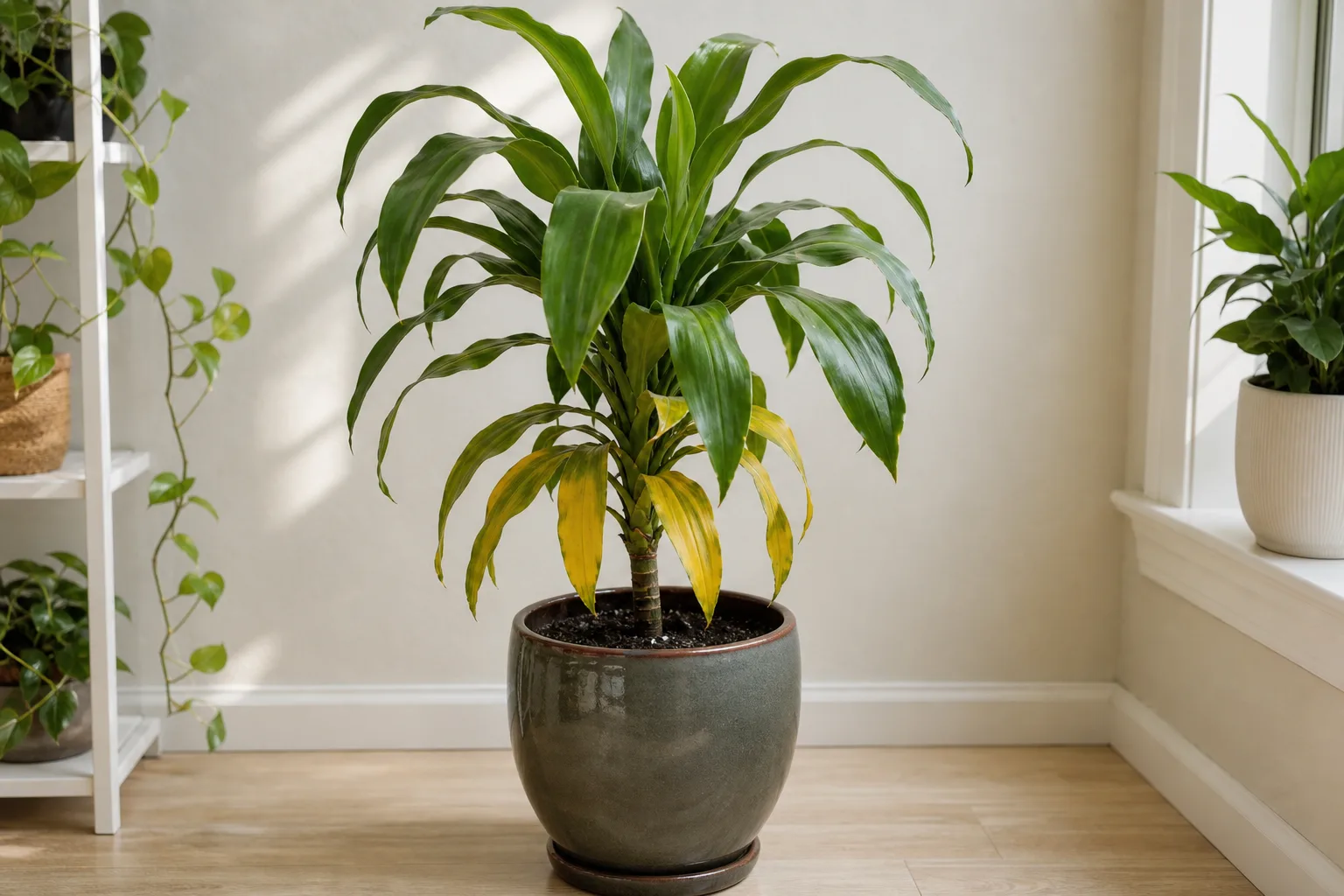
Yellow Leaves on Janet Craig Dracaena: Causes, Checks & Fixes
This guide covers yellow leaves on Janet Craig Dracaena. See also the general Yellow Leaves guide, watering, and light pages for this plant.
Yellow Leaves on Janet Craig Dracaena: Causes, Checks & Fixes
Quick answer
Yellow leaves on Janet Craig Dracaena (Dracaena deremensis ‘Janet Craig’) are most often a watering problem, not a nutrient mystery. In low-light positions where this plant is commonly placed-roughly 250 to 500 lux in many offices-metabolism slows and the mix stays wet far longer than owners expect. A summer weekly watering rhythm becomes chronic overwatering without any extra pours.
First step: check moisture at half pot depth before you change anything. If the mix is wet and the pot feels heavy, stop watering. If it is bone dry throughout and the pot is light, follow the drought branch below. For species baseline, see the Janet Craig overview.
A single yellow lower leaf on an otherwise stable plant is often normal aging as the cane develops. Judge recovery by new crown growth, not by hoping old yellow tissue re-greens.
What yellow leaves look like on Janet Craig
Yellowing on Janet Craig follows recognizable patterns once you separate soft yellow on wet soil from crisp yellow on dry mix and one slow lower leaf on a firm cane.
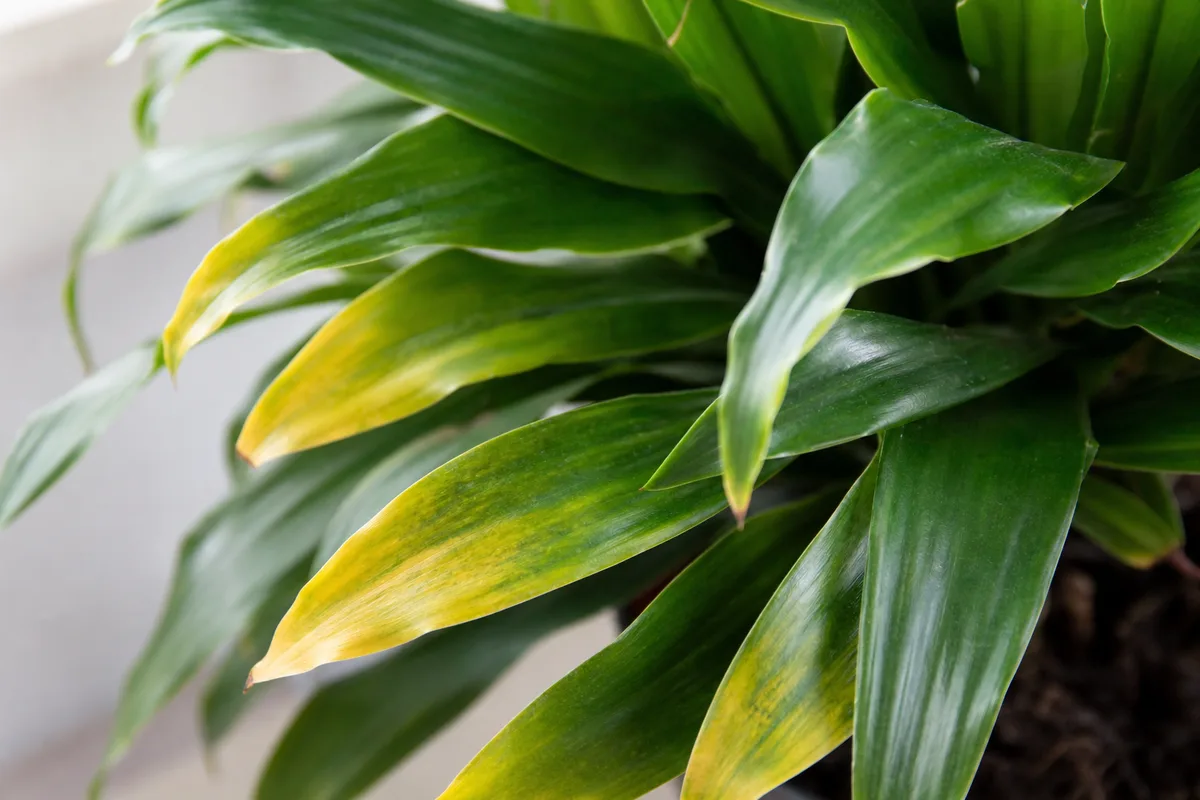
Yellow Leaves symptoms on Janet Craig Dracaena - compare with healthy tissue on the same plant.
Overwatering pattern (bottom-up, soft yellow, heavy pot)
- Lower inner leaves turn chartreuse or soft yellow first, sometimes dropping while still partly green
- Pot stays heavy several days after watering; skewer at half depth comes out cool and damp
- Crown growth stalls for weeks even though the plant looks otherwise upright
- Wilt-on-wet-soil paradox-limp strap leaves on a saturated pot because damaged roots cannot move water
- Fungus gnats around the surface when soil never dries-see also fungus gnats on Janet Craig
Full wet-soil workflow: overwatering on Janet Craig.
Underwatering pattern (light pot, crisp edges)
- Very light pot and dry mix throughout-not just the surface
- Slight leaf droop with crisp yellow or brown edges before full yellowing in prolonged drought
- Less common than wet-root yellowing on Janet Craig, but it happens in bright, dry rooms with long neglect
Details: underwatering on Janet Craig.
Natural lower-leaf senescence
- One or two lower leaves yellow slowly on a firm upright cane
- Healthy crown leaves and appropriate dry cycles between waterings
- No sour smell, no persistent dampness, no rapid multi-leaf spread
Fluoride tip burn lookalike (margins, not soft yellow)
Damage starts at tips and margins as tan-to-brown crispy tissue while the blade stays deep green and firm-unlike soft yellow leaves from saturated roots. Fluoride and overwatering yellowing can coexist; check both water quality and moisture. Full protocol: brown tips on Janet Craig.
Sudden light change (post-move yellowing)
Moving from a bright window to a dim hall-or swapping desk locations in an office-drops photosynthesis before you adjust watering. Lower leaves yellow as the plant sheds foliage it can no longer support. The trap: you keep the old schedule while transpiration falls, so roots sit wet longer. See not enough light on Janet Craig and the light guide for placement bands.
Cold drafts and spider mites on stressed plants
Extended exposure below about 55°F (13°C) can yellow and drop leaves on dracaena. Separately, spider mites on stressed office plants cause stippling and fine webbing on crown leaves-inspect undersides before blaming water alone; full workflow: spider mites on Janet Craig.
Why Janet Craig gets yellow leaves
Low light plus frequent watering is the classic Janet Craig mistake. Janet Craig is marketed as shade-tolerant, but low light means the plant uses water slowly. Watering every week in a dim office keeps roots oxygen-starved. In sub-500-lux placements, transpiration and evaporation drop sharply, so the lower root zone can stay saturated for weeks even when the surface looks acceptable. Allow the top inch of soil to dry between waterings is the extension minimum; Janet Craig in deep shade often needs the top half-or more-dry before the next soak.
Underwatering in bright dry rooms yellows older leaves after prolonged drought-usually with a light pot and dry mix, not damp soil.
Natural senescence sheds lower leaves as the cane elongates and the trunk develops.
Sudden light reduction without watering adjustment stacks wet feet on top of foliage loss.
Cold drafts below about 55°F (13°C) trigger yellowing and drop near AC vents or winter window contact.
Fluoride sensitivity is a separate stress pathway-dracaenas accumulate fluoride at leaf margins from tap water, which can distract owners into watering more when they see tip burn.
How to confirm the cause (7-step checklist)
Work through these checks before Janet Craig Dracaena repotting guide, fertilizing, or moving the plant again:
- Half-depth moisture - Push a finger or skewer to half pot depth. Wet cling with heavy pot means stop watering. Bone dry throughout points to drought.
- Pot weight - Lift the container. Heavy with limp foliage fits overwatering; feather-light with droop fits underwatering.
- Leaf texture and pattern - Soft yellow on multiple lower leaves plus wet soil fits overwatering. Crisp edges with dry soil fits drought. One bottom leaf on a firm cane fits aging.
- Crown growth - Stalled new leaves for weeks on a heavy wet pot support chronic saturation.
- Cane base firmness - Press gently at the soil line. Firm is reassuring; softening means escalate toward root rot or stem rot.
- Smell, pests, and light history - Sour odor or fungus gnats support wet-root diagnosis. Note recent moves to darker spots or AC drafts.
- Watering interval vs. light - In deep shade, every 21 to 28 days or longer between thorough waterings is normal, not neglect. Weekly watering in dim light is the leading overwatering suspect.
Confirmed overwatering: wet mix at depth, soft yellow lower leaves, heavy pot, possibly sour smell or gnats.
Confirmed underwatering: dry mix throughout, light pot, leaves perk after one thorough soak.
Suspected but not confirmed: several lower leaves yellow at once with wet mix-unpot and inspect roots for brown mushy tissue before the next watering.
First fix for Janet Craig - pick one branch
Apply one correction first. Do not water, repot, fertilize, and move the plant all on the same day.
Wet soil branch
Stop watering until half-depth moisture drops and the pot lightens noticeably.
Empty saucers and cachepots after every past watering. Extend dry-down by another 7 to 14 days in low light before reassessing. Do not fertilize on day one.
Escalation: overwatering on Janet Craig for moderate cases; root rot if the cane base softens, mix smells sour, or roots are mushy on inspection.
Dry soil branch
Give one thorough soak with filtered water low in fluoride, then resume dry-down checks per the watering guide. Leaves often firm within a day or two when thirst was the cause.
Light-change branch
When yellowing followed a move to a darker spot, correct watering first-do not also repot or relocate again on the same day. Match intervals to the new placement; consider slightly brighter indirect light if lower leaves keep dropping. Cross-check not enough light and light requirements.
Remove spent yellow leaves cleanly once the plant is stable; watch the crown for new growth.
Recovery timeline
Stabilization after corrected dry-down often takes two to four weeks in mild cases-leaf drop slows and the pot dries at a more normal pace.
New crown leaves are the best success signal. Expect them in four to eight weeks during active growth; low-light offices may take longer.
Old yellow leaves will not turn green again. They may drop on their own or stay until you trim them.
Moderate root damage after trim-and-repot can take six to ten weeks before strong crown growth returns-judge by firm cane tissue and steady new leaves, not old foliage.
Worsening signs: softness spreads up the cane, yellowing accelerates on wet soil, or new crown leaves emerge small then collapse-escalate to root rot rescue instead of repeating the same watering experiment.
Lookalike quick-reference
| Pattern | Key signs | Soil / pot | First action |
|---|---|---|---|
| Overwatering | Soft yellow lower leaves, stalled crown, limp on wet mix | Heavy pot; damp half-depth for days | Stop watering → overwatering |
| Underwatering | Crisp yellow edges, slight droop | Light pot; bone dry throughout | One thorough soak → underwatering |
| Senescence | One or two slow lower yellow leaves | Firm cane; normal dry cycles | Remove spent leaf; no schedule change |
| Light shock | Yellowing after move to dimmer spot | Often wet from old schedule | Correct dry-down → not enough light |
| Cold draft | Yellow drop near vents or cold glass | Variable | Move away from sub-55°F (13°C) drafts |
| Fluoride tip burn | Crispy margins, green blade | May coexist with wet soil | Low-fluoride water → brown tips |
| Root rot (advanced) | Soft cane base, sour smell, mushy roots | Chronic wet mix | Trim and repot → root rot |
| Spider mites | Stippling, webbing on crown leaves | Stressed plant in dry heated air | Inspect undersides → spider mites |
What not to do
Do not increase watering because leaves look pale in a dim room-that deepens saturation in low light.
Do not fertilize yellow plants sitting in wet soil or assume every yellow leaf needs repotting before moisture checks.
Do not repot or move while diagnosing unless the cane base is soft or roots are clearly mushy-stacking stress triggers more drop.
Do not judge recovery by old leaves re-greening-watch the crown.
When removing dropped yellow leaves, keep pets away. Dracaena is toxic to cats and dogs due to saponins. Ingestion can cause vomiting, depression, loss of appetite, and hypersalivation; in cats, dilated pupils may appear. If ingestion is suspected, contact your veterinarian or the ASPCA Animal Poison Control Center at (888) 426-4435.
How to prevent yellow leaves next time
Match watering to light level and dry-down, not the calendar. In bright indirect light, let the top half dry. In deep shade, wait until most of the pot dries-often every three to four weeks minimum. Use fluoride-free water. Improve light slightly if lower leaves drop progressively in very dim spots.
Full rhythm and season shifts: Janet Craig watering guide. Placement bands: light guide.
Lift before you pour-a noticeably lighter pot means the root zone has dried enough for the next soak.
When to worry / escalate
Treat as urgent if the cane base turns soft, mix smells sour, leaf drop accelerates on wet soil, or crown growth collapses. Those signs suggest progressing root failure-shift to root rot protocol or compare wilting patterns before another wait-and-see watering cycle.
Slow yellowing on one or two lower leaves with firm stems and mix that dries normally within two to three weeks can wait for a schedule adjustment.
Related Janet Craig problems
Use this page as the yellow-leaf triage hub:
- Janet Craig overview - species care baseline
- Watering guide - dry-down tiers and fluoride-free water
- Overwatering - wet-soil yellowing deep dive
- Underwatering - dry pot and crisp edges
- Root rot - mushy roots and cane softening
- Brown tips - fluoride margin burn lookalike
- Not enough light - dim-office slow dry-down
- Light guide - placement and lux context
- Spider mites - stippling on stressed plants
- Wilting - dry vs. wet wilt fork
Conclusion
Yellow leaves on Janet Craig are a moisture-and-light timing problem more often than a mystery disease. Run the seven-step checklist, pick the wet, dry, or light branch that fits, and judge recovery by firm new crown leaves-not old foliage re-greening. Janet Craig rewards dry cycles matched to dim offices; it rarely forgives roots that never get oxygen.
How we wrote and verified this guide: Recommendations were checked against NC State Extension, Missouri Botanical Garden, Clemson HGIC, and ASPCA references cited inline. Author: sai-ananth. Reviewer: LeafyPixels Review Board. Methodology: plant problem guidance is reviewed against botanical references, extension resources, and LeafyPixels plant-care data before publication. Claims validation: claims-validator-v1 pass with inline external links documented below. Last reviewed: 2026-06-16.
When to use this page vs other Janet Craig Dracaena guides
- Janet Craig Dracaena watering guide - Use for routine moisture checks before assuming yellow leaves is the main issue.
- Janet Craig Dracaena problems hub - Browse all 50 common issues on this species.
- Overwatering on Janet Craig Dracaena - Different entry point when symptoms overlap with yellow leaves.
- Not Enough Light on Janet Craig Dracaena - Different entry point when symptoms overlap with yellow leaves.