Spider Mites on Janet Craig Dracaena: Causes, Checks & Fixes
Quick answer
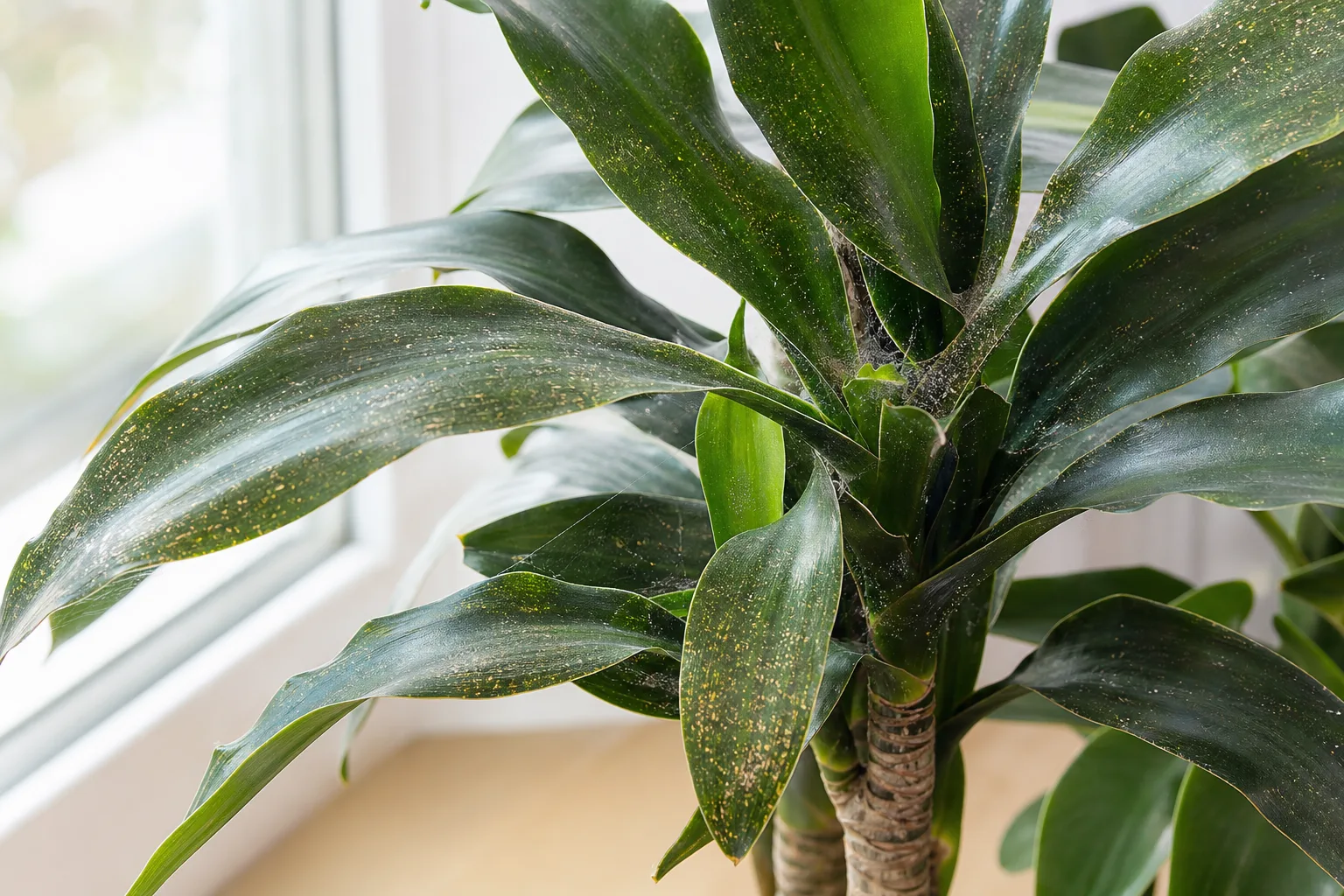
Spider mites on Janet Craig Dracaena show up as yellow stippling and fine webbing on broad strap leaves, especially near heating vents in dry winter air. First step: move the plant away from others and rinse every leaf underside and cane crotch with lukewarm water before applying any spray.
Spider Mites on Janet Craig Dracaena: Causes, Checks & Fixes
This guide covers spider mites on Janet Craig Dracaena. See also the general Spider Mites guide, watering, and light pages for this plant.
Spider Mites on Janet Craig Dracaena: Causes, Checks & Fixes
Quick answer
Spider mites on Janet Craig Dracaena (Dracaena deremensis ‘Janet Craig’) appear as yellow or bronze stippling on broad dark-green strap leaves, often with fine silk webbing at leaf axils and crown crotches where wide foliage meets thick tan canes. These tiny arachnids pierce individual leaf cells, causing a bleached speckled look on the upper surface while they feed and reproduce on undersides.
First step: isolate the plant and rinse every leaf surface-especially undersides, crown tissue, and cane crotches-with lukewarm water. That single action dislodges adults, confirms you are dealing with mites-not fluoride tip burn, thrips, or mealybugs-and buys time before you commit to repeated sprays. Only after a thorough rinse should you plan insecticidal soap or horticultural oil on a five- to seven-day cycle until tap-tests stay clean.
What spider mites look like on Janet Craig
Janet Craig’s upright cane habit gives spider mites long feeding rows along arching strap leaves and protected pockets at crown crotches-places a quick glance from across the room will miss.
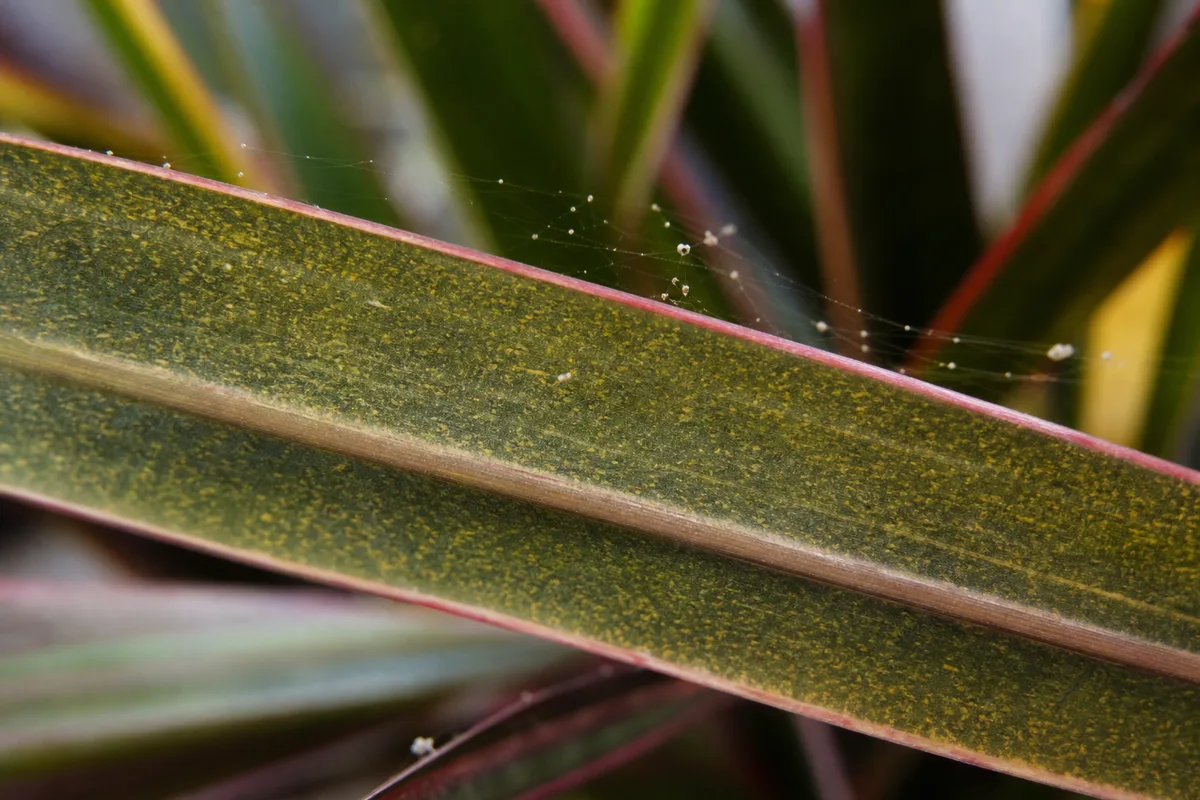
Spider Mites symptoms on Janet Craig Dracaena - compare with healthy tissue on the same plant.
Typical signs include:
- Fine yellow, white, or bronze stippling scattered across the leaf blade-not uniform brown margins. UF/IFAS notes each feeding site kills a small cluster of cells, creating a stippled-bleached effect that shows strongest on the upper leaf surface.
- Silk webbing at leaf bases, along midribs, and between strap leaves at the crown. Webbing is a hallmark of spider mites, not fluoride injury.
- Tiny moving dots on undersides-greenish, yellow, or reddish mites about 1/50 inch long. UC IPM describes adults as roughly 0.02 inch (0.5 mm) and best seen with a 10X hand lens.
- Bronzed or gray older strap leaves and premature drop when feeding is heavy on a slow-replacing cultivar.
- Dusty-looking foliage on the side facing a heating vent or sunny glass-mites favor hot, dry microclimates.
On Janet Craig, stippling on older lower strap leaves often appears first because those leaves have been exposed longest to dry forced air. Crown webbing is a late but urgent sign-by then mites have had weeks to build on a plant that replaces leaves slowly.
Unlike fluoride tip burn-Janet Craig’s most common lookalike-mite damage is scattered stippling with possible webbing, not crisp necrotic margins that stay fixed without insects underneath. Unlike thrips, mite stippling is finer and accompanied by silk threads rather than silvery patches with black frass specks.
Why Janet Craig gets spider mites
Spider mites are not caused by overwatering or fluoride in tap water. They thrive when warm, dry, still air stresses foliage without killing the plant-exactly the microclimate above a floor vent or beside a sunny window in heated winter rooms. Mississippi State Extension notes plants under heating vents and inadequately watered specimens are especially susceptible.
Several Janet Craig habits make infestations easier to miss and harder to clear:
Architecture. Wide strap leaves spiraling up thick canes offer long undersides where mites feed undetected. UC IPM notes mites concentrate on leaf undersides-on a 4- to 6-foot floor Janet Craig, the lowest third of foliage is often below casual eye level.
Slow growth. Janet Craig is a slow-growing interior plant. Stippling can spread across multiple strap leaves before the crown looks obviously damaged because this cultivar does not flush new foliage quickly enough to outrun early feeding.
Low-light office culture. Janet Craig tolerates deep shade, but specimens parked in dim corners above HVAC returns face hot dry air without the humidity rainforest understory plants prefer. low indoor humidity favors twospotted spider mite development-see the low-humidity guide for cultural context, but do not fix mites by overwatering the pot.
Floor-plant blind spots. Lobby and office Janet Craig specimens are dusted on topsides while undersides along full cane length go uninspected for months. Dust itself favors mites; occasional rinsing prevents buildup.
Introduction from nursery stock. North Carolina Extension lists Janet Craig among corn plant cultivars susceptible to indoor pests including mites. Infestations often begin on brought-in plants rather than flying in from outdoors.
Fluoride confusion delays treatment. Because Janet Craig is notably sensitive to fluoride, owners often misread stippling as water-quality tip burn and delay mite treatment-giving populations time to web the crown.
How to confirm the cause
Work through these checks before buying spray or Janet Craig Dracaena repotting guide:
- Run the paper-tap test. Hold white paper under a suspect strap leaf and tap the blade firmly. Moving specks confirm mites. UF/IFAS recommends striking foliage over white paper for easier observation than on green leaves.
- Inspect crown crotches and leaf axils with a phone light at leaf level. Janet Craig’s dense clusters hide webbing at the shoot apex.
- Check the warmest, driest side of the plant-often the face toward a heat vent, radiator, or west window. Mites concentrate where air is hottest and driest.
- Examine full undersides along each cane, lifting arching strap leaves to expose midribs. Floor specimens need you to crouch or tilt the pot.
- Look for silk webbing, not just yellow speckles. Webbing at leaf bases separates mites from fluoride margins and from thrips silver scarring.
- Rule out lookalikes using the table below-especially brown tips from fluoride and overwatering yellow leaves on wet mix.
- If leaves are yellow and soil stays wet, check cane firmness and root health before treating pests-root rot and mites can coexist on stressed Janet Craig, but soaking an already wet pot while rinsing makes culture worse.
Confirmed spider mites require treatment on the plant and the surrounding collection, not just the worst leaf.
Lookalike symptoms
| Symptom pattern | Likely cause | Key difference on Janet Craig |
|---|---|---|
| Fine stippling + silk webbing at axils | Spider mites | Moving dots on tap-test; webbing at crown crotches |
| Crisp brown leaf margins/tips only | Fluoride or salt injury | No webbing or moving specks; see brown tips |
| Irregular silvery patches + black frass | Thrips | Fringed-wing insects; see thrips |
| White cottony clusters in axils | Mealybugs | Wax masses at joints; see mealybugs |
| Smooth domed brown bumps | Scale | Scrapes hard; no stippling pattern |
| Yellow lower leaves on wet, heavy pot | Overwatering | No webbing; sour soil; see overwatering |
| Dry tan margins in heated winter air | Low humidity stress | No insects; cultural; see low-humidity |
First fix for Janet Craig
Move the plant away from other Dracaenas and houseplants, then rinse all foliage thoroughly with lukewarm water-tops, undersides, crown, and every cane crotch.
UC IPM recommends washing mites from leaf surfaces with water and disposing of heavily infested plant parts. UMN Extension suggests spraying small plants in a sink and large plants in a shower-ideal for a floor-sized Janet Craig. Tilt the pot so rinse water runs off without flooding cold, slow-drying soil in a low-light office. Cover the mix with foil if needed.
Use a steady stream focused on leaf undersides and the crown where mites concentrate. Bag pruned heavily webbed leaves in the trash, not the compost pile indoors.
Do not open with a full-soak repot or fertilizer on a pest-stressed plant. Do not increase humidity by overwatering the pot-that invites root problems on a shade-tolerant Dracaena. Do not return the plant to its display spot until you finish at least one full follow-up inspection cycle.
Step-by-step recovery
After isolation and rinsing, continue in this order based on severity:
-
Physical rinse pass. Repeat thorough rinsing every three to five days until tap-tests show fewer mites on white paper. Mississippi State Extension notes washing leaves at 3- to 5-day intervals can be effective on small plants when repeated consistently.
-
Increase airflow without soaking soil. A small fan near the plant-not blowing directly on wet foliage overnight-helps strap leaves dry after rinsing in dim offices. Relocate away from heat vents if possible.
-
Insecticidal soap or horticultural oil. For remaining mites, apply a product labeled for spider mites on houseplants, covering axils, crown tissue, and leaf undersides completely. UC IPM recommends insecticidal soap or horticultural oil with excellent underside coverage and notes oils should not be applied to water-stressed plants or above 90°F. Patch-test one lower strap leaf before saturating the crown-Janet Craig in low light dries slowly.
-
Repeat on label intervals for at least three cycles. UF/IFAS notes most miticides do not kill eggs, requiring two or more applications at five-day intervals in summer or seven-day intervals in winter. At 75°F, UC IPM reports mites develop from egg to adult in about two weeks-plan three to four weeks minimum on slow Janet Craig.
-
Inspect the collection. Check other floor plants, shared saucers, and stakes. Mites walk short distances between pots on the same bench.
-
Hold fertilizer until new crown growth looks normal for two weeks. Sap loss, not nutrient lack, is the immediate problem.
-
Monitor two extra weeks after you think you are clear. Eggs hatch on a staggered schedule; one missed female restarts the cycle on slow Janet Craig canes. Two clean tap-tests in a row, then one extra treatment cycle, is safer than stopping early.
Recovery timeline
Because Janet Craig grows slowly, mite recovery is measured in weeks, not days.
- First seven to ten days: Active stippling should stop spreading after isolation and repeated rinsing; fresh webbing on previously cleaned axils means keep treating.
- Two to three weeks: With soap or oil follow-ups every five to seven days, tap-tests should show few moving specks; bronzing on new flush should halt.
- Four to six weeks: Judge success by clean new crown strap leaves, not by old stippled foliage-which will not re-green.
- Six to ten weeks: A large floor plant may still look speckled on older leaves until enough new strap foliage fills gaps; that is normal for this cultivar.
Worked example: A lobby Janet Craig placed directly above an HVAC return showed stippling on the vent-facing strap leaves and early webbing at one crown crotch in January. After isolation, weekly shower rinses focused on undersides, and horticultural oil every seven days for three cycles, the first unstippled crown leaf emerged roughly six weeks later. Lower strap leaves kept their old speckles, but no new webbing appeared-correct success signal for this slow cultivar.
Worsening signs: webbing returns at the crown despite treatment, stippling spreads to new flush, lower leaves drop in clusters, or the cane feels soft while soil stays wet-soft cane points to rot or severe stress, not mites alone, and needs separate assessment per root rot.
What not to do
Do not stop after one rinse or one spray-mite eggs survive most contact treatments. Do not soak the pot repeatedly while treating; Janet Craig in deep shade already risks overwatering, and wet roots plus pest stress compound damage.
Avoid generic houseplant sprays without spider mite on the label. Do not use broad-spectrum insecticides that kill predatory mites and can worsen outbreaks per UC IPM guidance.
Do not return the plant from quarantine until two consecutive weekly tap-tests show no movement and new crown leaves emerge without fresh stippling.
Do not confuse pet safety with pest harm-mites are plant pests, but Janet Craig Dracaena is toxic to cats and dogs. Keep rinse runoff, treated leaves, and pruned strap foliage away from pets; wash hands after handling sap.
Do not fertilize a recovering plant to “push growth”-feed only after pests are controlled and watering rhythm is stable per the overview guide.
Do not misread fluoride tip burn as mites and spray unnecessarily-confirm webbing and moving specks first. Both Dracaena deremensis and D. fragrans are very sensitive to fluoride toxicity, which accumulates at leaf margins-not as scattered stippling with silk.
How to prevent spider mites on Janet Craig
Quarantine every new Janet Craig or mixed floor plant for at least two to three weeks before it joins your collection. Inspect cane joints and leaf undersides with a light during weekly care-the same pass you use to dust broad leaves.
Keep plants away from heat vents and radiator ledges where hot dry air concentrates. If relocation is impossible, rinse undersides monthly in warm months and weekly during active heating season on vent-exposed specimens.
Buy from sources with clean understock when possible, and reject plants with stippling or webbing even if top leaves look glossy. UMN Extension advises isolating plants as soon as pests are detected and examining all parts before bringing plants indoors for fall.
Keep Janet Craig in bright to moderate filtered light with a dry-down watering rhythm-allow the top half of mix to dry, and avoid calendar watering in dark offices. Clemson HGIC notes Dracaena problems spike with poor drainage and insect pests when culture slips-healthy culture supports recovery but does not replace quarantine.
Use filtered water for Janet Craig’s fluoride sensitivity per the watering guide, but still inspect undersides-good water quality does not prevent hitchhiking mites.
After summer outdoors or office moves, rinse and isolate before returning Janet Craig to indoor displays near other aphid- or mite-susceptible floor plants.
When to worry
Escalate or consider discarding the plant if:
- Webbing covers most of the crown and new leaves cannot emerge clean
- Two full labeled treatment cycles spanning six to eight weeks fail
- The same office collection keeps reinfesting from an untreated neighboring plant
- A large floor specimen is too heavy to rinse and spray every joint thoroughly
- Mites spread across multiple canes on a multi-stem specimen while neighboring Dracaena overview collection plants share a bench
UC IPM advises discarding severely infested houseplants rather than endless retreatment-economical when a slow-growing Janet Craig is already defoliated and neighboring office plants are at risk. For moderate infestations on an otherwise healthy cane, persistence usually wins if you combine isolation, repeated rinsing, and labeled soap or oil coverage of every underside.
Practical checks
Urgency check
Treat same-day if webbing appears at the crown, stippling spreads across multiple strap leaves, or tap-tests show numerous mites on white paper. Soft cane, sour soil, or spreading yellow on wet mix needs root assessment-not more pest spray alone.
Best inspection order
Crown and newest strap leaves → leaf axils along each cane → full leaf undersides and midribs → vent-facing side of the plant → lower cane near soil → neighboring floor plants and shared saucers.
Janet Craig care cross-check during recovery
| Care factor | During mite treatment | Why it matters for Janet Craig |
|---|---|---|
| Watering | Match dry-down to light per watering guide; do not soak to raise humidity | Wet roots in low light compound stress |
| Light | Bright filtered if possible; see light guide | Faster leaf drying after rinses |
| Humidity | Rinse foliage, not the pot; see low-humidity | Dry air favors mites; overwatering does not fix air |
| Water quality | Filtered water after pests clear | Fluoride tips mimic pest confusion |
| Neighbors | Inspect thrips, mealybugs, aphids on shared benches | Sap pests share office floor culture |
Conclusion
Spider mites on Janet Craig Dracaena exploit hot dry indoor air and the long undersides of arching strap leaves that floor specimens hide from casual view. Confirm stippling with webbing and a tap-test-not fluoride tip burn or thrips-then isolate and rinse first, follow with labeled soap or oil on five- to seven-day repeats until new crown leaves stay clean, and judge recovery by fresh strap foliage on this slow cultivar. Quarantine new plants, inspect undersides during routine care, and keep plants off heat vents so mites meet a healthy plant, not a stressed one.
Related Janet Craig guides:
- Janet Craig overview - Light, watering, and culture baseline
- Brown tips - Primary mite lookalike on strap leaves
- Thrips - Another stippling pest on Janet Craig
- Mealybugs - Sap pest with full recovery workflow
- Low humidity - Dry-air context for winter mite flare-ups
- Watering - Dry-down rhythm during recovery
When to use this page vs other Janet Craig Dracaena guides
- Janet Craig Dracaena watering guide - Use for routine moisture checks before assuming spider mites is the main issue.
- Janet Craig Dracaena problems hub - Browse all 50 common issues on this species.
- Curling Leaves on Janet Craig Dracaena - Different entry point when symptoms overlap with spider mites.
- Thrips on Janet Craig Dracaena - Different entry point when symptoms overlap with spider mites.