Wrong Soil Mix on Janet Craig Dracaena: Causes, Checks &
Quick answer
Wrong soil mix on Janet Craig Dracaena usually means dense unamended potting soil, peat-heavy nursery blend, or moisture-control mix that stays wet at depth for 21+ days in a dim office while the top inch looks merely cool. First step: stop watering, squeeze a handful of moist mix-if it forms a tight ball instead of crumbling, run the one-minute drainage check and plan a perlite-amended repot.
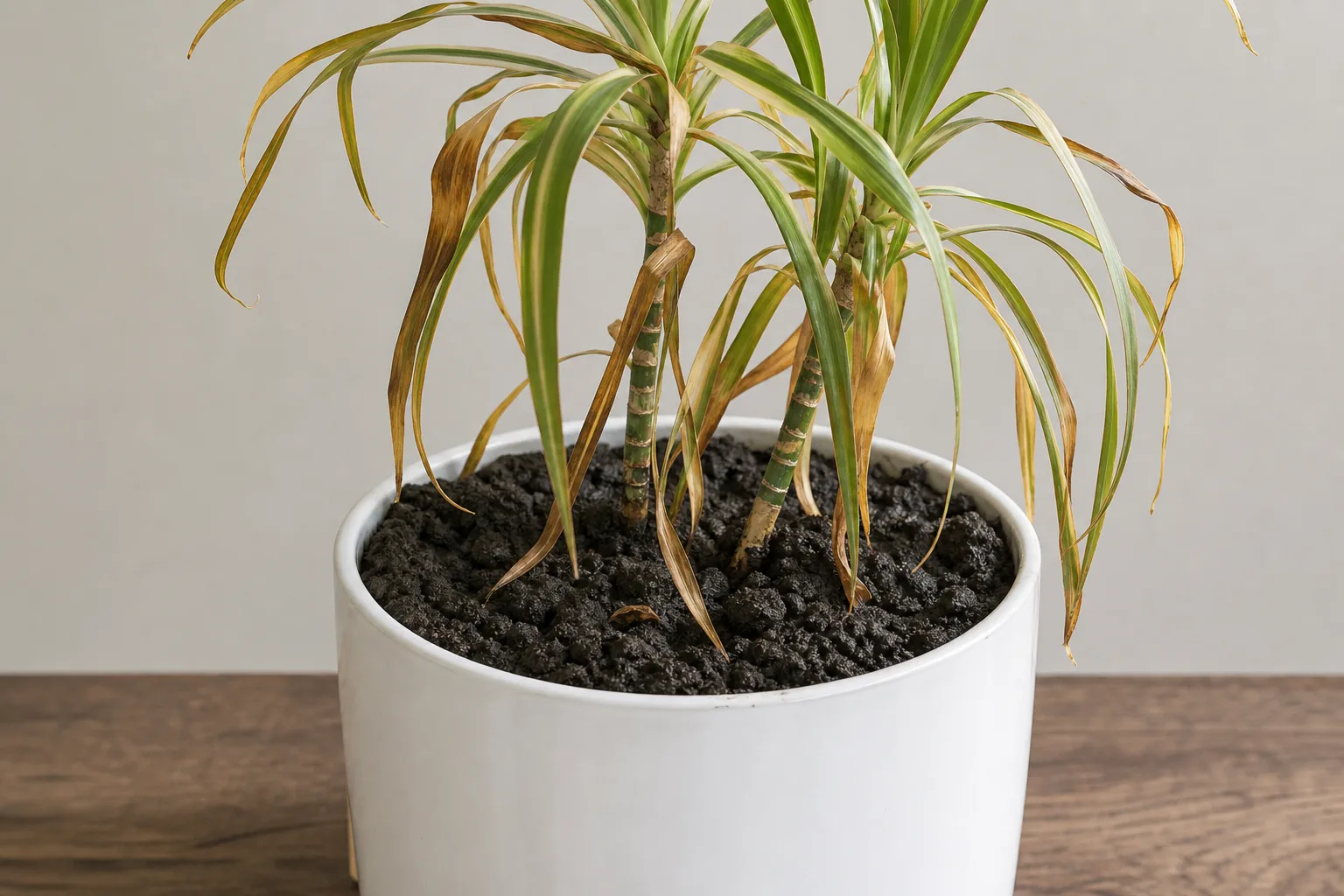
Wrong Soil Mix on Janet Craig Dracaena: Causes, Checks & Fixes
This guide covers wrong soil mix on Janet Craig Dracaena. See also the general Wrong Soil Mix guide, watering, and light pages for this plant.
Wrong Soil Mix on Janet Craig Dracaena: Causes, Checks & Fixes
Quick answer
Janet Craig Dracaena (Dracaena deremensis ‘Janet Craig’) is sold as a low-maintenance office plant, but the substrate under those glossy strap leaves decides whether infrequent watering works or quietly rots roots. Missouri Botanical Garden recommends organically rich, well-drained, loamy peaty potting soil for container Dracaena fragrans-enough organic matter to buffer moisture between drinks, yet fast drainage so low-light placements never sit in stale mud.
Wrong soil mix on Janet Craig usually means dense unamended nursery blend, peat-heavy indoor mix without perlite, moisture-control potting soil with water-absorbing crystals, or straight cactus mix in a dim office. The plant transpires slowly in deep shade, so a bad mix can stay wet at depth for 21 days or longer while the surface looks merely cool-damp and lower leaves yellow one at a time.
First step: stop watering and test the mix itself. Squeeze a handful of moist soil-if it forms a tight ball that does not crumble, your problem is substrate structure, not fluoride or light. Run the one-minute drainage check (water should stop streaming from the hole within 30 to 60 seconds), then compare texture to the Janet Craig soil guide baseline of 3 parts potting soil + 1 part perlite. Full species context: Janet Craig overview.
What wrong soil mix looks like on Janet Craig
Soil failure on Janet Craig announces itself through mix behavior before the crown looks dramatic. Broad dark-green leaves tolerate neglect, so caretakers often blame watering or tap water while the root zone stays wrong for months.
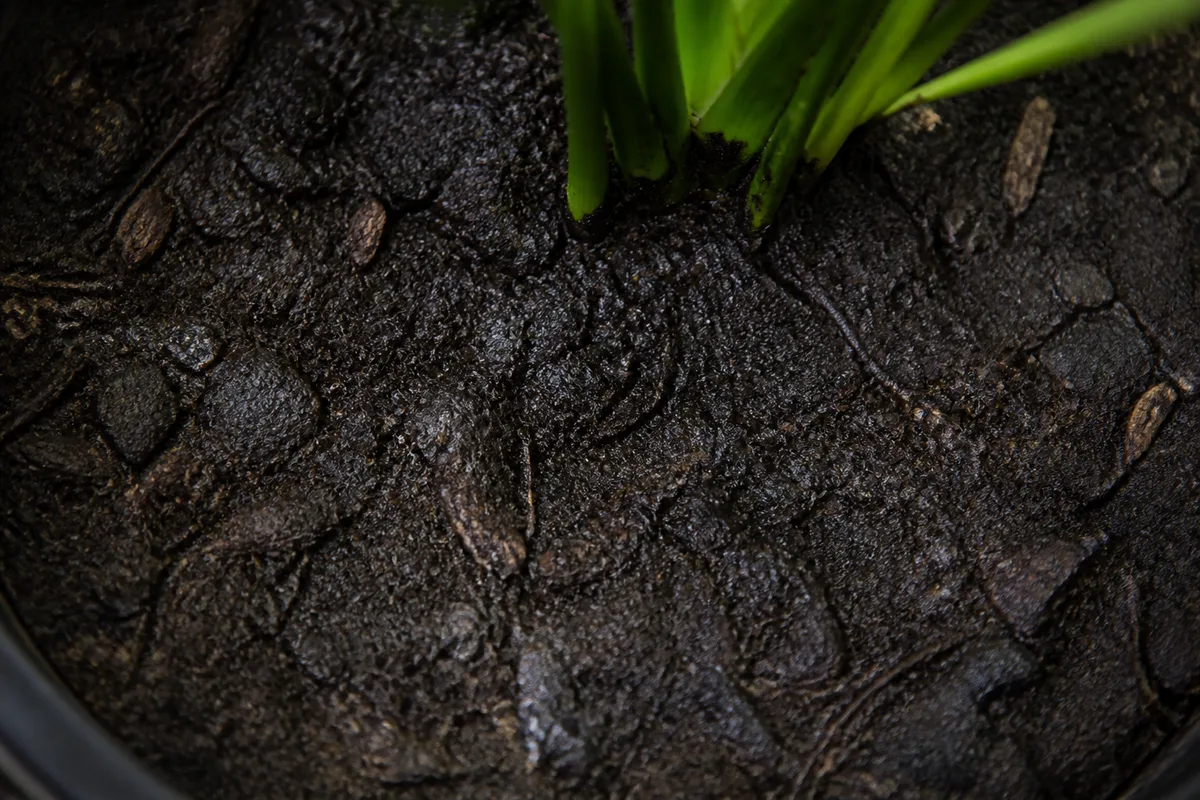
Wrong Soil Mix symptoms on Janet Craig Dracaena - compare with healthy tissue on the same plant.
Mix texture and drainage signals (check these first):
- Tight ball on squeeze test - moist handful holds shape like clay instead of crumbling loosely
- Water pools on the surface for minutes, then runs down the gap between root ball and pot wall
- Pot stays heavy two to three weeks after one thorough watering in a dim office while the top inch is only cool-damp
- Half-depth skewer wet when the top half has finally dried-classic perched moisture in dense peat
- Hydrophobic crust on old peat: surface looks dusty while the center of the root ball stays oddly dry or sodden
- White mineral or salt crust on the surface when wrong mix pairs with heavy tap water or fertilizer
Leaf and stem signs that follow bad mix (not the primary diagnosis):
- Lower strap leaves yellow and drop one at a time while the cane still feels firm-too-moist soils can brown or yellow foliage before the stem collapses
- Crown growth stalls for months despite stable light
- Brown tips may worsen from fluoride concentrating in wet root zones, overlapping with brown-tips guidance
- Advanced cases: soft cane at the soil line, sour smell, fungus gnats-then see root rot
Unlike dry hydrophobic soil, wrong dense mix usually feels heavy and cool at depth, not light and dusty throughout.
Common wrong mixes for Janet Craig (and why they fail)
| Wrong choice | What goes wrong in low-light offices | Janet Craig-specific risk |
|---|---|---|
| Unamended dense potting soil in large plastic pot | Bottom half stays wet for weeks; top dries on schedule | Slow transpiration masks wet feet until lower leaves yellow |
| 100% peat or peat-heavy nursery blend | Compacts in 12–24 months; perched water table at depth | Floor specimens sit in same mix years without refresh |
| Moisture-control / water-retaining mix | Designed to stay wet longer-opposite of cane Dracaena needs | Clemson HGIC recommends well-drained potting mix for dracaenas indoors |
| Straight cactus or succulent mix | Drains too fast at crown; forces drought cycles on thick roots | Brown tips and drop mimic fluoride burn; crown dries while old peat core stays wet if only top-dressed |
| Garden soil in containers | Compacts within weeks; poor aeration | Rarely worth the saved dollar on a long-lived architectural plant |
| Bottom gravel “drainage” layer | Reduces root volume; creates perched water above gravel | False fix-improve mix perlite instead |
| Oversized pot + any dense mix | Large unused wet zone roots never colonize | Common in corporate lobby floor pots |
NC State recommends commercial potting soil in a pot with drainage holes with dry-down between waterings-that standard assumes the mix is amended and correctly sized, not straight from a moisture-retaining bag in a 35 cm floor container.
Why Janet Craig suffers in the wrong substrate
Janet Craig evolved under tropical African forest canopy with loose surface litter and moderate moisture at depth. Indoors you compress that into a pot that may sit in fluorescent-only light where the same volume of mix dries far slower than in a bright atrium.
Slow transpiration hides wet mix. Janet Craig tolerates low light better than most houseplants and may need water only every three to four weeks in deep shade. That long dry-down interval is healthy only if the mix drains and aerates between drinks. Dense peat in an oversized plastic pot can hold oxygen-poor moisture at the bottom for the entire interval while you wait on the top-half dry-down between waterings rule from the watering guide.
Thick cane, sparse roots. Janet Craig puts energy into upright cane and broad leaves with a relatively small root system for the leaf mass. Unused wet mix around the root ball does not dry at the same rate colonized mix does-creating a chronic anaerobic pocket.
Peat decomposition timeline. Peat-based mixes compact and turn hydrophobic within 12 to 24 months-a hidden failure when a floor specimen outlives its substrate without refresh. Wrong mix plus age compounds both slow drainage and salt buildup.
Cachepot habits multiply density problems. Decorative outer pots without holes are fine only when the inner nursery pot drains freely and you empty runoff within 15 to 20 minutes. Stale water in the outer shell mimics swampy mix even when the recipe looked acceptable on repot day.
How to confirm wrong soil mix (not something else)
Work through these checks in order. One skewer reading at half depth beats guessing from yellow leaves alone.
- Stop watering - give the plant at least 7 to 10 days in low light so you are not measuring fresh pour-off
- Pot weight - lift the container. Heavy and cool after a long dry spell at the surface strongly suggests wet mix at depth
- Half-depth skewer - insert 10 to 15 cm (4 to 6 inches) down. Top half dry with bottom half wet for three weeks or more in a dim office points to density or oversized pot, not calendar overwatering
- Squeeze test - moisten a handful of mix from the outer root zone. Crumbly loose texture that falls apart = acceptable structure. Tight ball that holds shape = too dense for Janet Craig
- One-minute drainage check - water until runoff exits the hole, then time how long excess streams. Target 30 to 60 seconds to near-stop; many minutes of dripping means mix or pot failure
- Unpot only if decline continues - slide the plant out if yellowing spreads, the cane softens, or steps 2–5 fail after you corrected watering rhythm. Inspect roots: firm white-to-tan roots with dense mud smell = wrong mix stress; black mush = escalate to root rot
Differentiate from lookalikes:
| If this fits | Primary problem | Next guide |
|---|---|---|
| You water weekly in deep shade on a heavy pot | Overwatering frequency | Fix schedule after mix is sound |
| Mix drains fast but hole blocked or cachepot holds water | Poor drainage path | Clear hole; empty outer pot |
| Surface repels water; center dry; pot light | Dry hydrophobic soil | Rehydrate or repot |
| Roots circle; water runs straight through | Compaction / root-bound | Repot with fresh aerated mix |
| Tips only; soil moisture normal | Fluoride / salts | Brown tips |
First fix for Janet Craig
Stop watering immediately and do not repot, prune, fertilize, or relocate on the same day. Janet Craig recovers slowly; stacking stress obscures whether the mix fix worked.
Once the surface has had a few dry days, run the squeeze test and one-minute drainage check above. If both fail, plan a repot into aerated mix within the week-spring and early summer are safest, but rescue repotting is justified anytime the mix smells sour or the cane softens.
While you gather perlite and a right-sized pot:
- Empty saucers and cachepots after every prior watering
- Improve airflow around the pot base
- Use filtered or low-fluoride water when you eventually resume watering-wet wrong mix concentrates fluoride and worsens tip burn, but water quality is secondary to fixing structure first
Do not add bottom gravel, extra peat, or moisture-control crystals to “balance” a wet pot.
Step-by-step mix rescue and repot
When confirmation points to wrong mix-not merely a single overwater event-repot into fresh medium matched to Janet Craig’s biology.
Baseline blend (most low-light offices):
- 3 parts peat- or coir-based potting soil
- 1 part coarse perlite by volume
Rescue blend (recovering from chronic wet mix or trimmed rot):
- 40% base potting soil
- 50% perlite
- 10% orchid bark
Full recipes, pH notes, and ingredient roles: best soil for Janet Craig Dracaena.
Repot workflow:
- Water lightly two days before so the root ball holds together
- Choose a clean pot one size up at most (2.5 to 5 cm / 1 to 2 inches wider) with a clear drainage hole
- Slide the plant out and inspect roots. Trim dark mushy roots with sterilized pruners; keep firm roots
- Loosen only the outer 2 to 3 cm of the old root ball-do not bare-root unless treating severe rot. Thick cane roots break rather than bend
- Place fresh mix in the pot, set the cane at the same depth as before (never bury the stem), fill sides with moistened blend, settle gently without compacting
- Water lightly until drainage runs, empty the saucer within 15 to 20 minutes
- Hold fertilizer for four to six weeks; keep stable indirect light for two to three weeks
Detailed timing and pot-choice notes: Janet Craig repotting guide.
Amend-in-place (only when roots are healthy and rot is absent):
Remove the top 3 to 5 cm of old mix. Blend fresh 3:1 soil and perlite and work it into the outer root zone without changing planting depth. This helps slow dry-down slightly but cannot fix a sodden bottom half in an oversized pot-full repot is the honest fix.
Recovery timeline and warning signs
Janet Craig responds slowly. Judge recovery by new crown leaves and root stability, not by old yellow straps re-greening.
Improvement signals (usually 2 to 6 weeks after repot in stable light):
- Pot weight drops predictably between waterings on your corrected schedule
- Half-depth skewer shows genuine dry-down before you water again
- New strap leaves emerge clean and full-sized at the crown
- Lower yellowing stops spreading; occasional single lower leaf drop may still happen on mature canes
Worsening signals (reassess immediately):
- Cane softens at the soil line after repot
- Sour smell returns within two weeks on the new mix
- Widespread yellowing or crown stall past four weeks-pot may still be too large or mix too dense
- Fungus gnats persist in large numbers
Old brown tip tissue and fully yellowed lower leaves will not re-green. Recovery means clean new foliage above the damage line.
What not to do
- Do not water on a calendar to “help” a plant in dense mix-see overwatering if frequency was the only error
- Do not use moisture-control potting mix to reduce watering chores indoors
- Do not repot into straight cactus mix without blending 50/50 with peat- or coir-based potting soil
- Do not add a gravel layer at the pot bottom
- Do not oversize the pot hoping for faster growth-unused wet volume is the lobby-floor failure mode
- Do not fertilize a plant still sitting in wrong wet mix; salts accumulate faster in degraded peat
- Do not stack repotting, heavy pruning, and relocation in the same week
When handling moldy wet mix or trimming roots, keep tools and debris away from pets-Dracaena is toxic to cats and dogs.
How to prevent wrong soil mix next time
- Repot or refresh mix every 12 to 24 months for floor specimens, sooner if dry-down slows
- Blend 3:1 potting soil and perlite at every repot; increase perlite to 35–40% if the pot still stays wet at depth in low light
- Match pot size to root ball, not desired height-architectural Janet Craig specimens often need a heavier pot for stability, not a larger wet zone
- Run the one-minute drainage check after every repot and after any change in pot or mix
- Empty cachepots within 15 to 20 minutes of watering
- Plan nursery arrivals for amendment within the first 6 to 12 months if they arrive in unamended dense blend
Prevention details and commercial-vs-DIY notes live in the soil guide.
When to worry
Same-day action: soft cane, sour-smelling mix, spreading yellow on a heavy pot after you stopped watering, or black mushy roots when unpotting. Follow root rot rescue steps after repotting into the 40/50/10 rescue blend.
Lower urgency but do not defer past the growing season: top dry with bottom wet for three-plus weeks, squeeze test fails, or one-minute drainage check runs many minutes-repot before the next winter slowdown.
Fluoride-only tip burn with normal dry-down and crumbly mix points to water quality, not substrate-see brown tips after you confirm mix texture is sound.
When to use this page vs other Janet Craig Dracaena guides
- Janet Craig Dracaena watering guide - Use for routine moisture checks before assuming wrong soil mix is the main issue.
- Janet Craig Dracaena problems hub - Browse all 50 common issues on this species.