Leggy Growth on Ficus Audrey: Causes, Checks & Fixes
Quick answer
Leggy Ficus Audrey stems mean etiolation-long gaps between fuzzy gray-green leaves as the plant reaches for light. First step: move the pot within a few feet of your brightest east, south, or west window and wait two weeks before pruning any stretched shoots.

Leggy Growth on Ficus Audrey: Causes, Checks & Fixes
This guide covers leggy growth on Ficus Audrey. See also the general Leggy Growth guide, watering, and light pages for this plant.
Leggy Growth on Ficus Audrey: Causes, Checks & Fixes
Quick answer
Leggy growth on Ficus Audrey is the visible form of etiolation-plants stretch toward light when intensity is too low-the plant reaching between its large, velvety leaves because it is not getting enough usable light indoors. On Ficus benghalensis ‘Audrey’, that shows up as long internodes on fuzzy gray-green stems, smaller pale new leaves, a one-sided lean toward the brightest window, and often bare lower trunk with all the stretch concentrated at the top.
Audrey is marketed as an easier fiddle leaf fig alternative, but it is not a low-light tree. Wild banyan figs evolved under bright tropical canopy edges; the houseplant form still needs bright, indirect sunlight to stay compact.
First step: move the pot within a few feet of your brightest safe indirect window-east, filtered south, or filtered west-and leave it there for two weeks. Do not repot, fertilize, or prune stretched stems on day one. Brighter light changes how fast the mix dries; extra water in a dim corner is a common way healthy roots turn sour while the plant keeps stretching.
If you need a full window-direction audit or grow-light setup, see our not enough light on Ficus Audrey guide. This page focuses on recognizing leggy stems, confirming etiolation, and recovering shape after light improves.
What leggy growth looks like on Ficus Audrey
Leggy Audrey is a pattern over weeks, not one droopy leaf after watering day.
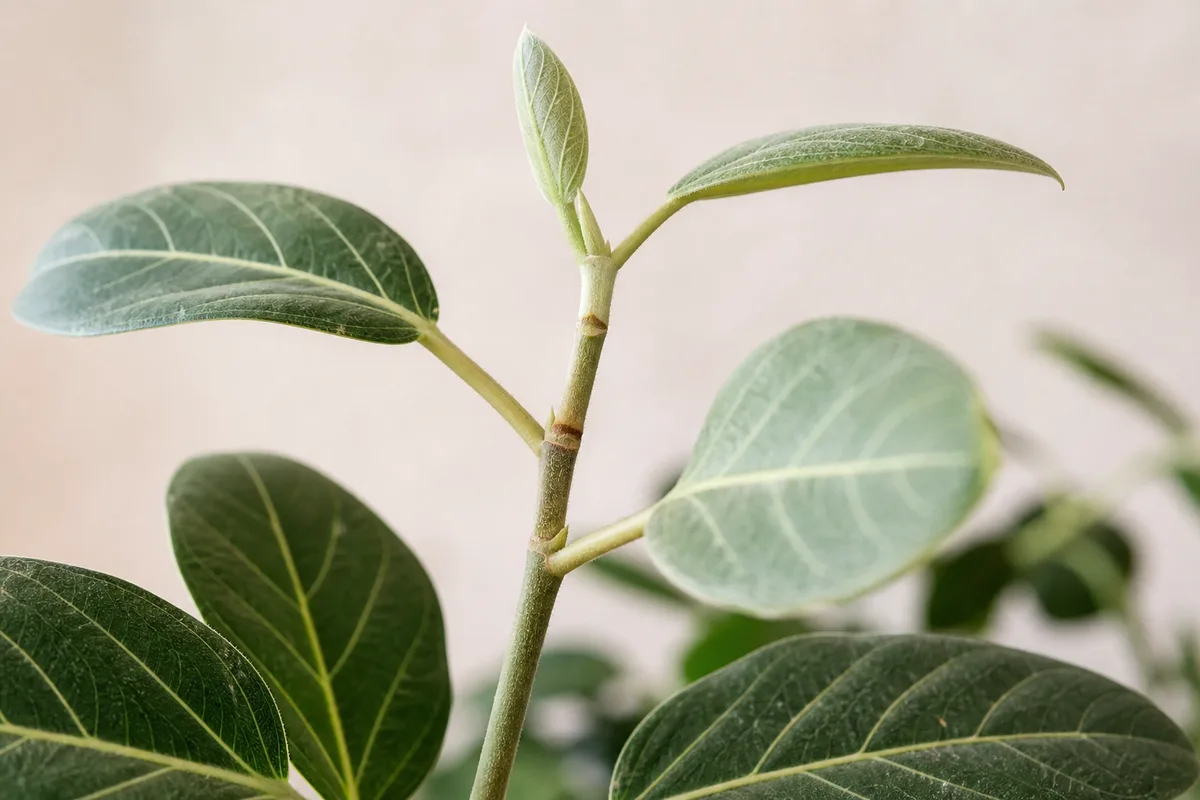
Leggy Growth symptoms on Ficus Audrey - compare with healthy tissue on the same plant.
Typical signs on new growth:
- Long gaps between leaves on the upper stem-internodes lengthen as the apical bud reaches for photons
- Smaller new leaves compared with older ones lower on the same branch; velvety texture stays, but lamina size shrinks
- Flat or dull gray-green color on new foliage instead of the firm, veined green of a well-lit specimen
- One-sided lean or all new tips pointing toward a window-plants in low light stretch or lean toward the light source
- Bare lower trunk with a leafy crown at the top-the tree-like silhouette collapses into a pole with a tuft
- Slow upward progress that still looks like “growth” until you measure internode spacing and realize stems are weak, not vigorous
Quick field test: pinch the gap between the last two leaves on the newest shoot. On a compact Audrey in good light, that gap might be one to three centimeters. On an etiolated plant, gaps of five centimeters or more on successive new leaves confirm stretch.
What leggy growth is not: crisp brown patches on sun-facing leaves-that is sunburn after a sudden move into harsh direct rays. Sudden mass leaf drop days after relocation is often shock, not gradual etiolation. Uniform stippling on leaf undersides points to spider mites, not internode stretch alone.
Why Ficus Audrey gets leggy
Insufficient light (primary cause)
Almost all indoor Audrey legginess is etiolation from too little light intensity or too few daily hours. Appropriate light supports healthy foliage growth indoors, and without it the plant elongates stem tissue between nodes to place leaves closer to whatever photons exist-a survival strategy, not healthy architecture.
Common home triggers:
- Distance from windows - Light intensity drops rapidly with distance from the glass. A spot that looks bright to human eyes may be too dim for a Ficus that wants medium-to-high indirect intensity.
- North-facing exposure alone - In the Northern Hemisphere, north windows often provide 25–100 foot-candles, classified as low light. Audrey may limp along in summer but stretches every winter unless you supplement.
- Winter daylight - Shorter days reduce effective hours even if you never moved the pot. Stretch that appears every November through February in the same corner is seasonal etiolation.
- Marketing confusion - Because Audrey tolerates brief adjustment better than fiddle leaf fig, growers sometimes place it in snake-plant corners. It will stretch there predictably.
Secondary factors that worsen the look
Overwatering in dim corners. In low light, Audrey uses water slowly. If you keep a summer Ficus Audrey watering guide, soil stays wet longer, lower leaves yellow or drop, and the bare trunk looks more dramatic-even though light started the stretch. Wet soil with long internodes still means fix placement first; see overwatering on Ficus Audrey if roots smell sour.
Uneven exposure without rotation. One-sided stretch from a single window is still etiolation; weekly rotation prevents the lean from freezing permanently.
Heavy fertilizing in shade. Excess nitrogen can push weak elongated shoots when light cannot support dense tissue. Do not feed a stretched plant before light improves.
How to confirm the cause
Work through this checklist before Ficus Audrey repotting guide, spraying for pests, or cutting stems:
- Internode trend - Compare spacing on the newest three leaves to leaves six months lower on the stem. Lengthening gaps confirm etiolation.
- Leaf size trend - Newest leaf smaller than an older one on the same branch confirms stretch, not a nutrient mystery.
- Lean direction - Does growth point toward a window or lamp? That lean confirms active light-seeking.
- Window distance - Stand where the pot sits. More than 1.5–2 m (5–6 ft) back from any bright window, or north exposure only, supports a light diagnosis.
- Season - Did stretch begin or worsen as days shortened?
- Soil rhythm - Finger the top 2–3 cm of mix. Damp for a week with weak stretch suggests slow uptake in dim light-not necessarily underwatering on Ficus Audrey.
- Pest scan - Check undersides for mite webbing or stippling. Mites stress plants but do not create long internodes by themselves.
If long internodes, smaller new leaves, and window lean align with a dim placement-and roots are not mushy when you spot-check-leggy growth from etiolation is confirmed. For a step-by-step light-placement fix, use the not enough light guide.
First fix for Ficus Audrey
Move the plant to the brightest location that still avoids harsh midday sun on the velvety leaves.
Practical targets:
- East window: Often ideal-gentle direct morning sun, then bright indirect rest of day
- South or west window: Place 2–4 feet back or behind a sheer curtain so hot afternoon rays do not scorch foliage
- No usable window: Set a full-spectrum LED grow light 30–45 cm (12–18 in) above the canopy for 12–14 hours daily-supplement for no more than 16 hours total light per day
Make one move, then wait. Water only when the top 2–3 cm of soil dries-the same rule as normal Audrey care-but expect the interval to shorten in brighter light. Do not prune leggy stems yet; see Ficus Audrey light needs for placement details and acclimation after months in deep shade.
Step-by-step recovery after light improves
Once the plant is in better light:
- Hold fertilizer until fresh leaves open with normal color and spacing.
- Rotate the pot a quarter turn weekly so all sides receive similar exposure and the lean does not set permanently.
- Dust the broad fuzzy leaves with a damp cloth-grime blocks light on textured surfaces.
- Stake extreme leans temporarily so the trunk does not bend permanently while new upright growth forms.
- Prune stretched stems only after new compact growth proves the spot works-cut just above a node on the worst etiolated shoots, staging removal across weeks if you must take more than one-third of foliage. Full technique is in our Ficus Audrey pruning guide.
- Adjust watering to the new dry-down speed-brighter Audrey drinks faster; recheck every few days for two weeks.
If winter light remains marginal at the best window, add a grow light rather than accepting stretch until spring.
Recovery timeline
Expect visible improvement in new growth within two to three weeks after a meaningful light increase during the active season. The first new leaf should sit closer to the previous one, feel firmer, and show clearer veining on the fuzzy surface.
Older stretched stems will not compact. They remain long even when conditions improve-the same species in brighter light would be more compact with normal-size leaves, but existing etiolated internodes do not shrink back. Evaluate success on the next two flushes of leaves, not on branches that formed in the dark.
Full silhouette recovery-a bushier, tree-like Audrey-can take several months of consistent bright indirect light and may require selective pruning of the worst etiolated shoots once replacement growth is established.
If nothing new appears after four to six weeks in a clearly brighter spot during warm weather, reassess roots, pests, or whether the “upgrade” is still too dim-common with north windows in winter. Slow growth from other causes is a separate diagnosis when internodes are normal but the plant barely moves.
Lookalike symptoms
| What you see | Often confused with | How to tell them apart |
|---|---|---|
| Long stems, small leaves, window lean | Not enough light (cause page) | Same biology-leggy growth is the low-light symptom; this page names the stretch pattern; not-enough-light covers placement fixes |
| Yellow lower leaves, wet soil | Overwatering | Overwatering: soil wet throughout, possible sour smell, soft roots. Leggy etiolation: long internodes and lean present; soil may stay wet because growth is slow in dim light |
| Leaf drop days after a move | Relocation shock | Shock: sudden drop even if light is adequate. Leggy: gradual stretch over weeks in one dim spot |
| Pale stippled leaves | Spider mites | Mites: webbing, speckles on undersides. Leggy: uniform stretch without pest debris |
| Brown crispy patches on sun side | Too much direct sun | Sunburn: damage on the leaf facing the window after a sudden bright move. Leggy: no scorch patch pattern |
Mistakes to avoid
Do not prune all leggy stems before light improves-you remove stored energy and may slow recovery. Do not water more because leaves look limp in a dark corner; roots in soggy mix cannot fix etiolation.
Avoid moving Audrey into direct hot afternoon sun in one step after months of shade-velvety leaves scorch quickly. Do not fertilize heavily to “green up” stretched stems; salts build up while photosynthesis stays weak.
Do not assume stretch equals healthy vigor-rapid upward reach with thin stems and tiny leaves is light starvation, not a growth spurt worth feeding. And do not ignore the sibling diagnosis: if your question is “how far from the window,” start with the light guide and not-enough-light fix page rather than stacking unrelated treatments.
How to prevent leggy growth next time
Place Audrey where bright indirect light is realistic every month, not only where the pot looks best in the room layout. East exposures, filtered south or west windows, or a dedicated grow shelf all work.
Rotate weekly for even growth. Clean windows and leaves seasonally-grime cuts intensity more than people expect. In autumn, move plants closer to glass or add artificial light before stretch begins rather than after bare lower stems appear.
When buying, avoid specimens already etiolated in a shop with poor lighting; starting with compact new growth is easier than rehabbing a long-stemmed pole. Match watering to how the pot actually dries in that light level-see the Ficus Audrey overview for baseline care rhythm.
When to worry
Escalate if many leaves drop while soil stays wet in a dark location-inspect roots for rot and improve light and drainage together. Worry if new growth stops entirely for more than a month in warm conditions despite a light move; the new spot may still be insufficient or another stressor is involved.
A few dropped lower leaves after a large light improvement can happen as the plant rebalances; widespread collapse with soft stems is not a normal leggy pattern-check roots before pruning further.
Conclusion
Leggy growth on Ficus Audrey is etiolation made visible-long internodes, small pale new leaves, and a lean toward the window tell you the tree needs more usable brightness, not more fertilizer or a bigger pot. Move it to bright indirect exposure, recheck watering as the mix dries faster, and judge recovery on new compact leaves. Old stretched growth may stay long until you prune it after light proves stable-but a well-lit Audrey regains the glossy, upright habit that makes this banyan cultivar worth keeping out of dim corners reserved for true low-light species.
When to use this page vs other Ficus Audrey guides
- Ficus Audrey watering guide - Use for routine moisture checks before assuming leggy growth is the main issue.
- Ficus Audrey problems hub - Browse all 17 common issues on this species.
- Not Enough Light on Ficus Audrey - Different entry point when symptoms overlap with leggy growth.
- Slow Growth on Ficus Audrey - Different entry point when symptoms overlap with leggy growth.
- Leaf Drop on Ficus Audrey - Different entry point when symptoms overlap with leggy growth.