Low Humidity on Dieffenbachia: Causes, Checks & Fixes
Quick answer
Dieffenbachia performs best at 40–60% relative humidity; winter heating and placement near vents or sunny glass often drop RH below 30% and crisp large leaf margins. First step: measure humidity beside the pot and move the plant at least 3 feet from heat or AC vents before adding a humidifier or pebble tray.
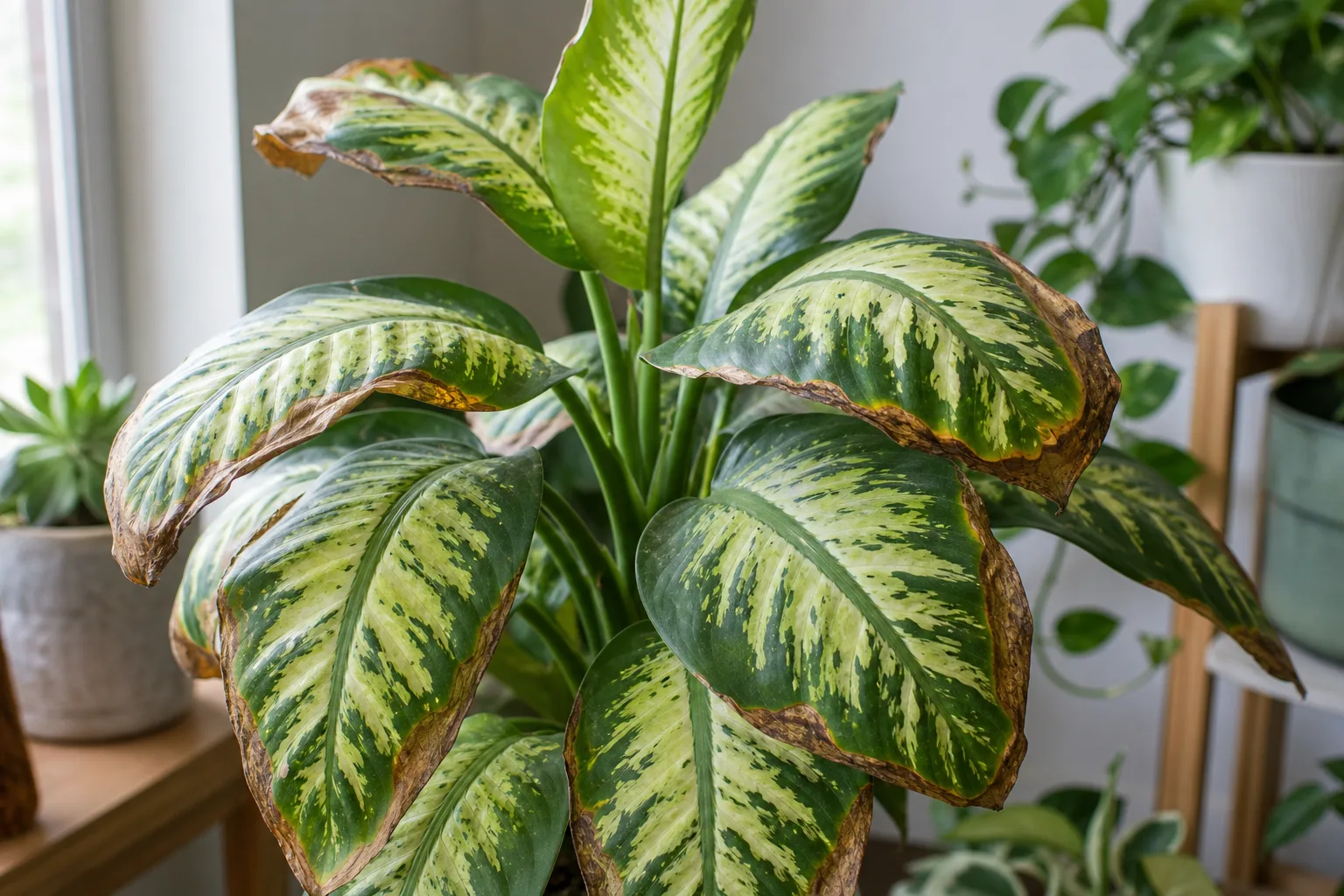
Low Humidity on Dieffenbachia: Causes, Checks & Fixes
This guide covers low humidity on Dieffenbachia. See also the general Low Humidity guide, watering, and light pages for this plant.
Low Humidity on Dieffenbachia: Causes, Checks & Fixes
Quick answer
Dieffenbachia (Dieffenbachia spp., dumb cane) is a tropical Araceae foliage plant with large, thin-blade leaves that transpire heavily in bright rooms. It performs best when relative humidity stays in the 40 to 60% range alongside stable indoor temperatures. Most homes drop well below that in winter when furnaces, heat pumps, and space heaters run-often into the 20 to 30% band near vents and west-facing glass.
Low humidity on dumb cane usually shows as crisp brown leaf margins, slow or stuck new-leaf unfurling, and-if air stays very dry for weeks-higher spider mite risk. It is not the same problem as underwatering, fluoride burn, or active pest stippling, and treating it with more water alone will not fix dry air.
First step: place a hygrometer beside the pot, note the reading, and move the plant at least 3 feet (1 m) away from heating vents, AC registers, and hot window glass. If RH is below 40%, add a room humidifier (most effective), group plants, or a pebble tray-in that order of impact-before Dieffenbachia repotting guide, fertilizing, or heavy pruning.
What low humidity looks like on Dieffenbachia
Dry air damage on dumb cane appears on the leaf edges first, because Dieffenbachia’s mature blades are 8 to 14 inches long with broad surface area that loses moisture faster than small-leaved houseplants when ambient RH falls.
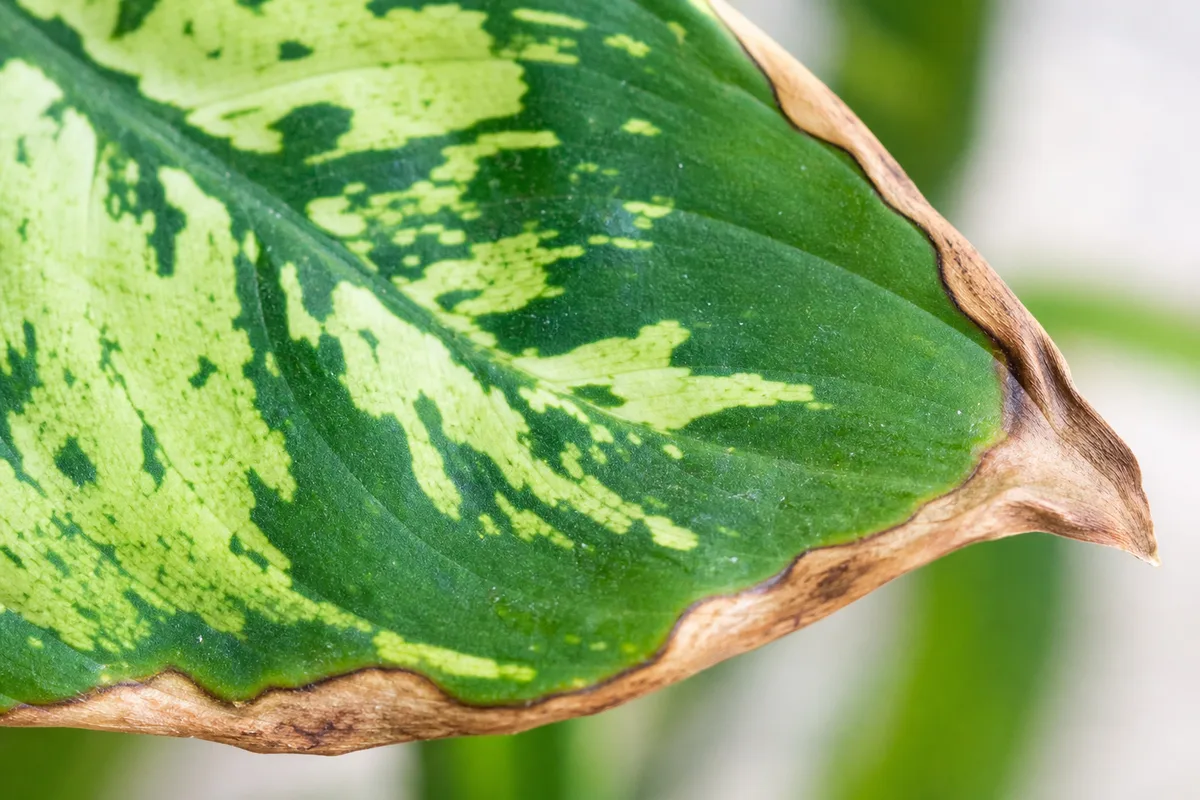
Low Humidity symptoms on Dieffenbachia - compare with healthy tissue on the same plant.
Common patterns include:
- Even brown or tan crisping along margins, sometimes worse on the leaf half facing a vent or window
- New leaves that unfurl slowly, stay small, or emerge with brown edges already present
- No stippling or webbing on the leaf surface-those point to spider mites, not humidity alone
- Firm central cane and normal soil dry-down while only margins suffer (contrast with underwatering wilt)
- Seasonal timing-symptoms that appear or worsen when heating season starts, often without any change to your watering calendar
Heavily variegated cultivars such as ‘Camille’ and ‘Tropic Snow’ often show margin burn sooner than darker green forms, because pale tissue has less margin buffer when air is dry and sun through glass adds local heat stress.
Normal winter slowdown is different from humidity injury. Dieffenbachia may grow more slowly in short-day months, but healthy resting plants still hold firm leaves with intact margins. Progressive crisping on multiple leaves while RH reads below 30% beside the pot is environmental stress, not dormancy.
Why Dieffenbachia is sensitive to dry indoor air
In its native tropical American understory, dumb cane grows in humid, filtered conditions. Indoors, NC State Extension notes that Dieffenbachia prefers moderate temperatures, indirect light, and high humidity-a combination that breaks down quickly in modern heated rooms.
Common triggers in real homes:
- Forced-air heating that drops whole-room humidity below 20% for weeks at a time
- Placement within the blast zone of floor or ceiling vents, where localized air is drier than the rest of the room
- Large pots on sunny window sills, where afternoon sun through glass heats leaf tissue while winter air stays dry
- Air-conditioning paths in summer that blow cold, dry air across foliage
- Single-plant isolation in a big dry room, with no grouping or humidifier to buffer transpiration loss
Dieffenbachia tolerates average indoor humidity better than calatheas or ferns, which is why it survives many offices-but very dry air below ~30% still accelerates margin burn and favors spider mites on stressed foliage. Large leaves near heat sources lose water faster than the root zone can replace it, so edges desiccate even when you water correctly.
Lookalike symptoms to rule out
| What you see | More likely cause if… |
|---|---|
| Even margin crisping, no stippling, plant near vent or dry winter room | Low humidity - confirm with hygrometer |
| Brown tips on many leaves regardless of placement; persists after humidifier | Fluoride or salt in tap water - see brown tips on Dieffenbachia |
| Whole-plant wilt, light pot, dry mix several inches down | Underwatering - see underwatering |
| Yellow speckles, bronzing, fine webbing at leaf bases | Spider mites - see spider mites |
| Bleached patches on side facing glass | Too much direct sun - see not enough light (placement overlap) |
| Yellow lower leaves with wet, heavy soil | overwatering on Dieffenbachia / root rot on Dieffenbachia - not humidity primary |
If margins crisp without wilt on dry soil, stippling, or scorch patches, low humidity is the leading explanation-especially when RH beside the pot reads under 40%.
How to confirm low humidity
Work through these checks before changing fertilizer, repotting, or pesticide:
- Hygrometer reading at plant height - Place the sensor beside the foliage, not across the room. Act if RH is below 40%; target 40–60% for best foliage. Extension guidance for dumb cane recommends aiming for that surrounding range when winter rooms run dry.
- Vent and window audit - Feel for warm or cold drafts at leaf level. Move pots at least 3 feet from registers; avoid touching cold winter glass or sitting directly under a ceiling vent.
- Symmetry test - Damage worse on one side toward a heater or window supports placement-driven dry air, not random pest or disease pattern.
- Soil moisture cross-check - Press the top inch of mix. Firm stems with dry margins but appropriate moisture fit humidity stress; a light pot and limp leaves suggest underwatering instead-see the watering guide.
- Leaf underside inspection - No specks or webbing? Rule out mites before spraying. Low indoor humidity favors mite development on many houseplants, but confirmation requires pest signs, not margin color alone.
- Water quality screen - If margins stay brown on new growth after RH is stable for three weeks, test filtered or distilled water for a month to rule out fluoride overlap covered on the brown tips page.
- Two-week placement trial - Move off the vent path and add one humidity step (humidifier or grouping). Cleaner unfurling on the next leaf confirms the diagnosis.
First fix for Dieffenbachia
Relocate away from dry-air sources, then raise humidity toward 40–60%.
Practical order:
- Move the pot today off the vent line, away from hot window glass, and out of the direct path of AC blasts.
- Run a humidifier in the same room if RH stays below 40% after the move-this is the most reliable way to lift ambient moisture for a large floor specimen. UF/IFAS Extension notes humidifiers work well when several humidity-loving plants share a space.
- Group humidity-loving plants so collective transpiration raises the local microclimate-modest but free.
- Add a pebble tray under the pot if a humidifier is not available: rest the pot on pebbles above the water line so roots never sit submerged.
Do not stack repotting, fertilizer, and heavy pruning on the same day. One environmental correction at a time lets you read the plant’s response on the next unfurling leaf.
Step-by-step humidity recovery
After the first fix:
- Hold watering steady using the top-inch dry rule from the watering guide-dry air is not fixed by extra soil moisture.
- Run the humidifier daily through heating season while RH reads under 45% at plant height; empty and clean the tank weekly to avoid mold.
- Wait for one to two new leaves before judging success. Look for full expansion without pre-browned edges.
- Trim only fully dead margin tissue if it is brittle and brown; partial green leaves still photosynthesize.
- Switch to filtered or rainwater if tips persist after RH stabilizes-humidity and fluoride stress often overlap on Dieffenbachia.
- Inspect undersides weekly while air is dry. If stippling appears, escalate to the spider mites guide while keeping humidity up.
Recovery timeline
Expect visible stabilization within two to three weeks once RH rises and vent exposure stops-faster in warm growing months, slower in mid-winter.
Crisp brown margins on existing leaves do not turn green again. Damaged cells are permanent; judge recovery by clean new growth and stopped spread to older leaves.
A hygrometer reading that climbs from the high 20s to the mid-40s often correlates with the next leaf unfurling cleanly within three weeks on a otherwise healthy cane. If margins keep browning on fresh leaves after four weeks above 40% RH, revisit water quality (brown tips) or pest inspection (spider mites).
Signs the problem is worsening: stippling and webbing spreading, multiple leaves bronzing while RH stays low, or new growth aborting entirely. Those patterns mean dry air has opened the door to mites or another stressor-act on humidity and pests together.
What not to do
- Do not water more because leaf edges look dry-soggy soil on a humidity-stressed Dieffenbachia invites root problems without raising air moisture.
- Do not rely on misting alone-surface moisture evaporates in minutes and does not meaningfully raise room humidity the way a humidifier does.
- Do not fertilize stressed plants hoping to green margins-salts can burn edges when roots are already under environmental pressure.
- Do not place the pot in standing water to “add humidity”; pebble trays must keep the root ball above the water line.
- Do not assume a pebble tray fixes a large room running at 25% RH-a humidifier or room move is the realistic fix.
- Do not spray pesticides for margin crisping without confirming mites or other pests first.
How to prevent low humidity next time
Treat humidity as a placement and season variable, not a one-time rescue:
- Check RH weekly beside the plant from October through March in heated climates; target 40–60% per extension guidance for cane plants and maintain humidity with grouping or pebble trays when a humidifier is not available.
- Keep floor specimens away from vent lines when rearranging furniture for winter.
- Run a humidifier in the plant room before margins crisp, not after half the crown shows damage.
- Group tropical foliage plants that share similar humidity needs; keep succulents separate so you are not fighting conflicting goals.
- Cross-check baseline care on the Dieffenbachia overview when margin burn, mites, and watering questions overlap.
Heavily variegated cultivars in dry apartments may need a dedicated humidifier year-round-not just in winter-if you want museum-clean margins.
When to worry
Low humidity alone rarely kills a firm-caned Dieffenbachia quickly, but prolonged RH below 30% plus mite infestation can defoliate a weakened plant. Treat as urgent if you see rapid stippling spread, webbing on new growth, or widespread bronzing while the hygrometer still reads dry-follow the spider mites page and humidify at the same time.
Also escalate if new leaves stay crinkled and brown-edged for more than a month after RH holds above 40% and water quality is addressed. Another stressor-chronic overwatering, cold drafts below about 55°F (13°C), or insufficient light-may still be limiting recovery; use not enough light and watering guides to cross-check.
Conclusion
Low humidity on Dieffenbachia is an environmental placement problem you confirm with a hygrometer, vent audit, and lookalike table-not a mystery disease. Move dumb cane off dry-air paths, raise RH toward 40–60% with a humidifier-first plan, and judge success on new leaves, not old crisp margins. When tips persist after air stabilizes, branch to brown tips for water quality; when speckling appears, branch to spider mites. Prevent repeat damage by monitoring winter RH beside the plant, not guessing from a calendar.
When to use this page vs other Dieffenbachia guides
- Dieffenbachia watering guide - Use for routine moisture checks before assuming low humidity is the main issue.
- Dieffenbachia problems hub - Browse all 16 common issues on this species.
- Brown Tips on Dieffenbachia - Different entry point when symptoms overlap with low humidity.