Dieffenbachia Light Needs: Bright Indirect, Low-Light
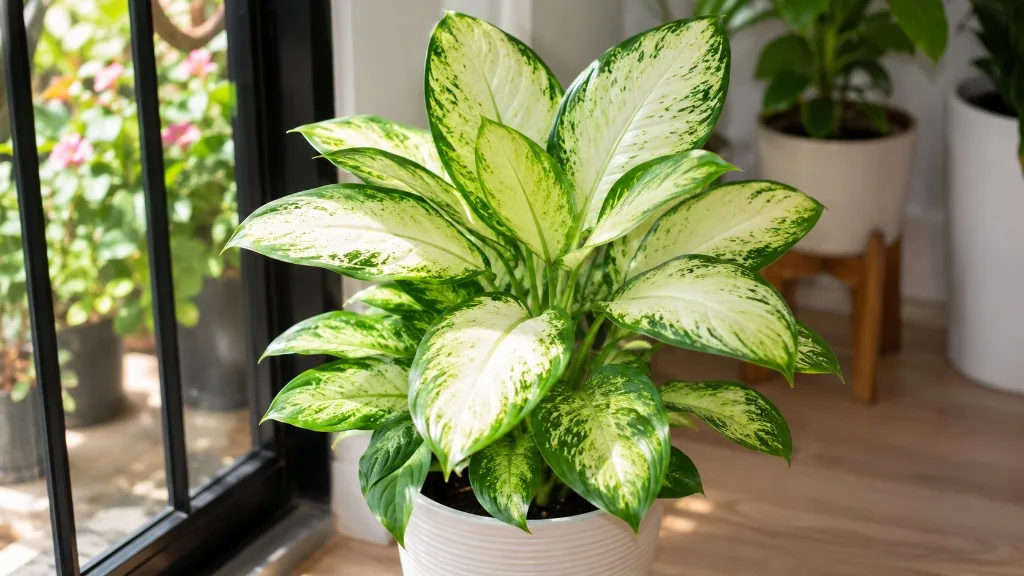
Dieffenbachia Light Needs: Bright Indirect, Low-Light Limits & Sun Burn
Dieffenbachia Light Needs: Bright Indirect, Low-Light Limits & Sun Burn
Dieffenbachia - often called dumb cane or dumbcane - is sold as an easy foliage plant for dim offices and shaded corners. That reputation is half true. Dieffenbachia spp. will survive lower light longer than many showy tropicals, but survival is not the same as the bold white, cream, and yellow patterns on the tag, the compact upright habit you saw at the nursery, or firm new leaves opening every few weeks. Light is the control dial for all three: growth speed, stem length, and variegation contrast.
The practical target for most homes is bright indirect light - strong ambient brightness on the leaf surface without harsh direct rays beating on the tissue for hours. University of Illinois Extension lists dieffenbachia among houseplants that perform best in bright, indirect sunlight with warm temperatures. (Illinois Extension) North Carolina Extension notes the genus prefers indirect light and must be protected from direct sunlight, which can scorch the broad leaves. (NC State Plant Toolbox) The plant also tolerates lower light - sometimes impressively so - but that tolerance has a ceiling where variegation washes out, stems stretch, and lower leaves drop.
This guide focuses on the decisions that protect foliage quality: how much light Dieffenbachia actually needs, where low-light tolerance stops being an asset, how direct sun causes leaf burn and washout, how light and variegation are linked cultivar by cultivar, where to place pots by window direction, when to add grow lights, and how to read warning signs before a placement mistake becomes a permanent leggy silhouette.
How Much Light Dieffenbachia Actually Needs
Dieffenbachia is native to the tropical Americas - from Mexico through Central and South America and the Caribbean - where it grows in the filtered light of forest understories, not on open rock in full midday sun. That origin explains the species-level preference for bright, dappled light indoors. In cultivation the genus includes dozens of hybrids and cultivars with different amounts of white, cream, and yellow in the leaves, and those pigments change the math: a mostly green Compacta type and a heavily white ‘Camille’ or ‘Tropic Snow’ may both be labeled “Dieffenbachia,” but they do not live happily at identical foot-candle levels.
For home growers, the usable baseline is medium to bright indirect light for most of the day. Missouri Extension classifies dieffenbachia in the medium light range, noting that this band helps prevent loss of lower leaves - a common complaint when plants sit too far from windows. (MU Extension) Commercial interior guidelines from University of Florida IFAS go further with cultivar specificity: some selections such as ‘Star Bright’ and ‘Snow Flake’ remain attractive at roughly 50 foot-candles, while ‘Camille’ needs on the order of 150 to 250 foot-candles to hold variegation and avoid excess stem elongation. (UF IFAS EP137) You do not need a light meter to apply the lesson - heavily variegated cultivars generally need brighter placement than greener ones - but the numbers confirm what windowsill growers observe: “low light tolerant” is not “low light optimal.”
Too little light produces etiolation: longer spaces between leaves, thinner petioles, smaller new blades, and a visible lean toward the brightest direction. Too much light - especially unfiltered direct sun through south or west glass - produces photobleaching, crisp brown patches, and a washed-out, faded look IFAS describes when plants are exposed to excessive brightness. (UF IFAS EP137) The workable band sits between those failures: enough photons for compact growth and pattern contrast, not so much radiation that the leaf tissue overheats or bleaches.
Light also sets the pace for water use. A Dieffenbachia in correct bright indirect light dries its pot faster and uses nutrients steadily during active growth. The same plant moved to a dim corner stays wet longer; if you keep watering on the old schedule, root stress follows even though the light - not the water formula - was what changed. Treat light as the throttle for the whole care system.
The Short Answer for Busy Growers
If you only remember four rules, use these. Default placement: bright indirect light - within roughly 12 inches (30 cm) of an east window or a filtered south or west window - where you can read comfortably without switching on a lamp at midday, and the plant receives light on its leaves, not just on the wall behind the pot. Low light is a compromise, not a goal: Dieffenbachia may persist in dim conditions, but expect slower growth, faded variegation, and bare lower stems over time; heavily white cultivars fade first. Direct sun is the main burn risk indoors: avoid hot afternoon rays on the glass-facing side; sheer curtains or a few feet of setback from south/west panes usually beat repeated scorch. Judge by new growth: firm, correctly sized, appropriately patterned newest leaves mean the current light works; stretching, pale new tissue, or bleached patches mean adjust before changing fertilizer or Dieffenbachia repotting guide.
Give any placement change 10 to 14 days before calling it a failure. Old damaged leaves do not revert; only new ones tell the truth.
Rainforest Origins and Indoor Light Logic
In the wild, Dieffenbachia receives shifting patches of light through canopy gaps - bright when a beam lands, softer the rest of the day - with high humidity and stable warmth. Indoors we flatten that environment into a single window vector and often add dry air and irregular watering. The plant’s tolerance for lower light is real evolutionary flexibility, not an invitation to treat it like a cast-iron plant in a hallway with no windows.
Araceae family members, including Dieffenbachia, share a general pattern: roots need airflow, leaves respond quickly to light shifts, and stress often shows first on older lower foliage when the plant reallocates resources toward new growth in suboptimal conditions. When light is chronically low, the plant drops lower leaves to reduce the photosynthetic load it must support - Missouri Extension explicitly ties medium light to preventing lower leaf loss. (MU Extension) That symptom is frequently misread as underwatering on Dieffenbachia or old age when it is simply the plant simplifying itself to survive a dim site.
What Dappled Understory Light Looks Like at Home
Dappled understory light indoors is not a mood-lit corner where your eyes strain to read. It is the zone where:
- The plant sees open sky from its perspective, not just a glowing wall across the room
- No direct sun disk hits the leaf for more than a few minutes at a time, or only gentle early-morning direct through east glass
- Leaves cast a soft, diffuse shadow rather than a knife-sharp outline at midday
- You could comfortably keep a fern or calathea neighbor in the same zone without either crisping or starving
An east-facing window often delivers this pattern naturally: bright morning direct that is cooler than afternoon sun, then bright indirect for the rest of the day. A south or west window with a sheer curtain can match understory intensity if the curtain stays closed during peak hours. A spot three to six feet back from a bright window may still qualify as bright indirect if the room has light-colored walls and no heavy obstructions - but ten feet into a room rarely does, even if the space feels “bright” to human eyes adapted to dim interiors.
Rotate the pot a quarter turn every week or two so new growth does not hard-lean toward the glass. Dieffenbachia stems are not self-correcting; a plant that grows crooked in year one stays crooked unless you stake or propagate.
Bright Indirect Light Explained
Bright indirect light is the phrase every Dieffenbachia care sheet repeats and few define. Practically, it means high illuminance without direct beam exposure on the leaf surface for extended periods. Outdoors, horticulturists would call similar conditions filtered shade or partial shade - NC State lists Dieffenbachia seguine as suited to partial shade with direct sun only part of the day, roughly two to six hours, which maps to morning exposure or late-day softness, not blazing noon. (NC State Plant Toolbox)
Indoors, glass changes the equation. South-facing panes can concentrate heat and radiation, turning “bright indirect” at the sill into effective full sun on the leaves touching glass. Dieffenbachia’s broad blades have large surface area; they heat faster than small-leaved succulents and show damage sooner. IFAS warns that direct sun or excessive brightness gives leaves a washed-out appearance even before crisp brown scorch appears - an early signal many growers miss because they assume more light always equals more variegation.
The relationship is curved, not linear. Up to a cultivar-specific point, more light improves variegation contrast and leaf size. Beyond that point, photobleaching erases the very pattern you wanted. Bright indirect is the band before the curve bends downward.
How to Test Whether a Spot Qualifies
Use a two-week new-growth test rather than a single afternoon snapshot:
- Place the pot where you think bright indirect exists - close to the window, not across the room.
- Note direction and time: does direct sun hit leaves? For how long? Is it morning (usually safer) or afternoon (higher burn risk)?
- After 10 to 14 days, inspect the newest fully opened leaf and the stem segment above the last cut or broken petiole.
- Pass: internode length similar to nursery growth, leaf size stable or increasing, variegation pattern matching the cultivar’s expected look, no glass-side bleaching.
- Fail low light: visible stretch between nodes, smaller new blades, strong lean, fading white/cream zones toward plain green.
- Fail high light: chalky bleached patches, tan crisp spots on the window-facing side, margins drying on new tissue, sudden leaf curl during peak hours.
Optional: a phone light meter app or dedicated meter reading roughly 200–400 foot-candles at the leaf surface often aligns with the medium-to-bright band Missouri Extension recommends for Dieffenbachia - with heavily variegated types toward the upper end. (MU Extension) Meters help in borderline offices; the new-leaf test remains the final judge because cultivar genetics shift the target.
If the spot fails on the low side but you cannot move the plant, plan for grow-light supplementation rather than accepting a slow decline - Dieffenbachia can look fine for months in marginal light, then suddenly drop lower leaves once reserves exhaust.
Low-Light Tolerance and Its Hard Limits
Dieffenbachia’s reputation for low-light tolerance comes from decades of commercial interiorscape use. UF IFAS notes the genus has been used indoors for over a century and highlights cultivars bred for attractive foliar variegation even in challenging buildings. (UF IFAS EP137) Arkansas Extension observes that dumb cane can flourish at light levels around 25 foot-candles - close to what humans call mood lighting - though it also notes plants respond well when better light arrives in spring and summer. (University of Arkansas)
That wide floor is real, but it comes with trade-offs IFAS documents clearly: inappropriate low light reduces foliar variegation and causes excess stem elongation. (UF IFAS EP137) Illinois Extension adds that although dieffenbachia tolerates lower light, it grows best in brighter light - tolerance is not preference. (Illinois Extension)
In a dim office, Dieffenbachia may stay green and upright for a year while white sectors shrink, internodes lengthen, and lower leaves yellow and drop one by one. The plant is not being dramatic; it is reallocating limited energy to fewer, greener, more efficient leaves. overwatering on Dieffenbachia makes this worse because low-light plants use less water; soggy roots plus dim light is one of the fastest routes to crown rot on bare canes.
Cultivar Differences in Shade Performance
Not all Dieffenbachia cultivars share the same low-light floor. UF IFAS production data offers concrete examples:
- ‘Star Bright’ and ‘Snow Flake’ remain acceptable at roughly 50 foot-candles - true low-light performers among showy types
- ‘Camille’ needs roughly 150–250 foot-candles to stay attractive; below that, variegation reduction and legginess appear quickly
Greener, more compact selections - many ‘Compacta’ types and solid green sports - often tolerate lower light with less visible pattern loss because more of the leaf already contains chlorophyll. Heavily white or yellow cultivars like ‘Camille’, ‘Tropic Snow’, and some ‘Seguine’ patterned forms behave like light-hungry variegated plants even though the genus label says shade-tolerant.
Practical rule: match cultivar to site before purchase. A white-heavy dumb cane in a north-facing cubicle will fade unless you add a lamp; a greener type may look acceptable there for years. If you already own a faded plant, increasing light is the first fix, not extra fertilizer - salts on stressed roots burn leaf edges IFAS warns about when soluble salts climb. (UF IFAS EP137)
How Light Drives Variegation and Pattern
Dieffenbachia variegation is not paint on the surface; it is uneven chlorophyll distribution across leaf tissue. White, cream, and yellow zones contain little or no chlorophyll and cannot photosynthesize. The green sectors must produce enough energy for the entire leaf, the stem, the roots, and new growth. When light drops, the plant’s survival logic favors expanding green area and reducing expensive variegation display - white sectors shrink, patterns blur, and new leaves emerge more uniformly green.
This is why two pots of the same cultivar can look like different plants after six months: one in bright filtered light holds crisp white margins; one in a dim bedroom drifts toward plain green with faint ghosting where the pattern used to be. The change is reversible only on new leaves after light improves; existing leaves keep their faded look until they age out.
Light also affects leaf size. Under adequate brightness, Dieffenbachia produces the large 8–14 inch blades the genus is known for indoors. Under chronic shade, new leaves shrink - a subtle early warning before obvious stretch appears.
When More Light Sharpens Contrast
Up to the cultivar’s ceiling, increasing bright indirect light typically:
- Deepens green background tone, making white or yellow markings read sharper by contrast
- Supports larger new leaves with stable petiole length
- Reduces internode stretch, keeping the cane compact and bushy longer
- Slows lower-leaf drop because the plant is not starving for photons
Move brightness in one step, not jumps: from a dim corner to within a foot of an east window, or from north exposure to filtered south with a curtain, then wait two weeks. If no bleaching appears on new tissue, you can hold or increase slightly. Heavily variegated cultivars benefit most from this upward move - they are also the first to bleach if you overshoot into direct sun.
When Low Light Fades White and Cream Zones
When light is insufficient, watch for pattern-specific fade before general wilt:
- New leaves open with less white or yellow than older leaves higher on the cane
- Margins that were crisp white turn greenish from the midrib outward
- Older variegated leaves look “better” than new ones - a telltale sign the current site is dimming over time or was always marginal
- Longer petioles and smaller blades on the newest leaf pair while the plant still appears “healthy green”
Fade from low light is often confused with nutrient deficiency or normal aging. Check light first: if the plant sits far from glass, in a north room, or behind furniture, brightness is the likelier culprit. If light is already strong and pattern still collapses, then investigate feed and roots - but do not fertilize a dim, wet plant hoping for whiter leaves.
Direct Sun and Leaf Burn on Dieffenbachia
Direct sunlight is the most destructive common light mistake for indoor Dieffenbachia. Outdoors in the tropics, filtered canopy protects leaves; indoors, window glass removes wind cooling and can intensify radiation on the side facing the pane. NC State Extension notes that direct sunlight can scorch the broad leaves, producing brown irregular patches, yellow halos, and crisp margins - especially through south and west windows.
Sun damage on Dieffenbachia often appears in stages:
- Washout - leaf looks faded, almost gray-green or chalky on the window side; IFAS links this to excessive brightness before full scorch
- Bleached patches - white or yellow variegated zones turn tan or papery first because they lack protective pigment
- Crisp brown spots - irregular interior patches and margin burn where tissue died
- Curling or drooping at midday on moist soil - leaf temperature stress, not always drought
Some growers report one to two hours of gentle early direct sun on acclimated plants without damage, particularly through east glass in cool seasons. That is not permission for all-day sun or unfiltered west-afternoon beams. Indoors, the safer default is zero prolonged direct on variegated types unless you are deliberately acclimating and watching new leaves daily.
Acclimation Before Adding Direct Rays
If you move Dieffenbachia from a dim shop or office toward a brighter window, acclimate over 7 to 14 days:
- Days 1–3: bright indirect only - near but not in the direct beam
- Days 4–7: add 30–60 minutes of early morning direct if east exposure; otherwise keep indirect and move 6 inches (15 cm) closer to the window every few days
- Days 8–14: assess newest leaves; if clean, hold position; if bleaching, step back or add sheer diffusion
Never combine a major light jump with repotting, heavy feed, or a Dieffenbachia watering guide change. Dieffenbachia already reacts to sudden shifts with leaf drop, curl, or stalled growth; stacked stress makes cause and effect impossible to read.
For south/west windows, sheer curtains or blinds angled to block the sun disk while keeping the room bright usually deliver better variegation than raw glass with repeated weekly scorch cycles.
Best Window Placement by Direction
Compass direction is a starting guess, not a verdict. A “south window” blocked by a porch roof may deliver less usable light than an open east pane. Dieffenbachia placement succeeds when leaf-level brightness matches cultivar needs for enough hours daily - typically bright indirect for most of the photoperiod, with optional gentle morning direct on tolerant placements.
Keep the pot within 12 inches (30 cm) of the glass on the chosen exposure when possible. Light falls off quickly with distance; a Dieffenbachia on a coffee table six feet away often lives in low light while the room feels fine to you.
East, South, West, and North Compared
An east-facing window is the most reliable default for Dieffenbachia indoors. Morning sun is bright but cooler than afternoon sun, which supports variegation on ‘Camille’-type cultivars without the heat load that bleaches white zones. East works for both greener and heavily variegated selections when pots sit close to the pane.
A south-facing window delivers the strongest winter sun in the northern hemisphere and can be excellent from fall through spring with the pot one to two feet back or behind a sheer curtain in summer. Watch for one-sided bleaching on leaves facing the glass; rotate and diffuse peak summer rays. South is ideal when you pair window light with a small overhead LED in winter.
A west-facing window throws hot afternoon direct - high risk for variegated Dieffenbachia unless filtered. If west is your only bright exposure, use sheer curtains during peak hours or place the plant to the side of the window where it receives bright ambient light without the sun disk striking leaves. Unfiltered west sills crisp white sectors within days on sensitive cultivars.
A north-facing window rarely supplies enough brightness for strong variegation long-term. North may maintain survival green on low-light-tolerant selections like ‘Star Bright’ in summer at higher latitudes, but expect stretch, smaller new leaves, and pattern fade unless you add supplemental light. Treat north as grow-light territory for white-heavy cultivars.
Office desks under overhead fluorescents or LEDs often sit in 50–100 foot-candles - enough for some greener types short term, marginal for showy variegation. Missouri Extension notes Dieffenbachia benefits from supplementary lighting in poorly lit areas. (MU Extension) A small desk lamp rated for plants beats hoping ceiling grid lights substitute for a window.
Grow Lights When Windows Are Not Enough
When windows cannot deliver enough brightness for compact growth and stable variegation - north rooms, winter at high latitude, interior offices, or rooms blocked by adjacent buildings - a full-spectrum LED grow light is the most reliable upgrade. Dieffenbachia responds well to artificial light in holding and recovery setups; the goal is consistent daily totals, not blinding peak intensity for a few hours.
You do not need commercial greenhouse hardware. A horticultural white LED - not a standard room bulb optimized for human lumens - provides the photosynthetic spectrum Dieffenbachia uses for leaf and stem development. Single-fixture setups work well for upright cane plants; run them on a timer so photoperiod stays steady.
Distance, Hours, and Spectrum Starting Points
A workable starting setup for indoor Dieffenbachia:
- Position the fixture 12 to 24 inches (30 to 60 cm) above the top of the canopy - close enough for intensity, far enough to avoid leaf hot spots on small pots under high-output lamps
- Run the light 10 to 12 hours daily on a timer; UF IFAS and multiple grower references cite at least 8–10 hours when natural light is weak, with 10–12 hours safer for variegated cultivars needing higher totals
- Choose 5000–6500 K white full-spectrum LEDs unless experimenting; avoid “bloom-only” red-heavy spectra for foliage maintenance
- Combine overhead LED with the brightest window available when possible so growth is not one-directional
Adjust using new-growth signals over two weeks. If stems still stretch and new leaves pale or lose pattern, lower the fixture 2 inches (5 cm) or add one hour to the timer - not both at once. If leaf edges bleach or curl only under the lamp, raise the fixture 2 to 3 inches or reduce hours slightly. Small enclosed shelves can still overheat; feel leaf temperature with your hand at midday lamp-on.
For winter holding, aim for compact maintenance, not forced summer growth in December. Increase window proximity or lamp hours in late winter as natural photoperiod lengthens, matching the plant’s spring acceleration rather than fighting it with excess feed.
Warning Signs Your Dieffenbachia Has the Wrong Light
Dieffenbachia reports light problems on new tissue first. Old bleached or stretched leaves will not revert; watch the youngest fully opened leaf and the next node after any change. Make one light adjustment, then wait 10 to 14 days before also changing water, fertilizer, or pot size - overlapping edits make diagnosis guesswork because wilt, fade, and edge crisping overlap across stress types.
Too little light shows as long internodes and visible stretching toward the window or lamp, with the cane looking taller and sparser than when you bought it. Smaller, thinner new leaves confirm chronic deficit, not a single cloudy week. Loss of white, cream, or yellow contrast with new leaves emerging greener than older ones signals insufficient photon flux - especially on ‘Camille’ and ‘Tropic Snow’ types. Hard lean to one side indicates directional starvation common on single-window placements without rotation or overhead supplementation. Yellowing lower leaves on moist soil in dim cool rooms often couples low light to overwatering; fix brightness and dry-down together rather than watering less alone while leaving the plant in shade. Slow or absent new growth in growing season, with an otherwise healthy cane, frequently traces to a spot far from usable light.
Too much light shows as chalky or gray-green bleached zones on the window- or lamp-facing side, especially in variegated tissue with little chlorophyll protection. Crisp brown patches or dry margins appearing suddenly after a move closer to glass suggest scorch or heat stress, not necessarily drought. Washed-out pattern contrast - the leaf looks like a faded print - often precedes crisping and matches IFAS descriptions of excessive brightness. Midday curling on moist soil can be a protective response to excess light or leaf heat load through glass. Sudden leaf drop after relocation to harsh exposure without acclimation is a common failure mode, not a mysterious disease.
Fixes for low light: move closer to glass, remove obstructions, rotate pots, shift to east or filtered south, add or lower a grow light, extend photoperiod on the timer, and reduce watering frequency to match slower metabolism. Fixes for high light: pull back from glass, add sheer diffusion, shift to east, block afternoon sun disk on west/south, acclimate gradually over 7–14 days, and avoid leaving variegated leaves touching hot panes.
Conclusion
Dieffenbachia light needs are not captured by a vague “medium indirect” label alone - they are a balance between cultivar genetics, window quality, and daily photon totals. The practical target for most homes is bright indirect light close enough to the window that new leaves stay compact, large, and true to the cultivar’s pattern. The genus tolerates low light longer than many tropical foliage plants, but tolerance trades away variegation contrast, stem compactness, and lower leaves - and heavily white types like ‘Camille’ hit their limit far sooner than greener ‘Star Bright’ selections.
Direct sun is the primary burn risk indoors: washout and bleached patches precede crisp brown scorch, especially on white sectors and on leaves pressed against hot glass. Variegation and light are linked directly - insufficient brightness fades patterns on new leaves; excessive brightness erases them through photobleaching. Read new growth, not nostalgia for older foliage. Move exposure in steps over 7 to 14 days, pair every light change with an adjusted watering rhythm, and use a 10–12 hour full-spectrum LED when north windows or office grids cannot support the plant you actually bought. Get the light band right and Dieffenbachia becomes one of the most dramatic easy-care foliage plants in the room; miss it and even perfect soil produces a leggy green impostor of the variegated cane on the nursery bench.
When to use this page vs other Dieffenbachia guides
- Dieffenbachia overview - Start here for whole-plant context before deep-diving this topic.
- Dieffenbachia problems hub - Jump to symptom-specific fix guides when this care topic does not resolve the issue.
- Not Enough Light on Dieffenbachia - Escalate here when light adjustments are not enough.
- Leggy Growth on Dieffenbachia - Escalate here when light adjustments are not enough.
Related Dieffenbachia guides
- Dieffenbachia overview
- Dieffenbachia watering
- Dieffenbachia soil
- Dieffenbachia propagation
- Dieffenbachia fertilizer
- Dieffenbachia repotting
- Not Enough Light on Dieffenbachia
- Leggy Growth on Dieffenbachia
- Dieffenbachia problems
Related tool
Try the Plant Problem Diagnosis Tool with dieffenbachia pre-selected to estimate needs for your setup.