Leggy Growth on Dieffenbachia: Causes, Checks & Fixes
Quick answer
Leggy growth on Dieffenbachia is etiolation-long bare cane, wide gaps between leaves, and a small crown-from chronic low light, not random bad luck. First step: move the pot to bright, filtered light within a few feet of an east window or behind sheer curtains on south or west glass before you prune, repot, or fertilize.
Leggy Growth on Dieffenbachia: Causes, Checks & Fixes
This guide covers leggy growth on Dieffenbachia. See also the general Leggy Growth guide, watering, and light pages for this plant.
Leggy Growth on Dieffenbachia: Causes, Checks & Fixes
Quick answer
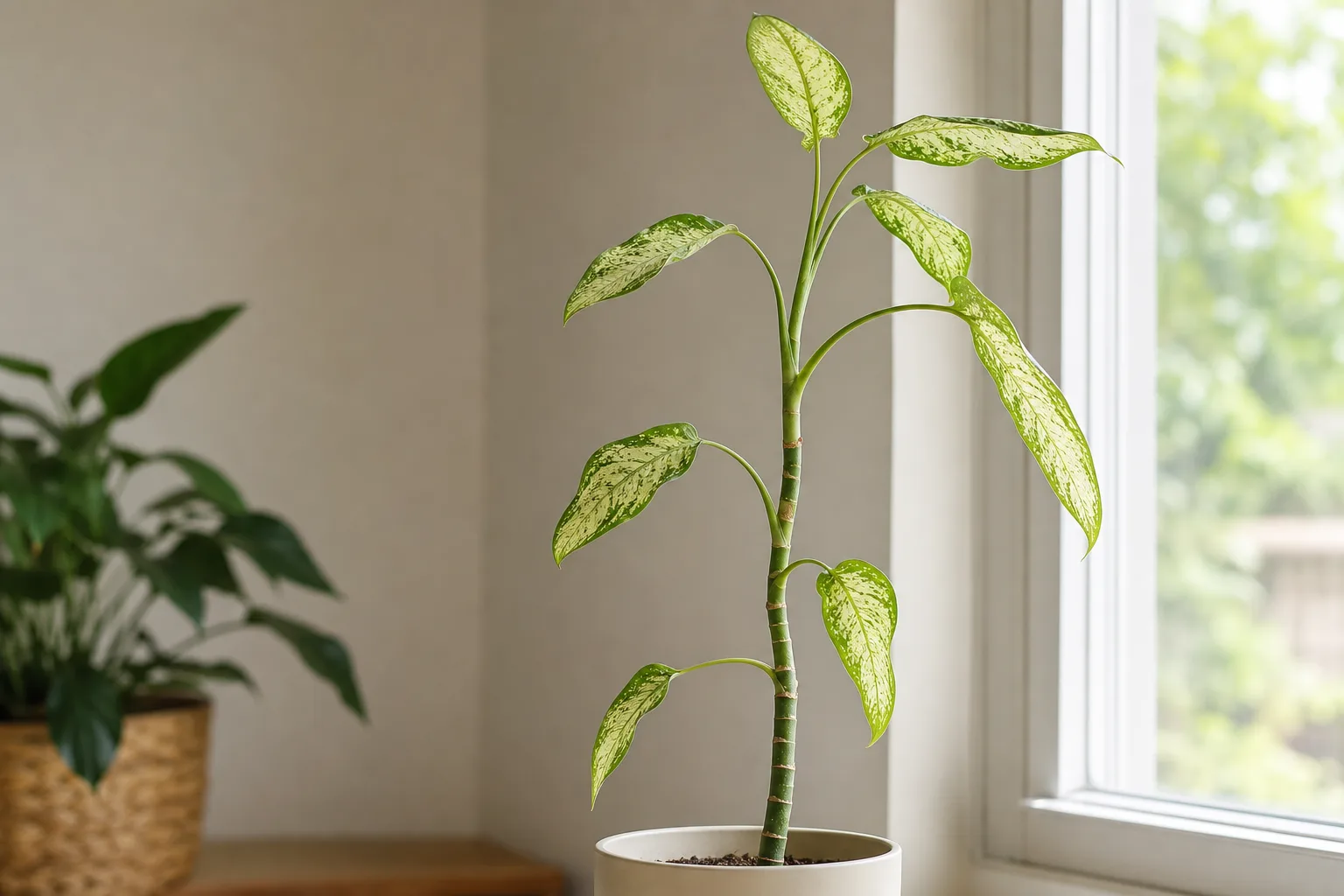
Leggy growth on Dieffenbachia (Dieffenbachia spp., dumb cane) is etiolation-the cane stretches toward light, leaves spread farther apart, and the plant develops a palm-tree silhouette: long bare stem, heavy crown at the top.
First step: move the pot to bright, filtered light-within a few feet of an east-facing window, or one to two meters back from a south or west window with sheer curtains. Do that before you prune, repot, or feed. Light stops further stretch; pruning only reshapes what light alone cannot shorten.
For placement details and a full low-light symptom checklist, see the not enough light and light guides. This page focuses on already-stretched canes, what recovers, and when to top a leggy stem.
What leggy growth looks like on Dieffenbachia
Dumb cane grows as an upright, cane-forming plant with large variegated blades. Legginess shows up in the architecture, not just one tired leaf:
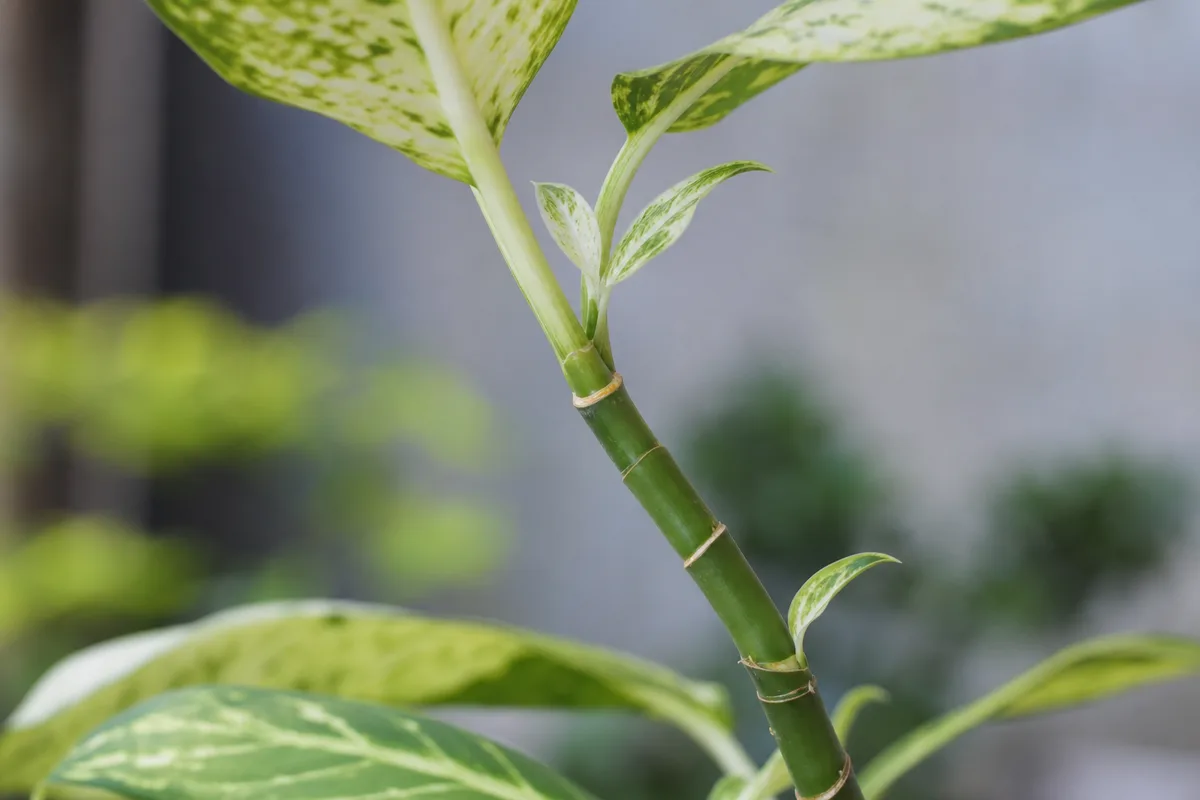
Leggy Growth symptoms on Dieffenbachia - compare with healthy tissue on the same plant.
- Bare lower cane - a long naked stem with no leaves for 30–90 cm or more, topped by a cluster of foliage
- Wide internode gaps - new leaves sit much farther apart on the cane than when the plant was compact at purchase
- Long petioles - leaf stalks extend before the blade, making each leaf feel “reaching”
- Smaller, dull new foliage - the latest leaves are narrower or shorter than mature ones lower on the crown; cream, white, and yellow variegation fades toward solid green
- One-sided lean - the whole cane bends toward the brightest window instead of growing upright
- Lower leaf drop speeding up - older bottom leaves yellow and fall faster than on a plant in adequate light
Heavily variegated cultivars such as ‘Camille’ and ‘Tropic Snow’ show pattern fade and stretch first. Solid-green forms like ‘Compacta’ tolerate dimmer spots longer but still develop bare cane over time.
These patterns differ from sun scorch, which bleaches or crisps patches on leaves facing direct hot glass. Dieffenbachia wants filtered brightness, not midday sun on the foliage.
Why Dieffenbachia stretches (etiolation and light)
Dieffenbachia evolved under dappled tropical canopy light. Indoors, chronic shade triggers etiolation-cells elongate so the plant can reach brighter energy. UF/IFAS notes that inappropriate low light causes foliar variegation reduction and excess stem elongation on interiorscape dieffenbachia cultivars.
The “shade-tolerant” label on nursery tags masks the problem. Some cultivars remain acceptable at roughly 50 foot-candles, while heavily variegated types such as ‘Camille’ need on the order of 150–250 foot-candles to hold pattern and compact spacing. (UF IFAS EP137) Surviving in a dim corner is not the same as thriving-stretch is the plant compensating for too few photons.
Common triggers in real homes:
- Decor placement - corner shelves, bathroom alcoves, and rooms more than two meters from windows
- North-only exposure in winter, when daylight hours are shortest
- Misreading tolerance - variegated tissue carries less chlorophyll per leaf area, so weak light hits twice-pattern fades and internodes lengthen
- Seasonal fade - a summer placement that becomes too dark after clocks change
Secondary contributors can worsen stretch but rarely cause it alone:
- Overwatering in a dark corner - slow uptake keeps soil wet; weak stems and yellow lower leaves mimic stress, but the spacing pattern still points to light first. Cross-check the watering guide.
- Heavy fertilizer in shade - nitrogen cannot replace photons; insufficient light is not cured by extra feed, water, or repotting alone
- Root-bound stall - a crowded pot can slow growth, but long bare cane with lean toward a window still signals etiolation first. See slow growth if the plant is compact yet stalled.
Lookalikes to rule out
| Pattern | Cane | Leaf spacing | Soil | Likely cause |
|---|---|---|---|---|
| Long bare stem, small top crown | Firm, leaning to window | Wide gaps on new growth | Dries on a slow rhythm | Etiolation / low light |
| One or two yellow bottom leaves | Upright, compact | Normal | Even moisture | Normal senescence |
| Whole plant droops, base softens | Mushy at soil line | Any | Wet for days | Overwatering / root rot |
| Crispy brown leaf margins | Upright | Normal | Dry throughout | Low humidity or fluoride, not stretch |
| No new leaves for months, compact cane | Upright | Normal | Variable | Slow growth - different from active stretch |
Rotation alone will not fix chronic shade-Clemson HGIC notes dieffenbachia tolerates low light but grows best in bright filtered indoor light. A rotated pot in a dim corner still etiolates.
How to confirm the cause
Work through these checks before cutting or repotting:
- Distance from glass - If the pot sits more than two meters from the brightest window or on an interior shelf, light is the prime suspect.
- Compare internodes - Measure gap between the last two leaves. Wider than when you bought the plant, with smaller new blades, confirms stretch.
- Variegation fade - Cream, white, and yellow patches dull to mostly green on new foliage before the cane looks dramatically bare.
- Growth direction - All new leaves face one window; the cane leans the same way.
- Soil dry-down - Push a finger 3–5 cm into the mix. Damp more than ten days after watering in a dark spot suggests low light slowed uptake-rule out oversized pots too.
- Two-week light trial - Move one meter closer to filtered window light. If the next leaf is larger and closer to the prior node, light was the limiter.
If leaves show bleaching on the window side, you may have too much direct sun-filter with a sheer curtain rather than moving closer.
First fix: correct light before anything else
Move the pot to the brightest filtered spot you can offer-typically within one to two meters of an east window, or one to two meters back from a south or west window with sheer curtains.
Make this a single change. Do not top the cane, repot, or fertilize the same day. Give the plant one to two weeks to respond before adjusting watering or adding grow lights.
If no suitable window exists, add a full-spectrum LED grow light about 30 cm above the top leaves for 12–16 hours daily-a second step after repositioning, not a substitute for checking natural light first.
When to top a leggy cane
Existing stretched internodes never shorten. A leaf that already grew with a long petiole stays that way. Light fixes the next leaves; it does not rewind bare cane.
Plan cane topping only after:
- The plant has one or two compact new leaves in the brighter spot (usually two to four weeks)
- More than about 60 cm of bare cane remains below the crown and the silhouette still bothers you
- Cane tissue at the soil line is firm, not soft or rotting
To top: cut just above a node-the ring where a leaf attached-leaving a few millimeters of firm cane above the node at a slight angle. Dieffenbachia does not sprout from bare internodes between nodes. Wear waterproof gloves; Dieffenbachia sap contains calcium oxalate crystals that irritate skin and are toxic to pets if chewed.
Do not top and repot the same week. Full cut placement, sap safety, and recovery timing are in the pruning guide.
Recovery timeline - what shrinks vs. what never does
| Tissue | Can it recover? | What to watch |
|---|---|---|
| Old internode length | No - permanent | New leaves closer together |
| Old petiole length | No | Shorter stalks on new leaves only |
| Faded variegation on old leaves | Unlikely | Clearer pattern on fresh foliage |
| Lean | Partially - with rotation | Cane upright once light is even |
| Bare cane below crown | Only via pruning | Side shoots from nodes after topping |
Expect the next leaf to show improvement within two to three weeks after a meaningful light increase during active growth (roughly spring through early fall indoors).
Success signs:
- New leaves larger and closer together
- Variegation clearer on fresh foliage
- Cane stops leaning once you rotate a quarter turn every few days
- Soil drying on a predictable rhythm in the brighter spot
If nothing improves after four to six weeks in verified bright filtered light, reassess for root issues, chronic overwatering in the old location, or pests-not more fertilizer.
What not to do
Do not prune first in a dim spot-new shoots will stretch again unless light improves.
Do not blast the plant with direct south-window sun to fix etiolation-acclimate with sheer curtains over one to two weeks.
Do not fertilize heavily in shade to force compact growth; feed only after one healthy new leaf in better light.
Do not stake a leaning cane indefinitely without improving light and rotation-the stem keeps reaching.
Do not top and repot the same week-stacking stress slows bud break on nodes.
Do not expect old stretched spacing to tighten-judge recovery on new growth only.
How to prevent leggy growth on Dieffenbachia
Place dumb cane where bright, filtered light is realistic all day-not only where the pot looks best decoratively. East windows and sheer-filtered south or west exposures suit most homes. Heavily variegated cultivars need one step brighter than solid-green forms.
- Keep the pot within one to two meters of filtered glass; move closer when winter shortens daylight
- Rotate the pot regularly for even growth
- Clean windows and open blinds seasonally
- Use a grow light in offices or north-facing rooms below medium-bright levels
- Match watering to how fast the pot dries in the current light per the watering guide
When to worry
Escalate if the cane softens at the base, soil smells sour, or lower leaves drop weekly while the mix stays wet-that pattern can precede root rot and needs root checks before cosmetic topping.
Pure stretch with firm cane tissue and stable soil is not an emergency-increase light gradually and watch the next leaves.
Conclusion
Leggy growth on Dieffenbachia is etiolation from chronic low light, showing as bare cane, wide leaf gaps, and a fading crown. Correct filtered light first, wait for one or two compact new leaves, then top the cane only if bare stem still dominates the silhouette. Old spacing never shrinks-recovery lives in the next foliage. Link light placement, watering, and safe pruning together and dumb cane can regain the bold variegated presence it was chosen for.
When to use this page vs other Dieffenbachia guides
- Dieffenbachia watering guide - Use for routine moisture checks before assuming leggy growth is the main issue.
- Dieffenbachia problems hub - Browse all 16 common issues on this species.
- Not Enough Light on Dieffenbachia - Different entry point when symptoms overlap with leggy growth.
- Slow Growth on Dieffenbachia - Different entry point when symptoms overlap with leggy growth.
- Yellow Leaves on Dieffenbachia - Different entry point when symptoms overlap with leggy growth.