Best Soil for Dieffenbachia: Mix, pH & Drainage
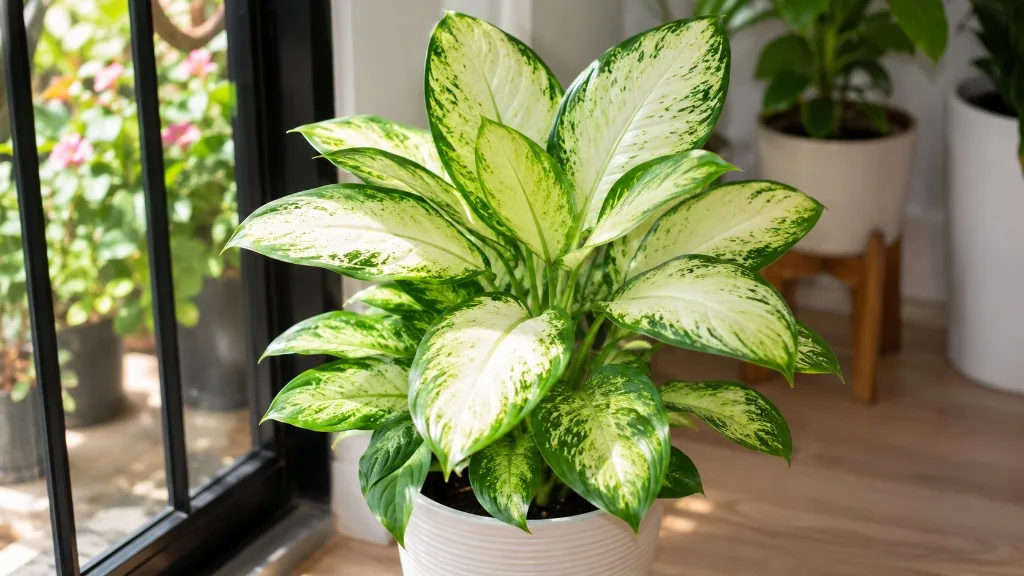
Best Soil for Dieffenbachia: Mix, pH & Drainage
Best Soil for Dieffenbachia: Mix, pH & Drainage
The best soil for Dieffenbachia is not the richest bag on the shelf. It is a peat-based, well-draining potting mix with enough perlite - or similar coarse aeration material - to keep oxygen around the roots after every watering. Dieffenbachia, commonly called dumb cane, belongs to the aroid family (Araceae), the same broad group that includes philodendrons, aglaonemas, and alocasias. Like other aroids grown indoors, it needs a root zone that holds usable moisture without becoming a stagnant sponge. Heavy, fine potting soil that drains slowly is one of the most reliable ways to lose an otherwise forgiving plant.
That distinction matters because Dieffenbachia looks tough. It tolerates lower light than many tropical foliage plants, grows quickly in good conditions, and stores moisture in its thick stem. Those traits can mislead growers into thinking the mix should stay wet for long stretches. In practice, the stem’s water reserve buys time between waterings; it does not replace the need for airy soil. When the lower root ball sits in saturated, compacted media, roots lose oxygen first. Leaves yellow, stems soften at the soil line, and growth stalls long before the problem feels obvious at the surface.
This guide covers proven mix recipes - including ratios recommended by the University of Connecticut Home & Garden Education Center, pH targets, perlite and bark amendments, container drainage for aroids, when to refresh or repot, and how to fix a setup that stays wet too long.
Quick Answer: The Best Dieffenbachia Soil Mix
Use a loose, fertile, well-draining peat-based mix. Three reliable starting points, all cited by UConn for Dieffenbachia, are:
- Equal parts peat moss and perlite (1:1)
- Equal parts potting soil and peat moss (1:1)
- Equal parts potting soil, peat moss, and perlite or vermiculite (1:1:1)
If you already own a quality indoor potting mix, a practical home shortcut is roughly 60–70% potting mix and 30–40% perlite by volume, optionally with a modest handful of fine pine bark or orchid bark per batch for extra structure. Aim for a slightly acidic root zone around pH 5.5–6.5, though steady growth on sound leaves is a better everyday signal than chasing a decimal on a cheap probe. Always pair the mix with a container that has at least one open drainage hole, and never let the pot stand in collected runoff.
The functional goal is predictable behavior: water should penetrate the whole root ball, excess should exit freely, and the medium should move from evenly moist toward the next watering without remaining swampy in the lower half. If your current mix fails that cycle, adjust the recipe or the pot before changing light, fertilizer, or humidity.
Why Dieffenbachia Soil Needs Differ From Ordinary Houseplants
Dieffenbachia is often sold in dense nursery peat that works temporarily in a greenhouse but breaks down or stays wet too long on a living-room shelf. Standard indoor potting soil can also be too fine for long-term container culture if it compacts around thick aroid roots. The plant does not need desert dryness, but it does need a medium where water and air coexist in the same pot - a balance that garden soil, topdressing stones, and “moisture-control” blends frequently disrupt indoors.
Commercial growers treat Dieffenbachia as a foliage crop with specific media targets. University of Florida IFAS Extension describes successful propagation and production media containing about 50% peat, 25% pine bark, and 25% perlite by volume, with pH 5.0–6.0 and moderate soluble salts. You do not need a greenhouse batch mixer to copy that logic at home. You need the same structural idea: a moisture-holding organic base, durable coarse particles, and enough connected pore space for drainage and gas exchange.
Aroid Roots and the Moisture-Air Balance
Aroid roots are adapted to forest-floor conditions where organic matter is loose, oxygen moves through the profile, and moisture arrives in pulses rather than constant saturation. In a pot, the entire root environment is confined. Every watering decision and every particle size choice either preserves or destroys pore space. Fine, degraded peat and crushed mix collapse over months, especially under a large plant in a warm room with repeated shallow watering.
Dieffenbachia roots perform best when the medium dries partially between waterings rather than swinging between bone-dry surface and sodden center. Clemson Cooperative Extension advises keeping Dieffenbachia moist but not overly wet, which only works if the physical mix and pot allow it. “Moist” in an airy peat-perlite blend is not the same as “moist” in a dense, water-retentive bag. Judge moisture at root depth with a wooden skewer, the weight of the pot, or a finger through the drainage hole when possible - not only by whether the top inch looks dry.
What Happens When the Mix Stays Too Wet
Chronic wetness is the primary soil failure mode for Dieffenbachia. NC State Extension notes that overwatering on Dieffenbachia and poor drainage contribute to root problems in this genus. Roots need oxygen to function; waterlogged pores replace air with liquid, and root tissue begins to decline. Because Dieffenbachia stores water in its stem, the plant can look temporarily stable even while roots are compromised. By the time lower leaves yellow widely, stems feel soft at the base, or the mix smells sour, the damage may already be substantial.
Wet soil also encourages fungus gnats, encourages bacterial issues in stressed tissue, and slows new root growth. Fluoride and fertilizer salts become more damaging when roots are impaired and the medium never flushes cleanly. Fixing the soil system - mix texture, pot size, drainage outlet, and Dieffenbachia watering guide - is therefore the first response to decline, not a last resort after multiple other changes.
Best DIY Dieffenbachia Potting Mix Recipes
A useful home recipe should be easy to reproduce, easy to adjust, and honest about what each ingredient does. Start with clean scoops and a tub or tarp, lightly moisten dusty perlite before mixing to reduce dust, and break apart compacted peat or coir clumps so particles distribute evenly. The finished blend should feel springy and heterogeneous: when damp and squeezed, it may hold a loose shape briefly but should crumble apart readily when touched.
Peat and Perlite at 1:1 (UConn Standard)
The simplest UConn-recommended blend is equal parts sphagnum peat moss and perlite. This mix drains freely, stays light, and gives you a clear baseline when diagnosing watering problems. It holds less water than a peat-heavy commercial bag, which is an advantage in average household humidity and moderate light. The trade-off is that it may dry faster in a warm, bright window or with a large root mass, so you water slightly more often rather than adding fine, water-hogging material.
Peat contributes acidity, moisture retention, and cation exchange capacity - the ability to hold nutrients in forms roots can access. Perlite contributes non-decomposing pore space. Do not confuse horticultural sphagnum peat with fine, black garden peat sold mainly as a soil amendment; the latter can be too dense for container aroids. If the 1:1 blend dries faster than your schedule allows, add a modest portion of quality indoor potting mix rather than removing perlite entirely.
Soil, Peat, and Perlite at 1:1:1
The 1:1:1 blend of potting soil, peat, and perlite or vermiculite is another UConn-listed option with slightly more nutrient-holding material and a bit more moisture reserve. It suits growers who want a little more forgiveness between waterings without returning to a heavy mix. Vermiculite holds more water and nutrients than perlite; in cool, dim rooms where the pot already dries slowly, prefer perlite over vermiculite so you do not accidentally increase water retention.
For a peat-free direction, substitute coconut coir for part or all of the peat, but treat coir as a variable ingredient. Coir rewets more easily than old peat and can perform well, yet products differ in salt content, particle size, and processing. Use horticulture-grade coir, rinse if the manufacturer recommends it, and still add perlite and optionally bark for structure. Coir is not automatically better-draining than peat; either base can stay too wet when milled finely or packed hard.
Pine bark fines or small orchid bark are worth adding even when not strictly necessary. UF IFAS production media includes bark at 25% by volume because it creates irregular spaces, resists immediate collapse, and improves long-term structure. A handful per quart of mix is a reasonable home scale. Avoid fresh, chunky bark that leaves unstable voids unless you are deliberately building a very open blend for bright, warm conditions.
pH Range and Mineral Sensitivity for Dieffenbachia
Container pH influences nutrient availability, but for most indoor Dieffenbachia growers, texture and drainage matter more than micromanaging acidity. Still, a realistic target helps when troubleshooting chronic tip burn or strange leaf mottling that does not match obvious pest or light problems.
Target pH and When to Test
A practical target for Dieffenbachia is pH 5.5–6.5, aligned with UF IFAS production guidance in the low-to-mid six range and slightly broader survivable bounds often cited around 5.5–7.0. Most reputable peat- or coir-based indoor mixes arrive close to that range. If the plant produces firm new leaves, stable variegation where expected, and steady internode growth, routine pH testing is unnecessary.
Test when you have a persistent pattern that resists cultural fixes: chronic tip necrosis despite conservative feeding, heavy crusting on the soil surface, reliance on very alkaline tap water, or a mix built from unusual components. Cheap probe meters are often unreliable in loose potting media; a calibrated meter or lab-style soil test is more meaningful. Remember that impaired roots, cold soil, and excess fertilizer can mimic pH-related deficiency. Correct physical drainage and root health before adding acidifiers, lime, or extra fertilizer.
Fluoride, Salts, and Irrigation Water
Dieffenbachia is sensitive to fluoride, a fact noted in Clemson HGIC and other extension references on dumb cane culture. Fluoride damage often appears as dark brown or tan scorch along leaf margins and tips, sometimes with a speckled pattern, and it can occur even when watering feels “correct” if the water source is high in fluoride or if salts accumulate in a slow-draining mix. Filtered water, rainwater, or low-fluoride tap water reduces risk. Flushing the pot occasionally with plain suitable water helps move soluble salts through the profile - but only if the mix actually drains freely.
Fertilizer salts also concentrate when water evaporates from the top while the bottom stays wet, a common pattern in dense media and oversized pots. If crust forms on the surface or leaf tips burn despite modest feeding, inspect the drainage system and consider refreshing the upper layer or Dieffenbachia repotting guide into a better-aerated blend rather than stacking more nutrients on a failing root zone.
Container Drainage and Pot Choice
Soil does not drain in isolation. A perfect peat-perlite blend cannot protect roots if runoff has nowhere to go or if a decorative outer pot traps water against the nursery container. For aroids like Dieffenbachia, container drainage is part of the soil system, not an optional finishing detail.
Drainage Holes, Saucers, and Cachepots
Use a pot with at least one unobstructed drainage hole. Water thoroughly until excess runs out, let drainage finish, and discard saucer water before returning the plant to furniture. If you use a cachepot - a decorative cover without a hole - keep the plant in a removable inner pot and empty the cover after every watering. Never let the inner pot sit in standing water “just for a few hours”; that is long enough to re-saturate the bottom layer in a peat-heavy mix.
Do not add a layer of gravel, pot shards, or stones at the bottom as a substitute for a drainage hole or for aeration. That layer reduces rooting volume and can create a perched water table where fine media above a coarse layer stays wetter than growers expect. If particles escape through a large hole, cover it with a small piece of mesh or a coffee filter - not a deep rock layer. The fix for poor drainage is particle structure plus an open outlet, not a decorative false bottom.
Pot Size and Material
Repot into a container only one size larger than the current root ball - typically about 2–5 cm (1–2 inches) wider depending on plant size. Dieffenbachia grows actively in good conditions and may need repotting every one to two years, but an oversized jump surrounds roots with a large volume of unused wet medium. That extra reservoir is especially risky after repotting when roots have not yet colonized the new space.
Pot material changes drying speed. Unglazed terracotta breathes through its walls and can help a careful grower in humid or slow-drying rooms, but it demands more frequent watering in hot, bright conditions. Plastic and glazed ceramic retain moisture longer and are lighter or more decorative, but they leave less margin for an overly dense mix. Match material to your room: in low light and cool air, plastic with a well-aerated mix is often easier to manage than terracotta filled with heavy peat.
How to Test Your Dieffenbachia Soil Mix
Test a candidate blend before committing a stressed plant. Fill a pot of the intended size with lightly moistened mix, tap gently to settle without compressing, and water slowly across the surface. Water should soak in within a minute or two, not pool for several minutes or race down one crack along the pot wall. Excess should exit the hole in a steady stream, then slow to a drip.
Next, observe retention under your real conditions. Weigh the freshly drained pot in your hands, then check it daily. A skewer inserted to the bottom third should tell you whether the center stays wet while the top looks dry - a classic pattern in tall pots and dense mixes. The goal is a cycle where the root zone approaches the next watering evenly, without chronic sodden bottoms or rapid whole-pot desiccation within a day unless the plant is root-bound or in extreme heat.
After several cycles, look for even wetting and drying. Channeling water down one side, a hydrophobic dry center, or a sour smell indicates structural failure. White crust suggests salt accumulation. A healthy mix can be flushed occasionally, but compacted, degraded, or pest-infested media should be replaced rather than endlessly washed.
When to Refresh or Replace the Mix
Refresh soil when it compacts, smells sour, drains unevenly, or no longer supports healthy new growth - not on a fixed calendar alone. Peat-based mixes decompose over time as organic particles break down, shrinking air space and sometimes becoming difficult to rewet after extreme drying. A plant that wilted soon after a thorough watering may be root-bound, but it may also be sitting in repelling, degraded peat with a dry core and wet exterior.
Surface refresh can help when deeper media still drains well: remove the loose upper inch or two without damaging surface roots, replace with compatible fresh mix, and avoid burying the stem deeper than before. Top-dressing cannot fix a waterlogged lower half, salt-saturated profile, or active root rot on Dieffenbachia. When roots circle densely, emerge from drainage holes, or break apart in a solid mass, repotting with fresh mix is the appropriate step.
Avoid repotting purely because of one yellow leaf. Repot when the root-zone system - texture, volume, drainage, and root density - is clearly limiting recovery. If the plant is otherwise healthy and the mix still behaves well, unnecessary disturbance can set growth back without solving anything.
Repotting Dieffenbachia Into Fresh Soil
Repot during active growth in spring or early summer when possible, using premixed fresh medium and a clean pot one size up. Slide the root ball out, loosen only the outer congested roots, and remove degraded media that falls away without aggressive tearing. Healthy roots are firm and pale to tan; rotten roots are soft, dark, hollow, or foul-smelling and should be trimmed with clean tools.
Set the plant at the same depth as before, keeping the crown and lower stem above the line where constant moisture would contact tissue not adapted to it. Backfill with loose mix; do not stomp or press it into a brick. One thorough watering settles particles around roots. Let all excess drain, then return the plant to stable warmth and medium to Dieffenbachia light guide. Hold off on heavy fertilizing until new growth resumes - many commercial mixes already contain starter fertilizer, and stressed roots do not need a salt spike on top of transplant shock.
If substantial rot was removed, use a smaller pot matched to the remaining root mass rather than the previous container size. A diminished root system in an oversized wet reservoir is one of the most common post-repot failures for Dieffenbachia.
Troubleshooting Soil and Root Problems
When soil stays wet, investigate in a fixed order: confirm the drainage hole is open, empty the cachepot, assess light and temperature, compare pot size to roots, and inspect mix texture. Yellow lower leaves alone do not prove root rot, but yellowing combined with a heavy wet pot, soft lower stem, stagnant smell, or collapsing new growth warrants a root inspection.
If the mix is dense but the plant is otherwise healthy, amend the next repot with more perlite and bark rather than fighting the current bag with superficial watering tweaks. If the mix is appropriate but dries unevenly, check for channeling, partial watering, or a root ball that has pulled away from the pot sides. Rehydrate a hydrophobic root ball in stages with thorough drain cycles between, then repot if the problem returns.
Leaf tip burn with otherwise sound roots may point to fluoride or salts rather than soil texture alone. Switch water sources, flush if drainage is good, and reduce fertilizer until the pattern stabilizes. Fungus gnats suggest the surface stays moist too long; improving aeration and letting the upper layer approach dryness between waterings is more effective than relying only on traps.
Common Dieffenbachia Soil Mistakes
Using straight garden soil or topsoil in a pot is a frequent error. Mineral soil compacts indoors, reducing air and making watering unpredictable. Trusting “drainage layers” of gravel instead of amending the whole profile wastes depth and misleads growers about how water moves in containers. Oversized pots after repotting - often motivated by wanting the plant to “grow big fast” - create a wet outer ring that roots avoid.
Another mistake is partial watering to cope with slow-drying dense mix. Shallow sips leave dry pockets, concentrate salts, and encourage weak surface roots while the center stays anaerobic. Water thoroughly when the plant needs water, or fix the mix so that thorough watering is safe. Buying cactus soil alone without checking the label is risky: some brands are simply fine peat with sand and still stay wet; others drain so fast that a large Dieffenbachia in moderate light may need blending with a moisture-retentive base.
Finally, changing light, fertilizer, pruning, and soil all at once makes failures impossible to diagnose. When soil is the suspected issue, correct the mix and pot first, then observe for several watering cycles before stacking other interventions.
Conclusion
Dieffenbachia soil succeeds when it behaves like aroid-friendly container media should: peat-based, well aerated with perlite, optionally strengthened with bark, held in a slightly acidic profile near pH 5.5–6.5, and paired with a pot that drains freely. UConn’s 1:1 peat and perlite, 1:1 soil and peat, and 1:1:1 soil-peat-perlite blends are proven starting points; UF IFAS production guidance points the same direction with bark in the mix and a focus on oxygen around roots.
No recipe overrides environment. Low light and cool rooms slow drying, so extra aeration and conservative pot sizing matter. Bright, warm rooms may call for slightly more moisture-retentive base - but never a return to heavy, compacted soil. Watch how the root ball cycles between moist and ready-to-water, test new mixes before repotting stressed plants, and refresh media when it decomposes or smells sour. Get the soil system right, and Dieffenbachia repays the effort with the fast, dramatic foliage growth that made dumb cane a staple indoor plant in the first place.
When to use this page vs other Dieffenbachia guides
- Dieffenbachia overview - Start here for whole-plant context before deep-diving this topic.
- Dieffenbachia problems hub - Jump to symptom-specific fix guides when this care topic does not resolve the issue.
- Root Rot on Dieffenbachia - Escalate here when soil adjustments are not enough.
- Mold on Soil on Dieffenbachia - Escalate here when soil adjustments are not enough.
Related Dieffenbachia guides
- Dieffenbachia overview
- Dieffenbachia watering
- Dieffenbachia light
- Dieffenbachia propagation
- Dieffenbachia fertilizer
- Dieffenbachia repotting
- Root Rot on Dieffenbachia
- Mold on Soil on Dieffenbachia
- Dieffenbachia problems
Related tool
Try the Soil Mix Calculator with dieffenbachia pre-selected to estimate needs for your setup.