Dieffenbachia (Dumb Cane) Fertilizer: When, How
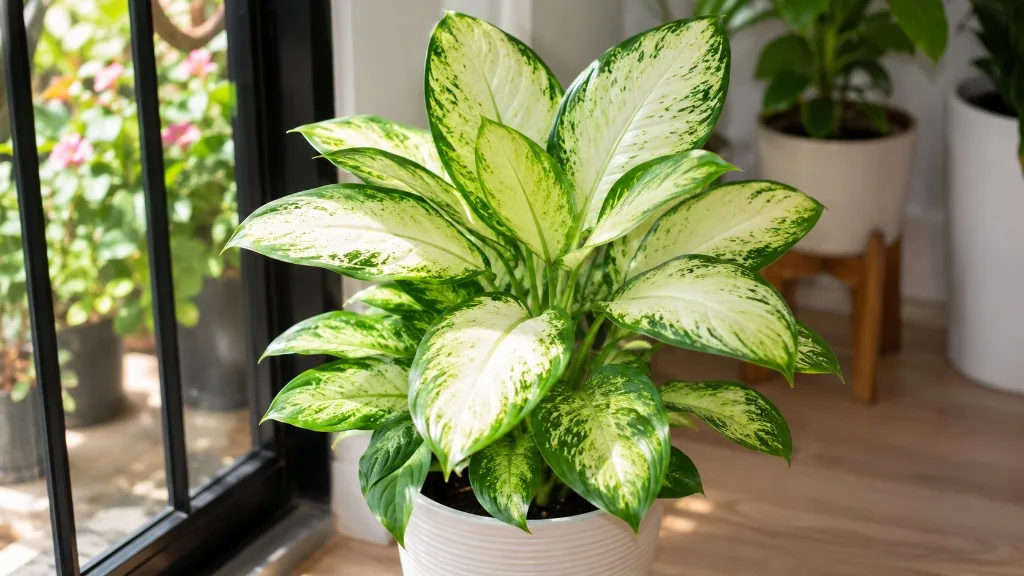
Dieffenbachia (Dumb Cane) Fertilizer: When, How, and Mistakes
Dieffenbachia (Dumb Cane) Fertilizer: When, How, and Mistakes
Dieffenbachia - the tropical foliage genus most people call dumb cane - belongs to the Araceae family alongside philodendrons, aglaonemas, and peace lilies. That family connection shapes feeding more than most care tags admit. Araceae plants push large leaves from cane-like stems, shed lower foliage as they mature, and accumulate raphides - needle-shaped calcium oxalate crystals - in every tissue. They also show marginal leaf burn when soluble salts or fluoride accumulate faster than roots can manage. Fertilizer on dumb cane is therefore less about chasing a magic NPK ratio and more about matching modest, consistent nutrition to visible new growth without stacking salts in a small pot.
Reviewed by LeafyPixels Review Board · Author: sai-ananth
This page is the species fertilizer hub for Dieffenbachia. Shared biology, flush recovery, and conservative half-strength defaults live here. Cultivar pages such as Camille fertilizer and Tropic Snow fertilizer add variegation-specific nuance where light demand differs - but most home growers searching “Dieffenbachia fertilizer” need this guide first. Pair feeding with our overview, watering, light, soil, repotting, and pruning guides on the same plant.
Dieffenbachia Fertilizer: Quick Answer
Product: Complete water-soluble 10-10-10 or 20-20-20, or a foliage-weighted 3-1-2 formula such as 24-8-16, all diluted to half label strength.
When: March through September while new leaves are actively unfurling (Clemson HGIC - Dieffenbachia). Pause from late fall through winter unless strong grow lights keep continuous growth.
How often: Every four to six weeks for most indoor containers; every two to four weeks only for fast growers in bright filtered light with periodic flushing; every six to eight weeks in moderate or low light.
Application rule: Water onto moist soil, never dry roots. Discard saucer drainage within 30 minutes.
Why Dumb Cane Needs Steady, Not Heavy, Feeding
Dieffenbachia is a moderate to fast-growing tropical foliage plant that typically reaches 2 to 5 feet tall indoors with leaves 8 to 14 inches or larger depending on cultivar. Clemson HGIC notes specimens can reach 3 to 6 feet under ideal conditions (Clemson HGIC - Dieffenbachia). Continuous leaf production pulls nitrogen, phosphorus, potassium, and trace elements from the potting mix. Watering leaches some; root growth consumes others. Fertilizer replaces what the plant uses - but only when roots are healthy, light is adequate, and salts are not already accumulating.
Dieffenbachia responds to feeding during active growth more than many low-light-tolerant houseplants, yet it is unforgiving when salts build up in a small container. In dim corners, growth slows sharply - and so should feeding. Think of fertilizer as maintenance for an actively growing plant, not a rescue for one that is pale from too little light or inconsistent watering. Clemson HGIC states that nutrient lack causes yellowing, smaller leaves, and stunting, while excess causes marginal leaf burn (Clemson HGIC - Dieffenbachia). Fix light and water first, then feed at half strength.
Dieffenbachia Biology: Leaf Production, Fluoride, and Salt Sensitivity
Indoors, Dieffenbachia grows as an upright herbaceous perennial with a cane-like stem that naturally sheds lower leaves to reveal trunklike structure - not a sign of hunger when new growth at the crown stays healthy (Clemson HGIC - Dieffenbachia). Fertilizer supports new leaf expansion and variegation clarity during warm, bright months. It cannot restore patterning on leaves already formed, and it cannot compensate for chronic low light where internodes stretch and colors wash out.
Raphides, Araceae Family, and Safe Handling
All Dieffenbachia parts contain raphides that cause numbing, burning, and swelling if chewed (Clemson HGIC - Dieffenbachia). The ASPCA lists Dieffenbachia as toxic to cats and dogs. Wear gloves when mixing concentrate or handling cut stems. Keep fertilizer bottles, runoff, and crusty soil out of reach - concentrated liquid and salt crust are not safe for pets or children either.
Fluoride Sensitivity vs. Fertilizer Salt Buildup
Brown leaf tips and margins are the overlap symptom. Fertilizer salt injury usually follows recent feeding, shows white crust on soil or pot rims, and aligns with winter feeding or full-strength applications (University of Maryland Extension - Fertilizer Toxicity). Fluoride damage from hard tap water can look identical on fluoride-sensitive Araceae even when feeding is modest. Before increasing fertilizer after tip burn, switch to filtered or rainwater and review your watering rhythm. In peat-heavy mixes, iron or manganese deficiency can also cause interveinal yellowing on new leaves - UF/IFAS lists these patterns separately from excess soluble salts (UF/IFAS EP137).
Best Fertilizer Type and N-P-K for Dieffenbachia
The best dieffenbachia fertilizer for most homes is a complete, water-soluble, balanced foliage houseplant formula with nitrogen adequate for leafy growth and phosphorus kept moderate. Micronutrients on the label - iron, magnesium, manganese - matter because pale new growth on otherwise well-watered plants sometimes traces to trace-element gaps rather than macronutrient hunger.
| Formula type | Example NPK | Best for | Notes |
|---|---|---|---|
| Balanced liquid | 10-10-10 or 20-20-20 | General foliage maintenance | UConn recommends 20-20-20 every 4–6 weeks in active growth |
| Foliage-weighted | 20-10-10 or 3-1-2 (24-8-16) | Fast leaf production | UF/IFAS EP137 uses 3-1-2 ratios in commercial production |
| Slow-release | 3-1-2 controlled-release | Hands-off growers | Do not stack with liquid for 2–3 months after application |
| Skip | High-phosphorus bloom boosters | - | Dieffenbachia is grown for foliage, not flowers |
Avoid shopping by the word “Dieffenbachia” on the bottle unless you trust the brand’s dosing guidance. A standard balanced indoor formula used conservatively outperforms most specialty products applied at label strength.
Balanced Liquid vs. Slow-Release vs. Organic
Liquid formulas win for control - mix at half strength, apply to moist soil until a little drains, and skip feeds when growth pauses. Clemson HGIC allows liquid types at half strength every two to four weeks from March through September, or time-release per label directions (Clemson HGIC - Dieffenbachia).
Slow-release granules release unpredictably in small pots and stack dangerously with liquid feeds. If you incorporate time-release at repotting, skip liquid for two to three months.
Organic liquids - fish emulsion, compost tea, seaweed extract - work at half strength or weaker. Odor and salt accumulation still require conservative dosing and occasional flushing.
Skip foliar feeding, fertilizer-pesticide combos, and full-strength application in containers.
The Half-Strength Rule and Worked Dilution Examples
If you remember one number, make it half strength - never full label strength on a container-grown Dieffenbachia unless you have experience leaching salts regularly. Quarter strength is reasonable for monthly feeding on a plant in moderate light with a history of tip burn.
Example A - tablespoon-per-gallon outdoor label: Bottle says 1 tablespoon per gallon for outdoor annuals. Half strength for container Dieffenbachia = 1½ teaspoons per gallon on a four- to six-week schedule.
Example B - teaspoon-per-gallon houseplant label: Bottle says 1 teaspoon per gallon for houseplants. Half strength = ½ teaspoon per gallon. For a 6-inch pot holding roughly 1 quart of mix, scale to ⅛ teaspoon in 1 quart of water - measure with a spoon or syringe, not by eye.
UF/IFAS commercial guidance dissolves 3-1-2 fertilizers to 200 ppm nitrogen in production - far above what most home pots need monthly. Interior care after purchase recommends 100 ppm nitrogen once a month when soluble salts are below concern thresholds (UF/IFAS EP137). Half label strength on a typical 20-20-20 houseplant product usually lands in a safer home range.
Seasonal Schedule: Spring Through Winter
Feed when Dieffenbachia is actively producing new leaves, and stop when growth slows sharply. Indoors, that rhythm tracks warm weather, longer days, and adequate light - not the calendar alone.
| Month (temperate climate) | Growth phase | Feeding guidance |
|---|---|---|
| March–April | Waking up, new shoots | Start half-strength liquid if active growth visible |
| May–August | Peak foliage production | Every 4–6 weeks; bright light on shorter end |
| September | Slowing slightly | Reduce to every 6–8 weeks or taper off |
| October | Wind-down | Final light feed if still growing, then pause |
| November–February | Low growth indoors | No fertilizer for typical setups |
Clemson HGIC recommends feeding from March through September with a foliage houseplant fertilizer (Clemson HGIC - Dieffenbachia). Start when you see fresh growth at stem tips - new leaves unfurling with full cultivar color - not merely when a date arrives.
Winter pause: Dieffenbachia does not go fully dormant, but metabolic demand drops in short days and lower light. University of Maryland Extension notes that excessive or frequent fertilizer use is a primary cause of high soluble salts indoors (University of Maryland Extension - Fertilizer Toxicity). Exception: strong grow lights with continuous new leaves may justify half-strength feeding every six to eight weeks - watch for salt crust.
How Often to Feed by Light, Pot Size, and Cultivar
Frequency should follow growth rate, light level, container size, and salt management - not guilt about whether you are “doing enough.”
| Situation | Suggested frequency | Strength |
|---|---|---|
| Active growth, bright light, container | Every 2–4 weeks | Half label strength |
| Active growth, moderate light, container | Every 4–6 weeks | Half label strength |
| Low light, slow growth | Every 6–8 weeks or skip | Half strength if fed at all |
| Early fall, slowing growth | Once, then pause | Half strength |
| Winter indoors, low light | Skip | - |
| Winter under grow lights, new shoots | Every 6–8 weeks | Half strength |
| After repotting into fresh mix | Wait 3–4 weeks | Then resume half strength |
| Recovering from over-fertilizing | Pause 4–6 weeks | Flush; resume at half strength |
Reconciling Clemson Biweekly vs. Four-to-Six-Week Guidance
Two authoritative schedules coexist. Clemson HGIC allows liquid fertilizer at half strength every two to four weeks from March through September. University of Connecticut guidance points to 20-20-20 every four to six weeks during active growth. Both are correct at different growth intensities.
| Source | Interval | Conservative home default |
|---|---|---|
| Clemson HGIC | 2–4 weeks (liquid, half strength) | Use for fast growers in bright filtered light with periodic flushing |
| UConn factsheet | 4–6 weeks (20-20-20) | Default for most moderate-light living rooms |
| UF/IFAS interior | ~Monthly at 100 ppm N | Use after checking salts; ideal for post-purchase hold |
Conservative default for most homes: half strength every four to six weeks during active growth. Shorten toward Clemson’s two-to-four-week end only when the plant visibly pushes large new leaves in bright light and you flush salts monthly in small pots.
Step-by-Step: Pre-Moisten, Dilute, Apply, and Drain
- Check the calendar and the plant. Confirm active growth window and new leaves forming. If winter and nothing is growing, stop.
- Inspect for salt crust or tip burn. White residue means skip feeding and flush instead.
- Water with plain water if the top inch is dry. Never pour fertilizer onto dry soil - salts concentrate at the root surface and burn tissue (Clemson HGIC - Dieffenbachia).
- Mix fertilizer at half strength in room-temperature water. Wear gloves - sap is irritating.
- Apply slowly across the soil surface, away from the leaf crown. Stop when a little drains from the bottom.
- Discard drainage from the saucer within 30 minutes.
- Mark the date so you do not double-feed in an enthusiastic week.
Morning feeding after the plant has hydrated is fine; the moist-soil rule matters more than the clock.
Cultivar Differences: Compacta, Camille, Tiki, and Tropic Snow
Not every Dieffenbachia cultivar shares the same appetite in a real home. Growth rate and light demand drive feeding more than variegation color alone.
| Cultivar | Growth habit | Light demand | Feeding tendency |
|---|---|---|---|
| Compacta | Compact, bushy | Tolerates moderate light | Lighter feeding; 6–8 week intervals or skip in dim rooms |
| Camille | Full, bushy cream-green | Brighter than Compacta (~150–250 fc per UF/IFAS) | Standard 4–6 weeks in bright filtered light; see Camille fertilizer |
| Tiki | Large upright, silver-green | Tolerates lower light but grows faster in bright conditions | Shorter interval when actively pushing large leaves |
| Tropic Snow | Wide-spreading, large leaves | Tolerates lower light than many cultivars | Moderate feeding; do not overfeed in shade - see Tropic Snow fertilizer |
| Paradise | Upright, taller than Camille/Compacta | Moderate to bright | Shorter interval when pot dries quickly in bright offices |
Clemson HGIC notes Dieffenbachias grow quickly in ideal conditions or barely at all if light is low (Clemson HGIC - Dieffenbachia). Match dose to visible growth across cultivars, not to the most aggressive schedule on any single extension factsheet.
Signs Your Routine Is Working
Healthy feeding shows up on new growth, not old leaves you cannot uncurl. Watch for:
- New leaves unfurling with crisp cultivar markings and firm texture
- Reasonably short internodes for the cultivar in your light conditions
- No white salt crust on soil or pot rim between feeds
- Steady leaf production through peak summer without sudden tip necrosis
- Soil drying on a predictable rhythm aligned with your watering checks
Pale new foliage with good light and moisture may indicate trace-element gaps - UF/IFAS lists iron deficiency as veinal chlorosis on newer foliage (UF/IFAS EP137). Fix water quality and consider a complete fertilizer with micronutrients before doubling nitrogen.
Over-Fertilizing vs. Fluoride Burn: How to Tell
| Clue | Likely fertilizer salts | Likely fluoride / water quality |
|---|---|---|
| Timing | 1–2 weeks after feeding or winter feeds | Gradual; persists without recent feed |
| Soil surface | White crust common | Crust may be absent |
| Recent care | Full strength, dry-soil application, or stacked slow-release | Regular tap water on sensitive cultivar |
| Fix first step | Stop feed, flush 2–3 times | Switch to filtered/rainwater before feeding more |
Over-fertilizing is the dominant fertilizer problem on Dieffenbachia. Clemson HGIC states directly that too much fertilizer can cause marginal leaf burn (Clemson HGIC - Dieffenbachia). High soluble salts cause osmotic stress - burn looks like drought even when soil is wet (University of Maryland Extension - Fertilizer Toxicity).
Flushing Salts from the Root Zone
If you suspect burn, stop fertilizing immediately and leach the soil.
- Move the pot to a sink or tub where copious drainage is acceptable. Wear gloves.
- Water slowly with plain room-temperature water - filtered if fluoride is a concern - until water runs freely. Let drain completely.
- Repeat two to three times over 30–60 minutes with full drainage between passes.
- Pause all feeding for 4–6 weeks while monitoring new growth.
- Resume at half strength only when new leaves emerge without burnt margins and salt crust is gone.
Badly burned leaves will not green up - judge recovery by new growth at the top. For prevention, flush with plain water once a month during feeding season in small pots or hard-water areas.
After Repotting, Stress, and Low-Light Rooms
After repotting into fresh mix with starter fertilizer, wait three to four weeks before the first liquid feed. Many commercial mixes include starter charge; doubling up causes immediate tip burn. Clemson HGIC recommends repotting in early spring if needed (Clemson HGIC - Dieffenbachia), which aligns naturally with resuming the feeding schedule.
After stress - drought wilt, cold below 50°F (10°C), pests, or mechanical injury - hold food until stable new growth appears. Fertilizer on damaged roots adds salt stress to a system already struggling.
Low-light rooms: Dieffenbachia tolerates low light, but Clemson notes growth will be reduced (Clemson HGIC - Dieffenbachia). A static plant in a dim corner does not need monthly feeding. Stretch intervals to every six to eight weeks at half strength, or skip until you improve light. Propagation cuttings need no fertilizer until roots are established.
Fertilizer and Other Dieffenbachia Care
Fertilizer only works when light, water, and soil are in range. Bright filtered light speeds nutrient use; deep shade causes leggy, faded growth that fertilizer cannot fix. Water when the top inch dries; never fertilize waterlogged roots. Target pH 6.0 to 7.0 in well-draining soil with perlite. Maintain 60 to 75°F (16 to 24°C) (Clemson HGIC - Dieffenbachia). Track any slow-release in the mix. Persistent brown tips after correcting fertilizer usually mean fluoride, humidity, or watering - not hunger. Lower leaf drop on a maturing plant is normal senescence, not deficiency - manage shape through pruning rather than doubling feed.
Common Mistakes to Avoid
The most common failures: full label strength, winter feeding on a static plant, fertilizer at every watering, dry-soil application, ignoring salt crust, feeding stressed or newly repotted plants, bloom boosters on a foliage plant, and adding fertilizer when pale leaves mean too little light. Do not confuse fluoride burn with under-feeding - better water fixes the first; more fertilizer worsens the second.
Conclusion
Dieffenbachia fertilizer success means matching a modest, foliage-focused plan to real growth across cultivars - not forcing a summer schedule through winter or doubling dose after pale leaves in a dim room. Use a balanced or slightly nitrogen-leaning water-soluble formula at half strength, feed every four to six weeks during active spring and summer growth (or every two to four weeks only for fast growers in bright light with regular flushing), and stop in late fall and winter unless grow lights keep continuous new leaves. Water onto moist soil, flush when crust appears, and pause after repotting or stress.
Watch new growth: crisp cultivar color and sturdy stems mean your rhythm works. Brown tips, white crust, and stunted unfurling leaves mean pull back, flush, and fix light, water, and water quality before reaching for the bottle again. When those pieces align, fertilizer becomes simple maintenance - the kind that keeps dumb cane looking like the cultivar on the tag.
When to use this page vs other Dieffenbachia guides
- Dieffenbachia overview - Start here for whole-plant context before deep-diving this topic.
- Dieffenbachia problems hub - Jump to symptom-specific fix guides when this care topic does not resolve the issue.