Dieffenbachia 'Camille' Dumb Cane Fertilizer: When, How &
Dieffenbachia 'Camille' Dumb Cane Fertilizer: When, How & Mistakes
Dieffenbachia 'Camille' Dumb Cane Fertilizer: When, How & Mistakes
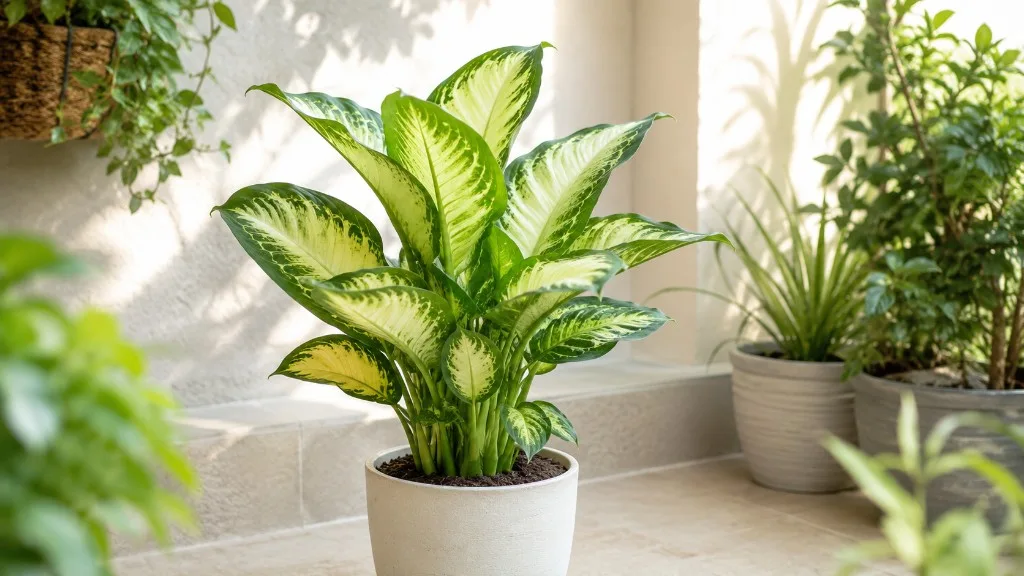
Dieffenbachia seguine ‘Camille’ is the cream-centered dumb cane - wide chartreuse-to-ivory panels framed by green margins on a compact upright cane sized for a plant stand or side table, not a floor specimen. Those pale central panels contain less chlorophyll than the green edges, which means two things for feeding: Camille cannot photosynthesize as efficiently per leaf area as all-green cultivars, and salt damage shows on cream tissue before green margins look stressed. Fertilizer will not paint cream blocks back onto a leaf that already reverted to green in dim light, but conservative feeding during active growth helps the plant push large, well-marked new leaves when light is already adequate.
Dieffenbachia Camille fertilizer success is matching half-strength balanced liquid to real growth in a small root zone - every four to six weeks from mid-spring through early fall for most home setups, pausing in late fall and winter when new leaves stop forming. Water onto moist soil only. Read brown margins on cream centers first before you blame sun scorch or underwatering on Dieffenbachia Camille.
Reviewed by LeafyPixels Review Board · Author: sai-ananth
Use this page for Camille-specific cream-variegation feeding logic, side-table pot salt dynamics, and cultivar comparisons. For genus-wide dumb cane biology, see the Dieffenbachia fertilizer hub. For the full Camille care picture, start at the overview hub.
Quick Answer for Side-Table Camille Growers
When: Feed April through September while fresh leaves unfurl at the crown with crisp cream centers. Clemson documents dieffenbachia feeding from March through September (Clemson HGIC - Dieffenbachia); Camille growers in temperate homes often start in April when indoor light actually wakes the plant - not on a calendar flip alone.
What: Water-soluble 10-10-10 or 20-20-20 (or foliage-weighted 3-1-2 like 9-3-6) diluted to half label strength.
How often (Camille home default): Every 4–6 weeks at half strength in bright filtered light; monthly for fast growers on east windowsills; every 6–8 weeks in moderate light or after slow-release at Dieffenbachia Camille repotting guide. Pause November–February unless strong grow lights keep active shoots forming.
How: Moist soil first, even application away from the crown, discard saucer runoff within 30 minutes.
Stop when: Winter slowdown, white salt crust, brown cream margins after a feed, repotting stress, or dry soil.
Why Camille Is a Moderate, Salt-Sensitive Feeder
Dieffenbachia is a moderate feeder during active growth - heavier than succulents, still unforgiving of salt buildup in containers. Clemson links too much fertilizer to marginal leaf burn and notes that nutrient-lacking plants may yellow, produce smaller leaves, and become stunted (Clemson HGIC - Dieffenbachia). Camille sits in the conservative middle of that range because its display tissue is physiologically fragile and its pots are usually small.
NC State Extension describes Dieffenbachia seguine as an erect broadleaf perennial with cane-like stems and large variegated leaves (NC State Extension - Dieffenbachia). Camille’s commercial form emphasizes cream-centered variegation on a shorter, bushier habit than floor-caned cultivars like Tropic Snow. Nutrient demand tracks new leaf production, not guilt about whether you fed last month.
Think of fertilizer as maintenance for actively growing Camille - not a rescue for a pale plant in too little light, one that dries out repeatedly, or one sitting in waterlogged mix. Fix placement and watering rhythm on the overview hub first, then feed at half strength.
Compact Habit and Small-Pot Salt Dynamics
A Camille on a side table often lives in a 6-inch or 8-inch pot with limited soil volume. That root zone cannot dilute soluble salts the way a ten-inch floor planter can. University of Maryland Extension explains that excessive fertilizer causes brown leaf tips, marginal necrosis, and white crust on potting media as salts accumulate (University of Maryland Extension - Fertilizer Toxicity). In a small Camille pot, that buildup arrives faster - and pale variegated tissue shows burn first because it has less photosynthetic buffer.
Clemson states dieffenbachias grow quickly in ideal conditions or barely at all if light is low (Clemson HGIC - Dieffenbachia). A bright-windowsill Camille may dry its pot weekly and use nutrients on a shorter interval. A dim-corner Camille metabolizes slowly - feeding on the aggressive schedule meant for a sunlit specimen stacks unused salts. Match frequency to observed new leaves, not pot guilt.
Cream Variegation, Light, and Nutrients
Camille is defined by cream-centered leaves, and that pattern is controlled primarily by light intensity, secondarily by genetics, and only tertiarily by fertilizer. Cream portions photosynthesize less efficiently; the plant compensates on green margins. UF/IFAS Gardening Solutions notes that curled, browning leaves can follow excessive fertilizer application and recommends flushing accumulated salts - a warning that matters doubly when pale tissue already runs near its salt tolerance.
Fertilizer cannot substitute for photons. No amount of 20-20-20 restores wide cream panels on a Camille in a dim hallway. Conversely, a well-lit Camille with depleted soil produces smaller leaves and slower unfurling even when variegation holds - that is where balanced feeding helps.
Brighter light increases photosynthesis and growth rate, which increases nutrient demand. A windowsill Camille may need monthly half-strength feeds in peak summer while a dim-corner sibling needs every six to eight weeks or none beyond fresh repotting mix. Over-feeding a low-light Camille is one of the fastest routes to salt burn because the plant cannot use the nutrients you supply.
Reversion vs. Hunger vs. Salt Burn
These three problems send Camille owners to the fertilizer bottle when food is the wrong tool - or keep them from feeding when the plant actually needs maintenance.
Genetic reversion (light problem): New leaves emerge mostly green with narrow cream bands, stems stretch with long internodes, or the plant leans sharply toward one window. Fix light gradually over one to two weeks before increasing feed frequency. Fertilizer cannot restore cream variegation on leaves that already opened green.
True hunger (nutrient problem): During peak spring and summer with adequate filtered light, new leaves are uniformly paler across the entire blade (not cream-to-green pattern loss), smaller than the previous generation, and leaf production slows despite consistent watering and no root rot on Dieffenbachia Camille. Move from every six weeks to every four at half strength - never double concentration overnight.
Salt burn (feeding or water problem): Brown crispy margins on cream portions of newer leaves, white crust on soil or pot rim, wilt despite moist soil one to two weeks after feeding. Stop fertilizer, flush, pause four to six weeks. Cross-check hard tap water and fluoride before increasing feed.
Editorial observation - cream-tip timing: Over-fed Camille often shows a tan-to-brown band on the cream center within seven to fourteen days of a too-strong or dry-soil feed, while green margins still look glossy - mimicking underwatering until you notice the timing lines up with your last fertilizer date.
When to Fertilize: Active Growth vs. Winter Rest
Feed when Camille is actively producing new leaves and extending its cane. Stop when shoot production slows sharply - even if old foliage stays upright through December in a heated room.
Lower light and shorter days reduce new tissue formation while roots still absorb water. Unused nutrients accumulate as soluble salts - the path to brown tips on cream leaf tissue and a weak spring comeback.
Spring Through Early Fall Window
Start feeding when you see fresh growth at the crown - new leaves unfurling with cream centers and green margins, firm petioles, normal size for the plant’s current scale. In temperate climates that usually means April through September, though Clemson documents March through September for dieffenbachia generally (Clemson HGIC - Dieffenbachia). Use your plant’s first new leaf as the trigger in dim rooms that wake slowly.
During this window, Clemson recommends liquid fertilizer at half strength every two to four weeks (Clemson HGIC - Dieffenbachia). For Camille in typical side-table pots, LeafyPixels defaults to every four to six weeks - the longer end of Clemson’s range plus the genus hub’s conservative four-to-six-week frame - because small pots and cream tissue punish aggressive feeding. Fast growers in bright filtered light may sit at monthly half strength; moderate-light plants use the longer interval.
| Month (temperate climate) | Growth phase | Camille feeding guidance |
|---|---|---|
| March–April | Waking up | Start half-strength when active growth visible (often April indoors) |
| May–August | Peak foliage | Every 4–6 weeks bright light; monthly if fast grower |
| September | Slowing | Every 6–8 weeks or taper off |
| October | Wind-down | Final light feed if still growing, then pause |
| November–February | Low growth | No fertilizer for typical setups |
Watch the plant, not the table. Steady cream-and-green leaves mean timing is right. Static growth means solve light and water before adding food.
Fall Taper and Winter Pause
Taper in early to mid-fall as day length drops. One final half-strength feed if new growth continues, then stop from late fall through winter - roughly November through February for most indoor setups.
No - do not fertilize Camille in winter for typical room-grown plants. Resume in spring when new shoots appear. Exception: a plant under strong supplemental grow lights that keeps producing new foliage all winter may take half strength every six to eight weeks - watch closely for salt crust. Skipping winter feeds remains safer than forcing growth with nutrients roots cannot process.
Which Fertilizer and NPK Ratio to Use
The best Dieffenbachia Camille fertilizer for most homes is a complete water-soluble foliage houseplant formula with nitrogen adequate for leafy growth, moderate phosphorus, potassium for stress tolerance, and micronutrients on the label.
Avoid shopping by the word “dieffenbachia” on the bottle unless you trust the brand’s dosing guidance. A standard balanced indoor formula used conservatively outperforms specialty products at full label strength.
Half-Strength Dilution and Pot-Size Math
A 10-10-10 or 20-20-20 water-soluble fertilizer diluted to half strength is the default across extension guidance (Clemson HGIC - Dieffenbachia). Some growers prefer a slightly nitrogen-leaning 3-1-2 ratio - such as 9-3-6 - when light is already adequate. Avoid high-phosphorus bloom boosters; Dieffenbachia rarely blooms indoors, and phosphorus-heavy feeding produces leggy stems without improving cream variegation.
Label math: If the bottle says 1 tablespoon per gallon, half strength is 1½ teaspoons per gallon. If it says 1 teaspoon per gallon, half strength is ½ teaspoon per gallon.
Worked example - 6-inch pot (~1 quart of water per thorough watering):
- Label rate 1 tbsp/gal → half strength = 1½ tsp/gal
- Scale: 1½ tsp ÷ 4 = ⅜ tsp (about 1.25 ml) per quart of feed solution
- Pour slowly until a little drains; discard saucer water within 30 minutes
Worked example - 10-inch floor Camille (~2 quarts per watering):
- Same half-strength gallon mix → ¾ tsp total fertilizer per 2 quarts water
- Larger soil volume tolerates the same concentration but may need less frequent feeding than a 6-inch sibling in the same room - judge by new leaf quality, not pot diameter alone
Go to quarter strength if cream tip burn recurs despite conservative scheduling. Faded cream on new growth usually means insufficient light - fix the window before increasing concentration.
Fluoride, Hard Water, and Mineral Stacking
Dieffenbachia is fluoride-sensitive (Clemson HGIC - Dieffenbachia). Fluoride in tap water causes margin damage that growers often blame on fertilizer. The Pacific Northwest Pest Management Handbook notes fluoride is an accumulative poison in foliage, with marginal and tip necrosis on sensitive broadleaf plants (PNW - Fluorine Toxicity in Plants). If brown tips appear without recent feeding and without salt crust, switch water sources before increasing feed strength.
Stacking hard tap water minerals with synthetic fertilizer salts accelerates marginal necrosis on pale variegation - cream zones show it first. Use filtered or rainwater for both everyday watering and fertilizer mixing when municipal water is high in fluoride.
Camille vs. Tropic Snow vs. Genus Dieffenbachia
| Factor | Camille | Tropic Snow | Genus hub default |
|---|---|---|---|
| Growth habit | Compact upright, side-table scale | Tall floor cane, wide leaves | Mixed cultivars |
| Variegation pattern | Cream center panels | White splashes on green | N/A |
| Light demand | Bright indirect to hold cream | Tolerates lower light (Clemson) | Moderate filtered |
| Home feed interval | 4–6 weeks half strength | 2–4 weeks bright; 4 weeks low light | 4–6 weeks conservative |
| Salt risk in typical pot | High (small pot + pale tissue) | Medium (larger volumes) | Medium |
| Season window | April–September (growth-triggered) | March–September (Clemson) | March–September |
| Best standalone page for | Cream reversion, small-pot salts | Office low-light, white-splash burn | Any dumb cane baseline |
Camille needs more light than Tropic Snow to maintain its pattern, which can increase nutrient use in a bright window - but its smaller root zone still demands conservative concentration. Do not copy a floor-specimen Tropic Snow schedule onto a 6-inch Camille without watching cream margins on the next new leaf.
Step-by-Step: Feed Safely on Moist Soil
Safe feeding is mostly order of operations.
- Confirm active growth - new leaves at the crown. Skip if winter and nothing is growing.
- Inspect for salt crust or cream-tip burn - white residue on soil means flush instead of feeding.
- Moisten dry soil with plain water before fertilizing. Never pour fertilizer onto dry soil - salts concentrate at roots and burn variegated tissue first (University of Maryland Extension - Fertilizer Toxicity).
- Mix at half strength in room-temperature water - filtered if you use it for fluoride-sensitive dieffenbachia.
- Apply evenly across soil, away from the crown and pale leaf panels. Stop when a little drains.
- Discard saucer water within 30 minutes.
- Record the date to avoid double-feeding in an enthusiastic week.
Before every feed, run a four-point check: soil moisture, newest leaf variegation, light level, and season. A Camille moved closer to a filtered window and drying faster may need the shorter feeding interval. One pushed into a dim corner needs less food and less water - not more fertilizer to compensate for low light.
Signs of Hunger, Over-Feeding, and Salt Burn
Under-fertilizing is less common than over-fertilizing, especially in nutrient-enriched potting mix. Most “hunger” diagnoses are low light, inconsistent watering, root rot, or variegation loss from dim placement.
When a plant truly needs more nutrients, signs appear gradually on new growth while older leaves stay reasonably healthy: slower leaf production in peak summer despite good light, uniformly paler new blades, smaller new leaves with thinner petioles, overall lack of vigor after a season in depleted mix with no feeding.
Over-fertilizing is the dominant fertilizer problem on Camille. Watch for brown crispy tips on cream portions of newer leaves, white crust on soil, sudden curl or leaf drop despite moist soil, leggy stems with long internodes from excess nitrogen in low light, and stunted new growth with burnt edges on unfurling leaves.
UF/IFAS recommends flushing away accumulated salts when fertilizer damage is suspected. Burn often mimics drought - if edges browned within two weeks of feeding, suspect fertilizer before drought.
Flush and Recovery After Over-Fertilizing
If you suspect burn, stop fertilizing immediately and leach the soil.
- Move the pot to a sink, tub, or outdoor spot where copious drainage is acceptable.
- Water slowly with plain room-temperature water - filtered or rainwater if you use it for fluoride-sensitive dieffenbachia - until water runs freely from the bottom. Let drain fully.
- Repeat two to three times in the same session, waiting a few minutes between rounds.
- Discard all saucer water.
- Pause all fertilizer for 4 to 6 weeks while monitoring new growth.
- Resume at half strength only after new unfurling leaves emerge without fresh burn on cream centers.
Burned leaves will not recover - judge success on the next leaf only. Cream portions browned from salt stress stay blemished until that leaf is dropped during normal senescence.
Seasonal and Situational Adjustments
After repotting: Fresh potting mix usually holds starter nutrition for three to four weeks. Hold fertilizer until the plant shows new growth - typically four to six weeks after repotting. Doubling up causes immediate tip burn on pale tissue.
After stress events: Skip feeding on a Camille dropping leaves from cold drafts, relocation, pest treatment, or root rot recovery. Resume only when stable new growth returns.
Propagation cuttings: No fertilizer until roots are several centimeters long and new leaves appear; then quarter to half strength at wide intervals.
Hard tap water: If cream tips burn despite modest feeding, switch to filtered or rainwater before increasing fertilizer.
Common Camille Fertilizer Mistakes
The failures that damage Camille most often: full label strength in small containers, bloom boosters that leggy stems without improving variegation, feeding every watering that stacks salts, dry-soil application that burns cream tissue first, winter feeding on a plant that only looks active, ignoring white salt crust, feeding stressed or newly repotted plants, more fertilizer when pale leaves mean too little light, and copying Tropic Snow’s bright-light schedule without accounting for Camille’s smaller pot. A bright-windowsill Camille and a dim-office Camille are not the same plant - match schedule to light and root zone size.
Pet, Child, and Sap Safety
Dieffenbachia Camille is toxic to cats and dogs. The ASPCA lists dieffenbachia as toxic, with insoluble calcium oxalates causing oral irritation, burning, drooling, vomiting, and difficulty swallowing (ASPCA - Dieffenbachia). All plant parts contain raphides that irritate mouth and throat tissues; sap contact can irritate skin - wear gloves during feeding or pruning when sap exposure is likely.
Concentrated fertilizer solution and crusty soil are not safe for pets or children to ingest. Keep plants, runoff, and bottles out of reach.
If a pet ingests plant material or fertilizer-soaked soil: call the ASPCA Animal Poison Control at (888) 426-4435 or contact your veterinarian immediately (ASPCA - Dieffenbachia). A consultation fee may apply. Seek medical care for children who chew leaves or touch sap to eyes.
Conclusion
Camille rewards light-first, salt-conservative feeding: half-strength balanced liquid on moist soil, every four to six weeks when new cream-centered leaves prove active growth, and a full winter pause when shoots stop. Reconcile Clemson’s two-to-four-week liquid range with Camille’s side-table reality by watching cream margins on the newest leaf - not the calendar alone.
Before your next feed, check cream centers and the soil surface for crust. Fix light and watering when variegation fades or growth stalls. Increase frequency before concentration. Stop, flush, and wait if pale panels crisp after a feed. Get that rhythm right once, and Camille keeps the soft cream-and-green leaves that make this cultivar worth the side-table spotlight.
When to use this page vs other Dieffenbachia Camille guides
- Dieffenbachia Camille overview - Start here for whole-plant context before deep-diving this topic.
- Dieffenbachia Camille problems hub - Jump to symptom-specific fix guides when this care topic does not resolve the issue.