Dieffenbachia Camille Light Needs: Windows, Variegation &
Dieffenbachia Camille Light Needs: Windows, Variegation & Sun
Dieffenbachia Camille Light Needs: Windows, Variegation & Sun
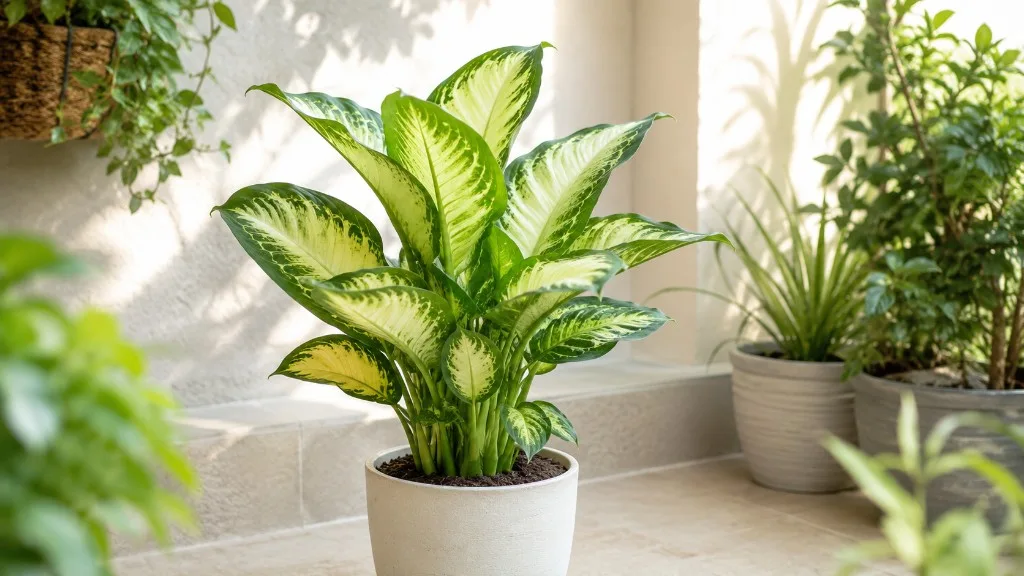
Dieffenbachia Camille is sold for its soft, cream-centered leaves framed by deep green margins - a pattern that reads beautifully on a desk or side table and disappears when light is wrong. Dieffenbachia seguine ‘Camille’ (sometimes labeled ‘Camilla’) is not a generic low-light filler plant with a decorative paint job. It is a compact dumb cane cultivar whose pale central panels need brighter filtered light than all-green Dieffenbachia types to hold crisp cream-and-green contrast, yet those same pale tissues scorch faster than darker leaves when unfiltered sun hits them. Get the balance right and new foliage opens with the clean pattern you bought. Miss it and Camille either fades toward plain green in dim corners or develops bleached, crisp brown patches on the cream zones near a hot window.
The practical target is bright indirect light - strong ambient brightness without harsh direct rays on the leaf surface for most of the day. That matches the filtered understory light of tropical Central and South American forests where the species evolved - bright but indirect, with too much direct sun scorching leaves and too much shade weakening the plant and stripping its pattern (Missouri Botanical Garden). This guide focuses on the decisions that protect Camille’s cream variegation: how much light it actually needs, where to place it by window direction, why low light turns new leaves green, how to prevent sun scorch on pale tissue, when to add grow lights, and how to read warning signs before damage becomes habit.
How Much Light Dieffenbachia Camille Actually Needs
Dieffenbachia Camille performs best in bright indirect light for most of the day - roughly the brightness you get within a few feet of an east-facing window, at a north-facing window with open sky, or three to six feet back from a south- or west-facing window filtered by a sheer curtain. Specialty growers often describe this range as approximately 10,000 to 20,000 lux at canopy level, which is brighter than the “medium light” corner many houseplant lists assign to dumb cane generically. Camille is not asking for desert sun. It is asking for enough photons that the plant can afford to maintain non-green display tissue in the leaf center while still powering steady, compact growth.
The distinction that saves Camille owners frustration is survival light versus display light. Like most Dieffenbachia, Camille will tolerate lower light for months - it will not collapse the way a succulent or fiddle-leaf fig might in the same dim hallway. Tolerance is not recommendation. In reduced light, the plant prioritizes photosynthetic efficiency over ornamental cream pigment, new leaves emerge more green and less distinctly marked, internodes stretch, and growth slows. That is not a mystery disease. It is a predictable response to insufficient brightness for a high-variegation cultivar.
Camille also needs more light than deeper-green dumb cane selections to look like the tag photo. All-green or mostly-green Dieffenbachia can photosynthesize across nearly the entire leaf blade. Camille’s cream centers carry less chlorophyll, meaning the plant must capture light across a smaller effective area. Less chlorophyll in the pale zone means more total brightness is required to produce the same growth energy while still expressing cream pigment in new tissue. Place an all-green dumb cane and a Camille side by side in a dim office, and the green plant may look acceptable while Camille washes out within three to four weeks of new growth.
Light also sets the pace for water use, feeding response, and stress recovery. A Camille in correct bright indirect light dries its pot on a predictable rhythm, pushes firm new leaves on short stems, and tolerates normal household humidity. The same plant in deep shade stays wet longer - a common root-rot setup if watering is not adjusted - and in harsh direct sun loses water and tissue integrity faster through scorch on the thinnest pigment zones. Treat light as the throttle for the whole care system, not a standalone detail you set once and forget.
The Short Answer for Busy Growers
If you only remember five rules, use these. Default placement: bright indirect light close enough to the window that the plant receives real brightness on its leaves, not just ambient room glow. Protect cream tissue: filter south and west afternoon rays with a sheer curtain or pull the pot back during peak hours - unfiltered midday sun on cream centers is the fastest route to irreversible scorch. Expect more light demand than all-green dumb cane: if new leaves open mostly green, increase brightness gradually before reaching for fertilizer or a larger pot. Judge by new growth only: old washed-out or scorched leaves do not recover; the newest leaf tells you whether the current spot works. Change one variable at a time: move light, wait 10 to 14 days, read the next leaf, then adjust watering if needed - not water, repot, and window all in one weekend.
Why Cream Variegation Needs Brighter Light Than All-Green Dumb Cane
Variegation is not a static paint layer applied at the nursery. It is a living balance of pigment, cell structure, and light energy that shifts with every new leaf. On Camille, broad oval blades carry creamy ivory to pale yellow-green centers bordered by darker green margins. The green edge contains more chlorophyll and handles moderate light flux efficiently. The cream center contains less chlorophyll and less protective pigment overall, which makes it visually striking in good light and physically vulnerable in excess sun or chronic shade.
In bright indirect light, Camille can allocate resources to both growth and pattern maintenance. The plant produces new leaves with crisp contrast because it is not starving for photosynthetic output nor burning excess energy in the pale zones. In low light, the economics flip. Camille increases chlorophyll production in new tissue - the familiar fade toward green - because plain green leaf area captures more usable light per square inch. The cream pattern you purchased is metabolically expensive in dim conditions, and the plant quietly drops it to survive. In excess direct light, the failure mode is different but equally pattern-destroying: photobleaching and tissue death in the pale center before the tougher green margin shows damage.
This is why generic advice that “Dieffenbachia is a low-light plant” misleads Camille owners. The species accepts lower light as a group. The Camille cultivar was selected for bright variegation and compact habit, traits that require brighter filtered exposure to persist. Retailers often group all dumb canes under one light icon. Your plant does not read the icon. It reads photons.
How Pale Leaf Centers Respond to Light Level
Understanding the direction of change prevents misdiagnosis. More light (up to the scorch threshold) generally produces sharper cream-and-green contrast, firmer petioles, and shorter internodes on Camille. Growers who move a washed-out Camille from a distant north corner to a sheer-filtered east window often report noticeably brighter cream tones on new leaves within two to four weeks. The older green-leaning leaves remain as history; the improvement shows only on fresh growth.
Insufficient light pushes new leaves toward uniform yellow-green, reduces leaf size, and lengthens stem gaps as the plant etiolates - stretches toward the brightest vector in the room. You may also see hard lean and one-sided crown development if the pot is never rotated. Excess direct light hits the cream panel first: bleached white patches, tan crisp spots, dry brown edges on the pale tissue, sometimes while the green margin still looks intact for a few days. Heat magnifies the damage - hot window glass, dark pots on sun-heated sills, and reflected light from white walls can scorch even when the sun angle looks mild to you.
Camille’s pale tissue also shows moisture and fertilizer stress faster than all-green leaves because it has less margin for error. That can confuse diagnosis: brown tips might be fluoride sensitivity, inconsistent watering, or sun scorch on cream zones. When brown appears only on the sun-facing pale center after a window move, suspect light first. When browning is symmetrical on leaf tips across the plant in stable light, widen the investigation to water and water quality.
Best Window and Room Placement for Dieffenbachia Camille
Compass direction is a starting guess, not a verdict. A labeled “south window” blocked by a porch roof may deliver less usable light than an open east window. Camille placement succeeds when canopy-level brightness stays in the bright indirect band for enough hours daily - typically six to eight hours of strong indirect exposure - without direct beam contact on leaves during the hottest part of the day.
Indoors, put the pot within 12 to 36 inches (30 to 90 cm) of the glass on the brightest suitable exposure, not on a bookshelf across the room where your eyes detect daylight but the plant receives little photosynthetically useful flux. Camille’s compact size tempts owners to tuck it on a distant console for aesthetics. That works visually for a week. Botanically, it is often the start of green fade and lean. If the spot must be farther from glass, treat supplemental grow lighting as part of the design, not an emergency later.
Rotate the pot a quarter turn every few days. Dieffenbachia exhibits strong phototropism - stems and leaves track the brightest source quickly. Uneven rotation produces a lopsided crown and hides poor light on the shaded side until that face produces weak, small leaves. Keep Camille away from narrow walkways where broken petioles distort shape for months, and remember that calcium oxalate crystals in the sap make dumb cane irritating to skin and dangerous if chewed by pets or children; placement matters for safety as well as light.
East, North, South, and West Windows Compared
An east-facing window is the most reliable default for Camille indoors. Morning sun is bright but cooler and shorter in duration than afternoon rays, which supports cream pigment retention without the heat load that bleaches pale centers. Many Camilles that scorch on west glass thrive east with no curtain during morning hours. If you have one good east window, start there before experimenting with riskier exposures.
A north-facing window works when the view is open to sky and not blocked by deep overhangs or neighboring buildings. North light is softer and more consistent through the day, which protects against scorch but may underpower variegation in winter at higher latitudes. Watch new leaves: if they emerge small and increasingly green through December and January, add a grow light rather than accepting fade as seasonal inevitability. North is excellent for Camille in bright apartments; it is marginal in dim rooms with small windows.
A south-facing window delivers the strongest winter sun in the northern hemisphere and can be excellent for Camille from fall through spring when rays enter at a lower angle and heat buildup is moderate. In summer, south glass becomes a magnifying lens. Use a sheer curtain during midday, pull the pot six to twelve inches back, or shift Camille slightly off the direct beam path. One-sided bleaching on leaves facing the pane is a classic south-window warning.
A west-facing window provides strong afternoon rays - the highest scorch risk for cream-centered leaves. West can work in cool seasons with diffusion, but it is the exposure most likely to produce sudden brown patches on pale tissue after a innocent-looking sunny afternoon. If west is your only bright option, sheer curtain mandatory during peak hours, and favor placement where leaves never sit in a direct beam for more than one hour unless you are deliberately acclimating with careful monitoring.
Distance From the Window and the Hand-Shadow Test
Distance matters as much as direction. Light intensity drops rapidly as you move away from glass. Camille on a table six feet (1.8 m) back from a bright window may live in what feels like a “well-lit room” while receiving shade-level flux at leaf height. When in doubt, move closer in six-inch increments, wait for one new leaf, and reassess.
The hand-shadow test costs nothing and beats guessing. At noon on a reasonably bright day, hold your hand 12 inches (30 cm) above Camille’s crown, between the plant and the window. A soft, faint shadow with blurred edges suggests adequate bright indirect light for active growth. A sharp, dark shadow means direct-beam intensity is hitting the test point - too strong for unprotected cream tissue. No visible shadow means insufficient light for strong variegation; expect green fade and stretch unless you add brightness. Repeat the test seasonally; winter sun angle and bare trees outside the window can change the result dramatically without you moving the pot.
Direct Sun, Sheer Curtains, and Scorch on Pale Leaves
Direct sunlight is not a gentle boost for Camille. It is a tissue-level stress event on pale leaf centers. The green margins tolerate moderate flux better because chlorophyll and associated chemistry handle photon load more efficiently. Cream and ivory zones lack that buffer. Unfiltered beams - especially midday and afternoon - cause photobleaching (whitening that looks like the color was rinsed out), followed by dry brown necrosis on the damaged patch. That damage is permanent on that leaf. No amount of later shade heals scorched tissue.
This does not mean Camille must live in a cave. It means direct rays need diffusion or strict time limits. A sheer white curtain cuts intensity while preserving brightness - often the best tool for south and west windows. Light-filtering blinds angled to bounce light upward can work similarly. Outdoor shade cloth and dappled porch shade apply if you summer Camille outside in USDA zones 10a–11b; bring plants indoors before nights drop below about 55°F (13°C), because cold plus light stress compounds damage.
Avoid placing Camille where only part of the plant sits in a sunbeam - mixed exposure produces half-scorched leaves that look like disease. Also watch reflected heat from dark surfaces, radiators, and sun-heated glass touching leaves. Pale tissue fails from heat plus light faster than from light alone.
Morning Sun vs Afternoon Ray Risk
Not all direct sun carries equal risk. Early morning sun is lower in the sky, cooler, and shorter in duration. Many Camilles tolerate one to two hours of gentle morning direct sun on an east sill, especially in fall and winter, without cream damage - particularly if leaves were produced under similar brightness and the plant is not jumping from deep shade. Late morning to afternoon sun carries higher heat load and UV intensity. The same leaf that handled 8 a.m. sun unscorched may bleach by 2 p.m. on a west exposure.
If you want to experiment with slightly more direct light to deepen contrast, increase exposure in the morning window only, watch the next two leaves, and retreat at the first sign of pale-zone whitening. Never use afternoon sun as the trial period for cream-centered dumb cane. When seasons shift, revisit the assumption: winter morning sun is often a gift; summer morning sun through unobstructed east glass can still scorch if outdoor temperatures spike.
What Happens When Dieffenbachia Camille Gets Too Little Light
Camille in chronic low light does not always die quickly. It ** adapts downward** - and that slow decline is why owners miss the cause. The plant becomes leggy, with long gaps between leaves on upright cane-like stems. New blades emerge smaller, thinner, and more uniformly green, losing the crisp cream center that defines the cultivar. Lower leaves may yellow and drop as the plant reallocates resources upward toward the dim light source. Growth stalls, watering intervals stretch, and the whole specimen reads as ” tired” despite unchanged fertilizer.
This pattern mirrors extension guidance for Dieffenbachia seguine in too-shady positions: loss of striking variegation, weakness, and legginess. For Camille specifically, the variegation loss is the early tell - before catastrophic collapse. If the newest leaf is greener than the one before it, light is almost certainly limiting, assuming watering has not swung to chronic soggy roots (which produces yellowing by a different mechanism).
Low light also encourages hard lean toward the brightest corner of the room. Rotate pots for even crown development, but rotation alone does not fix insufficient flux. It only distributes the stretch symmetrically.
Variegation Fade, Leggy Stems, and Smaller New Leaves
Separate three low-light symptoms so you respond correctly. Variegation fade - cream centers on new leaves shrink or disappear into yellow-green - means increase brightness. Leggy stems - internodes longer than a finger width on a compact Camille - confirm the plant is reaching, not merely growing. Smaller new leaves often accompany both and indicate the plant lacks energy for full-size blade development.
Fix low light by moving closer to the brightest filtered window or adding a grow light, not by fertilizing heavily in place. Feed cannot substitute for photons. After a move brighter, expect one to two leaves of transition before cream contrast sharpens. If the plant came from a dark shop corner, acclimate upward over 7 to 14 days - shift six inches closer every few days - to avoid shock leaf drop while still correcting fade.
Reduce watering frequency when Camille lives in dimmer light after a move away from sun, because slower metabolism uses less water. The pairing of less light, less water prevents the common low-light root-rot cycle.
Grow Lights When Natural Light Falls Short
Office desks, interior bedrooms, and winter north windows often fail Camille’s brightness needs despite careful watering. Full-spectrum LED grow lights fill the gap when you cannot place the plant at a suitable window. The goal is canopy-level bright indirect equivalent, not spotlight heat on one leaf.
Start with a fixture rated for houseplants - many desk lamps deliver 20 to 40 µmol/m²/s at close range, enough to prevent collapse but sometimes marginal for vivid cream variegation. Position the light 12 to 18 inches (30 to 45 cm) above the crown, run 12 to 14 hours daily on a timer to mimic long bright days, and adjust height based on new leaf color and temperature at the leaf surface. If leaves feel warm to the touch after hours under the lamp, raise the fixture.
Watch for one-sided bleaching if the light is directional; rotate the pot or choose a wider panel array. Combine modest window light plus supplemental LED in winter for better results than either alone. When new leaves under the lamp show restored cream centers and short internodes, keep the setup stable through the dim season rather than yo-yoing between dark windowsill and lit desk.
Fixture Height, Hours, and Canopy-Level Brightness
Treat grow lights like a virtual east window, not a sun substitute. Too close produces the same pale-tissue stress as direct sun - bleached centers, crisp edges. Too far produces green fade. The adjustment dial is distance and duration, not maximum wattage. Increase brightness by moving closer in two-inch steps, waiting for one new leaf between changes.
Budget fixtures marketed as “full spectrum” vary widely in actual output. If variegation stays dull after four weeks under a bulb, the issue may be insufficient PAR at the canopy, not plant stubbornness. Upgrading to a stronger panel or adding a second low-intensity source often beats running a weak bulb 18 hours a day.
Seasonal Light Adjustments Indoors
Indoor light is not static. Winter lowers sun angle, shortens day length, and may expose Camille to more direct beam penetration through bare trees outside - paradoxically increasing scorch risk on a south sill while the room feels colder. Summer intensifies heat load on glass-facing leaves even when duration is longer. Camille does not need a new room every season, but it benefits from small positional tweaks tied to what new leaves report.
In winter, a Camille that faded green at the back of the room may need closer window placement or supplemental LED rather than acceptance of dormancy-like appearance. In summer, the same plant at the same south sill may need sheer curtain diffusion it did not need in January. Check the hand-shadow test monthly through seasonal transitions.
Winter Brightness Drops and Summer Heat Spikes
Winter dimming shows up as smaller, greener new leaves and slower dry-down. Response: move toward glass without putting cream tissue in an unfiltered noon beam, or extend grow-light hours. Do not compensate with heavy fertilizer on a plant that lacks light to use it.
Summer heat spikes show up as sudden pale-zone browning, leaf curl during brightest hours, or wilting despite moist soil from transpiration overload on scorched tissue. Response: diffuse or back the pot away during peak heat, improve airflow, and verify leaves are not touching hot glass. Air conditioning can dry air quickly; humidity dips rarely cause variegation fade alone, but heat plus light stress on cream panels is common in July on west windows.
Moving and Acclimating Camille Without Leaf Drop
Sudden light jumps cause leaf drop, curl, scorch, or stalled growth on Dieffenbachia even when the new spot is theoretically correct. Camille leaves formed in low light lack the structural and pigment readiness for strong sun. Leaves formed in bright indirect may yellow if shoved into a dim corner because the plant sheds leaves it can no longer support at lower energy capture.
Acclimate in one direction at a time. To increase light: shift six inches closer to the window or open sheer curtains gradually over 7 to 14 days, evaluating each new leaf. To decrease light after scorch: move to filtered bright indirect immediately - retreat is urgent - but expect some older stressed leaves to continue declining while new ones stabilize.
Never combine a major light change with Dieffenbachia Camille repotting guide, heavy feed, or Dieffenbachia Camille watering guide overhaul. One stressor at a time preserves diagnostic clarity. If Camille drops a few lower leaves after a upward move but new growth is firm and better marked, the move was likely correct and the plant is reallocating. If new leaves scorch or emerge tiny, retreat and diffuse further.
Warning Signs Your Dieffenbachia Camille Has the Wrong Light
Light problems are readable if you prioritize newest leaves and recent placement history over panic about old cosmetic damage. Camille keeps a record on every blade. Your job is to interpret the latest entries.
Too little light typically shows: new leaves predominantly green with reduced cream center; long internodes and visible lean toward the window; smaller leaf size compared to when the plant was purchased; slow opening of new blades; lower leaf yellowing in advanced cases; and soggy-soil tolerance because the plant uses water slowly. Fix by increasing filtered brightness or adding grow light, then reduce watering to match slower growth if the plant remains in moderate rather than high light.
Too much light typically shows: bleached white or tan patches on cream centers; crisp brown edges on pale tissue while green margins still look OK initially; leaf curl or droop during brightest hours; one-sided damage on the window-facing surface; and sudden collapse of soft tissue after a recent move to direct sun. Fix by filtering or retreating immediately, not by watering more - scorch is not thirst.
Mixed symptoms usually mean mixed exposure - a sunbeam hitting only part of the crown - or a secondary stress (roots too wet in dim light, fluoride burn on tips) layered on top of light issues. Separate timing: damage that appeared the week after a window move is light until proven otherwise.
Diagnose Too Much Sun vs Too Little Light From Symptoms
Use this decision logic before changing fertilizer or repotting. If only the cream center on sun-facing leaves shows bleaching or crisp brown patches and new leaves on the shaded side look greener but not scorched, you likely have excess direct sun. If all new leaves around the crown are uniformly greener, smaller, and farther apart on the stem with no bleaching, you likely have insufficient light. If tips brown symmetrically on old and new leaves in stable indirect light, widen diagnosis to water quality and moisture - Dieffenbachia is fluoride-sensitive, and edge burn from tap water can mimic light stress.
When both scorch and fade appear sequentially - common when a plant burns near glass then is pulled deep into the room - treat scorch first by stabilizing in bright filtered indirect, wait for one healthy new leaf, then increase brightness gradually if green fade persists. Jumping from burned sill to dark corner trades one pattern loss for another.
Conclusion
Dieffenbachia Camille rewards a specific light band: bright indirect strong enough to keep cream centers crisp, soft enough that pale leaf tissue never sits in harsh direct sun. East and filtered north windows are the easiest wins; south and west work with sheer diffusion and distance. Low light will not kill Camille quickly, but it will fade variegation to green, stretch stems, and shrink new leaves until the plant looks like a generic dumb cane. Excess sun strikes cream panels first, leaving bleached and brown scorch that no later shade reverses.
Place the pot where canopy-level light passes the hand-shadow test, rotate for even growth, acclimate over one to two weeks when brightness changes, and judge success only on the newest leaf. Pair every light shift with an honest watering adjustment, because brightness controls how fast roots use moisture. Nail the window, and Camille stays compact, upright, and worth the counter space you gave it - cream centers bright, green margins sharp, and the next leaf proof that the spot works.
When to use this page vs other Dieffenbachia Camille guides
- Dieffenbachia Camille overview - Start here for whole-plant context before deep-diving this topic.
- Dieffenbachia Camille problems hub - Jump to symptom-specific fix guides when this care topic does not resolve the issue.
- Not Enough Light on Dieffenbachia Camille - Escalate here when light adjustments are not enough.
- Leggy Growth on Dieffenbachia Camille - Escalate here when light adjustments are not enough.
Related Dieffenbachia Camille guides
- Dieffenbachia Camille overview
- Dieffenbachia Camille watering
- Dieffenbachia Camille soil
- Dieffenbachia Camille propagation
- Dieffenbachia Camille fertilizer
- Dieffenbachia Camille repotting
- Not Enough Light on Dieffenbachia Camille
- Leggy Growth on Dieffenbachia Camille
- Dieffenbachia Camille problems
Related tool
Try the Plant Problem Diagnosis Tool with dieffenbachia-camille pre-selected to estimate needs for your setup.