Leggy Growth on Dieffenbachia Camille: Causes, Checks &
Quick answer
Leggy growth on Dieffenbachia Camille is etiolation-long internodes and stretched petioles as the cane reaches for light. Camille's cream centers need brighter filtered exposure than all-green dumb canes. First step: move the pot within a few feet of an east window or behind sheer curtains on south or west glass before pruning or feeding.
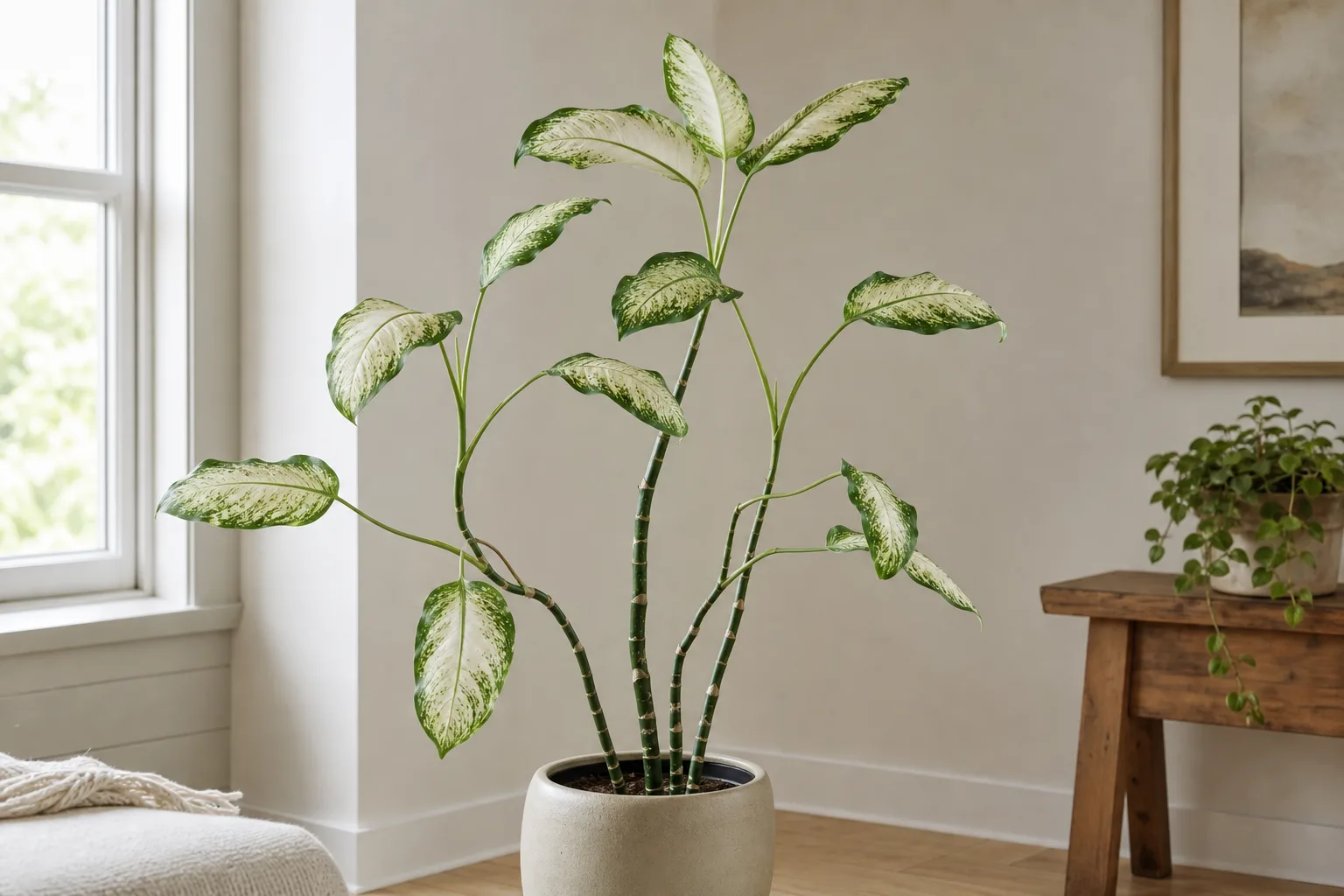
Leggy Growth on Dieffenbachia Camille: Causes, Checks & Fixes
This guide covers leggy growth on Dieffenbachia Camille. See also the general Leggy Growth guide, watering, and light pages for this plant.
Leggy Growth on Dieffenbachia Camille: Causes, Checks & Fixes
Quick answer
Leggy growth on Dieffenbachia Camille (Dieffenbachia seguine ‘Camille’) is etiolation-the plant stretching toward usable light by lengthening internodes and petioles while producing smaller, paler leaves. On this cream-centered cultivar, legginess usually means the spot is too dim for variegated tissue, not that Camille is a fast climber.
Camille needs roughly 150–250 foot-candles to stay compact indoors-far more than darker cultivars such as ‘Star Bright’ that remain attractive near 50 foot-candles. A dim corner that keeps an all-green dumb cane upright often turns Camille into a bare cane with a leaf cluster at the top.
First step: move the pot to brighter filtered light today-within a few feet of an east window, or behind a sheer curtain on south or west glass where cream centers never take harsh midday sun. Do not prune heavily, repot, or fertilize until you see whether the next leaf emerges with tighter spacing and sharper variegation. Full light-placement workflow: not enough light on Dieffenbachia Camille and the light guide.
What leggy growth looks like on Dieffenbachia Camille
Leggy Camille is easy to mistake for healthy height until you compare new growth to older leaves. Etiolation shows in structure, not just color.
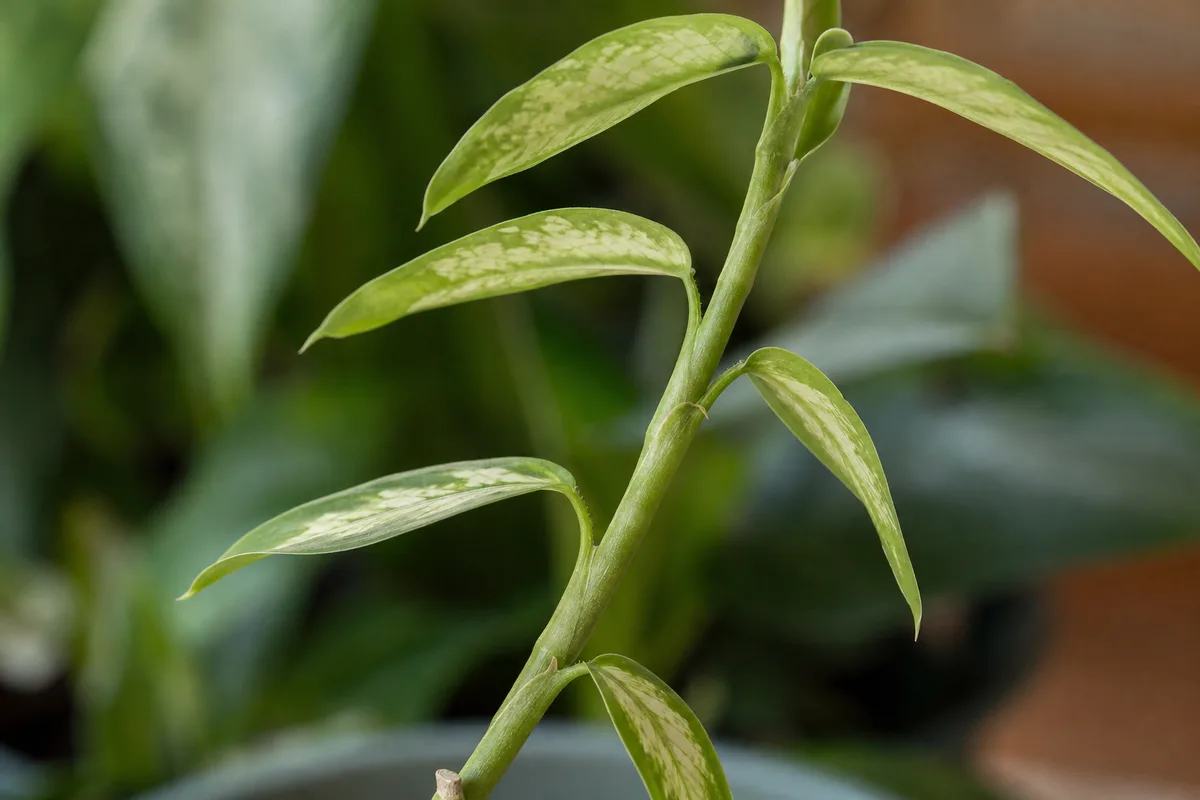
Leggy Growth symptoms on Dieffenbachia Camille - compare with healthy tissue on the same plant.
Typical legginess pattern:
- Long, thin petioles holding smaller leaf blades much farther apart on the cane than when you bought the plant
- Bare lower stem with most foliage clustered at the top-sometimes called a lollipop silhouette
- Strong lean toward the brightest window; one side of the crown stays fuller
- Cream centers washing toward plain green on the newest leaves, with dull dark-green color overall
- Slower unfurling between leaves, sometimes with lower-leaf yellowing as the plant sheds tissue it cannot support in dim light
Older leaves that formed in adequate light keep their cream-and-green pattern. The mismatch-crisp variegation below, stretched greenish growth above-is one of the clearest signs you are seeing etiolation, not random reversion.
Missouri Botanical Garden’s general indoor-plant troubleshooting guide notes that insufficient light produces stretching toward the source, small pale new leaves, and light green foliage. On variegated dumb cane, pattern loss on stretch is especially common.
Leggy growth is not the same as scorch: too much direct sun bleaches or browns cream panels. Low-light legginess looks like reach and fade, not crispy patches on the window side.
Why Dieffenbachia Camille gets leggy growth
Dieffenbachia evolved as an understory tropical-shade-tolerant for survival, not shade-optimal for display. Clemson HGIC states that dumb canes tolerate low light yet grow quickly in ideal conditions or barely at all if light is low. When light is inadequate, the plant etiolates: it allocates growth toward the brightest vector, lengthening stems and reducing leaf size to capture more photons per unit of metabolic cost.
Camille sits on the brighter end of the dumb-cane range because its cream centers carry less chlorophyll than green margins. Pale tissue cannot photosynthesize efficiently in dim corners, so the plant produces greener, more widely spaced new leaves while the cane stretches. An all-green Dieffenbachia in the same hallway may look acceptable for months while Camille opens three or four etiolated leaves and loses its signature pattern.
Common home triggers:
- Décor placement - hall tables, bathroom counters, and interior shelves often deliver under 100 foot-candles even when the room feels bright to human eyes
- Distance from glass - indoor light intensity drops sharply more than a few feet from a window; a pot “near the window” blocked by a deep sill may still starve Camille
- Winter daylight shrink - the same east sill that worked in June may fail in December without a move or grow light
- One-sided exposure without rotation - the cane grows toward light, exaggerating lean and bare sides
- Myth that all dumb canes are low-light plants - survival in a corner is not compact, colorful growth
Low light also slows water use. Soil that stays damp for weeks while the cane stretches can overlap with overwatering symptoms-but the primary stretch driver is still photon shortage. Fix light before assuming the watering chart alone is wrong.
Lookalike symptoms to rule out
| Pattern | Likely cause | Key check |
|---|---|---|
| Long petioles, window lean, cream fade on new leaves only | Etiolation / low light | Improves after brighter filtered move |
| Upright cane, wet soil weeks, soft lower stem, sour smell | Overwatering / root rot | Firmness and drainage fail before stretch dominates |
| No new leaves for months, firm plant, winter calendar | Seasonal rest or slow growth stall | Resume in spring with light audit |
| Light pot, dry mix throughout, limp petioles | underwatering on Dieffenbachia Camille | Pot weight and dry soil, not directional reach |
| Bleached cream patches, crisp brown on window side | Too much direct sun | Opposite fix-filter light, do not add more |
Normal lower-leaf drop on an otherwise firm plant with good new variegation is often aging, not legginess crisis. Leggy etiolation shows in the spacing and direction of new growth, not one yellow bottom leaf every few months.
How to confirm the cause on Camille
Work through these checks in order before pruning or feeding:
- Compare new versus old leaves - If only the top two or three leaves show long petioles and green-dominant color while older leaves keep crisp cream centers, etiolation from low light is the prime suspect.
- Measure window distance and direction - Note nearest exposure and how many feet the pot sits from glass. Camille usually needs east or filtered south/west within roughly 1–1.5 m (3–5 ft); deep interior placement rarely supports compact growth. Placement details: light guide.
- Shadow test at midday - Hold your hand between the window and the crown. A soft faint shadow suggests usable indirect light; no shadow means likely too dim; a sharp dark shadow on leaves means direct sun that may scorch cream tissue.
- Check lean and rotation - Persistent one-sided growth confirms the plant has been reaching for light. Rotate weekly after any move.
- Two-week brighter trial - Shift to the brightest filtered spot available without jumping to unfiltered afternoon sun. If the next emerging leaf shows shorter petioles and more cream, you have confirmed etiolation.
- Rule out wet-root collapse - Firm upright cane with stretch points to light. Mushy base with wet soil points to roots-see root rot before treating stretch as cosmetic only.
If a month in clearly brighter filtered light during active growth produces no change in new leaf spacing, widen the audit to chronic overwatering, cold drafts below about 18°C (65°F), or spent potting mix before blaming light alone.
First fix: improve light before pruning or feeding
Move the pot to brighter filtered light-gradually if the change is large.
Target placement: within a few feet of an east window, or several feet back from south or west glass with a sheer curtain so cream centers never take harsh midday rays. Missouri Botanical Garden’s Dieffenbachia profile recommends bright indirect light with protection from direct sun-the balance Camille needs for compact regrowth.
If the plant currently lives in a very dark room, increase exposure over 7–14 days: move closer to the window in stages rather than from a back corner to a south sill in one step. Sudden intense light can bleach pale tissue even when the plant was starving for brightness.
Do not fertilize a light-starved Camille as a shortcut. Clemson HGIC notes growth slows in low light; feeding without fixing light adds salt stress without producing shorter internodes. Do not repot on the same day as a major light change-give the plant one variable to respond to.
Pruning is secondary. Correct light first; shorten bare canes only after new growth proves the brighter spot works. Pruning workflow and sap safety: Dieffenbachia Camille pruning guide.
Step-by-step recovery
Once light is improved:
- Rotate the pot a quarter turn weekly so new leaves do not all form on one side.
- Adjust watering - Brighter light usually means faster dry-down. Check the top 3–5 cm (1–2 in) of mix before each drink instead of keeping a dim-room schedule that leaves roots wet too long.
- Add supplemental light if windows are insufficient - A full-spectrum LED 30–45 cm (12–18 in) above the crown for 12–14 hours daily helps north-facing rooms and short winter days. Aim for enough intensity to cast a soft shadow at noon.
- Wait for two new leaves before judging - The first leaf after a move may still reflect old conditions. The second and third leaves reveal whether spacing and variegation are improving.
- Prune leggy canes only after compact new growth appears - Cut bare stems above a node where healthy tissue remains, or remove the top crown as a propagation cutting while the rooted base resprouts. Wear gloves: Dieffenbachia sap contains calcium oxalate crystals that irritate skin and are toxic to pets. Limit removal to about one-third of foliage per session because cream-centered leaves photosynthesize less efficiently than all-green foliage.
- Remove only fully spent lower leaves - Yellow or brown lower leaves that detach easily can be trimmed; leave partially green tissue until senescence finishes.
Recovery timeline
Expect noticeably shorter petioles on new growth within two to three weeks after a meaningful light upgrade during spring or summer active growth. Winter recovery may take four to six weeks because shorter days limit photosynthesis even after a move.
Old stretched petioles and elongated internodes do not repair themselves. They stay long until they age out. Judge success by:
- Tighter distance between new leaves on the cane
- Broader new blades with distinct cream centers
- Reduced lean once you rotate regularly
- Faster pot dry-down without chronic wet soil
Worsening signs: continued green-only stretch after a month in clearly brighter filtered light, soft lower stems with sour wet soil, or widespread yellowing while the mix stays damp-those suggest root problems or layered stress beyond etiolation alone.
What not to do
Do not plunge Camille into unfiltered south or west afternoon sun to fix legginess-cream centers scorch faster than green cultivars. Do not prune the entire plant back before light improves; you remove the tissue the plant needs to recover and often trigger another stretch.
Do not fertilize heavily while light is still inadequate. Do not overwater because growth looks slow-dim light slows evaporation; check moisture and brightness together.
Avoid labeling Camille as a bathroom or basement plant because it has not died yet. Survival with washed-out stretch is not success. Do not stack Dieffenbachia Camille repotting guide, heavy pruning, and pesticide on the same day as a major light move.
How to prevent leggy growth on Camille next time
Place Camille where it receives bright filtered light most of the day, not where the pot looks best in the room layout. Clemson HGIC recommends bright filtered light spring through fall and notes that bright light-even some direct sun-is beneficial in winter when rays are weaker; an east window often needs no seasonal pull-back.
Rotate weekly, wipe dust from leaves monthly, and run a full-spectrum grow light in dark rooms or winter rather than accepting etiolation for months. When buying, choose plants with crisp cream centers on the newest leaves-the top leaf reveals whether store light was adequate.
Match watering to how fast the pot dries in your light level. A Camille in a bright east window needs a different rhythm than one still in a marginal corner. Baseline biology and placement: Camille overview.
Related Camille care and problems
- Not enough light - foot-candle targets, variegation fade, and window placement deep-dive
- Pruning - cane cuts above nodes, sap safety, and rejuvenation after stretch
- Light requirements - window direction, cream variegation, and scorch prevention
- Slow growth - when the cane stalls rather than stretches
- Overwatering and root rot - wet-soil collapse in dim rooms
- Camille overview - cultivar baseline and care hub
When to use this page vs other Dieffenbachia Camille guides
- Dieffenbachia Camille watering guide - Use for routine moisture checks before assuming leggy growth is the main issue.
- Dieffenbachia Camille problems hub - Browse all 16 common issues on this species.
- Not Enough Light on Dieffenbachia Camille - Different entry point when symptoms overlap with leggy growth.
- Slow Growth on Dieffenbachia Camille - Different entry point when symptoms overlap with leggy growth.
- Yellow Leaves on Dieffenbachia Camille - Different entry point when symptoms overlap with leggy growth.