Slow Growth on Dieffenbachia Camille: Causes, Checks & Fixes
Quick answer
Dieffenbachia Camille in bright filtered light often opens a new leaf every two to four weeks in warm months; winter pause is normal. First step: count days since the last unfurl, check window distance and cream-center color on new leaves, and confirm top-inch soil dryness before repotting or feeding.
Slow Growth on Dieffenbachia Camille: Causes, Checks & Fixes
This guide covers slow growth on Dieffenbachia Camille. See also the general Slow Growth guide, watering, and light pages for this plant.
Slow Growth on Dieffenbachia Camille: Causes, Checks & Fixes
Quick answer
Dieffenbachia ‘Camille’ (Dieffenbachia seguine ‘Camille’) is a moderate to fast grower when light, warmth, and roots align-not a weekly sprinter, but capable of steady cane elongation in the right spot. In bright filtered light during warm months, many plants open a new leaf every two to four weeks. Winter slowdown and a short pause after repotting are normal. Concern starts when no new leaf unfurls for six or more weeks through spring or summer despite stable care.
First step: run a growth audit before changing anything. Note the calendar month, measure how far the pot sits from glass, check whether cream centers on recent leaves have dulled toward plain green, and confirm the top inch of mix dries on a predictable rhythm. Clemson HGIC notes dieffenbachias grow quickly in ideal conditions or barely at all when light is low-window distance and season explain most stalls before you reach for fertilizer or a bigger pot.
What slow growth looks like on Dieffenbachia Camille
Slow growth on Camille means little or no new cane tissue from the top bud, not one lower leaf yellowing as part of normal cane aging. Camille grows upright from a single apical point-when that tip stalls, the whole plant looks frozen even if older leaves stay green.
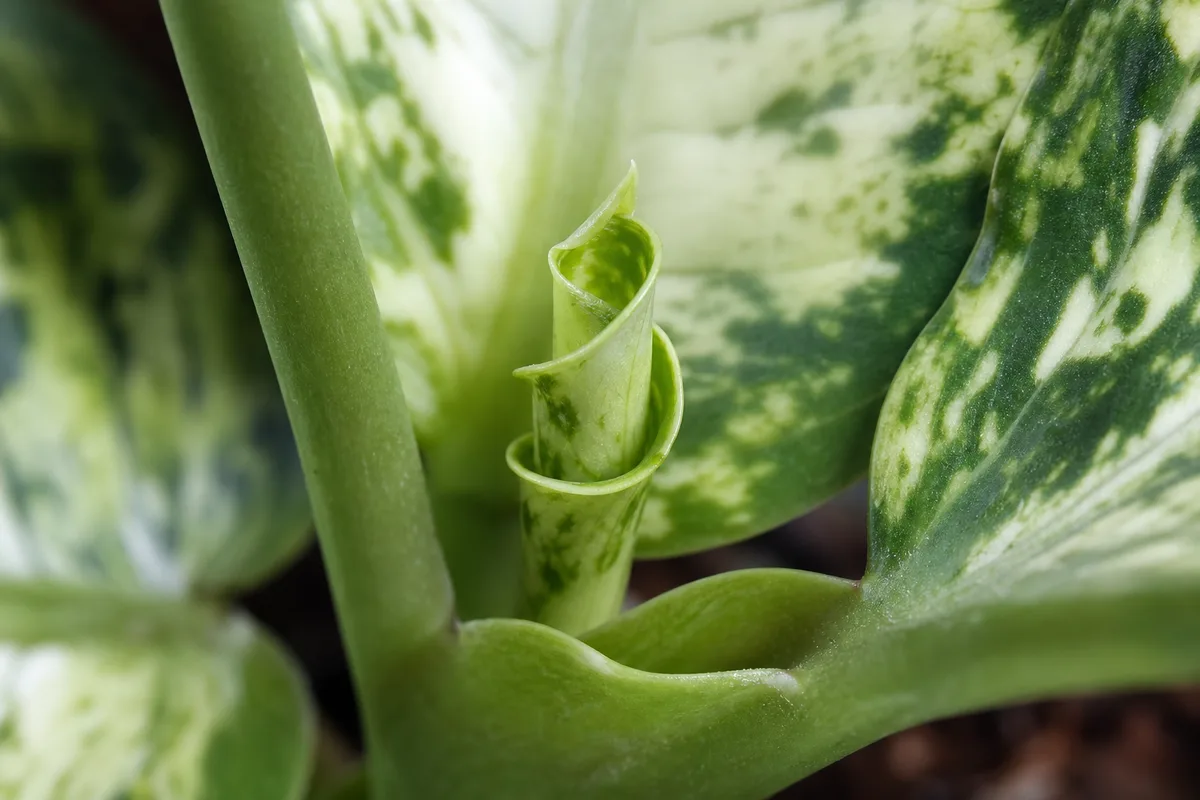
Slow Growth symptoms on Dieffenbachia Camille - compare with healthy tissue on the same plant.
Normal active-season growth:
- One new leaf every two to four weeks in bright filtered light at roughly 18–27°C (65–80°F) during spring through early fall
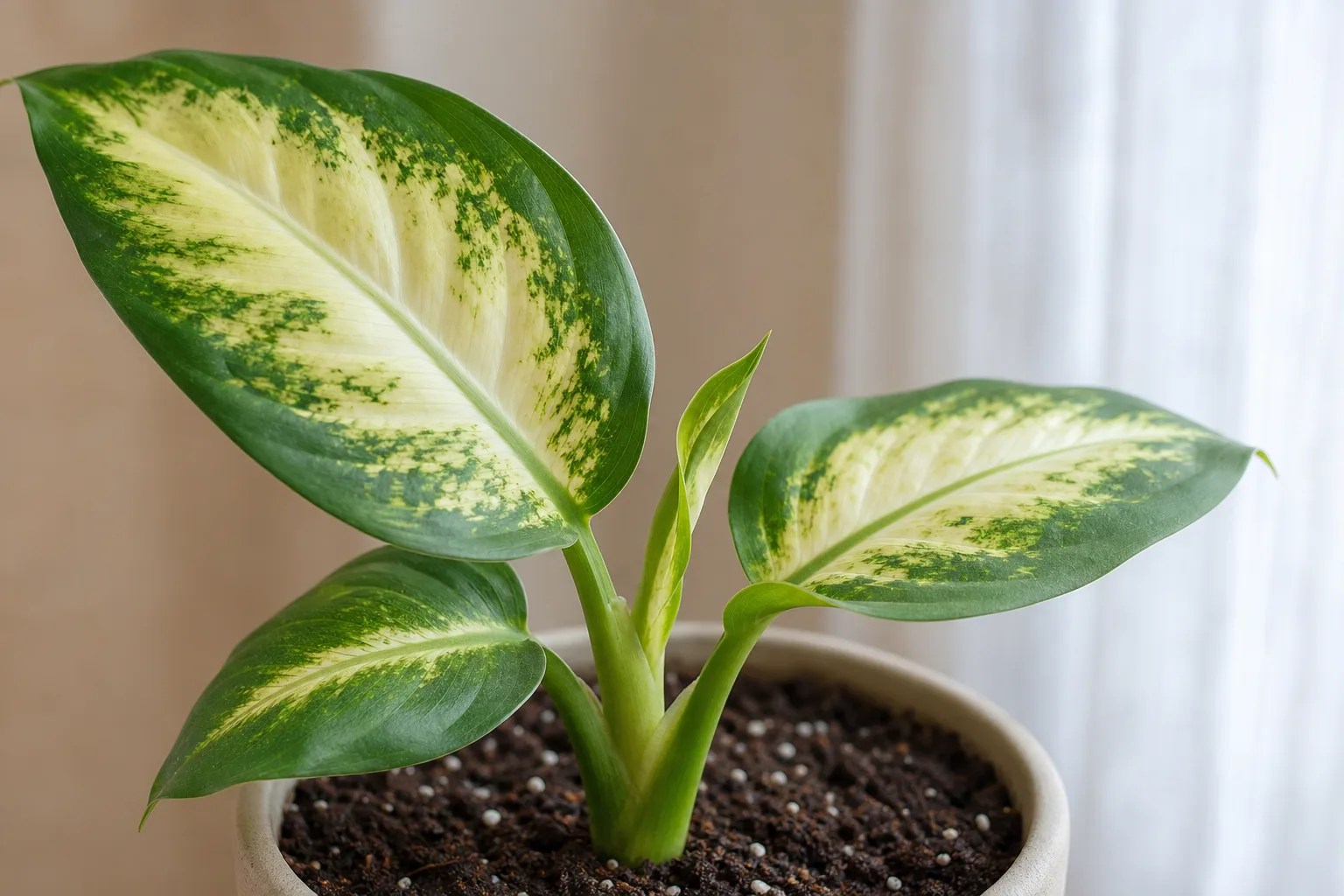
- Broad cream or yellow-white centers bordered by green margins on fresh foliage; leaf spacing stays moderate on the cane
- Pot weight cycles between lighter dry and heavier after a thorough soak
- UF/IFAS commercial production guidelines place ‘Camille’ at about 150–250 foot-candles to remain attractive indoors-active plants maintain crisp cream-and-green contrast on new leaves at that light level
Slow-growth signals (problem, not rest):
- No new leaf for six or more weeks during March through September despite firm existing foliage
- Smaller new leaves with wider gaps between nodes than when you bought the plant-internodes of 10 cm (4 in) or more between tiny leaves are a red flag
- Mostly green new foliage with only a thin cream streak-variegation fade often precedes a full stall
- Soil stays damp two or more weeks with zero growth-common when low light slows evaporation while watering stays on a summer schedule
- Water runs through in seconds, roots visible at drainage holes, or mix shrunk from pot sides
- Cane leans toward one window but growth still stalls-light may be directional, not total
Visual comparison: Healthy Camille new growth opens compact, cream-centered blades spaced a few centimeters apart on the cane. Light-starved Camille pushes small, mostly green leaves with long thin petioles and wide internode gaps-often described as “the plant is alive but not moving.” That pattern differs from winter rest, where spacing on the last leaf may look normal but no new bud appears for months.
Seasonal pause (normal, not a problem):
- Winter rest from late fall through February: little center activity while leaves stay firm
- Two to four weeks of pause after repotting while roots explore fresh mix
- Brief slowdown after a major move or HVAC season change
How fast Camille should grow (normal baseline)
Camille is sold as a compact to mid-height dumb cane that typically reaches 3 to 5 feet (0.9 to 1.5 m) indoors over several years-not a windowsill plant that doubles size each season, but faster than many low-light-tolerant foliage plants when conditions align. Missouri Botanical Garden’s Dieffenbachia profile describes moderate indoor growth in bright indirect light with protection from direct sun-the same balance Camille needs for steady leaf production.
Think in seasons, not daily change:
| Season | What healthy growth usually looks like |
|---|---|
| March–May | New leaves resume; cream centers sharpen in strengthening light |
| June–August | Steady leaf production every two to four weeks in good placement |
| September–November | Slower but continuing growth in many homes |
| December–February | Winter pause-little or no new leaves is normal |
UF/IFAS notes that when dieffenbachia growth has slowed or stopped, it is likely not receiving enough light-but that diagnosis applies during active months, not a December stillness with firm leaves and reduced watering.
Variegation is your early warning. Camille’s cream tissue contains less chlorophyll than green margins. When light weakens, the plant often produces greener, smaller leaves before growth stops entirely. Faded cream centers on the last two leaves deserve a light check even if the cane still looks upright. Camille needs brighter filtered exposure than solid-green dumb canes and more than cultivars like ‘Star Bright’ that UF/IFAS lists as attractive at about 50 foot-candles-Camille sits on the brighter end of the dieffenbachia light spectrum.
Why Dieffenbachia Camille gets slow growth
1. Insufficient light for variegated tissue
The top cause indoors. Camille’s pale centers photosynthesize less efficiently per square inch than green tissue, so a dim corner that keeps a solid-green dumb cane moving may still stall Camille. Low light also slows evaporation, so the same watering rhythm keeps soil wet longer. When stretch and lean dominate, see not enough light on Dieffenbachia Camille and the light guide.
2. Winter dormancy and short days
Calendar explains many false alarms. Cooler rooms, shorter photoperiods, and reduced watering needs slow metabolism from late fall through February. Do not repot, fertilize, and relocate simultaneously in January because the cane looks unchanged.
3. Chronic overwatering root stress in dim corners
The classic Camille trap: table or floor pot in a dim room with a fixed weekly watering habit. The thick cane stores water, so the plant stays upright while roots sit in oxygen-poor mix. Growth pauses before obvious wilt. Clemson HGIC notes root rot usually results from mix that does not drain quickly or overly frequent watering. Overlap with overwatering and root rot.
4. Root-bound container and depleted mix
Camille in the same pot for three or more years may circle roots tightly. When peat-based mix breaks down, water channels through without wetting roots, salts accumulate, and new leaves stall despite green foliage. UF/IFAS recommends repotting as needed to allow for best growth. Repotting workflow: repotting guide.
5. Cold drafts and suboptimal temperature
Camille prefers stable temperatures between 65 and 80°F (18 and 27°C) during active growth. UF/IFAS lists thriving temperatures in that range and notes that leaves droop and fall when the plant is too cold-sustained exposure below about 60°F (15°C) stalls root activity even when light looks adequate. AC vents, winter window sills, and entry drafts are common culprits.
6. Cane water storage masking underwatering
Less common but real on bright, warm windows: prolonged dry spells deplete internal reserves before obvious wilt. Very light pot, dry mix throughout, and slightly limp petioles point here-see underwatering.
7. Nutrient timing-not a first guess
After years without repot or feed, pale small new leaves in bright light with firm roots may indicate depleted mix. Clemson HGIC recommends foliage fertilizer from March through September-never as a first response to a dim-room stall. Full timing: fertilizer guide.
8. Relocation or repot shock
A two to four week pause after repotting or a major move is expected. Soft cane base with sour soil is not-inspect roots instead of waiting.
9. Pest-related stunting
Mealybugs and spider mites drain vigor on large Camille leaves, sometimes before obvious webbing or cottony clusters appear. Inspect leaf axils and undersides before fertilizing a stalled plant.
How to confirm the cause
Work through these checks in order-each narrows the list before you stack treatments:
- Season check - Note the month. December through February pause with firm leaves and slower watering is normal if mix is not sour.
- Last unfurl date - Mark when the newest leaf opened. Zero growth for six-plus weeks in March through September suggests a limiter beyond baseline slowness.
- Window distance - Stand where the pot sits. Beyond 1–1.5 meters (3–5 feet) from glass is often survival light for a cream-variegated cultivar. Indoor light falls sharply with distance from windows. Full placement workflow: light guide.
- Variegation on last two leaves - Dull green new foliage with wide spacing points to light before roots or feed.
- Soil moisture at depth - Push a finger or skewer into the top inch. Damp mix at depth for two-plus weeks with no new leaf suggests overwatering compounded by low light-not hunger. Clemson HGIC advises watering thoroughly then letting soil dry to one inch deep.
- Root-bound screen - Roots at drainage holes, water racing through, mix crumbling to mud → repot candidate in spring.
- Temperature scan - Feel for cold drafts from windows, doors, or AC. Sustained exposure below 60°F (15°C) stalls growth per NC State’s Dieffenbachia seguine profile.
- Post-repot timeline - Repotted within the last month? Pause may be normal shock.
- Pest scan - Mealybugs and spider mites drain vigor; inspect axils before fertilizing.
If winter rest explains the pause, hold course. If four or more active-season checks point to light or roots-and rot and pests are absent-treat that as confirmed.
Lookalike symptoms
| What you see | Likely cause | First direction |
|---|---|---|
| No new tips Dec–Feb, firm cane, slower dry-down | Winter dormancy | Wait; resume checks in March |
| Long petioles, lean toward window, dull cream centers | Low light / etiolation | Not enough light, leggy growth |
| Upright cane, static all spring, fast drain-through, circling roots | Root-bound / spent mix | Repotting in spring |
| Wet soil weeks, soft cane base, sour smell, yellow lower leaves | Overwatering / root rot | Overwatering, root rot |
| Light pot, dry mix throughout, limp petioles | Underwatering | Underwatering |
| Firm plant, no growth 2–4 weeks after repot | Transplant pause | Hold watering rhythm; do not re-repot |
| Cottony axils, webbing, pale stippling | Mealybugs / spider mites | Inspect and treat before feeding |
Slow growth is the headline-general stall with moderate or widening spacing. Leggy growth is architecture change (stretch and reach). Dormancy is a seasonal pause with stable form.
First fix for Dieffenbachia Camille (by confirmed cause)
Make one primary change, then wait two to three weeks before stacking treatments.
If winter dormancy: Reduce watering toward the slower winter rhythm from the watering guide; stop fertilizer. Keep reasonable filtered light-rest is not an excuse for a dark hallway.
If light is limiting: Move the pot to bright, filtered light-typically within 1–1.5 meters of an east window or behind sheer curtains on south or west glass. Hold watering, repot, and feed for fourteen days. UF/IFAS recommends moving to a brighter location when little new growth appears. Full workflow: not enough light.
If root-bound or spent mix: Repot in early spring into a container one size wider with fresh well-drained mix. Wait five to seven days before the first modest soak; no fertilizer for four weeks.
If overwatering or rot: Stop watering, inspect roots, trim mushy tissue, repot into dry mix if needed. Growth resumes only after roots stabilize-often with brighter placement so soil dries predictably.
If cold draft: Move off the window sill or away from the AC vent; keep temperatures in the 65–80°F band.
If underwatering: Water thoroughly once the top inch is dry-not small daily splashes.
If nutrients (last resort): After light and roots check out during active season, use diluted foliage feed per fertilizer guidance-never on wet rotting roots or in winter.
Wear gloves when inspecting roots or removing spent lower leaves-Dieffenbachia sap contains calcium oxalate crystals that irritate skin and mucous membranes.
Recovery timeline
Expect the next leaf to show improvement within two to three weeks after a meaningful light upgrade during active growth. Light fixes may show sooner on moderately stressed plants; repot recovery often needs four to six weeks for root re-establishment.
Old wide internodes do not shorten. Judge progress by new leaf size, spacing, and cream-center clarity-existing petiole length stays as grown.
Winter pause may need until March daylight before any timeline starts. Post-repot pause of two to four weeks is normal; beyond six weeks with spreading softness at the cane base, inspect for rot or oversized pot.
Worked example: A Camille in a north-facing hallway with mostly green new leaves and six weeks since the last unfurl moved to an east window with a sheer curtain. The first leaf after the move still looked partially green; the second leaf opened three weeks later with a broader cream center and half the internode gap of the previous leaf-that pattern confirms light was the limiter.
What not to do
Do not fertilize a stalled Camille to force growth-especially in winter or when soil stays wet. Insufficient light cannot be corrected with extra fertilizer, water, or repotting alone.
Do not repot before checking light and moisture-root disturbance on a stressed cane compounds stall unless roots are clearly bound or rotting.
Do not keep a dark-corner watering schedule after moving to brighter light-that invites soggy mix.
Do not confuse survival with vigor. Camille in a dim corner may live for years with almost no new leaves-that is tolerance, not the growth rate you see in nursery photos from bright greenhouse light.
Do not stack repot, prune, and pesticide on one day. One change at a time keeps the diagnosis readable.
How to prevent slow growth on Dieffenbachia Camille
Match the plant’s active-season rhythm: bright filtered light from the light guide, top-inch dry checks from the watering guide, and repot before severe root binding.
In winter, accept slower growth, water less, and skip feed. In spring, verify window distance and cream variegation on new leaves before assuming failure. Rotate the pot a quarter turn every few days for even growth, clean glass seasonally, and add a grow light if natural light drops.
Cross-check baseline biology on the Camille overview when multiple symptoms overlap.
When to worry
Escalate when the cane softens at the base, soil stays sour despite dry surface attempts, lower leaves drop weekly while mix stays wet, or pests coat every new tip. Those are decline patterns, not dormancy or baseline slowness.
Patience is enough when leaves stay firm, mix smells neutral, the calendar is winter, or you repotted two weeks ago and the plant is in expected transplant pause.
Camille care cross-check
| Factor | Active season target | Slow-growth mistake |
|---|---|---|
| Light | Bright filtered; crisp cream centers on new leaves | Dark corner survival mode |
| Water | Top inch dry between soaks | Summer calendar in dim winter room |
| Temperature | 65–80°F; no cold drafts | Winter sill below 60°F |
| Roots | Refresh mix before severe binding | Waiting until water runs through instantly |
| Feed | March–September only if actively growing | Winter fertilizer on wet soil |
| Season | Expect winter pause | Panic-repot in January |
Related Camille care and problems
- Not enough light - stretch, cream fade, and stall from weak light
- Leggy growth - when reach, not general stall, is the main symptom
- Overwatering and root rot - wet-soil stall in dim rooms
- Underwatering - drought before collapse
- Yellow leaves - lower-leaf drop and stress overlap
- Light requirements - window placement and variegation
- Watering - top-inch dry rhythm and winter reduction
- Repotting - root-bound and spent-mix recovery
- Fertilizer - feeding only during active growth
- Camille overview - cultivar baseline and care hub
When to use this page vs other Dieffenbachia Camille guides
- Dieffenbachia Camille watering guide - Use for routine moisture checks before assuming slow growth is the main issue.
- Dieffenbachia Camille problems hub - Browse all 16 common issues on this species.
- Not Enough Light on Dieffenbachia Camille - Different entry point when symptoms overlap with slow growth.
- Leggy Growth on Dieffenbachia Camille - Different entry point when symptoms overlap with slow growth.
- Yellow Leaves on Dieffenbachia Camille - Different entry point when symptoms overlap with slow growth.