Wilting on Chrysanthemum: Causes, Checks & Fixes
Quick answer
Wilting on Chrysanthemum starts with pot weight-light dry soil means underwatering, especially during hot autumn bloom. Heavy wet soil with limp leaves means root stress or crown rot. First step: lift the pot and check moisture before watering again.
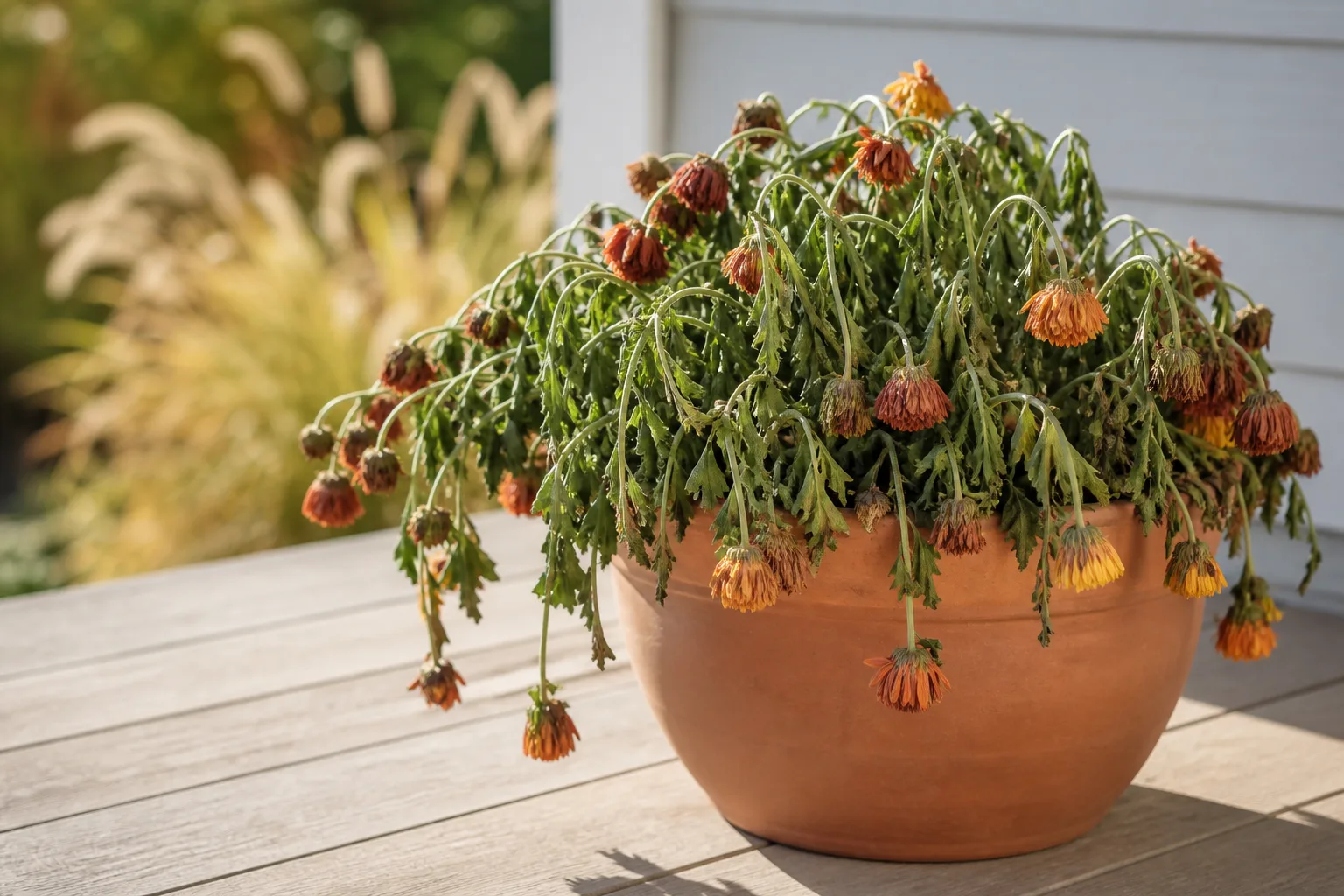
Wilting on Chrysanthemum: Causes, Checks & Fixes
This guide covers wilting on Chrysanthemum. See also the general Wilting guide, watering, and light pages for this plant.
Wilting on Chrysanthemum: Causes, Checks & Fixes
Quick answer
Wilting on Chrysanthemum (Chrysanthemum × morifolium) is usually water imbalance-not mysterious disease. Mums in full sun during autumn bloom transpire heavily; shallow fibrous roots dry fast in small pots. Dry pots wilt by afternoon. Conversely, heavy wet mix with limp leaves means roots cannot supply water-overwatering, poor drainage, or crown rot in soggy conditions.
First step: lift the pot. Light and dry → soak until water drains; empty saucer. Heavy and wet → stop watering, confirm drainage, inspect crown for rot. See underwatering and differentiate from drooping leaves when lower leaves sag without full canopy collapse.
Wilting vs drooping on Chrysanthemum
Both symptoms look like a sad mum, but timing and soil context differ:
| Symptom page | What it usually means on garden mums | Typical speed | Soil clue |
|---|---|---|---|
| Wilting (this page) | Acute turgor collapse-whole plant or major sections limp | Hours to 1–2 days | Wet vs dry fork is urgent |
| Drooping leaves | Gradual lower-leaf sag while upper growth stays firm | Days to weeks | Same wet/dry logic, slower onset |
| Underwatering | Dry top inch, light pot, dull leaves during bloom | Builds over missed checks | Bone-dry throughout |
| Overwatering | Yellow lower leaves, soggy mix, soft crown | Often follows daily watering without checks | Stays wet many days |
| Root rot | Limp foliage with damp soil, sour smell, mushy roots | Escalates after chronic wetness | Heavy pot despite wilt |
Chrysanthemums carry very shallow roots close to the crown. That biology makes drought wilt arrive fast in full sun-but also makes crown rot dangerous when the surface stays wet in cool indoor air.
What wilting looks like on Chrysanthemum
Healthy mum leaves and flower stems feel springy when bent gently. Wilting removes that firmness-the canopy hangs limp, and dense autumn blooms add weight that exaggerates the collapse.
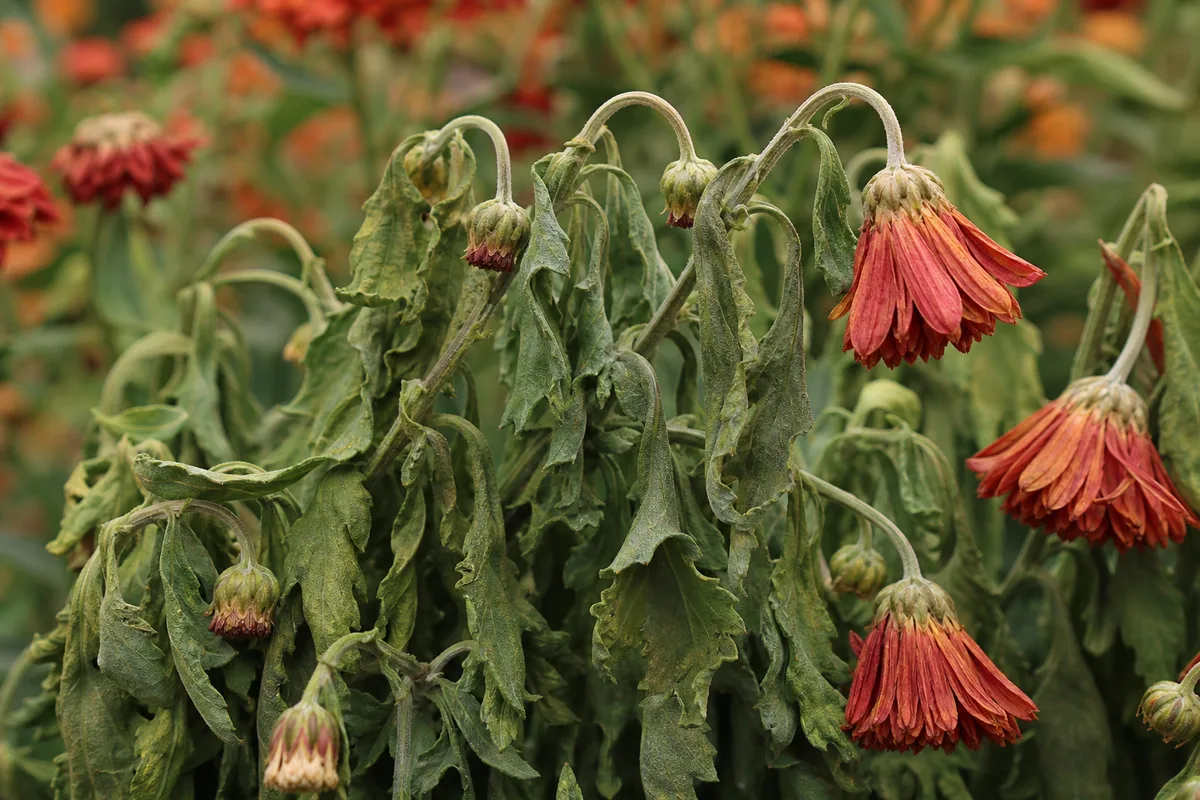
Limp chrysanthemum foliage and sagging flower stems - the canopy loses springy firmness when turgor drops from dry or wet root stress.
Dry-soil wilt (underwatering)
- Pot feels light for its size; top 1–2 cm of mix is dry
- Leaves and open flowers droop together, often worst in afternoon full sun
- Stems stay firm at the crown-no mush or grey mould
- Recovery visible within hours after a thorough soak and drained saucer
Heat wilt (temporary midday droop)
- Wilt appears only during peak afternoon heat in full sun
- Pot weight is normal to slightly light; soil moist below the surface
- Foliage firms by evening or next morning without extra water
- Distinct from all-day dry wilt where the pot stays light and soil is dry throughout
Wet-soil wilt (overwatering or root failure)
- Pot feels heavy; mix stays cool and damp for days
- Leaves limp despite wet soil-paradoxical wilt when roots fail
- Yellow lower leaves may appear before full collapse
- Sour or musty smell from drainage holes signals decay-see overwatering
Crown rot wilt
- Lower stem darkens at the soil line; grey mould (Botrytis) on wet stems in humid shade
- Crown tissue feels soft when pressed gently
- Wilt worsens even though mix stays wet-roots cannot move water
- Often follows foil-wrapped gift pots, blocked drainage, or overhead evening watering on dense foliage
Post-bloom partial collapse
- Spent flower heads weigh stems down; lower sections sag while crown stays firm
- Mix may be dry from neglect after the display peak-not the same emergency as wet wilt
- Trim spent blooms and check moisture before assuming disease
Why Chrysanthemum wilts
Underwatering during bloom
Mums especially need plenty of water when they bloom, and shallow roots dry quickly in porch pots and gift-mum containers. A mum in full September sun can go from firm to limp in one hot afternoon if the top inch dries while roots cannot reach deeper moisture in a tight root ball.
Retail gift mums in 6-inch nursery pots are especially vulnerable: dense flower domes transpire heavily, but the soil volume is small. Check twice daily during peak bloom-not once a week on a calendar.
Overwatering and root uptake failure
Overwatering causes yellowing leaves that blacken and drop on chrysanthemums-the opposite of drought. Saturated mix suffocates shallow roots; the plant cannot absorb water even though soil is wet. Daily top-ups to “save the blooms” on already-damp soil is the most common porch-mum mistake.
Poor drainage and trapped runoff
Blocked holes, foil sleeves, and full saucers keep the crown wet. Clemson HGIC notes drought causes woody stunted growth while overwatering causes yellowing and blackening leaves-two different wilt paths from the same watering habit applied wrong.
Heat stress in full sun
Chrysanthemums prefer full sun and fertile, well-drained soil. Full sun is correct-but extreme midday heat can outpace root uptake temporarily. Heat wilt recovers overnight if morning moisture is adequate; dry wilt does not.
Crown rot and soil-borne pathogens
Root and crown rots begin with wilting and poor growth as pathogens damage the root system. Pythium, Phytophthora, Rhizoctonia, and Fusarium are documented on chrysanthemums in greenhouse and container culture. Chronic wet crowns in cool weather favor grey mould and crown decay-see root rot when inspection confirms mush.
Fusarium wilt (less common on porch mums)
Soil-borne Fusarium wilt disrupts water movement in the vascular system, causing yellowing from the base upward and sectoral wilting on one side of the plant. This is more common in field and greenhouse stock than a single-season gift mum, but overwintered garden mums in reused soil can show one-sided collapse with brown vascular streaks inside cut stems.
How to confirm the cause
Work through these checks in order:
- Pot weight at wilt peak - Lift the container when leaves look worst. Light suggests drought; heavy suggests oversaturation or rot.
- Pot weight next morning - Heat wilt recovers overnight with normal weight. Dry wilt stays light until you water.
- Moisture at crown - Press finger into top 1–2 cm near the pot edge. Dry crumbly surface with firm crown fits thirst. Cool damp surface with limp leaves fits uptake failure.
- Time of day - Midday-only droop in hot sun points to heat wilt if soil is moist below. All-day limpness points to dry or wet root crisis.
- Drainage audit - Confirm holes are open, peel back foil wrappers, empty saucers within 30 minutes of watering.
- Crown inspection - Gently press lower stems at soil line. Firm tissue with dry soil points away from rot; soft dark tissue with wet soil confirms serious trouble.
- Bloom stage - Heavy open flowers plus dry soil fit drought. Heavy flowers plus wet soil fit overwatering or rot, not thirst.
Dry wilt vs wet wilt vs heat wilt diagnostic table
| Check | Dry-soil wilt | Heat wilt | Wet-soil wilt |
|---|---|---|---|
| Pot weight | Light | Normal to slightly light | Heavy |
| Top inch of mix | Dry | Moist below surface | Cool and damp |
| Time pattern | Worse all day; worse afternoon | Midday only | Constant limpness |
| Evening recovery | No-stays limp until watered | Firms overnight | No-stays limp |
| Crown at soil line | Firm | Firm | Soft or mushy |
| Lower leaves | Dull, may crisp at edges | Usually green | Often yellow |
| First action | Water thoroughly; drain | Verify morning moisture; avoid extra water | Stop watering; inspect crown |
| Wrong move | Waiting while bone dry | Soaking already-wet soil | Adding more water |
First fix for Chrysanthemum
Lift the pot and check whether the top inch of soil is dry or wet-then act on that reading, not on how limp the flowers look.
- If dry: water thoroughly until excess drains from the bottom, empty the saucer within 30 minutes, and recheck twice daily during hot bloom.
- If wet: stop watering immediately. Do not mist, fertilize, or repot until you know whether the crown is firm or mushy.
- If midday-only wilt with moist soil: verify adequate morning moisture; do not add an extra afternoon soak unless the top inch is actually dry.
This single step prevents the most common chrysanthemum mistake-watering a wilted mum that is already drowning in wet peat.
Step-by-step recovery
For confirmed underwatering
- Water deeply once so the entire root ball rehydrates-dry pockets in a tight gift-pot root ball can leave one side wilted.
- If water runs straight through without soaking, bottom-water for 15–20 minutes, then drain fully.
- Keep the mum in full sun with good drainage-do not move to deep shade to “help” wilt; mums need sun for recovery blooms.
- Resume checks: water when the top 1–2 cm dries-often daily during peak bloom on sunny porches. See the watering guide.
- Trim only fully spent flower heads that snap cleanly; leave firm buds and foliage.
For heat wilt without root damage
- Confirm recovery by evening-if foliage firms, roots are functioning.
- Check moisture each morning before heat builds; a deep morning soak beats repeated afternoon panics.
- In extreme heat only, light afternoon shade for porch pots-not permanent shade, which weakens mums the following season per Clemson HGIC.
- Do not fertilize during acute heat stress.
For overwatering without confirmed rot
- Stop watering and improve airflow around the pot.
- Peel back foil wrappers; confirm drainage holes are open and saucers stay empty.
- Let the top inch dry before the next drink-may take several days indoors.
- If mix stays wet more than a week at room temperature, plan a repot into airy mix once the crown firms-details in overwatering.
For crown rot or advanced wet wilt
- Stop watering and unpot gently-do not yank stems that may detach from a rotting crown.
- Rinse roots and inspect: firm pale roots vs brown mushy tissue that slips off.
- Trim all decay back to firm tissue with clean scissors; sterilize blades between cuts.
- Remove affected crown tissue if dark and soft; divide healthy side shoots if the center is lost.
- Repot into fresh well-drained mix in a clean pot with drainage-often the same size or slightly smaller if root mass shrank.
- Hold fertilizer until new basal shoots appear for two weeks.
- Full salvage protocol: root rot on Chrysanthemum.
Recovery timeline
| Pattern | What to expect | Judge success by |
|---|---|---|
| Dry wilt | Hours after thorough soak | Firm stems and perked flowers same day |
| Heat wilt | Same evening if roots healthy | Morning firmness without extra water |
| Wet root stress | 1–3 weeks once mix dries on corrected schedule | New green shoots from crown, not old limp leaves |
| Crown rot | Partial; may require division | Firm new basal growth; discard if crown is fully mushy |
| Post-bloom sag | Days after trim and one proper drink | Upper buds and firm crown |
Old wilted leaves and spent petals may stay limp permanently even after roots recover-watch new growth from the crown, not perfect old foliage.
Lookalike symptoms
Gradual lower-leaf droop, not sudden collapse - Slow sag over weeks fits drooping leaves or chronic underwatering rhythm more than acute wilt.
Yellow leaves without full canopy wilt - Lower yellowing on damp soil may be early overwatering before full collapse.
Root rot with sour smell - Limp foliage plus wet mix and mushy roots is root rot, not a simple missed watering.
Spider mite bronzing - Stippled, bronzing lower leaves with fine webbing point to spider mites in hot dry weather-not the same as whole-plant turgor loss, though severe infestations can weaken stems before bloom.
Normal post-frost decline - Outdoor mums wilt and brown after hard freeze; that is seasonal senescence, not a fixable summer wilt.
Mistakes to avoid
Do not water wet wilting plants-the paradoxical wilt trap kills more porch mums than drought.
Do not overhead soak dense bloom late in the day-wet foliage overnight in cool shade invites grey mould on chrysanthemums.
Do not keep gift mums in foil-wrapped cachepots without peeling back the sleeve to check drainage and saucer water.
Do not assume afternoon wilt always means thirst-check pot weight first; heat wilt on moist soil needs morning moisture adjustment, not another soak.
Do not repot on day one unless crown rot or failed mix is confirmed-unnecessary disturbance during bloom shock can worsen wilt.
Do not fertilize a stressed mum hoping to perk blooms-feed only after firm new growth on a corrected watering schedule per the fertilizer guide.
Chrysanthemum care cross-check
Wilting rarely happens in isolation. Match your fix to the broader care picture:
| Care factor | Wilting link | Where to read next |
|---|---|---|
| Water rhythm | Dry vs wet fork | Watering guide |
| Drainage and saucers | Wet wilt, crown rot | Overwatering |
| Full sun + heat | Heat wilt, fast dry-down | Overview |
| Bloom weight + small pots | Gift-mum afternoon collapse | Underwatering |
| Winter overwinter | Wet crown in cool storage | Overview |
How to prevent wilting next time
Check moisture daily during bloom in full sun-pot weight beats calendar watering. Mums need high water during bloom but only when the top layer has actually dried.
Use pots with open drainage holes and empty saucers after every drink. Never let foil sleeves trap standing runoff.
Water at the soil surface or with a gentle wand-avoid soaking dense flower domes from above in the evening.
For overwintered garden mums, keep crowns dry through dormancy-chronic winter wetness sets up spring crown rot.
Scout lower stems weekly during humid spells for grey mould before it reaches the crown.
For complete species culture, see the Chrysanthemum overview.
When to worry
Treat as urgent when the crown turns dark and mushy in wet soil, grey mould spreads up stems, wilt worsens despite wet mix, or buds abort on bone-dry pots in full afternoon sun during peak bloom.
Lower urgency applies when midday wilt firms by evening on moist soil, or when spent blooms alone weigh stems down on an otherwise firm crown with appropriate moisture.
If more than half the root mass is mushy and the crown dents under light pressure, salvage may be limited to healthy side shoots-honest stop before investing in repeated fungicide sprays without fixing drainage.
Conclusion
Wilting on Chrysanthemum always starts with one question: is the root zone too dry or too wet? Lift the pot, check the top inch, and match your first action to that reading. Dry gets one deep drink with full drainage; wet gets a pause and possible crown inspection-not another watering cycle. Mums in autumn bloom transpire heavily on shallow roots; they forgive brief drought better than chronic sogginess when you catch the fork early. Get it wrong and a thirsty-looking pot drowns in soil that never dries.
When to use this page vs other Chrysanthemum guides
- Chrysanthemum watering guide - Use for routine moisture checks before assuming wilting is the main issue.
- Chrysanthemum problems hub - Browse all 16 common issues on this species.
- Underwatering on Chrysanthemum - Different entry point when symptoms overlap with wilting.
- Overwatering on Chrysanthemum - Different entry point when symptoms overlap with wilting.
- Root Rot on Chrysanthemum - Different entry point when symptoms overlap with wilting.