No Flowers on Christmas Cactus: Causes, Checks & Fixes
Quick answer
Christmas cactus (*Schlumbergera* × *buckleyi*) usually fails to bloom because fall nights are too short or too bright-room lamps, streetlights, or a living-room placement break the 14+ hours of uninterrupted darkness needed from mid-September. First fix: move the pot to a spare room or closet that stays fully dark each night for six consecutive weeks, with cool nights around 55–65 °F.
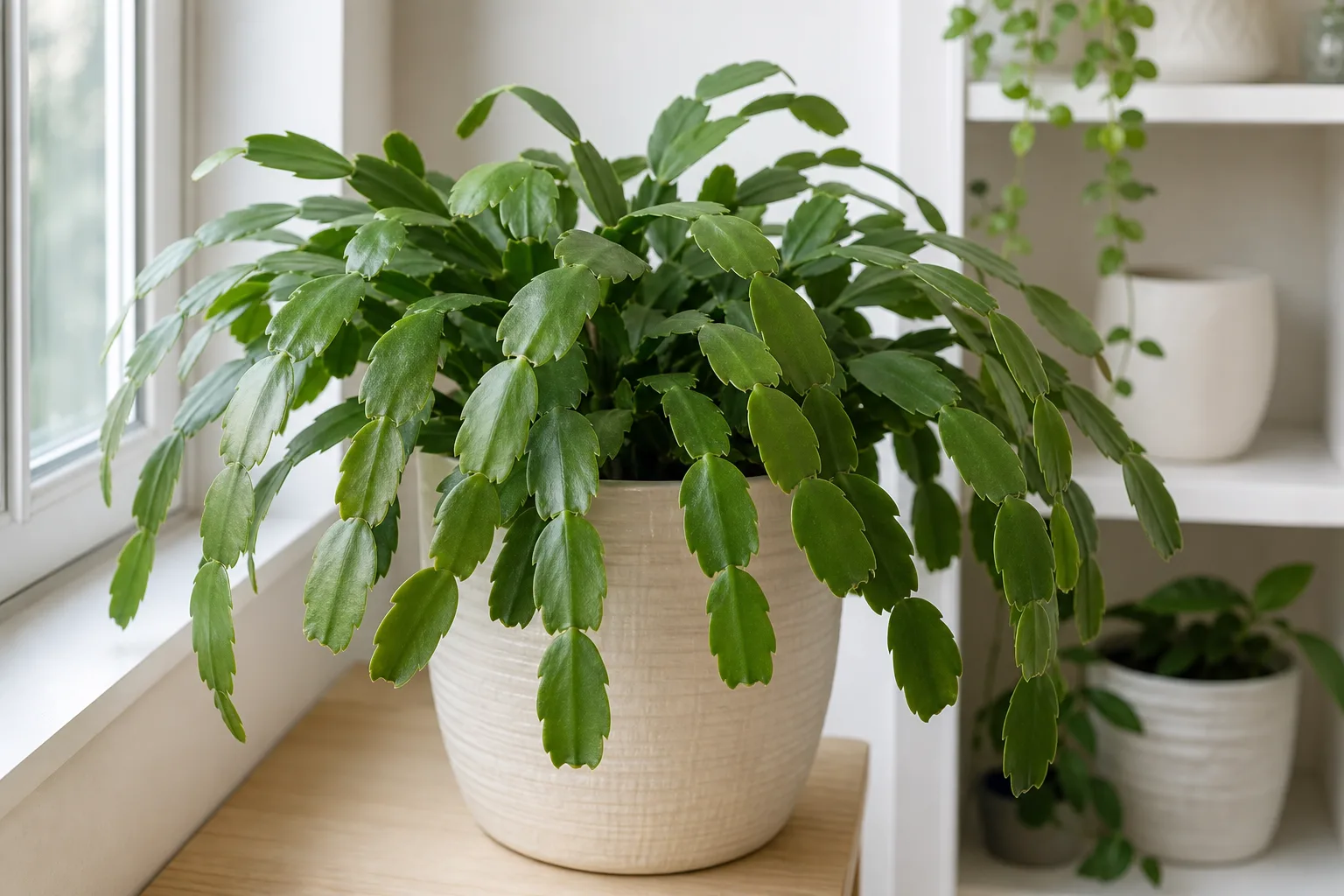
No Flowers on Christmas Cactus: Causes, Checks & Fixes
This guide covers no flowers on Christmas Cactus. See also the general No Flowers guide, watering, and light pages for this plant.
No Flowers on Christmas Cactus: Causes, Checks & Fixes
Quick answer
When Christmas cactus grows plump green phylloclades but no flower buds by November, the problem is almost never “give it more light right now.” Holiday cacti are short-day plants that need 14 or more hours of continuous, uninterrupted darkness each night for about six weeks starting mid-September to initiate buds. As little as two hours of light during that dark window-from a ceiling fixture, TV, streetlamp, or hallway bulb-can prevent bud set entirely.
First fix: starting around September 15, place the pot in a room or closet that stays fully dark from roughly 6 p.m. to 8 a.m. every night for six consecutive weeks. Keep fall nights cool-ideally 55–65 °F (13–18 °C)-and leave the plant undisturbed once pea-sized buds appear. Do not reach for bloom fertilizer or a larger pot until you have audited the dark period.
If segments are stretched and pale year-round, fix daytime light during the growing season first-but a compact, healthy plant with zero buds in November still points to photoperiod failure, not fertilizer shortage.
This page is a bloom-failure checklist hub. For daily placement, window direction, and the full photoperiod mechanics, see the Christmas cactus light guide.
By sai-ananth · Reviewed by LeafyPixels Review Board · Last expert review: June 2026
What no flowers looks like on Christmas Cactus
Christmas cactus does not have true leaves. Photosynthesis happens in the green phylloclades-the flat, jointed stem segments with notched margins. “No flowers” means those segments look healthy but terminal notches stay bare through October and November when buds should swell.
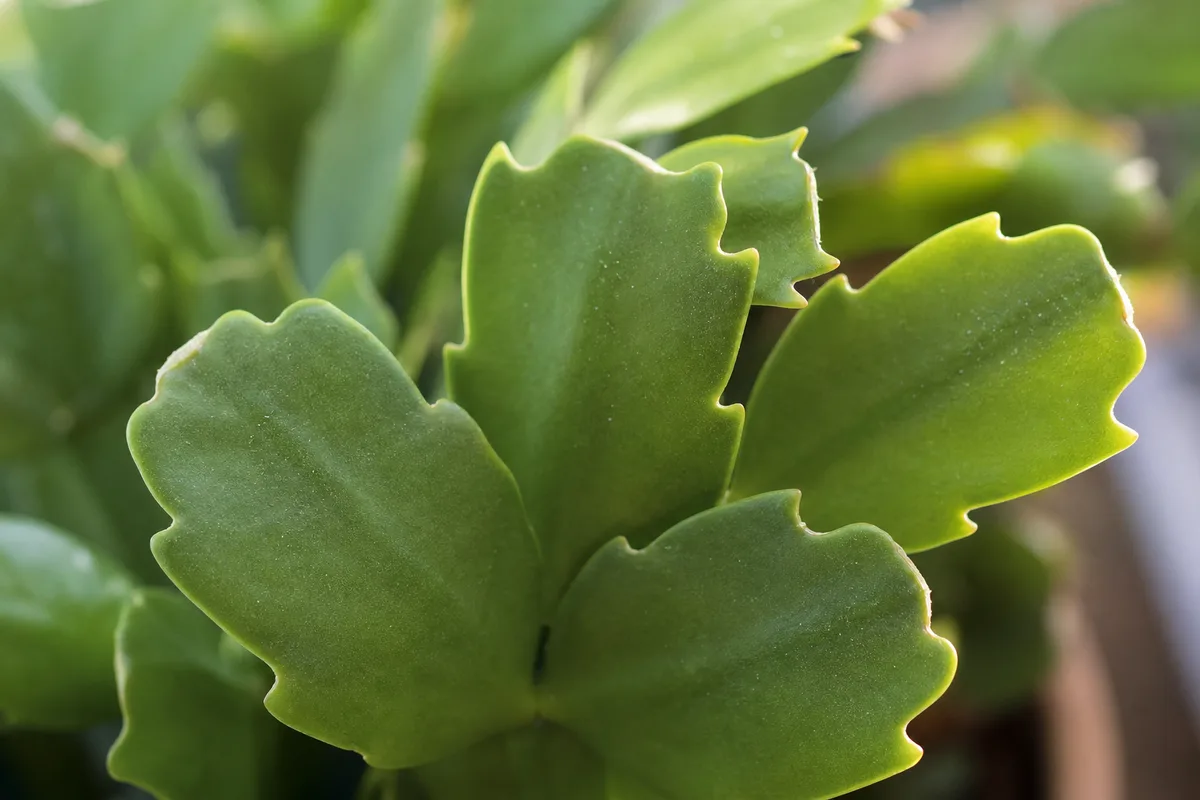
Plump green phylloclade tips with empty rounded notches - no raised bud bumps where flower buds should form by late October.
Look for these patterns at the segment tips:
- Plump, evenly green phylloclades with empty notches - the plant is storing energy but never received the fall short-day signal
- No bud initials - no tiny bumps at segment notches by late October after a correct dark routine should have run
- Lean toward the brightest window without buds - may signal weak daytime light and missed darkness; see not enough light if segments are thin and widely spaced
- A plant that bloomed last year but not this year - often a new lamp schedule, room move, or skipped September darkness rather than plant decline
Healthy budless segments in November look like smooth green paddles ending in rounded notches with nothing protruding. Bud initials, when they form, appear as small raised bumps at those notches-often pink-tipped before they open. If you see bumps that later vanish, that is bud drop, not a failure to initiate buds.
This is different from post-bloom rest, when open flowers fade normally after display.
Why Christmas Cactus stops flowering: causes ranked
Interrupted fall darkness and night-light leaks
This is the leading cause indoors. Lack of flowering is often due to light interrupting the long night period required for initiation. Common leaks:
- Living-room or kitchen placement where ceiling lights stay on after sunset
- Streetlights or car headlights through front windows
- A grow light on a timer that does not reach 14 hours off-or whose indicator LED, power strip light, or partial timer failure spills light into the dark window
- Checking the plant with a phone flashlight during the dark window
The dark period must be total, not dim. Even brief exposure resets the photoperiod clock. Grow-light setups are especially risky during the six-week run: if the lamp must stay in the same room, unplug it entirely each evening or move the plant to a separate dark space rather than trusting a timer alone.
Dark treatment started too late or skipped
Long nights should start about the middle of September and continue for at least six continuous weeks for complete bud set. Starting in November usually misses the window for December blooms. Skipping even one year resets the cycle-you need the full run again next fall.
Night temperatures too warm for bud initiation
During fall, holiday cacti depend on shorter day lengths and cooler temperatures to set flower buds. Plants grown with night temperatures between 50 and 59 °F will set flower buds regardless of day length, though growth will be slower. Nights consistently above 65 °F (18 °C) suppress bud formation even when darkness is correct. A warm spare bedroom with perfect darkness may still fail if heat runs all night.
Cool-porch shortcut: If you can hold night temperatures at 45–55 °F (7–13 °C)-a glassed porch, unheated mudroom, or garage above freezing-buds often form with less strict darkness control. UMN Extension notes that at 55 °F night temperatures, holiday cacti may bloom in five to six weeks regardless of day length-which is why an unheated porch can succeed when a dark closet in a warm bedroom fails. Move the plant back to normal room temperatures once pea-sized buds appear.
Excess nitrogen or wrong feeding season
High-nitrogen fertilizer during late summer pushes vegetative phylloclade growth at the expense of buds. Stop fertilization during the late summer for greater flower bud production in the fall. Bloom booster alone cannot replace photoperiod-do not fertilize your way out of a darkness problem.
Pot too large or recent repot
Holiday cacti flower best when kept somewhat pot bound. Christmas Cactus repotting guide into a much larger container in summer or fall diverts energy to root expansion. Spring repotting every three years is enough; fall is the wrong season to upsize.
Insufficient daytime light during the growing season
From April through August, Christmas cactus needs bright indirect light to build the reserves that fuel winter blooms. Weak summer light produces stretched, pale phylloclades and poor bloom potential even when fall darkness is correct. If segments are stringy and widely spaced, address daytime light during the growing season-not as a November substitute for darkness.
Thanksgiving vs. Christmas vs. Easter cactus misidentification
Most store-bought “Christmas cactus” plants are actually Schlumbergera truncata (Thanksgiving cactus), which blooms approximately a month before Christmas cactus under natural conditions. Easter cactus (Hatiora gaertneri) needs 8–12 weeks of short days and blooms in spring. Misidentification changes when you expect flowers-not whether darkness matters. Check segment margins: Thanksgiving cactus has pointed teeth; Christmas cactus has rounded segments. See the Christmas cactus overview for species ID.
Outdoor natural shortening days (often overlooked)
Plants kept outdoors in a shaded spot through September and October often receive shortening days and cool nights naturally-before you bring them indoors before frost. UGA Extension recommends keeping plants outdoors until just before frost, then bringing them in once natural photoperiod and temperature have done part of the work. If you bring a plant inside too early to a bright, warm room, you reset the cycle.
How to confirm the cause: bloom-failure checklist
Work through these checks in order before repotting, pruning, or buying bloom fertilizer.
- Fall dark hours uninterrupted? Count from sunset to sunrise-or your chosen 6 p.m.–8 a.m. block. Any lamp, TV, or streetlight during that window fails the test.
- Started mid-September? Mark the calendar. Six full weeks means roughly September 15 through October 27.
- Night temps in the 55–65 °F range? A thermometer at pot level beats guessing. Above 68 °F at night slows initiation.
- Any artificial light after you “put it to bed”? Walk the room at 10 p.m. with lights off-if you can read a label on the pot, darkness is not complete.
- Pot slightly root-bound? Roots visible at drain holes or tight in the current container support blooming; swimming in excess soil does not.
- High-nitrogen feed stopped by late August? Review your fertilizer routine-monthly half-strength during growth is enough; stop before fall bud initiation.
| Check | Pass | Fail → likely cause | Urgency |
|---|---|---|---|
| 14+ hours total darkness nightly for 6 weeks from mid-September | Bud initials by late October | Interrupted darkness | Fix now if before late October; next September if season lost |
| Night temps 55–65 °F during dark treatment | Cool room or porch before frost | Warm nights suppress buds | Fix now - move to cooler spot tonight |
| Compact green phylloclades in summer | Plump segments, close joints | If stretched/pale → low light | Next spring/summer - not a November substitute |
| Same pot 1–3 years, not oversized | Slightly tight root ball | Recent large repot delays bloom | Next spring - do not repot in fall |
| Fertilizer stopped late summer | No high-N feed in September | Excess nitrogen → vegetative growth | Stop now; buds may still set if darkness is correct |
| Species ID matches expected bloom month | Thanksgiving ~November, Christmas ~December | Wrong species → adjust expectations | Adjust expectations - not a care failure |
The first fix: short-day protocol summary
One action: establish uninterrupted long nights starting mid-September.
Full step-by-step placement, box-covering options, and window-by-window guidance live on the Christmas cactus light guide-this section is the checklist version only:
- Start mid-September - six consecutive weeks of long nights; November starts usually miss December blooms.
- Deliver 14+ hours of total darkness nightly - spare bedroom, closet, light-proof box, or outdoor porch with no night lights.
- Keep nights cool - target 55–65 °F (13–18 °C) indoors, or 45–55 °F on a protected porch if your home runs warm.
- Maintain bright indirect days - darkness at night does not replace daytime photosynthesis during the non-dark hours.
- Do not move the pot once pea-sized buds form-relocation triggers bud drop.
Hold water and feed steady through initiation; slight dryness in early fall is fine. Do not apply bloom fertilizer until buds are visible and photoperiod is no longer the limiting factor.
Recovery timeline
Buds normally visible in three to four weeks once the dark routine is consistent. Expect the first bud initials in mid-to-late October if you started September 15. Flowers open roughly four to eight weeks after buds set, depending on species and temperature.
If no buds appear by early November after a verified six-week dark run, review night temperature and species ID before trying other fixes.
This year’s bloom window may be lost if you are reading this in December with no buds. Use spring and summer to build compact growth in bright indirect light, stop late-summer nitrogen, and restart the full September protocol next year.
Signs the fix is working: tiny bumps at phylloclade notches → swelling pink-tipped buds → stable count without drop. Signs it is failing: still bare tips after six verified dark weeks with warm nights → reassess temperature; bare tips with stretched summer segments → fix daytime light before next fall.
What not to do
- Do not blast the plant with direct summer sun to force blooms-harsh rays bleach phylloclades; this is not a desert cactus.
- Do not repot into a larger container in fall hoping to trigger flowering-wait until spring, and only when roots are crowded.
- Do not rely on bloom booster without fixing photoperiod first-fertilizer cannot substitute for darkness.
- Do not move or rotate the pot after buds swell-see bud drop for why stability matters.
- Do not expose budding plants to temperatures above 90 °F (32 °C)-continuous warm temperatures can cause flower buds to drop and may prevent formation.
- Do not leave the plant outdoors once nights drop below 50 °F (10 °C) without protection.
How to prevent repeat bloom failure
- Run the six-week dark routine every September-set a phone reminder for September 15.
- Audit room lights annually-new lamps, moved furniture, or a houseguest in the dark room can break the cycle.
- Keep bright indirect light April–August per the light guide so the plant stores bloom energy.
- Stop high-nitrogen feed by late August; resume light feeding only after flowering finishes.
- Stay slightly pot bound-repot in spring every two to three years, not every fall.
- Match watering to season-even moisture once buds set; avoid bone-dry or waterlogged swings per the watering guide.
Related tool
Use the Plant Problem Diagnosis Tool to narrow causes for no flowers on this plant before changing multiple variables at once.
Related guides
- Christmas cactus light - photoperiod deep-dive and daily placement
- Not enough light - stretched phylloclades and weak summer growth
- Bud drop - buds formed then fell off
- Fertilizer - nitrogen timing and bloom feeding
- Christmas cactus overview - species ID and year-round care
When to accept a lost season vs. retry now
Use this escalation path instead of repeating the same advice:
| Situation | What it means | Next step |
|---|---|---|
| Late November or December, no buds ever formed | This bloom season is likely lost | Stop chasing blooms this year; plan September 15 dark routine + cool nights for next fall |
| Mid-October, dark routine running less than 4 weeks | Still within the initiation window | Continue the full six weeks; do not move the pot or add fertilizer |
| Early November, six verified dark weeks, warm nights (above 68 °F) | Temperature-not light-is the blocker | Move to a cooler room or porch tonight; buds may still form |
| Pea-sized buds visible | Photoperiod succeeded | Hands off-see bud drop for stability rules |
| No buds after two consecutive years with verified protocol | Unusual; beyond standard photoperiod failure | Contact your local cooperative extension office for hands-on diagnosis |
A compact, healthy Christmas cactus with zero buds in November is almost always fixable next September-not a sign the plant is dying.
When to use this page vs other Christmas Cactus guides
- Christmas Cactus watering guide - Use for routine moisture checks before assuming no flowers is the main issue.
- Christmas Cactus problems hub - Browse all 21 common issues on this species.