Christmas Cactus Light Needs: Bright Indirect & Bud Setting
Christmas Cactus Light Needs: Bright Indirect & Bud Setting
Christmas Cactus Light Needs: Bright Indirect & Bud Setting
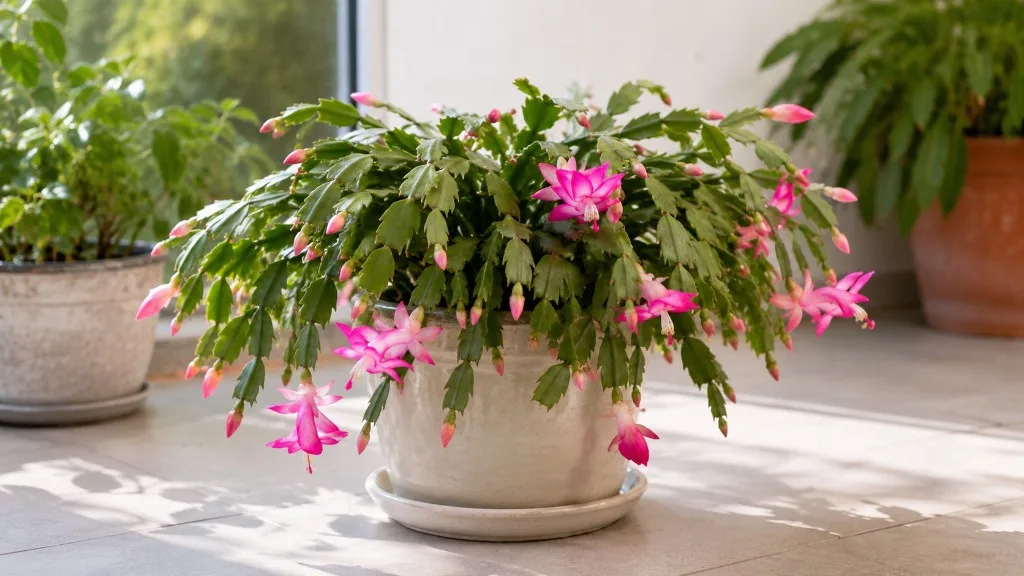
Christmas cactus (Schlumbergera × buckleyi) asks for two different light strategies across the year. From spring through summer, it wants bright indirect light strong enough to fuel compact new growth on its flattened stem segments. Then, starting in mid-fall, it needs something most houseplants never require: long, uninterrupted nights that signal bud initiation. Miss either phase and you get a plant that survives but looks pale, stretched, or stubbornly flowerless. This guide covers daily placement, the fall darkness routine that triggers blooms, and the single biggest category error - treating a Brazilian rainforest epiphyte like a sun-baked desert cactus.
Why Light Controls Both Health and Blooms on Holiday Cacti
Holiday cacti do not have true leaves. Photosynthesis happens in the green phylloclades - the jointed, flattened stem segments that look like leaves but are botanically stems. Because the entire photosynthetic surface sits exposed on a pendulous plant, light quality shows up fast. Segments formed in good light are plump, deeply colored, and spaced closely. Segments formed in weak light are thinner, paler, and spaced farther apart as the plant reaches for photons.
Light also governs how quickly the potting mix dries, which indirectly affects root health. A Christmas cactus in a bright east window uses water faster than the same plant in a dim corner, so light changes should always trigger a watering reassessment. The bloom side of the equation is separate but equally strict. Flower buds are not a reward for keeping the plant alive all year. They are a photoperiod response - a hormonal shift triggered when nights grow long enough and cool enough in autumn. Clemson HGIC and the Missouri Botanical Garden both emphasize that temperature regulation and day-length control together drive bud production. Light is not one variable on Christmas Cactus overview. It is the variable that connects daily vigor to holiday flowers.
Christmas Cactus vs Desert Cacti: Two Completely Different Light Profiles
The word “cactus” sends most people down the wrong path. Desert cacti such as saguaro, barrel cactus, and many Opuntia species evolved for full sun, extreme dryness, and mineral soils. They store water in thick stems, tolerate blazing afternoon exposure, and often need maximum light to maintain compact form. Christmas cactus evolved on tree branches in the shady rainforests of southeastern Brazil, where it grows as an epiphyte - anchored to bark, collecting moisture from humid air and filtered light that barely reaches the forest floor.
That origin explains nearly every light rule in this article. A desert cactus underpotted on a south-facing sill may thrive. A Christmas cactus in the same spot through a hot summer often turns pale, yellow-green, or scorched within weeks. Desert types want light intensity pushed upward; Schlumbergera wants bright but diffused light with protection from harsh midday sun during the growing season. Desert cacti bloom on their own schedule tied to rainfall and heat. Christmas cactus blooms when shortening days and lengthening nights arrive in fall - a cue that does not exist in a room where a ceiling fixture runs until midnight every night. If you have kept desert cacti successfully, reset your assumptions entirely. This plant is a short-day, rainforest epiphyte, not a sun collector from the American Southwest.
What Bright Indirect Light Means for Schlumbergera
Bright indirect light means the plant sits where it receives strong ambient illumination without the sun’s beam hitting the phylloclades directly for long stretches. Picture the light you would get a few feet back from an east-facing window on a clear morning, or behind a sheer curtain on a west window in late afternoon. The room looks well lit. Shadows are soft, not razor-sharp. You could read comfortably without turning on a lamp, but you would not feel heat radiating onto your skin from direct glass exposure.
For Christmas cactus, this level of light supports firm new segment growth through the active season from roughly April through September. Clemson HGIC describes the ideal growing-season temperature range as 70 to 80 °F (21 to 27 °C) paired with light shade - not deep shade, not full sun. The practical test is always the newest growth at the stem tips. If segments are thick, evenly green or appropriately reddish for your cultivar, and the internodes (joints between segments) stay short, your light level is working. If the plant looks healthy but has not bloomed in years, your daily light may be fine while your fall photoperiod is the missing piece - a distinction covered later in this guide.
How to Tell Whether Your Room Delivers Enough Usable Light
Human eyes adapt to dim rooms far better than plants do. A space that feels “bright enough” to you may deliver too few photons for compact Schlumbergera growth. Use the plant before you buy a light meter. Hold your hand between the window and the plant around midday. If the shadow is faint and indistinct, the spot is likely too dim for long-term health. If the shadow has a sharp edge and the segments feel warm to the touch after an hour, direct sun is hitting the plant and you should filter or move it back.
Watch the growth direction. Holiday cacti are not aggressive reachers like a leggy pothos, but they still lean toward the strongest light source. Rotate the pot a quarter turn every week or two during the growing season so growth stays balanced. If one side stays flat while the other arches toward the glass, the plant is telling you where the usable light lives. Finally, track segment color across seasons. Segments that were deep green in spring but bleach to yellow-green by midsummer almost always mean too much direct summer sun, not a nutrient problem.
Best Window Placements for Year-Round Growth
Window choice matters because it determines both intensity and duration of light exposure. Christmas cactus performs best when it spends most of the day in bright, filtered light and avoids the hottest direct beams of summer. Hanging baskets are common for this genus because the pendulous stems display well and sit slightly back from the glass, which reduces scorch risk compared to a pot pressed against a south pane.
Distance from the window is as important as direction. Light drops off quickly as you move into the room. A plant on a table six feet from a large window may receive a fraction of the light available on the sill. For daily health, keep the pot within one to three feet of the glass unless sheer curtains or a deep overhang already soften the exposure. During the fall bud-set period, placement takes on a second meaning: the plant must also be somewhere you can eliminate artificial light at night, which is harder in a kitchen or home office than in a spare bedroom with a closable door.
East, North, West, and South Exposures Compared
An east window is the easiest win for most homes. Morning sun is cool and brief. By the time intensity rises, the angle shifts away from the plant. East exposure delivers the bright-indirect sweet spot through spring and summer with minimal scorch risk. A north window works in many rooms, especially if the window is large and unobstructed by outdoor shade. Light is consistent and never harsh. Growth may be slightly slower than on an east sill, but segment color usually stays clean. Watch for stretch in very dark north rooms during winter; a supplemental grow light may be necessary.
West windows demand more care. Afternoon sun can be intense from late spring through early fall. A sheer curtain or a position set back from the glass keeps phylloclades from bleaching. West exposure can work well from late fall through winter, when the lower sun angle provides beneficial brightness without summer heat. South windows are the highest-maintenance option. Direct south sun through June, July, and August frequently causes pale, stressed foliage on holiday cacti. If south is your only bright option, filter the light heavily in summer or move the plant deeper into the room during the hottest months, then allow it closer to the glass in autumn when Clemson HGIC notes that full sunlight becomes beneficial during fall and winter.
Seasonal Light Shifts: Spring and Summer Active Growth
From late winter through early autumn, Christmas cactus is in its vegetative phase. New phylloclades form at the stem tips, roots expand, and the plant builds the energy reserves it will draw on for flowering. Light during this period should be steady and moderately bright - not the dim corner treatment people sometimes give “cacti” out of fear of sunburn, and not the blazing sill treatment borrowed from desert species.
If you summer the plant outdoors, choose dappled shade under a tree, on a covered porch, or on the east side of a building. Outdoor shade is often brighter than it appears because open sky still delivers diffuse photons from every angle. Bring the plant back indoors before nights drop below 50 °F (10 °C), which Clemson HGIC lists as the lower safe limit. Many growers in mild climates leave holiday cacti outside until late October specifically because natural shortening days outdoors begin the bud-initiation process before the plant ever moves inside. University of Georgia Cooperative Extension recommends keeping plants outdoors as long as possible in fall, then bringing them in just before freezing temperatures, noting that by late October in the Atlanta area short-day plants are already programmed to form flower buds.
Indoors during summer, maintain bright indirect light and watch for air-conditioning drafts that can stress segments even when light is adequate. Reduce fertilizer if growth slows in very dim rooms, but do not compensate for low light by overwatering on Christmas Cactus. The combination of weak light and wet soil is one of the fastest routes to root rot on Christmas Cactus on epiphytic cacti.
Fall Bud Initiation: The Short-Day, Long-Night Requirement
Starting around mid-September, Christmas cactus transitions from vegetative growth to flower bud initiation. This shift is not optional and it is not triggered by fertilizer, Christmas Cactus repotting guide, or wishful thinking. It is a response to photoperiod - the relative length of day and night. Schlumbergera is classified as a short-day plant, meaning it forms flower buds when nights exceed a critical length. In practical home terms, the plant needs roughly 8 to 10 hours of light and 14 or more hours of continuous darkness each day for about six consecutive weeks to set buds completely.
Buds typically become visible within three to four weeks after the long-night routine begins. Once buds are established, photoperiod no longer influences flowering; the developmental path is set. Clemson HGIC is explicit on a detail many guides bury: as little as two hours of interrupted light during the dark period can inhibit bud set. A streetlight through the blinds, a car headlight sweep, or a household lamp flipped on for a late-night kitchen trip can reset the clock. This is the number-one reason mature, healthy Christmas cacti fail to bloom in otherwise well-run homes.
Photoperiodism and Why Darkness Length Matters More Than Brightness
Photoperiodism is the plant’s ability to measure night length using a pigment called phytochrome. Schlumbergera does not care whether your living room is stylish. It cares whether darkness lasts long enough without breaks. Short-day plants actually measure uninterrupted night duration, not day length - a nuance that explains why “put it in a closet” works when “put it in a dark corner” does not. A dark corner still catches light spill from a hallway. A closet with a cracked door still fails if light leaks through the gap.
Thanksgiving cactus (Schlumbergera truncata) follows the same photoperiod rules but typically blooms about a month earlier than true Christmas cactus under natural conditions, which is why garden centers often sell Thanksgiving cactus labeled as Christmas cactus. Light requirements are identical; bloom timing differs. If your plant bloomed in November one year and December the next, check which species you have before assuming your light routine failed.
Building a 14-Hour Dark Period Indoors
You have three workable approaches, and you can combine them. Option one: natural window light only. Place the plant in a room you do not use at night. Leave overhead and lamp fixtures off from roughly 6 p.m. to 8 a.m. This mimics what Missouri Botanical Garden recommends - total darkness from about 6 p.m. to 7 a.m. daily for six to eight weeks. Block streetlight leaks with blackout curtains or cardboard panels. Option two: cover the plant. Drape a thick black cloth or place the pot inside an opaque box each evening. Remove the cover every morning so daytime bright light reaches the phylloclades. This works well when the plant lives in a lit room during the day but must sleep in darkness. Option three: spare-room isolation. Move the plant to a guest room with no night lighting for the six-week period. Keep daytime light bright through the same window during waking hours.
Start the routine around September 15 and maintain it without gaps for at least six weeks. Mark it on a calendar. Missing even a few nights resets progress. When tiny buds appear at the tips of mature segments, you can gradually relax the strict darkness, though keeping night lighting minimal still reduces bud-drop risk.
Pairing Light With Cool Fall Temperatures for Reliable Bud Set
Light initiates buds, but temperature modulates how reliably they develop. During the fall bud-set window, Clemson HGIC recommends keeping fall growing temperatures between 60 and 68 °F (16 and 20 °C), as close to 68 °F as possible for maximum flower production. Night temperatures between 50 and 59 °F (10 to 15 °C) can trigger bud set regardless of day length, though growth slows and bud drop may occur at the lower end of that range.
The Missouri Botanical Garden adds a useful home-realistic note: if you can keep night temperatures at 45 to 55 °F (7 to 13 °C) - difficult in a heated house but achievable in a cool sunroom or enclosed porch - buds often form in autumn without the strict 13-hour darkness regimen. That cool-night shortcut explains why plants left on a protected porch through October frequently bloom even when the owner never heard the phrase “short-day plant.” Once buds are visible, avoid temperatures above 90 °F (32 °C), which Clemson HGIC warns can cause bud drop. Light and temperature stability matter together after initiation: a plant moved from a cool, dark routine into a hot, bright kitchen will often shed buds even though light levels themselves seem adequate.
Can Christmas Cactus Take Direct Sun?
Direct sun is situational, not forbidden. During fall and winter, when the sun angle is low and days are short, many holiday cacti benefit from brighter exposure, including some direct rays through east or south glass. Segments often color up and the plant photosynthesizes efficiently in cool, bright conditions. During late spring and summer, direct sun - especially afternoon sun - commonly causes bleached, yellow, or reddish-stressed phylloclades. If your plant looked perfect in November on a south sill and washed out by July, seasonal sun intensity is the likely cause, not a mysterious disease.
Acclimation matters whenever you increase exposure. Segments that formed in low light cannot handle sudden full sun. Move the plant closer to the window over one to two weeks, watching for color change each day. If you see crisp, sun-facing patches or segments curling inward during midday, pull the plant back or add a sheer curtain. Desert cactus collectors often push light to the maximum. Schlumbergera rewards a lighter touch. Think forest-edge brightness, not desert-at-noon intensity.
Low-Light Limits and Long-Term Consequences
Christmas cactus tolerates lower light than many flowering houseplants for short periods, but it is not a low-light plant in the long run. Extended dim conditions produce thin segments, wide spacing between joints, reduced branching, and weak bud formation even when a fall darkness routine is attempted. A plant starving for photons during summer enters autumn with insufficient stored energy; buds may initiate under long nights but abort before opening.
In low light, water use drops. Adjust watering so the mix dries more slowly and never stays soggy. If you cannot provide a bright window, a full-spectrum grow light on a timer is a better fix than accepting perpetual dim conditions. Low light also increases the gap between survival and performance. The plant may look “fine” for years - green enough, no obvious pests - while never producing the compact architecture and bloom count you expected. Treat persistent stretch and pale new growth as a light problem first, not a fertilizer deficiency.
Using Grow Lights When Natural Light Is Weak
A full-spectrum LED grow light can supplement or replace window light, especially in north-facing apartments, office settings, or rooms with deep overhangs. Position the fixture 12 to 18 inches (30 to 45 cm) above the plant and aim for roughly 10 to 12 hours of illumination daily during the growing season. Match the timer to the season: longer days in summer, slightly shorter in winter unless you are deliberately running the fall bud-initiation darkness routine.
During the six-week bud-set period, the grow light must turn off early enough that total darkness still reaches 14 hours. If your timer delivers 10 hours of artificial day, the plant needs 14 hours with zero light afterward - no glow from the fixture’s indicator LED, no nearby lamp spill. After buds form, you can return to a normal bright-indirect or supplemented schedule. Watch leaf temperature. Grow lights that sit too close can heat phylloclades and mimic sun scorch even without visible burn marks. If segments feel warm, raise the fixture.
Reading Light Stress on Phylloclades and Buds
Holiday cacti communicate light problems clearly if you know what to look for. Too much light shows as bleached or yellow-green segments, reddish sun-stress coloring on exposed faces, crisp patches on segments that face the window, and tip dieback after a sudden move to a brighter sill. Too little light shows as thin, elongated segments, unusually long spaces between joints, pale overall color, weak side branching, and leaning toward the nearest window. Fall photoperiod failure shows as lush vegetative growth through October and November with zero bud formation despite an otherwise healthy plant - the classic sign that nights are not long or dark enough.
After buds form, sudden light changes cause a different symptom set: buds yellow and drop before opening, especially when combined with dry soil or hot drafts. Penn State Extension notes that holiday cactus flowers last longer in cooler temperatures and that stable conditions after bud set protect the display. Read the newest segments first. Old sunburn marks never heal, but new growth tells you whether today’s placement is correct.
Protecting Buds After Initiation: Why Light Stability Matters
Once buds appear, your job shifts from initiation to protection. Photoperiod no longer controls whether buds exist, but light stability strongly influences whether they mature. Moving a budded plant from its fall routine into a brighter display location, rotating it aggressively, or placing it near supplemental heat often triggers bud abscission - the plant drops flowers rather than open them under stress.
Keep the plant in a consistent bright-indirect spot with stable temperatures between roughly 60 and 70 °F (16 and 21 °C) if possible. Water evenly once buds are set; Clemson HGIC warns that the mix must stay evenly moist during bud development to prevent bud drop, a shift from the slightly drier approach tolerated during early fall. Avoid repotting, heavy pruning, or fertilizer changes while buds swell. If you want the plant in a prominent holiday display, move it before bud initiation begins, then leave it alone until flowers finish. Light changes after buds form should be minor - a few inches of repositioning, not a room change.
Common Light Mistakes That Prevent Holiday Blooms
The same errors appear year after year in extension office questions and houseplant forums. Leaving room lights on during the dark period is the most common bloom blocker. Even brief interruption can matter. Treat the six-week window like a sleep schedule for a sensitive sleeper. Placing the plant in a lit hallway or kitchen where refrigerator and under-cabinet lights cycle on overnight defeats darkness no matter how good the daytime window is. Assuming a “dark corner” equals long nights fails because corners in occupied rooms rarely stay dark for 14 continuous hours.
Other frequent mistakes include applying desert-cactus light logic and parking the plant in full south sun all summer, which weakens segments before fall even begins. Starting the dark routine too late - after October - may still produce buds in some climates but compresses the timeline and increases bud-drop risk as indoor heating rises. Ignoring streetlights and car headlights through thin curtains is an invisible reset button on photoperiod progress. Moving the plant repeatedly after buds form to “show it off” in different rooms breaks the stability buds need. Confusing Thanksgiving and Christmas cactus leads to misaligned expectations about bloom month, not light needs, but the frustration often sends owners to change light conditions that were already correct.
Moving and Acclimating Without Dropping Flowers
Light acclimation should happen during the growing season, not during bud development. If you need to relocate the plant, do it in spring or early summer when you can shift exposure gradually over 10 to 14 days. Move it closer to or farther from the window by a few inches every couple of days while watching new segment color. Sudden jumps from a dim shelf to a south sill - or vice versa - cause segment drop, tip scorch, or stalled growth independent of season.
When transitioning the plant outdoors for summer, start in full shade for a week, then move to bright dappled shade. Reverse the process in fall: bring indoors before cold nights, place in the brightest indirect spot available, and begin the long-night routine within days if buds have not already started outdoors. If you must move a budded plant in an emergency, match the new spot’s brightness and temperature as closely as possible to the old one and expect some bud loss. Cover the plant during transport if the trip crosses lit rooms at night. Acclimation is about respecting how slowly phylloclades adjust their photosynthetic machinery. Rush the process and the plant responds by dropping tissue rather than adapting.
Conclusion
Christmas cactus light care splits cleanly into two jobs. During spring and summer, give the plant bright indirect light from an east window, filtered west or south exposure, or a timed grow light - the same quality of light you would expect for a rainforest epiphyte, not a desert sun lover. Starting around mid-September, add the bloom trigger: 14 or more hours of uninterrupted darkness each night for six weeks, paired with cool fall temperatures near 60 to 68 °F, and protect buds from light shocks once they form. Judge daily placement by new segment growth; judge bloom success by whether nights stay truly dark. Get both phases right and a healthy Schlumbergera rewards you with segmented architecture worth displaying even when it is not in flower - and with holiday blooms that finally match the care you have been giving all year.
When to use this page vs other Christmas Cactus guides
- Christmas Cactus overview - Start here for whole-plant context before deep-diving this topic.
- Christmas Cactus problems hub - Jump to symptom-specific fix guides when this care topic does not resolve the issue.
- Not Enough Light on Christmas Cactus - Escalate here when light adjustments are not enough.
- Leggy Growth on Christmas Cactus - Escalate here when light adjustments are not enough.
- Sunburn / Scorched Leaves on Christmas Cactus - Escalate here when light adjustments are not enough.
Related Christmas Cactus guides
- Christmas Cactus overview
- Christmas Cactus watering
- Christmas Cactus soil
- Christmas Cactus propagation
- Christmas Cactus fertilizer
- Christmas Cactus repotting
- Not Enough Light on Christmas Cactus
- Leggy Growth on Christmas Cactus
- Sunburn / Scorched Leaves on Christmas Cactus
- Christmas Cactus problems
Related tool
Try the Plant Problem Diagnosis Tool with christmas-cactus pre-selected to estimate needs for your setup.