Slow Growth on Calathea Roseopicta: Causes, Checks & Fixes
Quick answer
Calathea roseopicta is a naturally slow-to-moderate grower indoors - often one to three new leaves per growing season in good conditions. Worry when no new leaf rolls appear through spring and summer, buds stall half-unfurled, or new foliage stays small and pale. First step: measure humidity at canopy height; below 50% RH is the most common fixable stall trigger for this Marantaceae species.
Slow Growth on Calathea Roseopicta: Causes, Checks & Fixes
This guide covers slow growth on Calathea Roseopicta. See also the general Slow Growth guide, watering, and light pages for this plant.
Slow Growth on Calathea Roseopicta: Causes, Checks & Fixes
Quick answer
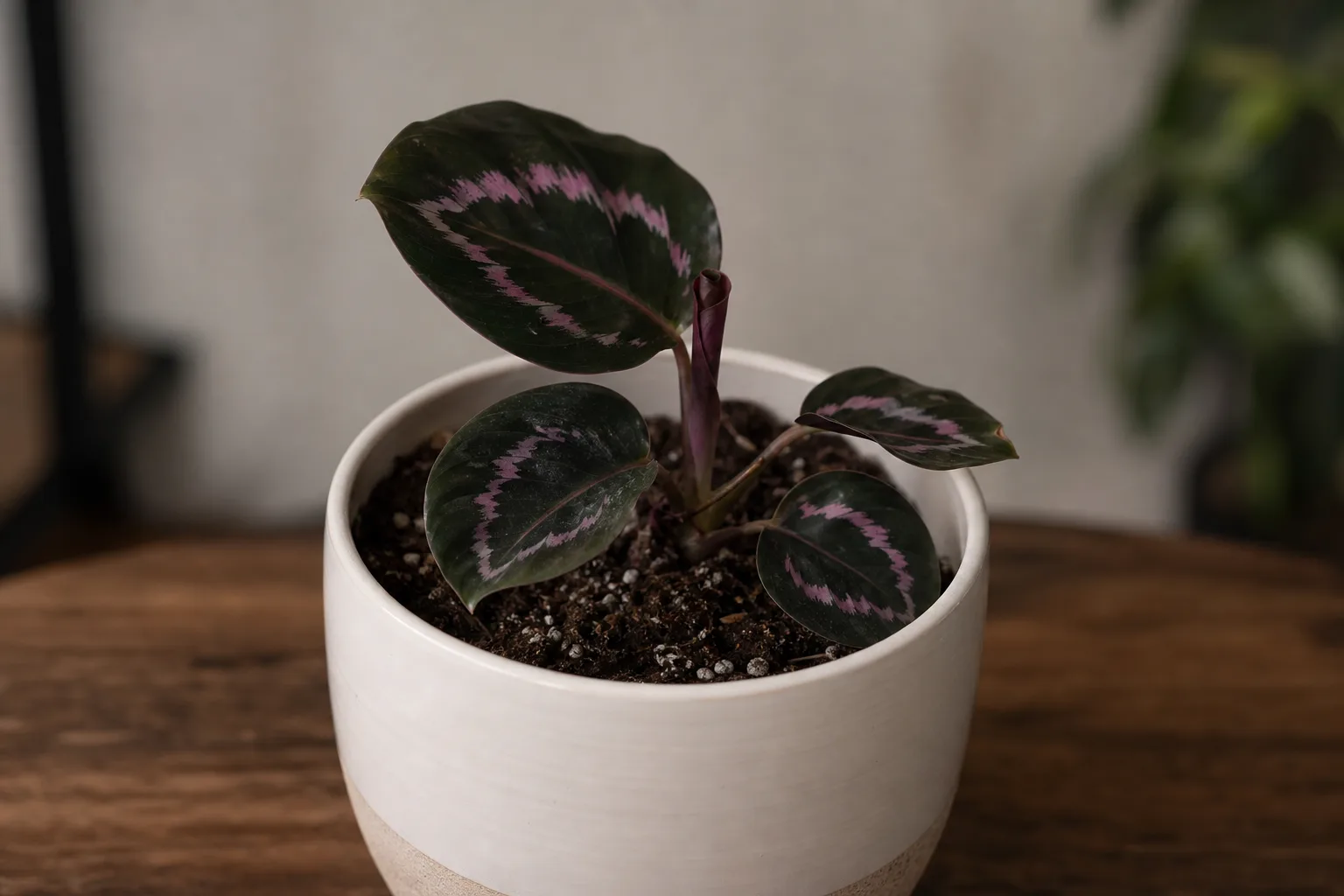
Slow growth on Calathea roseopicta (Goeppertia roseopicta) is often normal, not a crisis. This compact rhizomatous prayer plant is a slow to moderate grower indoors - many healthy specimens produce only one to three new painted leaves per growing season even when humidity, light, and watering are correct.
Concern starts when no new leaf rolls emerge from spring through late summer, visible buds stall half-unfurled for weeks, or every new leaf arrives smaller, paler, and less patterned than mature foliage. Those patterns usually trace to low humidity below 60%, insufficient bright indirect light, root stress from wet soil, recent repot shock, or tap-water mineral burn - not a missing fertilizer dose.
First step: place a hygrometer at canopy height and read relative humidity at midday. If RH is below 50%, run a humidifier within 3 to 5 feet (1 to 1.5 m) until readings hold at 60% or higher before repotting, fertilizing, or moving the plant to direct sun.
Is slow growth normal for Calathea roseopicta?
Typical indoor growth pace
Rose-painted calathea grows from an underground rhizome, not a single upright trunk. New shoots emerge as rolled leaf buds at the center of the clump, then unfurl into broad elliptical leaves. Missouri Botanical Garden describes mature container specimens as typically 12 to 16 inches (30 to 40 cm) tall - a compact mound, not a fast-spreading vine.
In a stable home with bright filtered light and 60%+ humidity, expect:
- One to three fully opened leaves during the warm growing season (roughly spring through early autumn)
- Weeks between visible bud and full unfurl - patience is part of normal roseopicta culture
- Evening nyctinasty - leaves folding upward at dusk and reopening by morning - continuing on existing leaves during slow periods
If your plant adds a clean new painted leaf every few months while older leaves stay firm and patterned, you may already be succeeding despite social-media comparisons to faster pothos or philodendrons.
Cultivars share the same slow rhizome pace
Whether your tag says Dottie, Medallion, Rosy, Cynthia, or Surprise Star, every rose-painted cultivar is the same species - Goeppertia roseopicta - with different pigment patterns, not different growth engines. NC State Extension lists these cultivars under one species profile; all share the same clump-forming rhizome and the same slow-to-moderate indoor pace. A Medallion with wide silver bands and a Dottie with dark green and pink feathering will both stall in dry winter air for the same physiological reasons. Judge pace against your plant’s recent history, not against a faster cultivar on another shelf.
Winter slowdown
Growth nearly pauses in cooler, dimmer months when room light drops and the pot dries more slowly. NC State Extension notes that fertilizing and heavy watering should scale back when plant growth typically slows in winter. Firm existing foliage with no new rolls from late autumn through February is seasonal dormancy, not necessarily a care failure.
Resume expecting new center growth when daylight lengthens and temperatures stabilize above about 65°F (18°C). If spring arrives and no bud appears by early summer, treat that as a fixable stall and work through the checklist below.
What slow growth looks like on Calathea Roseopicta
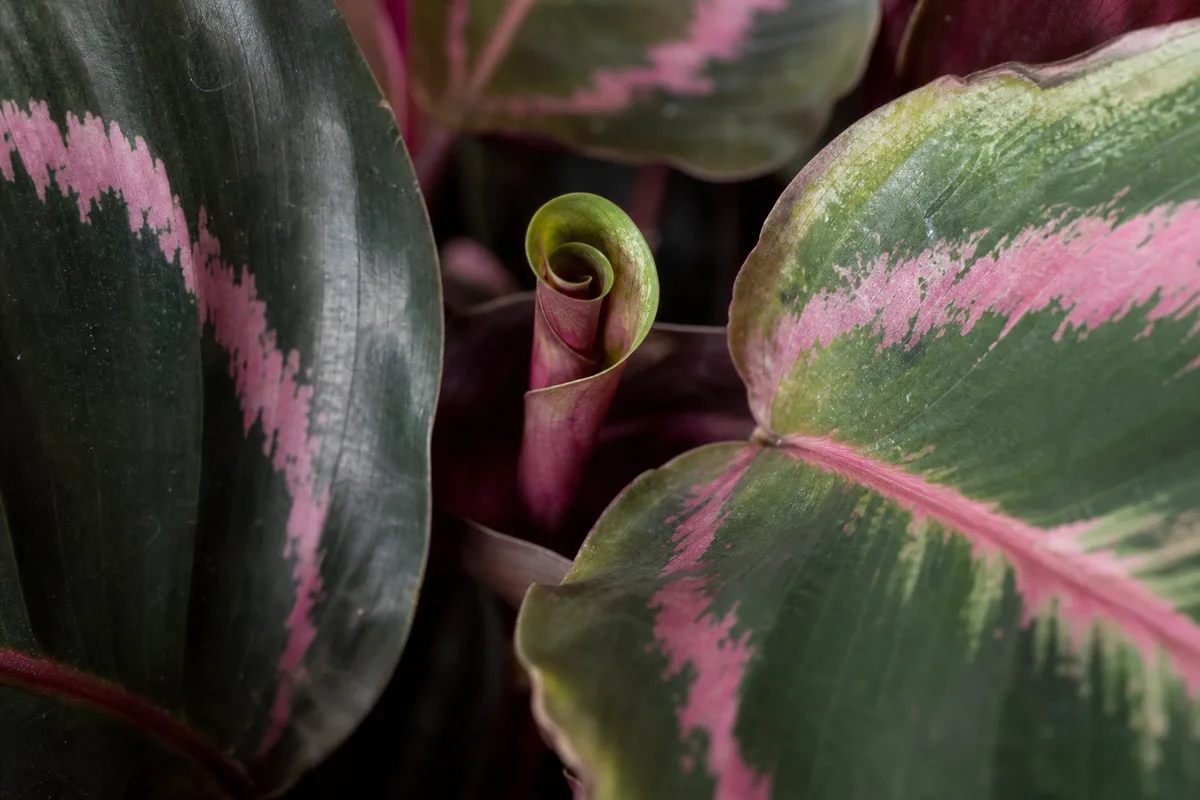
Stalled half-unfurled center leaf on rose-painted calathea - typical slow-growth stall pattern.
Normal slow growth:
- Existing leaves stay glossy with sharp pink, cream, or silver painted bands
- A single new roll visible at the crown for weeks before gradual unfurl
- Plant height increases slowly across a full year
- Healthy nyctinasty - evening prayer fold with leaves reopening flat by morning, a sign that turgor and roots are stable even when new shoots are scarce
Problematic stall (needs intervention):
- No center bud through an entire warm season
- Half-unfurled leaf stuck at the crown with brown, crispy edges on the roll
- New leaves dramatically smaller and paler than the previous year’s foliage
- Faded painted patterns on recent leaves while older leaves still look vivid - often light stress
- Multiple aborted buds in a row after repotting or division
- Lower leaf yellowing paired with wet soil - growth stall may follow root oxygen loss
- Loss of nyctinasty - leaves that no longer fold at night while daytime posture looks limp often point to root or humidity stress, not normal seasonal pause
Slow growth on roseopicta is not the same as leggy growth - leggy plants stretch toward windows with long gaps between leaves. A true stall keeps short petioles and compact form while simply failing to produce new tissue.
Why Calathea roseopicta stops producing new leaves
Low humidity delaying unfurl
Roseopicta evolved in tropical rainforest understory where humidity stays high year-round. Below about 50% relative humidity, new leaf rolls open slowly or abort, and painted margins brown before the leaf expands. This is the most common fixable stall in heated winter homes. Full symptom guide: low humidity.
Insufficient bright indirect light
RHS prayer-plant guidance lists poor, weak growth from low light levels - especially with Goeppertia species. In dim corners, roseopicta survives but produces small, pale new leaves with weak painted contrast. Low light also slows soil drying, which increases overwatering risk if you keep a summer watering rhythm all year. See not enough light and the light guide.
Overwatering and root stress
Chronic wet soil suffocates fine roots. The plant may look green while energy diverts to root repair instead of new shoots. Overwatering can cause root rot on calatheas; growth stalls before collapse in some cases. Yellow lower leaves on heavy wet pots warrant inspection - overwatering and root rot.
Underwatering and dry air combined
Repeated dry-downs damage root hairs. New buds may form but fail to expand because the plant cannot sustain turgor through unfurl. Check underwatering if the pot is light and mix is dusty below the surface.
Root-bound rhizome
Rhizomes circling a pot for years limit new shoot production even when top growth looks stable. Roseopicta prefers slightly root-snug conditions but not a solid root brick. Inspect if the pot dries in hours and no new shoots appear for two seasons.
Recent repotting or division shock
Rhizome division is the standard propagation method, but each division pauses growth for four to eight weeks while roots re-establish. A freshly repotted roseopicta with no new leaves for one month is often normal transplant shock - not an immediate second repot candidate.
Tap-water sensitivity
Fluoride in tap water browns margins and can stress new growth on calatheas. Chronic mineral burn diverts energy to leaf repair. Pair filtered or rain water with humidity correction if brown tips accompany stalled buds.
Pests on new growth
Spider mites, mealybugs, and aphids target soft new rolls in dry conditions. A bud that opens with stippling or webbing needs pest treatment before fertilizer or repotting - see spider mites and related pest pages.
How to confirm the cause - checklist
Work through these steps in order. Draw one conclusion before stacking fixes:
- Season check - Is it late autumn or winter with firm existing leaves? If yes, wait for spring before diagnosing stall.
- Humidity at canopy - Hygrometer reading below 50% strongly implicates dry air; target 60% or higher.
- Light quality - Is the plant in bright filtered indirect light (east window or filtered south-west), not a far corner? Faded new leaves suggest light deficit.
- Soil moisture rhythm - Compare to your watering baseline: top 1 to 2 inches should begin to dry between drinks; constant wetness or bone-dry cycles both stall growth.
- Pot weight and root peek - Heavy wet pot with yellow lower leaves → wet-side stress. Light pot with dry core → drought. Circling white rhizomes against pot walls → root-bound.
- Recent repot timeline - Repot or division within the last two months? Pause expectations; stabilize humidity and light instead of repotting again.
- Water source - Municipal tap with browning margins? Switch to filtered or rain water for one month before judging unfurl speed.
- Pest scan - Webbing, dots, or cottony clusters on new rolls? Treat pests before other changes.
- Leggy vs. stall fork - Long reaching stems with wide internodes = leggy growth (light problem). Compact plant with no new crown bud = this slow-growth guide.
First fix for Calathea Roseopicta
If humidity reads below 50% at the plant: run a humidifier within 3 to 5 feet until relative humidity holds at 60% or higher for at least a week.
This single step addresses the most common roseopicta-specific stall - dry air blocking unfurl - without the risk of repot shock or fertilizer burn. Misting alone will not sustain 60% RH; a humidifier or grouped plant microclimate is the reliable fix per NC State guidance.
If humidity is already 60%+ but new leaves stay small and pale: move the pot toward brighter filtered indirect light - an east window or back from filtered south-west glass - before fertilizing. See the light guide for placement detail.
If soil stays wet for weeks while growth stopped: stop watering until the top inch dries, then reassess roots if yellowing spreads - do not repot wet mushy roots without inspection.
Change one variable at a time - humidity, then light, then watering rhythm - so you can read the plant’s response over the next two to four weeks without masking which fix worked.
Recovery timeline
The week ranges below are typical indoor observation estimates, not laboratory benchmarks. Your room temperature, pot size, and cultivar leaf width will shift timing.
Humidity correction: New rolls often show cleaner unfurling within two to four weeks once RH stays at 60%+. Existing damaged margins on half-open leaves will not revert - judge success by the next bud opening with intact painted bands.
Light improvement: The next one to two new leaves after a brighter filtered position should show stronger color contrast. Older pale leaves keep their weak pattern.
Post-repot pause: Expect four to eight weeks before the first new shoot after spring division or repotting. If nothing emerges by week ten in warm bright conditions, inspect roots.
Root-bound repot: After a one-size spring repot into airy mix, new shoots may appear within three to six weeks if humidity and light were already adequate.
Winter pause: No timeline applies - wait for lengthening days. Do not fertilize through the pause.
Judge recovery by new center growth and returning evening nyctinasty, not by old leaf size or color.
Example recovery arc (editorial observation): A Dottie cultivar stalled through a dry heating season with a half-unfurled crown bud at roughly 38% RH beside a south-facing radiator. After moving the humidifier to within 4 feet and holding 65% RH at canopy height for ten days - without repotting or feeding - the stuck roll opened with intact pink feathering in about three weeks. Older crispy edges on that same leaf were trimmed; the next center bud confirmed the fix.
Slow growth vs. leggy growth - comparison
| Pattern | Slow growth (this page) | Leggy growth |
|---|---|---|
| Stem length between leaves | Short, compact petioles | Long gaps, plant reaches toward window |
| New leaf size | Small or stalled at crown | Small leaves at end of long stems |
| Plant shape | Tight clump, little height gain | Sparse, stretched profile |
| Primary cause | Humidity, roots, season, water quality | Insufficient light |
| First fix | Raise RH to 60%+ or fix roots | Move to brighter filtered light |
| Deep dive | You are here | Leggy growth guide |
| Pattern | Winter dormancy | Root rot stall |
|---|---|---|
| Season | Cool months, short days | Can occur any season |
| Soil | Moderate moisture, no foul smell | Often wet, heavy pot |
| Leaf color | Existing leaves stay firm green | Lower yellowing, limp texture |
| New growth | Pauses evenly | Buds abort or absent |
| Action | Wait; reduce water and feed | Inspect roots; see root rot |
What not to do
Do not repot repeatedly hoping to “wake up” a slow plant - each repot resets the rhizome clock. Do not fertilize a stressed roseopicta before humidity and light are stable; salts burn fine roots and margins. Do not move a stalled plant into direct sun - painted bands scorch while growth does not accelerate. Do not water more when the real issue is dry air at 35% RH. Do not expect pothos growth rates from a Marantaceae understory species. Do not stack repotting, pruning, and pesticide on the same day.
How to prevent slow growth next time
Anchor habits to the Calathea Roseopicta overview baseline:
- Humidity 60 to 80% at canopy through heating and AC seasons - low humidity guide
- Bright filtered indirect light - east or filtered south-west; avoid dim corners - light guide
- Water when top 1 to 2 inches begin to dry with filtered or rain water - watering guide
- Monthly dilute feed spring through summer only on healthy actively growing plants - fertilizer guide
- Wipe dust from broad leaves monthly so photosynthesis is not throttled - NC State notes dust slows photosynthesis
- Repot in spring only when rhizomes circle the pot - repotting guide - not on a calendar whim
- Track new leaf count per season so normal slow pace never feels like failure
Related Calathea Roseopicta problems
- Leggy growth - stretched stems toward light; different first fix
- Low humidity - stalled unfurl and crisp painted margins
- Not enough light - pale small new leaves
- Overwatering - wet soil growth stall
- Root rot - mushy roots behind chronic pause
- Brown tips - tap water and humidity overlap
- Calathea Roseopicta overview - full species care baseline
When to use this page vs other Calathea Roseopicta guides
- Calathea Roseopicta watering guide - Use for routine moisture checks before assuming slow growth is the main issue.
- Calathea Roseopicta problems hub - Browse all 16 common issues on this species.
- Not Enough Light on Calathea Roseopicta - Different entry point when symptoms overlap with slow growth.
- Leggy Growth on Calathea Roseopicta - Different entry point when symptoms overlap with slow growth.
- Yellow Leaves on Calathea Roseopicta - Different entry point when symptoms overlap with slow growth.