Low Humidity on Calathea Roseopicta: Causes, Checks & Fixes
Quick answer
Low humidity on Calathea Roseopicta shows as crisp brown edges on the painted bands, tight daytime leaf curl with otherwise moist soil, and dull leaf surfaces - often in winter when room RH drops below 50%. First step: measure humidity at the plant with a hygrometer, then run a small humidifier nearby until readings stay at 60% or higher.
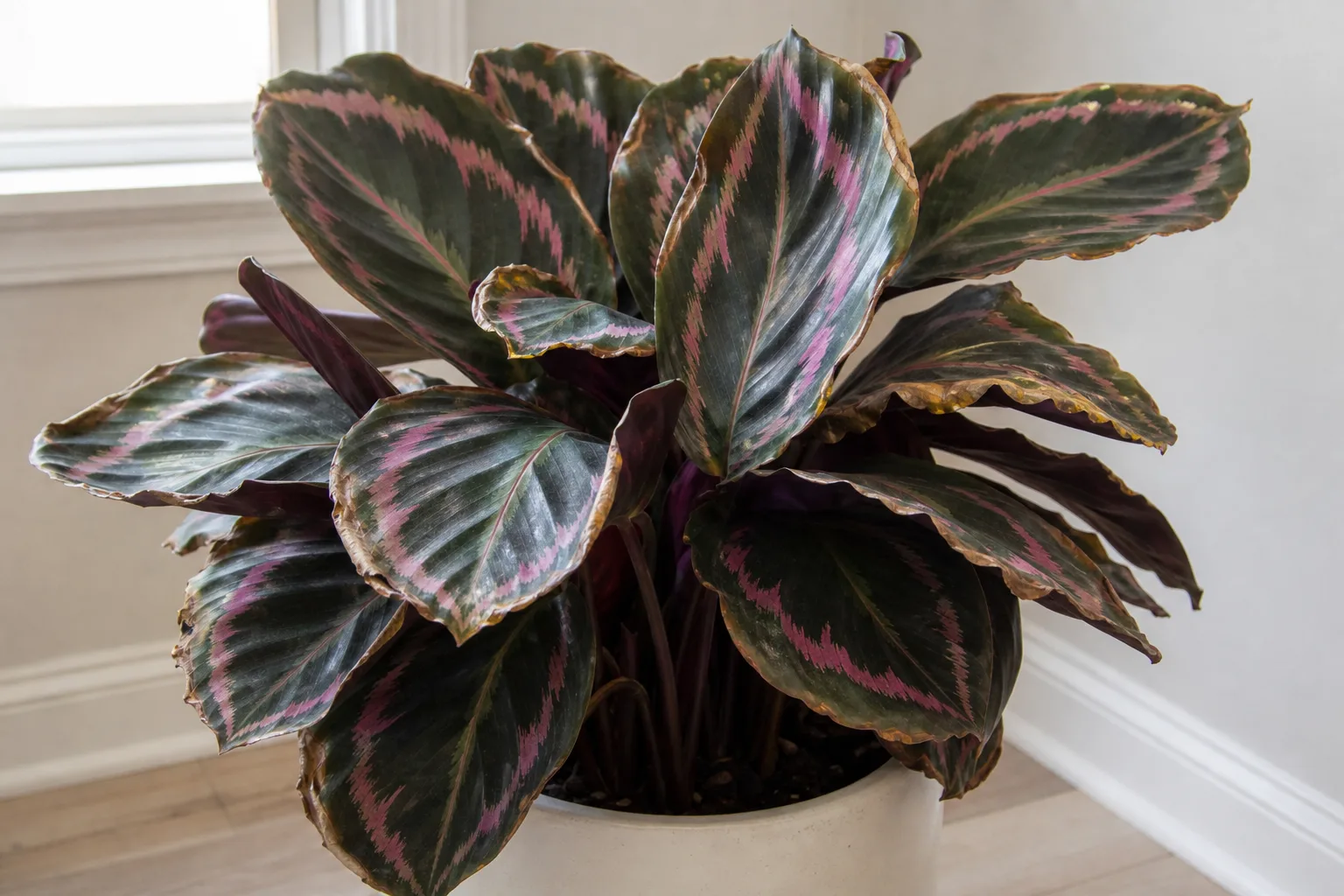
Low Humidity on Calathea Roseopicta: Causes, Checks & Fixes
This guide covers low humidity on Calathea Roseopicta. See also the general Low Humidity guide, watering, and light pages for this plant.
Low Humidity on Calathea Roseopicta: Causes, Checks & Fixes
Quick answer
Low humidity on Calathea Roseopicta means the air around the plant is drier than this rainforest understory species evolved for. The painted leaf margins turn crisp, leaves curl tightly during daylight hours, and the glossy surface looks dull - often starting in late autumn when heating drops indoor relative humidity into the 30–40% range.
First step: place a hygrometer at canopy height beside the pot and read the number at midday. If relative humidity is below 50%, dry air is a primary suspect. Run a small humidifier within 3 to 5 feet (1 to 1.5 m) of the plant until readings hold at 60% or higher - the threshold NC State Extension gives for rose-painted calathea. Do not compensate by watering more; moist soil with dry air still produces curl on this plant.
What low humidity looks like on Calathea Roseopicta
Roseopicta is a pattern-first plant: even a thin brown line along a pink or cream band ruins the whole leaf display. Dry air damage shows up on the broad, elliptical foliage before the plant collapses. Watch for:
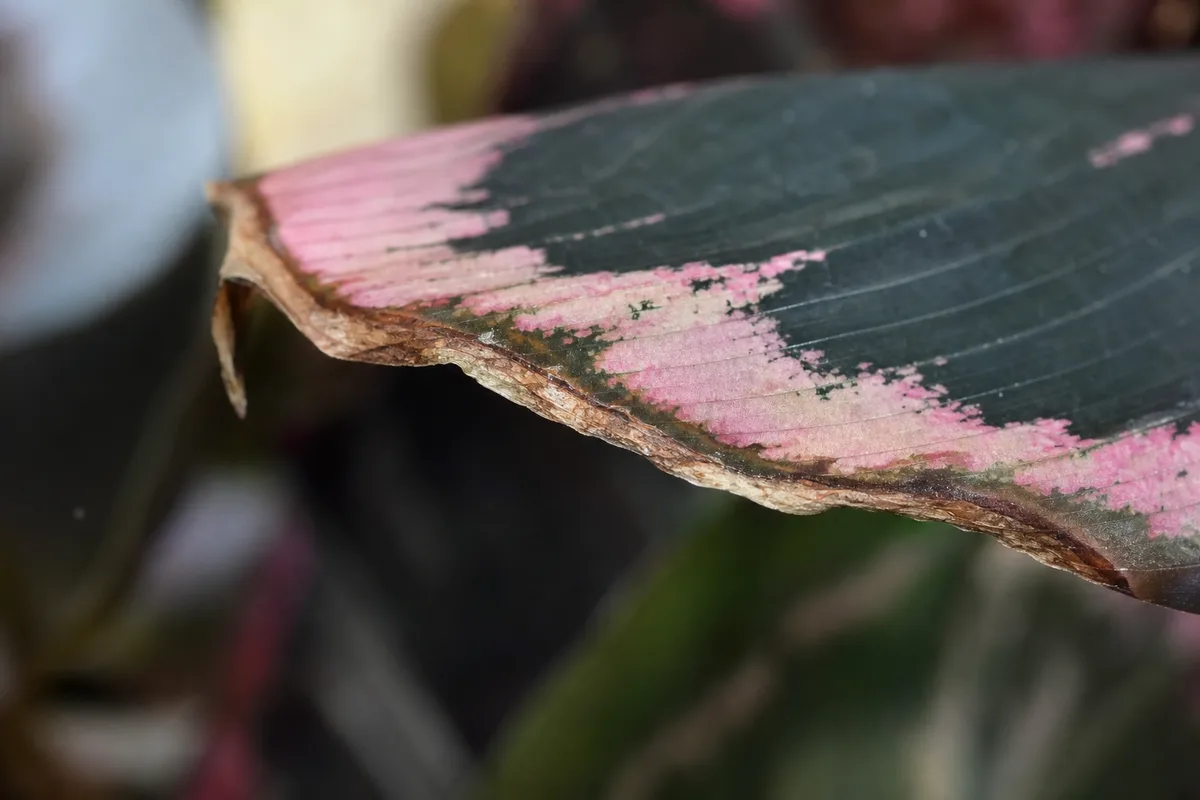
Low Humidity symptoms on Calathea Roseopicta - compare with healthy tissue on the same plant.
- Crisp brown edges or tips on the painted midrib bands and feathered margins - often the first sign when RH falls below about 50%
- Tight inward curl during the day that does not match normal evening prayer movement (nyctinasty)
- Dull, matte leaf surfaces instead of the usual glossy depth on new and mature leaves
- New leaf rolls that stick closed or open with brown, damaged edges
- Increased spider mite pressure - low indoor humidity favors mites on calatheas while the plant is already stressed
Normal vs. stress curl: Roseopicta folds leaves upward in the evening through nyctinasty - a healthy pulvinus response to light change. If leaves stay curled or rolled during daylight while the soil feels evenly moist, low humidity or underwatering is more likely than normal prayer movement.
Because roseopicta is more sensitive to edge damage than rattlesnake calathea, a few crisp margins on a painted leaf look worse than the same damage on a lance-shaped rattlesnake leaf. Treat early margin browning as a humidity warning, not cosmetic damage you can ignore.
Why Calathea Roseopicta is humidity-sensitive
Calathea roseopicta - botanically Goeppertia roseopicta - grows in the tropical rainforests of western South America and Brazil as an understory plant in warm, closed-canopy conditions. That origin means large, thin leaves lose water to transpiration whenever ambient humidity falls. Unlike succulents, roseopicta cannot close its stomata long enough to survive dry indoor air without showing leaf damage.
NC State Extension lists humidity above 60% as a core requirement and notes that curling leaves result from low humidity or inadequate watering. The painted surface area on each leaf increases water loss compared with smaller-leaved houseplants, so roseopicta reacts faster when a room dries out.
Commercial calathea production data from UF/IFAS shows that Calathea roseopicta cultivars maintain better interior appearance when relative humidity stays in a 40–60% band at minimum - and roseopicta at home looks best toward the upper end of that range or higher, especially when winter heat pulls room RH lower.
Common dry-air triggers in homes
Low humidity on roseopicta is rarely mysterious once you map the environment:
- Winter heating - Forced air, radiators, and fireplaces can drop whole-room RH to 20–35% while the thermostat still reads a comfortable 68–72°F (20–22°C)
- Air conditioning in summer - Cool, dry AC airflow dehydrates leaves even when soil moisture is correct
- Heating and AC vents - Direct airflow on the canopy accelerates edge crisping; keep calatheas away from draughts and radiators
- Hot, sunny windowsills - Bright glass raises leaf temperature and water loss without raising room humidity
- Newly purchased plants - Nursery greenhouse humidity often exceeds 60%; the shock of a dry living room shows within the first two weeks
- Cachepots and tight shelves - Stagnant air pockets around a pot dry faster than open room air; grouping helps, but a humidifier still matters in sub-40% rooms
Seasonal pattern matters: if symptoms appear every October through March and ease in summer, winter dry air is the likely driver - not a sudden watering mistake.
Lookalike symptoms to rule out
| What you see | Soil moisture | Typical RH | Likely cause | First check |
|---|---|---|---|---|
| Crisp painted margins, daytime curl | Moist, heavy pot | Below 50% | Low humidity | Hygrometer + humidifier |
| Limp curl, very light pot | Dry 2+ inches down | Any | Underwatering | Soak root ball; see underwatering guide |
| Brown tips with moist soil | Moist | 50%+ possible | Tap water fluoride | Switch to filtered water; see brown tips guide |
| Yellow lower leaves, wet soil | Wet, sour smell | Any | Overwatering / root rot | Stop watering; inspect roots |
| Bleached patches on sun side | Moist | Any | Too much direct light | Move to filtered indirect light |
| Evening fold only, firm leaves | Moist | 60%+ | Normal nyctinasty | No fix needed |
| Fine webbing, stippled leaves | Moist or dry | Low | Spider mites | Shower leaves; raise humidity |
If multiple columns match - for example dry winter air and hard tap water - fix humidity first, then address water quality. Both cause brown margins on roseopicta, but adding water to fix dry air curl worsens rot risk.
How to confirm low humidity
Work through this checklist before buying equipment or moving the plant:
- Hygrometer at canopy height - Place the sensor beside the leaves, not across the room. Read at midday and again in the evening. Below 50% with crisp margins strongly supports dry air as the main stressor; above 60% is the maintenance target for this species.
- Soil moisture at 1 to 2 inches - Insert a finger or skewer. Moist mix with curl implicates air, not drought. Dry, crumbly mix means rule out underwatering before blaming humidity alone.
- Symptom timing - Daytime curl that eases overnight but returns each afternoon fits transpiration loss in dry air. Constant limp wilt with wet soil fits root problems - see wilting or drooping leaves.
- Vent and window scan - Note radiators, AC returns, and drafty glass within 3 feet (1 m) of the pot.
- Newest leaf inspection - Damage on the leaf still rolling open confirms an active environmental problem, not old scarring.
- Water source - If tips brown symmetrically on older leaves with good RH, test filtered or rain water to rule out fluoride overlap with brown tips.
Confirmed diagnosis: RH below 50% at the plant, moist appropriate soil, and margin or curl symptoms on painted foliage.
First fix for Calathea Roseopicta
Run a small humidifier near the plant until canopy-level RH holds at 60% or higher.
Choose a cool-mist or ultrasonic unit sized for the room - a desktop humidifier often suffices for a single display plant. Place it within 3 to 5 feet (1 to 1.5 m) of the pot, aiming airflow toward the room rather than directly blasting leaves. Run it consistently during waking hours in winter; many growers run it daily while heat is on.
NC State Extension explicitly recommends a humidifier or wet pebble tray for this species. The pebble tray is a secondary step - pot elevated above water, never sitting in it - because trays alone rarely raise a 30% winter room to 60%. The RHS notes that standing the pot in a tray of damp gravel and grouping plants helps create a humid microclimate, but a humidifier is more reliable when the whole room is dry.
Do not increase watering as the first response. Leaf curl from low humidity is not fixed by wet soil and can invite root rot on roseopicta’s fine, shallow roots. One environmental change - humidity - lets you read the plant’s response clearly over the next week.
Step-by-step humidity recovery
After the humidifier is running:
- Record a baseline RH - Note the reading at canopy height before and one hour after the humidifier starts. Target a stable 60–80% band near the plant during active growth.
- Move the pot off the vent path - Shift roseopicta away from heating registers, AC blowers, and cold window glass while keeping bright filtered light. Review light placement if leaves faded before crisping.
- Group humidity lovers - Place other leafy plants nearby so shared transpiration nudges local moisture upward. This supplements but does not replace a humidifier in dry winters.
- Optional pebble tray - Add a shallow tray of pebbles and water beneath the elevated pot for extra evaporation near the canopy.
- Hold other variables steady - Pause repotting, fertilizer, and heavy pruning for two weeks. Keep the existing watering rhythm - moist but not soggy - while humidity rises.
- Check the hygrometer daily for one week - Refill the humidifier and clean it per manufacturer instructions to prevent mold in the tank.
- Inspect new growth - The next leaf roll should open with cleaner edges. Persistent curl on moist soil after RH exceeds 60% for two weeks suggests a second problem (pests, roots, or water quality).
Recovery timeline
First 3 to 7 days: With RH stabilized above 60%, daytime curl often loosens and leaves feel firmer. Existing brown edges remain brown.
Two to four weeks: New leaves should unfurl with sharper pink or cream patterning and fewer margin burns. This is the success signal - judge recovery by new growth, not by old tissue.
One to two months: A full flush of clean foliage may require maintaining humidity through the rest of the heating season. Partial tip damage on older leaves is permanent; trim only fully dead sections once several new leaves look healthy.
Worsening signs: Tightening curl while RH reads above 60% and soil stays wet - inspect roots. Fine webbing with stippling means spider mites exploited dry stress - shower leaves and keep humidity high. Widespread yellowing with wet soil is not humidity - see overwatering or root rot.
What not to do
Do not overwater to fix leaf curl when the soil is already moist - roseopicta rots easily in waterlogged mix. Do not rely on misting alone; mist raises humidity only briefly and wet foliage overnight can encourage leaf spot. Do not place the pot inside the pebble tray water - roots need drainage above the water line. Do not fertilize a humidity-stressed plant; salts on stressed roots mimic burn. Do not stack humidifier install, repotting, and pruning on the same day - change one variable at a time so you can read the response.
Avoid assuming all calatheas behave identically: roseopicta’s painted margins show damage faster than rattlesnake calathea, so waiting until half the plant is crisp means many leaves are already unsightly.
How to prevent low humidity next time
Build winter care around measurement, not guesswork:
- Keep a hygrometer at canopy height and run a humidifier whenever room RH drops below 50% for more than a day
- Maintain 60–80% near the plant through the heating season - the range cited in the Calathea Roseopicta overview and aligned with NC State guidance
- Clean humidifier tanks weekly to prevent bacteria and scale buildup
- Group tropical foliage and use pebble trays as backup, not primary humidity in sub-40% rooms
- Keep roseopicta off radiators and AC vents; a bright side table away from airflow often outperforms a windowsill above a heat register
- Use filtered or rain water alongside humidity so fluoride does not mimic dry-air brown tips on new growth
When buying a new roseopicta, plan humidifier placement before the plant arrives - greenhouse humidity rarely survives the first dry week in a heated home.
When to worry
Treat humidity as urgent when every leaf curls tightly during the day, RH stays under 40% despite a tray, or spider mites appear on new growth. Chronic exposure below 50% through a full winter can leave most painted leaves permanently scarred even after conditions improve - the plant survives, but the display value drops.
Escalate beyond humidity fixes if stems soften at the crown, soil smells sour, or yellowing spreads while the pot stays heavy - those patterns point to watering and root problems, not dry air alone. If humidity is stable above 60% for three weeks and new leaves still burn at the edges, switch to filtered water and review the brown tips page for fluoride overlap.
Related Calathea Roseopicta guides
- Calathea Roseopicta overview - full humidity, light, and watering baseline
- Brown tips - when fluoride or salts, not dry air, crisp the margins
- Underwatering - drought curl with dry soil
- Watering - keep moisture even without overcompensating for dry air
- Wilting and drooping leaves - when limp foliage means roots, not RH