Brown Tips on Calathea Roseopicta: Causes, Checks & Fixes
Quick answer
Brown tips on Calathea Roseopicta are usually cosmetic margin necrosis from tap-water fluoride, dry winter air below 60% RH, or inconsistent top-inch dry-down-not disease. First step: note your water source and place a hygrometer near the canopy before changing watering or buying a humidifier.
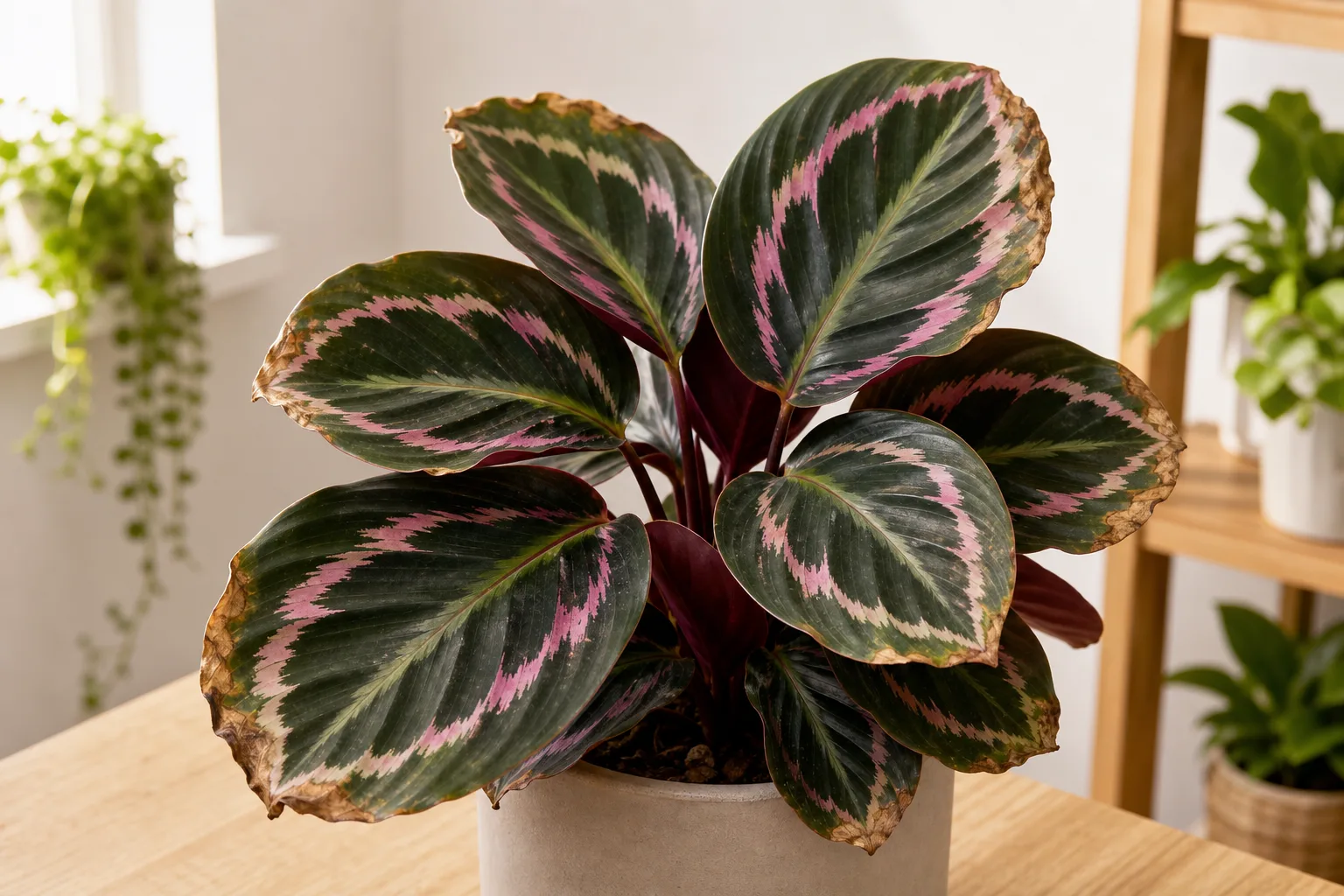
Brown Tips on Calathea Roseopicta: Causes, Checks & Fixes
This guide covers brown tips on Calathea Roseopicta. See also the general Brown Tips guide, watering, and light pages for this plant.
Brown Tips on Calathea Roseopicta: Causes, Checks & Fixes
Quick answer
Brown tips on Calathea Roseopicta (Goeppertia roseopicta) are almost always environmental margin necrosis on the rounded, painted leaves-not fungal disease. Rose-painted calathea evolved on the humid forest floor of western Brazil with rain-soft water and fine, shallow feeder roots that absorb minerals quickly. Indoors, fluoride and salts in tap water, relative humidity below about 60%, inconsistent dry-down of the top 1 to 2 inches of mix, or direct sun on pink and cream bands dry the leaf margins farthest from the vascular supply first.
First step: write down your water source and place a hygrometer within 12 inches of the top leaves. That pair separates the two most common fixes-filtered or rain water versus a humidifier-without stacking opposite treatments. If tips appeared after a move to a sunnier window, check light before you change anything else. Full watering rhythm and water-quality detail live in the Calathea Roseopicta watering guide.
What brown tips look like on Roseopicta painted leaves
On cultivars such as Medallion, Dottie, and Rosy, each leaf is a broad, rounded blade with brushstroke pink, rose, or cream patterning on deep green-often with burgundy undersides. Tip burn shows up as dry, tan-to-dark-brown crispy tissue at the leaf point and sometimes along the outer margin. The damage is especially visible on painted bands because a single browned edge interrupts the whole ornamental display.
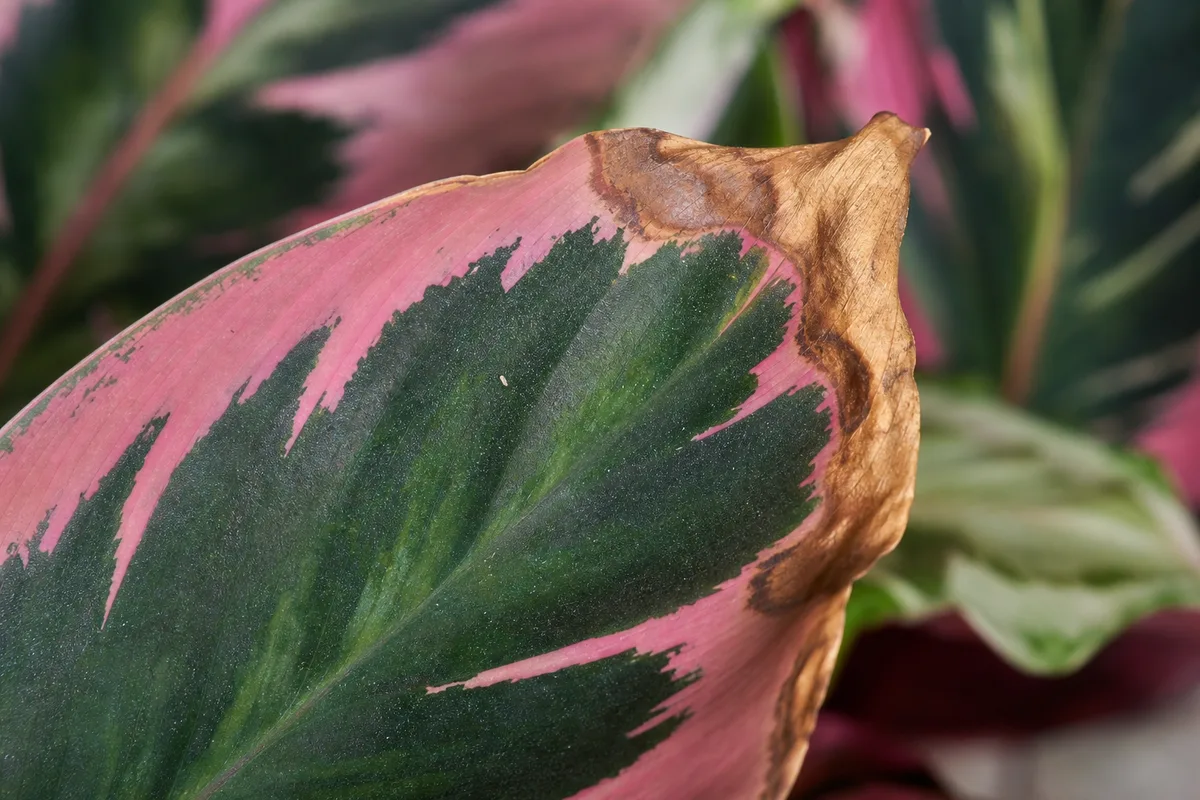
Dry tan-to-dark-brown crispy tissue at the leaf tip and outer margin on a rose-painted medallion leaf - compare with clean pink edges on healthy growth.
Typical tip-burn pattern:
- Starts at the very tip or outer margin and may creep a few millimeters inward along the edge
- Affects scattered leaves while the center of each blade stays firm and vividly patterned
- Feels papery and sharp-edged, not soft, water-soaked, or yellow-haloed
- Often worse on older, outer leaves when fluoride is the driver; more even across the clump when winter air is very dry
What tip burn is not:
- Black or dark brown splotches mid-leaf with yellow halos on wet soil-see overwatering on Calathea Roseopicta
- Fine yellow stippling and webbing on undersides-spider mites in dry heated rooms
- Bleached tan patches on the sun-facing side only-direct sun scorch on painted tissue
- Whole-leaf collapse with soft crown on soggy mix-root rot on Calathea Roseopicta, not margin burn alone
New leaves should unfurl with clean edges. If every new roll opens already browned, chronic water chemistry or sustained low humidity during unfurling is more likely than random aging on one old leaf.
Why Calathea Roseopicta gets brown tips
Rose-painted calathea is less forgiving than many houseplants because its large painted leaves transpire heavily, its fine roots concentrate minerals from infrequent flushing, and its native humidity band sits above 60%-a level most heated homes miss all winter.
Tap water fluoride, chlorine, and mineral salts
NC State Extension warns that tap water containing fluoride will cause foliage to turn brown on rose-painted calathea and recommends rain or distilled water. The University of Florida IFAS Extension lists calatheas among plants where fluoride in irrigation water causes dead spots near leaf margins-distinct from the black blotches of overwatering but easy to misread as “the plant needs more water.”
Fluoride accumulates in leaf tissue over repeated waterings. Letting tap water sit overnight reduces some chlorine but does not remove fluoride-NC State Extension recommends rain or distilled water because tap water contains fluoride. Sensitive plants irrigated with fluoridated city water develop necrotic regions at tips and along margins. Hard-water calcium and magnesium plus any fertilizer salts can produce similar marginal and tip necrosis when they build up in peat-heavy mix that is watered on a calendar without occasional flushing-the University of Florida IFAS Extension links leaf marginal or tip necrosis on calatheas to excess fertilizer and low pH as well as fluoride.
Fluoride damage often hits oldest, largest leaves first and keeps advancing on margins even when you have raised humidity-if humidity is already adequate, water chemistry is the more likely branch.
Low humidity and heated winter air
NC State Extension advises keeping humidity above 60% for rose-painted calathea. Central heating from late fall through early spring commonly drops indoor RH to 20–35% at the plant canopy even when the room feels comfortable to you. Large round leaves lose moisture at the margins first when air is dry.
Misting briefly raises humidity at the leaf surface but does not change the ambient RH that thick painted foliage needs through a full day. A pebble tray adds only a modest local boost; a room humidifier is the reliable fix in genuinely dry rooms. Measure at plant level with a hygrometer-not on the opposite wall. For a full humidity workflow, see low humidity on Calathea Roseopicta.
Inconsistent moisture and dry-down stress
Roseopicta needs consistently moist but not waterlogged soil per NC State Extension. Let the top 1 to 2 inches of mix begin to dry, then water thoroughly-never let the entire root ball go bone dry for long stretches. Repeated drought cycles crisp margins and curl leaves even when you eventually soak the pot. Conversely, adding extra water because tips look “dry” when the mix is already wet invites yellow lower leaves and black splotches-a worse problem than cosmetic tips.
Pot weight helps here: a very light pot with hard dry surface mix and crisp edges points to underwatering-related tip burn. A heavy, cool pot with limp lower leaves points away from tip burn and toward root stress.
Direct sun scorch on painted margins
Rose-painted calathea wants bright, indirect light. Hot direct sun through south or west glass can fade patterning and scorch margins on the sun-facing side while shaded leaves stay clean-NC State Extension notes that direct sunlight can cause leaf scorch on rose-painted calathea. Scorch often appears as bleached or tan patches that crisp, not as uniform tip necrosis on every leaf in the clump.
Less common: fertilizer salt buildup
Monthly feeding during active growth is normal for this species-NC State Extension advises fertilizing once a month during spring through summer-but heavy or frequent fertilizer on slow winter growth pushes salts into fine roots faster than the plant uses them. A white or chalky crust on the soil surface plus tip burn after a feeding binge points to salts-pause fertilizer and flush with plain filtered water before resuming at half strength in spring.
How to confirm the cause
Work through these six checks in order before stacking a water switch, humidifier, and repot on the same weekend.
- Water source - Municipal tap with known fluoride? Rain, distilled, or RO only? Chronic tap use with advancing margin burn on older leaves strongly implicates chemistry. If you already use soft water and tips persist, humidity or dry-down is more likely.
- Hygrometer at canopy height - Readings below 50% in winter with crisp margins on otherwise moist soil support low humidity. Above 55–60% with continuing margin advance on old leaves points back to fluoride or salts.
- Top 1 to 2 inches of mix - Dry, light pot and crumbly surface mix fit drought-related crisping. Damp or wet mix with yellowing lower leaves is not tip-burn-only-check roots and see overwatering.
- New leaf status - Clean unfurling rolls after a single care change mean you found the driver. Repeated burned new leaves mean the environment is still wrong during unfurling-usually water or RH, not pests.
- Light exposure - Are damaged leaves on the window-facing side? Midday sun beams on glass? Sun scorch fits that pattern; uniform tips on inner and outer leaves fit water or air.
- Salt crust and feeding history - White crust or recent heavy fertilizing implicates salt burn. No crust does not rule out fluoride from tap water alone.
Confirmed fluoride or salt tip burn: firm crown, appropriate soil moisture, margin necrosis without black mid-leaf spots, often older leaves worst first, tap-water history. Confirmed low-humidity tip burn: hygrometer below 50% at canopy, margins crisp on multiple leaves while mix moisture is correct, worse near heating vents. Confirmed dry-down tip burn: very light pot, dry top inch, curled leaves alongside crisp tips. Suspected sun scorch: damage on sun-facing blades only after a window move.
First fix for Calathea Roseopicta
Match one action to your strongest confirmed branch-do not change water, humidity, and pot size on the same day.
If tap water is your main source and margin burn is spreading on older leaves, switch to rain, distilled, or reverse-osmosis water for the next four to six weeks of watering. Water thoroughly when the top 1 to 2 inches dry, let drain fully, and empty the saucer. One water-quality variable tells you whether fluoride was the driver before you buy hardware.
If the hygrometer reads below 50% at canopy height and soil moisture is already correct, run a room humidifier targeting 60% or higher near the plant-not daily misting alone. Hold your normal watering rhythm; do not compensate for dry air by overwatering.
If the pot is very light and the top inch is dusty dry, give one measured drink with room-temperature filtered or rain water until a small amount drains, then wait for the top inch to reach the dry threshold again. See underwatering if the whole clump is limp.
If sun scorch is confirmed, move back to bright filtered indirect light away from hot midday rays before you touch water chemistry.
Step-by-step recovery by cause
Fluoride and hard-water path
- Switch all watering to rain, distilled, or RO water for at least four to six weeks.
- When the top 1 to 2 inches are dry, water until a modest amount drains; discard runoff within 30 minutes.
- If salt crust is visible, flush once by running plain filtered water through the pot at roughly two to three times the pot volume in the sink; let drain completely.
- Pause fertilizer until two new leaves open with clean margins-usually several weeks on this slow grower.
- Trim brown tips cosmetically only if you want-follow the natural leaf curve and leave a thin brown edge so you do not cut into green tissue.
Low-humidity path
- Place a humidifier in the same room as the plant; aim for 60%+ RH at canopy height.
- Move the pot away from heating vents, radiators, and frequently opened exterior doors.
- A pebble tray helps as a supplement if the pot sits above the water line-not in standing water.
- Hold correct top-inch dry-down watering separately; misting is optional cosmetic perk, not the fix.
- Expect partial firming of limp margins over one to two weeks; old crispy edges will not re-green.
Dry-down / underwatering path
- Water thoroughly once when the top 1 to 2 inches are dry; empty saucers and cachepots.
- If the plant was severely drought-stressed, repeat a moderate drink after 24 hours only if the top inch is dry again-not if the whole profile is saturated.
- Resume the partial dry-down rhythm from the watering guide.
- Watch for nightly leaf folding returning-that is a healthy sign on prayer plants in the Marantaceae family.
Sun scorch path
- Move to Calathea Roseopicta light guide; sheer curtain or a few feet back from south glass is usually enough.
- Do not prune heavily into green tissue; remove only fully dead scorched patches if they harbor moisture.
- New growth should show stronger pink or cream contrast within two to three weeks if light was the sole issue.
Salt buildup path
- Stop all fertilizer immediately.
- Flush the pot with plain filtered water as described above.
- Resume half-strength balanced feed only after new clean growth appears in spring or summer.
Recovery timeline
Rose-painted calathea is a moderate grower compared with tough foliage plants. After the correct single fix:
- Existing brown tips do not heal - damaged margin tissue stays brown permanently
- One to three weeks before the next leaf roll opens with clean edges when water chemistry or humidity was the driver
- Several weeks in low winter light before you can judge full recovery-watch two consecutive clean unfurls as the benchmark
- Gradual stop of new tip damage on fresh growth; old leaves may keep their scars indefinitely
If every new leaf still browns after six to eight weeks of filtered water and sustained 60%+ RH, inspect for chronic wet soil, an oversized pot, or a heating vent still aimed at the canopy.
Lookalike symptoms to rule out
| What you see | Likely cause | Quick differentiator |
|---|---|---|
| Crispy tips and margins only; firm stems | Tip burn (water, RH, sun) | No yellow halos; crown firm |
| Black splotches mid-leaf; yellow lower leaves; wet mix | Overwatering / root stress | Soil stays damp; soft roots possible |
| Fine stippling + webbing on undersides | Spider mites | Shake leaf over white paper |
| Bleached patches on sun-facing side | Direct sun scorch | Shaded leaves on same plant cleaner |
| Brown tips + very light pot + dry top inch | Dry-down stress | Heavy watering fixes new growth, not old tips |
| Whole-plant wilt on wet soil | Root rot | Crown softens; sour smell |
Brown tips without droop - Margins can crisp while stems stay upright. See this page. Drooping with wet soil - Drooping leaves and overwatering take priority over tip trimming.
What not to do
Do not increase watering because leaf tips look dry when the top inch of mix is already damp-that is how rose-painted calathea develops rot while you chase cosmetic margins. Do not assume overnight tap water fixes fluoride burn. Do not fertilize a stressed plant to “green up” tips; salts worsen margin necrosis. Do not mist heavily as your only humidity strategy on thick painted leaves. Do not cut deep into healthy green tissue when trimming-cosmetic snips following the leaf curve only. Do not stack Calathea Roseopicta repotting guide, heavy pruning, and pesticide on the same day as a water switch. Do not place the plant in harsh direct sun to “dry out” brown tips.
How to prevent brown tips next time
Water with rain, distilled, or filtered water if your tap supply is fluoridated or very hard. Follow the top 1 to 2 inch dry-down rule from the watering guide-not a fixed calendar and not bone-dry pots. Keep 60%+ relative humidity at canopy height through heating season with a humidifier; verify with a hygrometer. Give bright filtered indirect light without hot midday sun on glass. Use well-drained peaty mix with perlite in a pot with drain holes sized to the root mass per NC State Extension. Flush with plain filtered water every few months if you fertilize monthly in summer. Empty saucers within 30 minutes of every drink. Keep temperatures between about 65 and 75°F away from AC vents and cold windowpanes.
When to worry
Isolated brown tips on firm stems with stable soil moisture and no spreading black spots are cosmetic-fix the environment and read new growth. Treat as urgent when:
- Brown patches turn black and water-soaked while mix stays wet
- The crown softens or stems collapse at the soil line
- Lower leaves yellow rapidly across the clump on heavy, sour-smelling soil
- Fine webbing and stippling appear on leaf undersides in dry heat
- Every new leaf browns while you have already corrected both water and humidity for two months-inspect roots for rot or failed mix
Those patterns mean rot, severe root failure, or pests-not margin burn you can trim away.
Conclusion
Brown tips on Calathea Roseopicta usually mean fluoride or salts in tap water, humidity below about 60%, dry-down stress, or direct sun on painted foliage-not thirst alone. Check water source and RH at the canopy first, apply one matching fix, and judge success by new leaves unfurling with clean edges. Old browned margins stay brown; a single clean Medallion or Dottie roll is worth more than a dozen trimmed scars on aging leaves.
Related Calathea Roseopicta problems
- Watering - top 1 to 2 inch dry rule, filtered water, and seasonal rhythm
- Low humidity - humidifier setup and hygrometer targets
- Overwatering - black splotches and yellow lower leaves on wet mix
- Underwatering - light pot and dry surface mix with crisp edges
- Drooping leaves - limp foliage overlap with dry or wet soil
- Spider mites - stippling in dry heated rooms
- Calathea Roseopicta overview - full care hub
When to use this page vs other Calathea Roseopicta guides
- Calathea Roseopicta watering guide - Use for routine moisture checks before assuming brown tips is the main issue.
- Calathea Roseopicta problems hub - Browse all 16 common issues on this species.
- Low Humidity on Calathea Roseopicta - Different entry point when symptoms overlap with brown tips.
- Underwatering on Calathea Roseopicta - Different entry point when symptoms overlap with brown tips.
- Overwatering on Calathea Roseopicta - Different entry point when symptoms overlap with brown tips.