Watering Burro's Tail: Schedule, Soil Checks & Mistakes
Watering Burro's Tail: Schedule, Soil Checks & Mistakes
Watering Burro's Tail: Schedule, Soil Checks & Mistakes
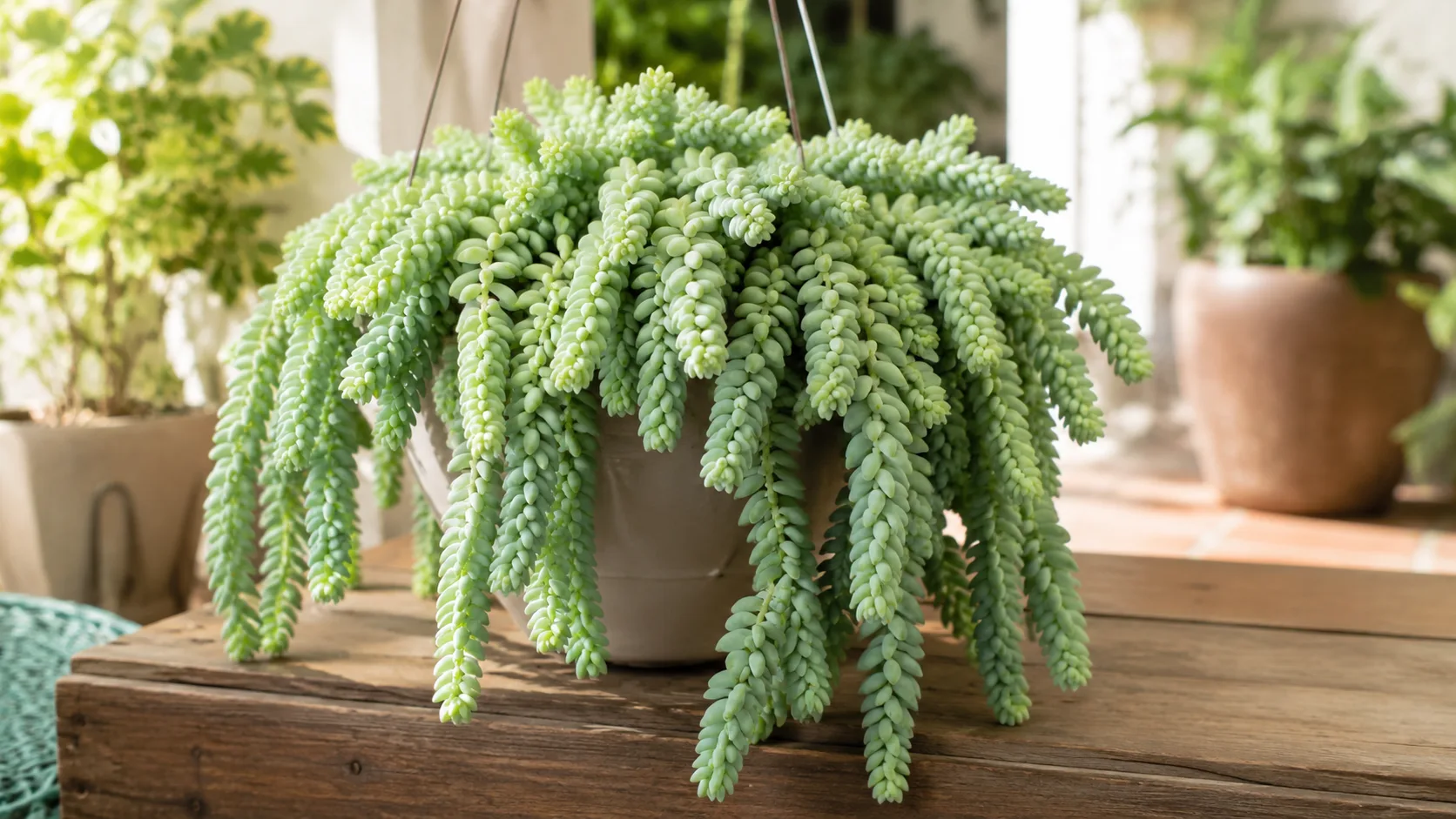
A Burro’s Tail can look indestructible - thick blue-green leaves packed along trailing stems, casually draping from a hanging basket like it has been growing there for years. Then you water it on a Tuesday because the calendar said so, and a dozen leaves fall off before you set the pot back on the shelf. Or you skip a few checks because the plant still looks fine, only to find mushy stems at the soil line and a sour smell when you lift the pot. Burro’s Tail (Sedum morganianum) is a drought-built succulent from southern Mexico and Honduras, not a leafy tropical that wants steady moisture. The watering mistake that kills more of these plants than any pest is simple: adding water before the root zone has actually dried, then letting the mix stay wet too long in a dim room or a pot with poor drainage.
This guide covers the full watering picture for Burro’s Tail: how often to water in summer and winter, the soil and pot checks that matter more than any schedule, bottom watering vs top watering, what overwatering on Burro’s Tail and underwatering on Burro’s Tail look like on the plant, how light and pot size change dry-down speed, and the mistakes that turn a beautiful trailing succulent into a compost candidate.
The Short Answer: How to Water Burro’s Tail
Water Burro’s Tail only when the potting mix is dry throughout the root zone - not when the surface looks pale, and not on a fixed weekly calendar. During active growth in spring and summer, that usually works out to roughly every 10 to 14 days indoors, though bright light, small pots, and warm rooms can shorten the interval. In fall and winter, when growth slows and the plant is semi-dormant, stretch watering to every three to four weeks or longer; University of Wisconsin-Madison Extension notes that indoor Burro’s Tail may not need water more than once a month in cool, low-light winter conditions. (University of Wisconsin-Madison Extension)
The method is soak and drain: water thoroughly until excess runs from the drainage holes, then empty the saucer or cachepot so the roots never sit in standing water. Bottom watering is often the safest technique because Burro’s Tail stems are brittle and leaves detach easily when the pot is tilted or jostled during top watering. Check moisture with a finger test, wooden skewer, or pot-weight comparison before every watering decision. The leaves themselves are a useful signal: firm, plump leaves mean the plant is hydrated; slightly soft or wrinkled leaves with bone-dry soil mean it is ready for a drink. Mushy, translucent, or yellowing leaves with damp soil mean you have already gone too far.
Why Burro’s Tail Watering Feels Confusing
Burro’s Tail does not announce thirst the way a wilting fern does. Its leaves store water internally, so the plant can look perfectly healthy while the soil has been dry for days - and it can also look acceptable while roots are rotting underground. That storage capacity is an adaptation to dry rocky slopes in its native range, where rain is irregular and drainage is sharp. Indoors, the same trait makes beginners think the plant needs frequent small drinks, because most common houseplants do. Burro’s Tail does not. It needs full drinks separated by complete dry-down periods, and it tolerates the dry side far better than the wet side.
The second source of confusion is the plant’s habit of dropping leaves when disturbed. A gentle bump, a tilt to pour water over the soil, or even a brush against the curtain can send plump leaves scattering. That leaf drop is not always a watering problem, but it makes people water more cautiously and more often than they should - or avoid watering altogether until the soil has been dry so long that fine roots are damaged. Good watering for Burro’s Tail is calm, infrequent, and confirmed by soil checks rather than driven by anxiety about fallen leaves.
What Makes Sedum morganianum Different From Other Houseplants
Sedum morganianum belongs to the stonecrop family (Crassulaceae), the same broad group as jade plants, echeverias, and hardy sedums. Like its relatives, it uses CAM photosynthesis and stores water in thick, overlapping leaves that surround the stem in a braided pattern. Wisconsin Extension describes those leaves as swelling when well watered and shriveling when dry - a direct, visible link between internal moisture reserves and your watering decision. (University of Wisconsin-Madison Extension)
Unlike moisture-loving foliage plants, Burro’s Tail prefers a well-drained cactus or succulent mix augmented with perlite, pumice, or baked clay granules, and it does well when slightly potbound. Oversized pots are a hidden watering trap: a large volume of mix stays wet around a modest root system, creating the exact conditions that lead to root rot on Burro’s Tail. The plant also grows best in bright light to Burro’s Tail light guide, which increases water use and speeds dry-down. A Burro’s Tail in a dim corner and a Burro’s Tail in a bright east window are effectively different plants from a watering standpoint, even if they share the same species name.
How Often to Water Burro’s Tail
The honest answer is: as often as it takes for the soil to go fully dry, then one thorough watering, then another full dry-down. Calendar ranges are useful starting points, not rules. Your home’s temperature, humidity, pot material, soil texture, light level, and whether the plant is actively growing all change the interval. A practical habit is to check the pot every five to seven days during the growing season and every ten to fourteen days in winter, but only water when the checks confirm dryness.
If you need a baseline before you learn your plant’s rhythm, use these ranges as rough guides and adjust from there. A Burro’s Tail in a small terra-cotta pot in a bright, warm room may need water sooner than one in a large plastic pot in a cool north-facing room. Hanging baskets dry faster than pots on a shelf because air circulates around more of the container surface. The goal is not to hit a number on the calendar. The goal is to never water while the root zone is still holding moisture from the last session.
Summer and Active Growth Schedule
From late spring through summer, when days are longer and Burro’s Tail is pushing new leaves along the stems, water use increases. In typical indoor conditions with bright indirect to some direct morning sun, many growers land in the 10-to-14-day range between thorough waterings. Plants moved outdoors for summer - once temperatures stay consistently above about 40°F - may dry out faster because of brighter light, warmer air, and increased air movement. Wisconsin Extension recommends watering regularly during the growing season while still allowing the medium to nearly dry out between sessions. (University of Wisconsin-Madison Extension)
During active growth, watch new leaf firmness along the stem tips. Healthy new leaves should be plump and tightly overlapping. If growth is pale, stretched, or slow despite dry soil, the limiting factor may be light rather than water - adding more moisture will not fix insufficient brightness. Conversely, if the plant is in strong summer sun and the pot is small, you may need to check every few days. The calendar is a reminder to look, not permission to pour.
Winter and Dormant-Season Adjustments
Burro’s Tail slows dramatically in fall and winter. Cooler temperatures, shorter days, and reduced growth all mean the plant draws far less water from the soil. This is when overwatering becomes most common, because the watering habit that worked in July is still running on autopilot in January. Wisconsin Extension advises reducing frequency in fall and providing just enough water in winter to prevent the potting medium from drying out completely - which, for many indoor plants, translates to no more than once a month, and sometimes less in a cool room. (University of Wisconsin-Madison Extension)
Winter watering is not about keeping the soil moist. It is about preventing a hard, hydrophobic dry-out that shrinks the root ball away from the pot walls while still avoiding persistent dampness. If the soil is fully dry and the leaves remain firm, you can wait. If the soil has been bone dry for many weeks and lower leaves look slightly deflated, give a modest thorough watering and let the pot drain completely. Do not compensate for gray winter light by watering more often. Low light and wet soil together are the combination that destroys roots on succulents.
Best Soil Moisture Checks Before You Add Water
The most reliable watering check for Burro’s Tail is confirmation that the root-zone soil is dry, supported by a lighter pot weight and, when appropriate, slightly soft leaves. No single test is perfect on its own. Surface soil can look dry while the center of the pot is still damp, especially in peat-heavy mixes or deep containers. A moisture meter can help but is not always accurate in gritty succulent mixes. Combining two or three checks takes about thirty seconds and prevents most watering errors.
Check 1 - Soil dryness: Press a finger into the top inch of mix. If it feels cool and damp, wait. For a deeper read without disturbing roots, insert a dry wooden skewer near the pot edge, leave it for a minute, and pull it out. Damp skewer means damp soil below. In a hanging basket, weight and leaf feel matter even more because reaching the soil line is awkward.
Check 2 - Pot weight: Lift the pot right after a proper watering to learn what “heavy” feels like. As the mix dries, the pot becomes noticeably lighter. If it still has the heft of a recent watering, the root zone likely holds moisture even when the surface looks dusty.
Check 3 - Leaf feel: Gently pinch a mature leaf. Firm and plump means the plant is still drawing on internal reserves. Slight softness or fine wrinkling on lower leaves, combined with confirmed dry soil, means the plant is ready. Do not rely on leaf feel alone - an overwatered plant can also feel soft because cell walls are failing from rot, not from drought.
The Finger Test, Skewer Method, and Pot Weight Test
The finger test is the fastest routine check. Burro’s Tail is usually grown in a container shallow enough that the top inch is a reasonable proxy for overall moisture in small and medium pots, though large hanging baskets benefit from the skewer method. Push gently; you are feeling for cool dampness, not color. Dry succulent mix can still look dark if it contains peat or coconut coir.
The skewer method is more reliable when the pot is deep or the plant is potbound with a dense root mat. Slide the skewer down the inside wall of the pot where roots are thinner, wait sixty seconds, and inspect. A darkened, cool skewer means wait. A clean, dry skewer means the mix has released most of its available moisture.
The pot weight test is especially valuable for hanging baskets you cannot easily finger-test at eye level. Over two to three weeks, you will learn the weight difference between “just watered” and “ready for water” in your specific setup. Many experienced succulent growers eventually water almost entirely by weight because it integrates pot size, soil texture, and root mass into one physical signal.
Best Watering Methods for Burro’s Tail
The best watering method for Burro’s Tail is whichever one delivers a full, even soak to the root zone without saturating the foliage, leaving the pot in standing water, or jostling the stems so badly that leaves shower the floor. For most growers, that means bottom watering for routine care and careful top watering when you need to flush salts or the soil has become hydrophobic.
Here is a practical comparison:
| Method | Best For | Main Risk | Key Rule |
|---|---|---|---|
| Bottom watering | Routine care, hanging baskets, fragile stems | Leaving pot submerged too long | Remove when top soil feels moist; drain fully |
| Top watering | Flushing salts, very dry hydrophobic soil | Wet leaves, leaf drop from tilting | Water soil only with a narrow spout; do not soak foliage |
| Soak and drain (either method) | Every watering session | Standing water in saucer or cachepot | Empty runoff within 30 minutes |
Bottom Watering vs Top Watering
Bottom watering means placing the pot in a sink or basin with a few inches of room-temperature water and letting the mix wick moisture upward through the drainage holes. Leave the pot for 15 to 20 minutes, or until the top of the soil feels lightly moist, then remove it and let it drain completely on a rack or dry sink. This method keeps water off the brittle leaves, avoids the tilt-and-pour motion that knocks leaves loose, and still delivers a thorough root-zone drink. It is particularly well suited to hanging baskets: unhook the basket, set it in a basin, and skip the acrobatics of aiming a watering can at a crowded canopy.
Top watering is still valid when you need to flush accumulated minerals from fertilizer or hard tap water, or when the soil has gone so dry that it repels water and channels down the pot sides without wetting the root mass. Use a narrow-spout can and direct water onto the soil surface only, moving slowly until the mix accepts moisture. Stop when water runs freely from the drainage holes. If water rolls off the surface, bottom water first to rehydrate the mix, then try top watering again. After any top watering, blot accidental splashes on leaves and keep the plant out of harsh direct sun until foliage is dry.
Whichever method you use, the session ends the same way: no standing water in the saucer, no plant sitting in a decorative outer pot full of runoff, and no permanently damp soil.
Signs You’re Overwatering Burro’s Tail
Overwatering is the most common cause of death in Burro’s Tail, and Wisconsin Extension lists root rot from overwatering as the primary cultural problem for Burro’s Tail overview. (University of Wisconsin-Madison Extension) The signs develop in a pattern worth learning, because early intervention is far more successful than late rescue.
Early signs: Leaves become soft, mushy, or translucent, sometimes turning yellow before they fall. Lower leaves near the soil line drop in clusters. The stem base may feel squishy where it enters the mix. Soil stays dark and cool several days after watering. The pot remains heavy when you expect it to be drying.
Progressive signs: Wilting or soft leaves despite wet soil - the classic root-damage signal. Roots cannot move water, so the foliage dehydrates even while the mix is saturated. A sour, swampy smell from the drainage hole or soil surface. Blackened or dark brown stem tissue at the base. Mealybugs sometimes appear on stressed stems, but rot is the urgent problem.
What to do: Stop watering immediately. Unpot if the plant is declining fast and inspect roots - healthy roots are firm and white or tan; rotted roots are brown, black, or mushy. Cut away rotted tissue with a clean blade, let cuts dry for a day, and repot into fresh, gritty mix in a clean pot with drainage. Discard soil from the infected pot. Recovery is possible if enough healthy stem and root tissue remains, but severely rotted plants are often better restarted from healthy stem cuttings. Do not water the repotted plant for five to seven days, then water sparingly until new growth confirms root function.
How to Recover an Overwatered Burro’s Tail
Recovery depends on how far rot has spread. If only a few lower leaves are mushy but the stem above them is firm and roots are mostly healthy, withhold water for two to three weeks, keep the plant in bright light with good air movement, and resume with a light bottom watering only when the new mix or remaining soil is fully dry. If the stem base is soft or roots are extensively brown, cut the healthy upper stem, let the cut callous for two to three days, and restart as a cutting in dry gritty mix. Burro’s Tail propagates easily from stem sections, and a clean restart is often more reliable than nursing a rotted base. During recovery, avoid fertilizer, avoid misting, and do not place the plant in a dim corner where wet soil will stay wet even longer.
Signs You’re Underwatering Burro’s Tail
Underwatering is less lethal than overwatering for Burro’s Tail, but repeated drought cycles stress fine roots and can make the plant look perpetually tired. The signs are usually visible on the leaves before permanent damage sets in.
Typical signs: Leaves look deflated, wrinkled, or thinner than usual, especially on lower and older sections. The soil is dusty, shrunken, or pulled away from the pot edge. The pot is very light. New growth may stall or produce smaller leaves than expected. In extreme dryness, the mix becomes hydrophobic and water runs down the sides without soaking in.
What to do: Give a thorough soak using bottom watering or slow top watering until the mix is fully rehydrated and water drains freely. Do not dribble tiny daily sips - that wets only the surface and leaves the root core dry. Most plump-leaf succulents recover visibly within 24 to 48 hours after a proper drink. If leaves re-plump but the soil dries again within a day or two in a normal indoor setup, the pot may be too small or the plant may be in more light than you realized; adjust checks accordingly rather than returning to a rigid calendar.
One dry episode is forgivable. Months of chronic underwatering followed by a sudden flood is not ideal - the stressed root system may not handle a heavy soak well. If the plant has been severely neglected, rehydrate gradually over two sessions a few days apart.
How Light, Pot Size, and Soil Change Watering Frequency
Watering Burro’s Tail in isolation from light, pot size, and soil is guesswork. These three variables set how fast the mix dries and how much margin for error you have before roots sit wet too long.
Light is the main driver of water use. Burro’s Tail in bright light to full sun photosynthesizes actively and pulls moisture from the soil faster. Wisconsin Extension notes that insufficient light lengthens internodes and reduces leaf density, which also signals a slower metabolism and slower dry-down - but dim light combined with frequent watering is the danger zone. (University of Wisconsin-Madison Extension) When you move a plant to a brighter spot, check moisture more often. When you move it dimmer, extend the dry-down window even if the calendar says Tuesday.
Pot size and material change how the root zone behaves. Small pots dry quickly. Oversized pots hold wet mix in the center long after the surface looks dry. Terra-cotta breathes and speeds evaporation; glazed ceramic and plastic retain moisture longer. Burro’s Tail does well potbound, and Wisconsin Extension recommends Burro’s Tail repotting guide only when the plant has completely filled its container. (University of Wisconsin-Madison Extension) A potbound plant in appropriate light often has a predictable, stable dry-down rhythm.
Soil texture is the foundation. A proper cactus or succulent mix with added perlite, pumice, or coarse grit drains fast and dries evenly. Regular potting soil, dense peat mixes, or sand-heavy blends that compact and block pores will stay wet dangerously long. If your Burro’s Tail consistently takes more than three weeks to dry in summer despite bright light, the mix - not the plant - is the problem.
Watering After Repotting, Propagation, and Leaf Loss
Repotting, propagation, and routine leaf drop each change watering temporarily, and treating them like normal established care is a common mistake.
After repotting: Wisconsin Extension advises waiting about a week after repotting before watering, then watering sparingly until the plant re-establishes. (University of Wisconsin-Madison Extension) Fresh mix around disturbed roots is more vulnerable to rot if saturated immediately. The first watering after the waiting period should be moderate, not a flood. Resume normal soak-and-drain cycles only when you see firm new growth or clear signs that roots are anchoring.
After propagation: Stem and leaf cuttings need no water at all until they are placed in mix and have calloused cut ends. Newly rooted cuttings need light, brief moisture - the mix should dry quickly. Mature propagated plants follow the same dry-down rules as the parent, but small starter pots dry faster, so check weight daily at first.
After leaf loss from handling: Fallen leaves are not an automatic signal to water. If the soil is dry and leaves are firm, wait. If the soil is dry and remaining leaves are soft, water thoroughly. If leaves fall while the soil is wet, investigate rot before adding more water. Do not interpret mechanical leaf drop as thirst.
Seasonal Watering Adjustments Indoors and Outdoors
Indoor Burro’s Tail watering shifts with the seasons even though the plant lives inside year-round. Shorter days and cooler room temperatures in fall and winter slow metabolism. Many growers reduce watering frequency by half or more between October and February compared with June and July. A plant near a cold window in winter may need water rarely, while the same plant in a warm, bright grow-light setup may still dry on a two-week rhythm.
Outdoor summer moves change the equation quickly. Once nighttime temperatures stay above about 40°F, Burro’s Tail can go outside to a bright, sheltered spot. Wisconsin Extension warns to acclimate gradually to brighter outdoor conditions to avoid sunburn, and to move plants back indoors before temperatures drop below 40°F. (University of Wisconsin-Madison Extension) Outdoor light and air movement usually shorten the dry-down window - check every few days during heat waves. Wind in exposed hanging baskets can also dry soil faster than a sheltered indoor shelf.
When bringing plants back indoors in fall, reduce watering immediately even if the outdoor schedule was aggressive. Lower indoor light means slower water use. Expect some leaf drop from the transition and resist compensating with extra water. Let the plant settle, match watering to the new indoor dry-down speed, and judge health by new growth over the following month.
Water Quality, Temperature, and Drainage Rules
Burro’s Tail is less fussy about water chemistry than African violets or calatheas, but a few basics still matter. Use room-temperature water - cold tap water can shock roots in a small pot. Hard tap water is usually acceptable for occasional watering, but mineral buildup over months can crust the soil surface and stress roots. If you see white deposits on the mix or pot rim, flush with plain water during a top-watering session or refresh the soil at the next repot.
Drainage holes are non-negotiable for long-term indoor care. A holeless decorative pot is only safe as a temporary cachepot that you empty after every watering. Stones at the bottom of a pot do not create drainage; they create a perched water table that keeps the root zone wetter for longer. Wisconsin Extension recommends a well-drained medium and explicitly identifies overwatering as the most common issue. (University of Wisconsin-Madison Extension) Pair sharp drainage with a disciplined dry-down habit and the plant has a high survival margin.
Avoid misting as a substitute for watering. Burro’s Tail prefers low humidity and dry air. Misting wets leaves without hydrating roots and can encourage fungal problems on crowded stems. Water the soil, not the foliage.
Common Burro’s Tail Watering Mistakes to Avoid
These are the errors that show up repeatedly in struggling plants. Most are preventable with a thirty-second check before each watering.
Watering on a calendar without checking soil. Tuesday waterings do not work when the pot is still heavy from last week. The calendar reminds you to check; the soil tells you whether to pour.
Watering because the top looks dry. Surface color is unreliable, especially in peat-based mixes. Confirm with a skewer or pot weight.
Using a pot without drainage or leaving runoff in the saucer. Wet feet cause rot faster than any other single factor.
Keeping a Burro’s Tail in low light on a summer watering schedule. Dim light plus frequent water is the classic rot setup. Reduce water when light drops.
Repotting into an oversized container and watering heavily. Extra wet mix around a small root ball extends dry-down time past the point of safety.
Top watering carelessly and knocking half the leaves off, then assuming the plant is dying. Mechanical leaf drop is normal. Adjust technique; do not panic-water.
Giving tiny sips instead of thorough soaks. Frequent shallow watering keeps the surface damp while the root core cycles between wet and dry unpredictably. Soak, drain, then wait for full dry-down.
Watering immediately after repotting. Disturbed roots in fresh, saturated mix rot quickly. Wait about a week, then water lightly.
Ignoring soft stems at the soil line. This is rot, not thirst. More water makes it worse.
Conclusion
Burro’s Tail watering comes down to one disciplined loop: confirm the root zone is fully dry, soak thoroughly, drain completely, then leave the plant alone until the next dry-down. Summer active growth usually lands in the 10-to-14-day range for many indoor setups; winter dormancy often stretches to three or four weeks or longer, sometimes no more than once a month in cool conditions. Bottom watering protects fragile stems, pot weight and skewer checks beat surface guesses, and the leaves tell you the truth - plump when hydrated, softly wrinkled when genuinely thirsty, mushy when you have already overdone it.
Read the pot, not the calendar. A heavy pot means wait. A light pot with dry soil and slightly soft leaves means water. Mushy stems with damp soil mean stop and inspect roots. Match watering to light and season, keep drainage sharp, and accept that Burro’s Tail forgives drought far more willingly than kindness in the form of extra water. Get the dry-down rhythm right and this trailing succulent will hang in your home for years - often decades - with firm blue-green leaves and stems long enough to make every visitor ask what your secret is. The secret is simpler than they expect: you stopped watering it like a fern.
When to use this page vs other Burro’s Tail guides
- Burro’s Tail overview - Start here for whole-plant context before deep-diving this topic.
- Burro’s Tail problems hub - Jump to symptom-specific fix guides when this care topic does not resolve the issue.
- Overwatering on Burro’s Tail - Escalate here when watering adjustments are not enough.
- Underwatering on Burro’s Tail - Escalate here when watering adjustments are not enough.
- Root Rot on Burro’s Tail - Escalate here when watering adjustments are not enough.
Related Burro’s Tail guides
- Burro’s Tail overview
- Burro’s Tail light
- Burro’s Tail soil
- Burro’s Tail propagation
- Burro’s Tail fertilizer
- Burro’s Tail repotting
- Overwatering on Burro’s Tail
- Underwatering on Burro’s Tail
- Root Rot on Burro’s Tail
- Wilting on Burro’s Tail
- Drooping Leaves on Burro’s Tail
- Mold on Soil on Burro’s Tail
Related tool
Try the Plant Watering Calculator with burros-tail pre-selected to estimate needs for your setup.