Best Soil for Burro's Tail: Mix Recipe and Drainage Tips
Best Soil for Burro's Tail: Mix Recipe and Drainage Tips
Best Soil for Burro's Tail: Mix Recipe and Drainage Tips
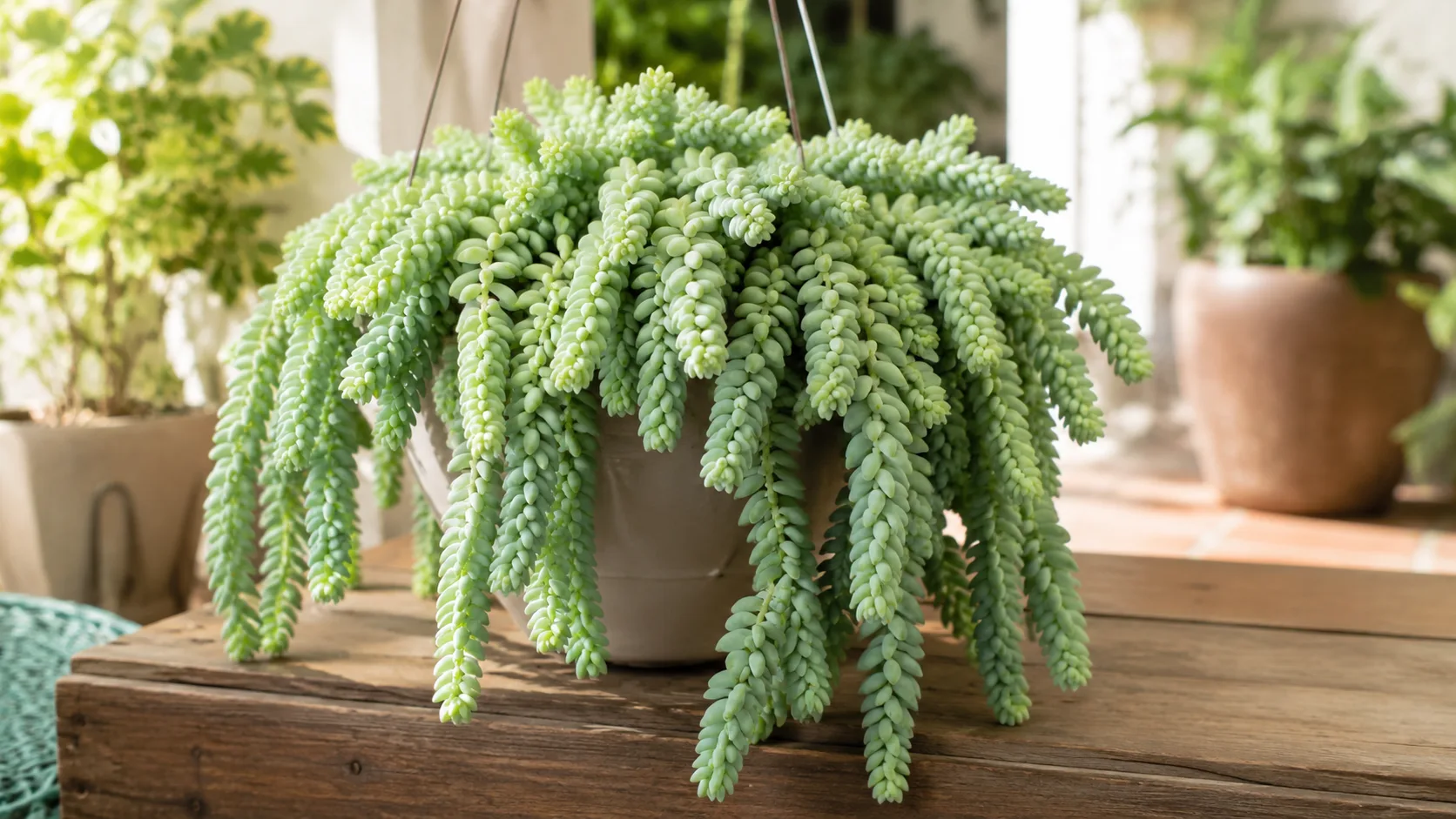
Burro’s Tail (Sedum morganianum) is one of those plants that looks effortless until the roots fail. The trailing stems can stay plump and blue-green for weeks while the root zone quietly rots underneath. When the leaves finally go soft and start dropping at the slightest bump, the damage is usually already done. In most cases, the soil-not the Burro’s Tail watering guide alone-is what set that chain reaction in motion.
Burro’s Tail stores water in thick, overlapping leaves along brittle stems that can reach four feet long indoors. That physiology makes it tolerant of drought and deeply intolerant of a soggy root zone. The right soil mix is not a minor preference. It is the foundation that determines whether your watering habits help or hurt the plant. This guide covers what Sedum morganianum actually needs from its substrate, why standard potting soil is the wrong tool, which components to use, three reliable DIY recipes, pre-made mixes worth buying, and how to pair soil with the right container so drainage works in your actual home-not just on paper.
What Burro’s Tail actually needs from its soil
The best soil for Burro’s Tail is a gritty, fast-draining mix dominated by coarse mineral particles, with just enough organic matter to anchor roots and hold a small amount of moisture between waterings. Water should move through the pot quickly, excess should exit through a drainage hole within seconds, and the mix should feel dry again within a few days in a typical indoor environment. If any of those three conditions fail consistently, the plant is living on borrowed time.
Burro’s Tail needs three things from its root zone, in this order: fast drainage, abundant air, and a slightly acidic to neutral pH. Drainage comes first because this is a succulent that evolved on rocky cliffs, not in peat bogs. Air comes second because even a well-intentioned watering routine cannot compensate for a dense, oxygen-poor mix. pH matters third, but it is rarely the first problem-most cactus and succulent mixes already land in an acceptable range without special adjustment.
A useful mental model: think of the soil as a timer. Every time you water, you start a countdown. In the right mix, the root zone dries before pathogens multiply and before the fine roots suffocate. In the wrong mix, the countdown never finishes. The plant’s fleshy leaves mask the problem because they hold reserves, which is why Burro’s Tail often looks fine right up until it does not.
The cliff-native context behind fast drainage
Sedum morganianum is native to southern Mexico, where it grows as a trailing sub-shrub on rocky slopes and cliff faces. In those habitats, rainwater runs through crevices almost instantly. Roots cling to thin pockets of mineral-rich material with very little organic buildup. There is no deep reservoir of damp peat holding moisture for a week.
That native context is the entire reason indoor growers cannot treat Burro’s Tail like a tropical foliage plant. Standard houseplant mixes are engineered for plants that evolved in moisture-retentive forest floors-peace lilies, pothos, ferns. Burro’s Tail wants the opposite: a substrate that behaves more like crushed rock with a little compost mixed in. The closer your pot mimics a cliff crevice, the less you fight the plant’s biology on every watering.
University of Wisconsin–Madison Extension specifically recommends a well-drained growing medium for Burro’s Tail, noting that root rot on Burro’s Tail due to overwatering on Burro’s Tail is the most common issue and that wilting or soft leaves often indicate too much soil moisture rather than drought. That single observation should reshape how you think about soil: the mix is your first line of defense against the failure mode that kills more of these plants than any pest.
The pH range Sedum morganianum prefers
Most stonecrop succulents, including Sedum species, perform best in a pH range of roughly 6.0 to 7.0-slightly acidic to neutral. In that band, nitrogen, phosphorus, potassium, and micronutrients like iron and manganese remain chemically available for root uptake. When pH drifts too alkaline, iron deficiency can show up as pale or yellowing growth. When it drifts too acidic, phosphorus availability drops.
In practice, pH is rarely the first thing to fix on a struggling Burro’s Tail. Pre-made cactus and succulent mixes, and most DIY blends built from standard potting soil plus perlite or pumice, already fall within or near the acceptable range. The bigger pH-related risk is using peat-heavy mixes that become more acidic as the peat decomposes over 12 to 18 months, which is one more reason to keep organic content modest and refresh the mix before it breaks down into fine, water-holding particles.
Why regular potting soil fails for Burro’s Tail
Standard indoor potting soil is the most common reason Burro’s Tail plants decline indoors, and the failure pattern is predictable. The mix is built around peat moss, compost, and fine bark products that act like sponges. They absorb water, hold it for days, and stay damp in the lower half of the pot long after the surface looks dry. For a cliff-dwelling succulent, that environment is hostile.
The problem is not that potting soil is “bad.” It is excellent-for plants that want consistent moisture. Burro’s Tail does not. Its roots are adapted to breathe in loose, mineral-heavy substrate with fast dry-down. When you plant it in peat-heavy mix, every thorough watering creates a wet zone at the bottom of the pot that can persist for a week or more in a cool, dim room. The roots weaken. Opportunistic pathogens multiply. The stems still look full because the leaves store water, so you do not get an obvious alarm until leaves go soft or start detaching.
“Moisture control” and “water retaining” potting soils are worse. They are engineered with water-absorbing polymers and extra coir to hold even more moisture for even longer. Anything labeled for tropicals, African violets, or general houseplants should stay away from a Burro’s Tail pot unless you amend it heavily-and even then, starting from a cactus base is simpler and safer.
What happens when trailing succulent roots stay wet
When Burro’s Tail roots sit in saturated soil, two processes run at once. First, water fills the pore spaces between soil particles and displaces oxygen. Healthy root cells need oxygen to respire. A waterlogged mix delivers almost none, and fine roots begin to die back within days. Second, weakened root tissue becomes an entry point for soil-borne pathogens-primarily Pythium and Phytophthora (oomycetes), along with Fusarium and Rhizoctonia-that are present at low levels in most potting media but only become lethal when conditions stay wet long enough for populations to explode.
The visible symptoms lag behind the root damage. Lower leaves may shrivel or feel mushy. Stems that were firm become soft at the base. Leaves fall off when you brush past the plant-something that happens naturally with Burro’s Tail’s brittle stems, but rot accelerates the drop rate dramatically. Because the plant holds water in its leaves, it can look healthy while the root system is already compromised. By the time the decline is obvious, recovery is difficult. Prevention through proper soil is far easier than rescue.
What “fast-draining” means for a donkey tail succulent
“Well-draining” gets thrown around loosely in plant care. For Burro’s Tail, it means something specific and testable. Fast-draining soil lets water pass through the entire pot profile within seconds, does not pool on the surface or run down the sides of the root ball, and dries to the touch within two to four days after a thorough watering in typical indoor conditions. If your mix is still damp a week later in a room with reasonable light and airflow, it is not draining fast enough for Burro’s Tail overview.
A gritty mix for Burro’s Tail has three measurable properties. High drainage rate: pour water into a dry pot and watch it exit the drainage hole almost immediately, not minutes later. Fast dry-down: the pot should feel noticeably lighter within 48 to 72 hours after watering in most homes. Stable structure: mineral particles like perlite, pumice, and baked clay hold their shape for years instead of collapsing into fine dust that clogs air spaces.
Iowa State University Extension recommends a baseline of one part organic material to two parts mineral material for desert-origin succulents and stonecrops-the group Sedum morganianum belongs to. That 1:2 ratio is a useful target: roughly 33% organic and 67% mineral by volume. In humid homes or low-light conditions, pushing even higher mineral content (40% organic, 60% mineral) is a safer bet.
The squeeze test and drainage speed check
Two home tests catch most bad mixes before they go into a pot. The squeeze test is the faster one. Moisten a handful of your finished mix and squeeze it firmly. When you open your hand, the mix should crumble apart immediately. If it holds a tight ball like clay, it is too fine, too peat-heavy, or both. A good Burro’s Tail mix feels gritty and loose, not spongy.
The drainage speed check takes one extra minute and is worth doing when you try a new recipe or bagged mix. Fill a small pot with dry mix, water until it runs freely from the drainage hole, and note how long water sits on the surface. In a properly gritty mix, surface water disappears within a few seconds and the pot drains completely within 15 to 30 seconds. If water pools on top for more than 10 seconds or the lower half of the pot feels waterlogged hours later, add more perlite, pumice, or baked clay granules before planting.
The core components of a Burro’s Tail soil mix
A reliable Burro’s Tail soil mix combines three categories of material: mineral drainage components (the majority by volume), a small organic base (for root anchoring and modest nutrient holding), and optionally a slow-release nutrient source if your base is inert. Each category has a specific job. Skipping the minerals or overloading the organics is what turns a good recipe bad.
Perlite, pumice, and mineral grit
Perlite is expanded volcanic glass-light, white, and cheap. It creates air pockets and speeds drainage. It floats and can migrate upward over repeated waterings, which gradually concentrates mineral material at the bottom of the pot. For Burro’s Tail in a hanging basket you repot every two to three years, that migration is a minor issue. For a large pot you plan to leave alone longer, pumice is more durable because its heavier particles stay distributed.
Pumice is porous volcanic rock. It drains well, holds a little more moisture than perlite without staying wet, and does not break down quickly. It costs more and is harder to find in small bags, but it is the preferred amendment for serious succulent growers who want long-term structure.
Baked clay granules, pea gravel, and calcined clay (products like Turface or similar baked clay) add weight and permanent air spaces. University of Wisconsin–Madison Extension specifically lists perlite, pumice, baked clay granules, and small pea gravel as suitable amendments for Burro’s Tail. These materials mimic the rocky substrate the plant evolved in.
Sand requires a warning. UW Extension explicitly notes that sand tends to fill soil pores and hinder rather than enhance drainage in container mixes. Fine sand packs tightly, reducing air space. If you see “coarse sand” in a succulent recipe online, understand that perlite or pumice achieves the same drainage goal more reliably for indoor pots. Coarse horticultural sand with particles roughly 1 to 3 mm can work in outdoor gritty mixes, but it is not the first choice for Burro’s Tail indoors.
Avoid vermiculite in Burro’s Tail mix. Unlike perlite, vermiculite holds significant moisture and is designed to keep mixes wetter-exactly the opposite of what this plant needs.
Cactus mix as a starting point
Commercial cactus and succulent potting mix is a reasonable starting point, but it is rarely sufficient on its own for Burro’s Tail indoors. Most bagged cactus mixes contain a meaningful percentage of peat or compost, and quality varies widely between brands. Some drain well out of the bag; others behave like slightly grittier regular potting soil.
Treat store-bought cactus mix as the organic base, not the finished product. The standard upgrade is to blend equal parts cactus mix and perlite or pumice (a 50/50 split by volume). In humid climates or dim rooms, shift to 40% cactus mix and 60% mineral amendment for extra safety. That single adjustment converts an average bag into a mix that behaves appropriately for Sedum morganianum.
Perlite vs pumice for Burro’s Tail
Both perlite and pumice work. The choice comes down to cost, availability, and how long you want the mix to hold its structure.
| Factor | Perlite | Pumice |
|---|---|---|
| Drainage speed | Excellent | Excellent |
| Weight | Very light; may float | Heavier; stays in place |
| Durability | Can crush and migrate over time | Lasts years without breaking down |
| Moisture retention | Very low | Slightly higher, but still fast dry-down |
| Cost | Lower; widely available | Higher; specialty suppliers |
| Best for | Budget mixes, frequent Burro’s Tail repotting guide | Long-term pots, large hanging baskets |
For most indoor Burro’s Tail growers, perlite is perfectly adequate and the most practical choice. If you are building a mix for a large hanging basket you do not want to disturb for several years, pumice earns its price. You can also blend both-there is no horticultural penalty to using perlite and pumice together in the same batch.
Three proven DIY mix recipes
Here are three recipes that work for Burro’s Tail, scaled by how aggressively you need drainage in your environment. Measure by volume, not weight-a gallon scoop of each part, not a kitchen scale.
Recipe 1: The balanced blend (good default for most indoor growers)
- 1 part commercial cactus or succulent mix
- 1 part perlite or pumice
This 50/50 blend is the fastest path to good results. It upgrades any decent bagged cactus mix into something Burro’s Tail can tolerate in average indoor light and humidity.
Recipe 2: The desert-gritty blend (humid homes, low light, or heavy waterers)
- 1 part standard potting soil or cactus mix
- 2 parts perlite, pumice, or a combination
- Optional: ½ part baked clay granules or small pea gravel for extra structure
This follows the Iowa State Extension guideline of one part organic to two parts mineral. Use it when your home runs above 50% humidity, when the plant sits in less than bright light, or when you have already lost a Burro’s Tail to rot and want a more forgiving substrate.
Recipe 3: The maximum-drainage blend (overwatering recovery, cool rooms, or winter dormancy)
- 1 part cactus mix
- 1 part perlite or pumice
- 1 part baked clay granules, crushed granite, or lava rock
This is the grittiest of the three. Water moves through almost instantly. It is appropriate when you are rehabbing a plant with damaged roots, growing in a cool room where evaporation is slow, or pairing soil with a glazed ceramic pot that retains more moisture than terra cotta.
Matching the recipe to your climate and home
The same recipe behaves differently in different rooms. A 50/50 blend that dries in two days under a south-facing window may take six days in a north-facing office with air conditioning. Humidity, light, pot material, and pot size all change dry-down speed more than the calendar does.
In humid climates (consistently above 50% relative humidity), start with Recipe 2 or push Recipe 1 toward 40% organic and 60% mineral. In dry, bright homes, Recipe 1 is usually sufficient. In low-light conditions, use a grittier mix and a smaller pot-less light means slower water use by the plant, which means the mix stays wet longer even if you water less often.
If you are unsure which recipe to pick, start with Recipe 2. It is easier to add a little water when a mix is too dry than to recover a plant from a mix that stays wet too long. You can always reduce mineral content at the next repot if the plant dries out uncomfortably fast.
Pre-made succulent mixes worth using
DIY mixing is not mandatory. Several pre-made products drain well enough for Burro’s Tail with little or no amendment, and others need a perlite boost. The key is reading the ingredient list and understanding what you are buying.
Bonsai Jack Succulent and Cactus Soil is a popular ultra-gritty option with calcined clay and pine bark fines. It drains extremely fast-often within seconds-and works well for Burro’s Tail without amendment in most homes. The trade-off: it dries so quickly that you may need to water slightly more often in bright light, and it is pricier than mainstream brands.
Hoffman Organic Cactus and Succulent Soil and Espoma Organic Cactus Mix are widely available and decent as bases. In practice, plan to cut either one 50/50 with perlite for Burro’s Tail indoors. Used straight from the bag in a humid home, they hold more moisture than this plant prefers.
Black Gold Cactus Mix and Miracle-Gro Cactus, Palm and Citrus Potting Mix sit in a similar category: usable starting points, not finished Burro’s Tail soil. Amend with perlite or pumice before planting.
When evaluating any bag, look for large-particle mineral content (perlite, pumice, sand labeled as coarse, calcined clay) and be cautious of mixes listing peat moss or compost as the first ingredient without substantial mineral amendment. The first listed ingredient is the largest component by volume. If peat leads and perlite is a footnote, you will be amending heavily or choosing a different bag.
Container choice and drainage setup
Soil does not drain in isolation. The pot determines how much air reaches the root zone, how fast moisture evaporates from the sides, and whether water actually exits or pools at the bottom. A perfect gritty mix in a pot without a drainage hole is still a root-rot setup.
A drainage hole is non-negotiable for long-term Burro’s Tail care. No layer of gravel, charcoal, or broken pottery compensates for a sealed bottom. The science is straightforward: water does not “jump” past a layer of coarse material into finer soil above it. Instead, the fine soil above holds water until it is saturated, creating a perched water table at the boundary. The gravel layer actually reduces the volume of well-aerated soil available to roots. Skip the gravel layer. Use a hole.
If you want a decorative cachepot, plant in a plastic or terra cotta grow pot with a drainage hole and set it inside the outer container. After watering, empty the cachepot of runoff. Never let the bottom of the inner pot sit in standing water.
Hanging baskets, terra cotta, and pot size
Burro’s Tail is a trailing plant with pendant stems that can grow several feet long. Container choice should match both its growth habit and its shallow, compact root system.
Unglazed terra cotta is the ideal material for most growers. It breathes through its walls, wicking moisture away from the root zone and accelerating dry-down. That extra evaporation is a genuine advantage for a succulent in a humid home. The weight also stabilizes hanging baskets as stems get longer.
Hanging baskets with drainage holes are the classic display option and work well when lined with coco coir or moss, provided water can exit freely. Use a gritty mix in baskets-peat-heavy liner material plus dense soil is a common double mistake.
Wide, shallow pots suit Burro’s Tail better than tall, narrow ones. The root system is relatively compact and shallow. A pot only slightly wider than the root ball provides adequate room without holding a large volume of unused wet mix. University of Wisconsin–Madison Extension notes that Burro’s Tail does well when potbound and recommends repotting in spring only when the plant has completely filled its pot. Resist the urge to give a small plant a large pot “so it can grow.” An oversized pot holds excess wet soil that roots do not reach, slowing dry-down and inviting rot.
Glazed ceramic can work in dry, bright environments but retains more moisture than terra cotta. In humid homes, pair glazed pots with Recipe 2 or 3 and water with extra caution.
Plastic pots are fine and lighter for hanging displays. They retain moisture longer than terra cotta, which means either a grittier mix or a more conservative watering hand. For beginners, terra cotta plus a gritty mix is the more forgiving combination.
Pot size rule: choose a container one size up at most when repotting-typically 1 to 2 inches wider in diameter. If the current pot is 4 inches, move to 5 or 6 inches, not 8 or 10.
When to refresh or repot the mix
Even a good mineral-heavy mix does not last forever. Organic components like peat and compost break down over 18 to 24 months, collapsing into fine particles that hold more water and less air. When that happens, drainage slows even if your watering schedule stays the same.
Repot or refresh Burro’s Tail soil when you notice any of these signs: the mix compacts and water runs down the sides instead of soaking in; the pot stays heavy for days after watering when it used to dry quickly; a sour or stagnant smell comes from the root zone; new growth stalls despite adequate light; or the plant has been in the same soil for more than two years.
University of Wisconsin–Madison Extension recommends repotting in spring only when the plant has completely filled its pot. Spring aligns with the start of active growth, giving roots the best chance to recover. After repotting, wait about a week before watering, then water sparingly until the plant re-establishes. That pause prevents watering damaged roots in fresh mix-a detail many guides skip.
Because Burro’s Tail stems are brittle and leaves detach easily, repot with patience. Water lightly a few days before to soften the mix, tip the pot gently, and support the stems as you lift. Do not yank. If the plant is happy and potbound but the mix still drains well, leaving it alone is often smarter than disturbing it for cosmetic reasons.
Common soil mistakes to avoid
Using regular potting soil without amendment is the number one failure. If all you have is standard mix, amend with at least 50% perlite or pumice before planting Burro’s Tail. Better yet, buy cactus mix as the base.
Adding a gravel drainage layer at the bottom of the pot does not improve drainage and can reduce the depth of usable aerated soil. Use a drainage hole instead.
Adding fine sand thinking it improves drainage. UW Extension specifically warns that sand fills pores in container mixes. Use perlite, pumice, or pea gravel instead.
Oversized pots after repotting. More soil volume means slower dry-down. Match pot size to the root ball, not the length of the trailing stems.
Glazed pots plus peat-heavy mix in humid rooms creates a setup where the root zone almost never dries fast enough. Either change the pot, grittify the mix, or both.
Repotting on arrival or when stressed. A new Burro’s Tail adjusting to your home does not need fresh soil on day one unless the current mix is visibly failing or pests are present. Let it settle, learn how the existing pot dries, then repot in spring if needed.
Ignoring the weight test. Lift the pot before and after watering. Over time, you learn what “dry enough to water” feels like for your specific setup. Soil that never lets the pot lighten is soil that needs more mineral content or a better container.
Conclusion
The best soil for Burro’s Tail is a gritty, mineral-heavy mix that drains in seconds and dries within days-not a peat-rich houseplant blend that holds moisture for a week. Sedum morganianum evolved on rocky Mexican cliffs, and your container setup should respect that biology. Start with a 50/50 blend of cactus mix and perlite if you want a simple default, push to a 1:2 organic-to-mineral ratio if your home is humid or dim, and pair any mix with a pot that has a real drainage hole.
Terra cotta, a modest pot size, and a willingness to refresh the mix every couple of years will solve more problems than any single watering schedule. Run the squeeze test on your blend, time how fast water exits the pot, and adjust before the leaves tell you something went wrong. Get the soil and container right, and Burro’s Tail becomes a genuinely low-drama trailing succulent. Get them wrong, and no amount of careful watering will keep the roots alive.
When to use this page vs other Burro’s Tail guides
- Burro’s Tail overview - Start here for whole-plant context before deep-diving this topic.
- Burro’s Tail problems hub - Jump to symptom-specific fix guides when this care topic does not resolve the issue.
- Root Rot on Burro’s Tail - Escalate here when soil adjustments are not enough.
- Mold on Soil on Burro’s Tail - Escalate here when soil adjustments are not enough.
Related Burro’s Tail guides
- Burro’s Tail overview
- Burro’s Tail watering
- Burro’s Tail light
- Burro’s Tail propagation
- Burro’s Tail fertilizer
- Burro’s Tail repotting
- Root Rot on Burro’s Tail
- Mold on Soil on Burro’s Tail
- Burro’s Tail problems
Related tool
Try the Soil Mix Calculator with burros-tail pre-selected to estimate needs for your setup.