Burro's Tail Light: Best Window & Warning Signs
Burro's Tail Light: Best Window & Warning Signs
Burro's Tail Light: Best Window & Warning Signs
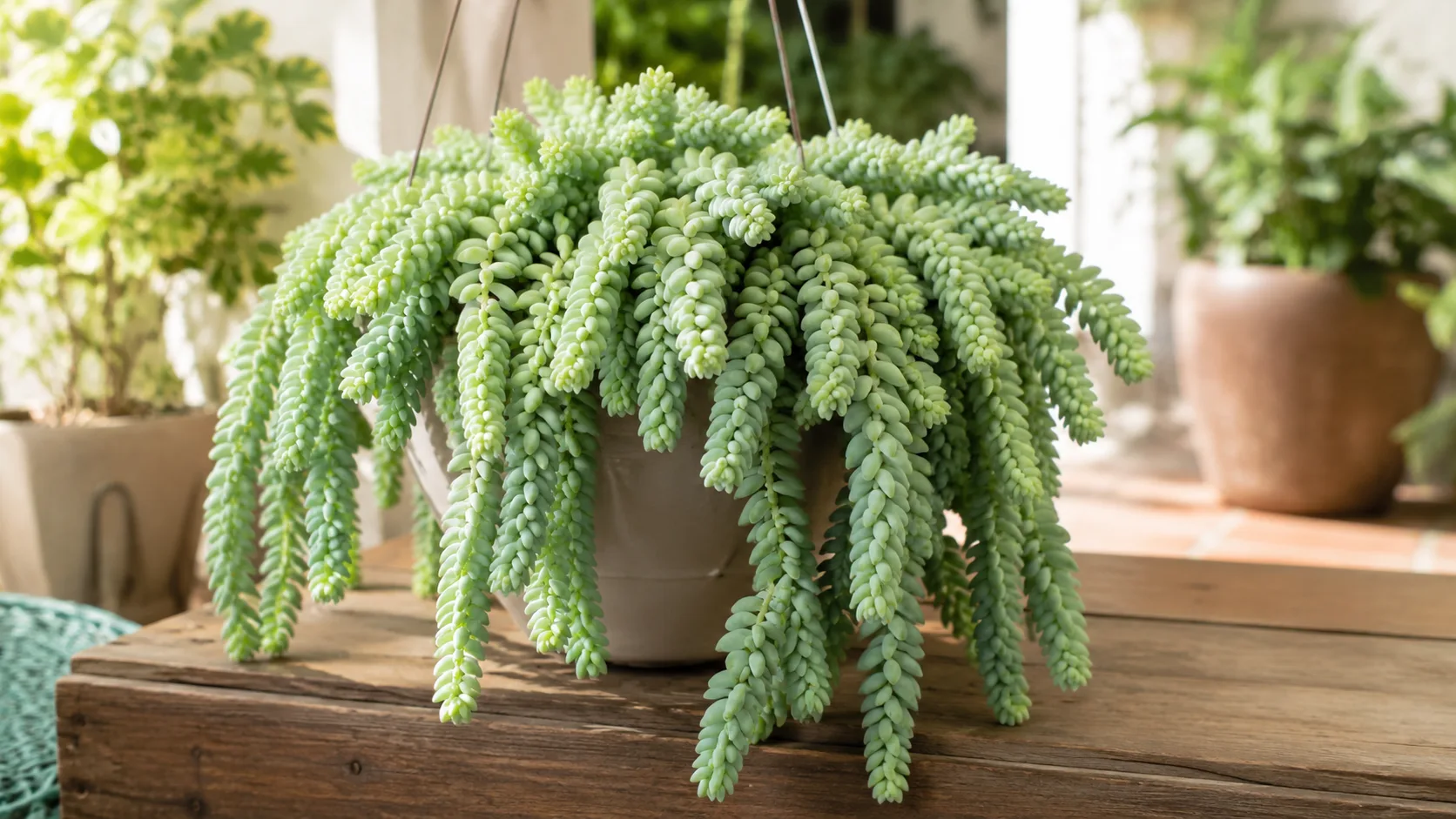
A Burro’s Tail can look like the most effortless plant in the shop - until light is wrong. Then the same trailing succulent stretches into thin, gappy strands, bleaches to a washed-out green, or drops leaves every time you bump the pot. The frustrating part is that Sedum morganianum tolerates mediocre light long enough to make you think the placement is fine. It is not a pothos and not a snake plant. It is a high-light cliff succulent squeezed behind window glass, and it will eventually tell you - through widened leaf spacing, pale new growth, or scorched farina - whether it agrees with your window choice.
This guide covers the full indoor light picture for Burro’s Tail: how much brightness it actually needs, which window works best, how much direct sun is safe, what too much and too little light look like on the plant, when to add a grow light, why hanging placement creates a hidden light trap, and how to move the pot without triggering the leaf drop Burro’s Tail overview is famous for.
The Short Answer: How Much Light Burro’s Tail Needs
Burro’s Tail grows best with bright light for most of the day - ideally four to six hours of strong ambient brightness plus two to three hours of gentle direct morning sun falling on the leaves themselves, not just on the room. The NC State Extension Gardener Plant Toolbox lists Sedum morganianum as needing full sun (six or more hours of direct sunlight daily) or partial shade (two to six hours of direct sun) outdoors, and recommends high light interior environments such as a windowsill with at least partial sun for indoor culture. In practical indoor terms, that means placing the plant directly in or within one to two feet of your brightest east- or south-facing window, or a filtered west window, where the trailing stems and the crown at the pot rim both receive usable light.
A north-facing room without supplemental lighting is a poor long-term setup. A plant hanging six feet from a sunny window is almost certainly under-lit, even if the room looks bright to your eyes. The Old Farmer’s Almanac notes that Burro’s Tail is more sensitive to direct afternoon sun than many other succulents and usually fares best in bright locations with some afternoon shade or filtered light. If your home cannot deliver that naturally, a full-spectrum LED grow light run 12 to 14 hours daily is the practical substitute. Judge success by firm, closely spaced new leaves on compact stems, not by whether the pot looks decorative in a dim corner.
Why Burro’s Tail Needs Bright Light More Than a Dim Corner Allows
Light is not a background detail for Burro’s Tail. It is the main driver of leaf spacing, stem thickness, color, and the dense rope-like texture that makes the plant worth the shelf space. A Sedum morganianum in strong, appropriate light will use water on a predictable rhythm, hold leaves tightly along each stem, and maintain the powdery blue-green farina that gives healthy plants their signature look. A plant in dim light will drink slowly, stay wet longer, produce smaller paler leaves with visible gaps between them, and often shed leaves at the slightest touch because the stems are structurally weak.
That matters because Burro’s Tail is often grouped with generic succulents that “like sun” without nuance. Jade plant and many echeverias can sit in harsh south-window sun and redden happily. Burro’s Tail wants brightness but punishes sustained hot afternoon exposure on unacclimated tissue. Get the light wrong in either direction and you get etiolation and leaf drop in low light, or bleached farina and scorch in excessive direct sun. The goal is not maximum sun at all costs - it is maximum usable brightness without cooking the leaves.
What the Mexican Cliff Habitat Tells Us About Window Placement
In its native range in Veracruz, Puebla, and Chiapas, Mexico - with populations also reported in the Dominican Republic - Sedum morganianum grows on vertical rock cliffs and sheltered ravines where it receives strong ambient light reflected off stone, plus a few hours of gentler direct sun before the hottest part of the day. NC State Extension describes the species as tolerant of rocky, poor, well-drained soils and drought. The plant did not evolve in deep forest shade. It evolved where bright, dry, airy conditions keep stems compact and leaves plump.
That habitat maps to the brightest safe indoor position you can offer, not a soft filtered spot suited to calatheas or ferns. You are not trying to recreate a dark hallway. You are trying to give the plant as much usable light as window glass allows - then filtering or distancing it slightly from the harshest afternoon beam. An east windowsill, or a south or west window set back a foot or filtered with a sheer curtain during peak hours, is the closest indoor analogue most homes can provide.
What Bright Indirect Light and Gentle Direct Sun Mean Indoors
“Bright indirect light” indoors means the plant sits in a well-lit room where most of the day is strong reflected and ambient light, with direct sun either absent or limited to soft morning rays. For Burro’s Tail, that phrase is only half the story. The plant also benefits from some direct sun - typically morning exposure - because total daily brightness near a window still falls well below outdoor cliff-side intensity. Even a south-facing windowsill at noon delivers a fraction of what the plant would receive in open Mexican highland sun, yet that windowsill is still far brighter than the center of most living rooms.
The better question is not “direct or indirect?” in the abstract. It is: Does strong light actually fall on both the trailing stems and the crown for multiple hours, and is any direct beam gentle enough to avoid scorching the farina? Intensity drops sharply with distance. A Burro’s Tail whose cascading strands hang into a sunbeam while the pot rim sits in shadow will thin at the base over time. Burro’s Tail needs the light on the whole plant, not only on the decorative trailing portion.
Why Window Glass and Farina Change the Light Equation
Window glass filters ultraviolet light and reduces overall intensity, but it also concentrates heat on leaves pressed against the pane. A strand that tolerates east-window morning sun in March may scorch in July when the same beam carries more heat through south or west glass. Low-E and tinted windows reduce intensity further, which can starve Burro’s Tail if you already sit at the minimum threshold.
The farina - the waxy powdery coating on healthy leaves - is both protection and a diagnostic surface. It diffuses light and reduces water loss, but it also makes sun damage visible as washed-out, patchy, or rubbed-off areas rather than the red stress color you see on jade. Human eyes adapt to indoor dimness faster than you notice. A simple test: hold your hand between the plant and the window around midday. A sharp, dark shadow on the leaves means direct sun is hitting the plant - usually fine for morning east exposure, risky for unfiltered west exposure at midsummer. Almost no shadow means the spot is too dim for long-term compact growth.
Best Window Placement for Burro’s Tail Indoors
The best window for Burro’s Tail is the one that delivers strong brightness for most of the day with gentle direct sun and protection from harsh afternoon heat. Distance matters as much as direction. Place the pot on the sill or within one to two feet of the glass, or hang the basket so the crown sits at window height, not so high that only the dangling tails catch light while the base fades. Rotate the pot or basket a quarter turn every week or two so growth does not lean permanently toward one side. Dust on leaves reduces usable light slightly; a dry soft brush or gentle rinse removes debris without rubbing off farina more than necessary.
If the pot rim or leaves near the glass feel hot to the touch at midday, pull the plant back slightly or add a sheer curtain during peak hours while keeping bright exposure for the rest of the day.
East and South Windows: The Indoor Sweet Spot
An east-facing window is the default recommendation for Burro’s Tail indoors. Soft morning direct sun gives the plant the energy it needs for compact, healthy growth without the punishing afternoon intensity that can bleach or burn leaves. Almanac guidance aligns with this: morning sun with afternoon shade or indirect light works better than all-day harsh exposure for this species.
A south-facing window in the Northern Hemisphere is the second-strongest option and often excellent in winter when the sun path is lower and less intense. In summer, set the plant one to two feet back from the glass or filter the window with a sheer curtain during the hottest two to three hours. South light keeps the dense trailing form through short winter days better than east light alone, but watch for farina bleaching if the plant sits flush against hot glass from noon onward.
West and North Windows: When They Work and When They Fail
A west-facing window can work when the plant is acclimated and filtered. West light is warm and arrives during the hottest part of the day, which is exactly when Burro’s Tail is most vulnerable to scorch. New nursery purchases should not go directly into unfiltered west sun at midsummer. Use a sheer curtain, hang the plant slightly farther from the glass, or combine west ambient brightness with a short morning boost from a grow light rather than raw afternoon beams.
A north-facing window is inadequate for long-term Burro’s Tail health in most homes. The plant may survive for months with slow, pale growth and widening gaps between leaves, but it will not maintain the dense cascading look that defines the species. Etiolated stems, persistent leaning toward any brighter source, and increased leaf drop at the slightest disturbance are predictable outcomes. If north is your only option, treat a grow light as required, not optional, and run it long enough each day to replace what an east or south window would provide.
| Window direction | Typical light profile | Suitability for Burro’s Tail |
|---|---|---|
| East | Morning direct sun, then bright indirect | Best default for compact growth without scorch risk |
| South | Strong direct sun most of the day | Excellent with distance or summer filtering |
| West | Warm afternoon direct sun, intense in summer | Good when acclimated and filtered; risky unfiltered at peak heat |
| North | Bright indirect at best, often dim | Inadequate long-term without grow lights |
Can Burro’s Tail Take Direct Sun?
Yes - Burro’s Tail can take direct sun indoors when the exposure is acclimated, timed, and not overwhelmingly hot, but it is not the “more sun is always better” succulent that jade or many cacti are. NC State Extension lists full sun as an outdoor cultural condition, and indoor growers often interpret that as permission to bake the plant on a south sill year-round. Almanac and experienced growers consistently add the nuance: strong afternoon direct sun scorches leaves, turning them from powdery blue-green to washed-out yellow or brown scarred patches.
The distinction that saves most plants is acclimation, duration, and time of day, not avoiding direct sun altogether. Two to three hours of gentle morning direct sun on an east window is ideal. Several hours of filtered south-window sun also works. Problems occur when a plant moves suddenly from low nursery light or a dim interior spot into unfiltered midday or afternoon sun, or when root-zone heat on a dark windowsill combines with intense exposure on unacclimated tissue. If leaves bleach only on the window-facing side during peak hours, filter or pull back slightly rather than relocating to a dim room - you likely need softer direct sun, not less total light.
Warning Signs Your Burro’s Tail Is Getting Too Much Light
Too much light - or more accurately, too much light too fast or at the wrong time of day - shows up on Burro’s Tail as tissue damage and farina loss rather than slow stretching. The most common signs include bleached or silvery patches on sun-facing leaves where the powdery coating has been damaged; brown, crispy scorched spots that feel dry and do not plump back up; washed-out yellow-green color across exposed strands; shriveling or wrinkling during the brightest hours even when soil is appropriately dry; and sudden leaf drop after a move to a much sunnier spot, sometimes before visible scorch appears because the stress response is fast in this species.
These symptoms are easy to confuse with underwatering on Burro’s Tail, but timing and location tell the story. Sun stress usually follows a placement change, a seasonal shift when June sun strengthens, or contact with hot glass at midday. Damage is often one-sided, concentrated on leaves facing the window or on the upper strands that receive the strongest beam while lower shaded leaves still look normal. Underwatering stress builds more gradually across the whole plant and is usually accompanied by a very light, very dry pot rather than a sudden move to brighter exposure.
How to Recover a Sun-Stressed Burro’s Tail
Move the plant immediately to a spot with bright light but no harsh direct beam on damaged tissue - one foot back from the window, behind a sheer curtain, or to an east exposure temporarily. Do not compensate by overwatering on Burro’s Tail; stressed leaves do not recover faster in wet soil, and soggy roots add a second problem in a plant that already transpires less when damaged. Leave partially scorched leaves in place unless they are fully brown and dry; the plant may still photosynthesize with them while pushing new growth from the crown.
Give the plant two to four weeks in stable, slightly softer light before judging recovery. Old bleached or crispy tissue will not turn powdery blue-green again. Your success metric is new leaves: plump, closely spaced, correctly colored leaves emerging at stem tips and the crown. Once new growth looks healthy, acclimate back toward your target bright window using the schedule below - slowly this time. Handle the pot as little as possible during recovery; leaf drop increases when the plant is both sun-stressed and physically disturbed.
Warning Signs Your Burro’s Tail Is Not Getting Enough Light
Insufficient light is the slower, quieter failure mode - and the more common one indoors. Burro’s Tail can survive in dim conditions longer than it can survive scorch, which is why so many plants linger in living rooms looking “alive” while gradually losing the dense tail that made you buy them. Warning signs include elongated stems with noticeable gaps between leaves, a condition called etiolation; smaller, paler new leaves compared to older compact growth; thin, weak strands that shed leaves when brushed or watered; strong one-sided leaning toward the nearest window; slow or absent new growth for months, especially in spring and summer; and an overall loss of the braided, rope-like texture as internodes stretch.
Low light also changes how the plant uses water. A dim plant transpires less, so soil stays wet longer. That wetness invites root problems, and yellowing leaves from root stress can look similar to overwatering damage - except the plant will show no bleaching on a sun-facing side, will sit far from any window or hang above one with only the tails lit, and will display stretched internodes rather than compact new growth. If your Burro’s Tail is yellowing in a dim spot with soil that never dries, fix light first, then adjust watering to match the slower metabolism.
Leggy etiolation cannot be reversed on existing stem sections. Recovery requires more usable light, not just rotating the pot in the same dim room. Move to the brightest safe window, add a grow light aimed at the crown as well as the trails, or both - then increase brightness gradually so you fix low light without triggering sunburn on tissue that adapted to shade.
Light, Leaf Drop, and Why the Crown Needs Sun Too
Burro’s Tail is famous for dropping leaves when touched, watered, or looked at sideways - and light stress makes that trait worse. A plant moved from low light to moderate light, or from moderate light to harsh sun without acclimation, may shed dozens of leaves within days even if the new spot would be correct long term. That leaf drop is a stress response, not always a death sentence, but it is why gradual acclimation and minimal handling matter as much as final placement.
There is a placement trap specific to trailing succulents: hanging the basket high so the cascading strands look beautiful in the window beam while the crown and upper stems sit in relative shadow. Over months, the base thins, new growth at the pot rim weakens, and the plant looks lush at the tips but hollow near the soil. The fix is to hang or shelf the plant so the crown receives the same quality of light as the longest strands, or supplement with a grow light angled to illuminate the top of the pot, not only the hanging tails. Burro’s Tail is not a plant where only the decorative drape needs sun; the entire photosynthetic surface drives the next season of compact growth.
How Light Changes Watering, Growth Speed, and Leaf Density
Every light change changes how fast your Burro’s Tail drinks. A plant in strong east- or south-window light transpires actively and may need water every ten to fourteen days in a warm room during the growing season, always checking that the soil is fully dry first. The same plant moved to a dim corner might need water every three to four weeks - or less - because it is photosynthesizing and losing moisture more slowly. Water on soil dryness and plant metabolism, not on a fixed calendar that worked last month in a different spot.
Bright light also increases the plant’s appetite for nutrients during active growth, but feeding a plant in dim light heavily will not replace missing photons. Light, water, and fertilizer move together. Changing light without adjusting water is the most common reason an otherwise healthy Burro’s Tail develops yellow leaves, soft stems, or root stress after a move. NC State Extension recommends allowing soil to dry between waterings and reducing water in winter - and winter dimness in many homes effectively doubles the dry-down time even if you do not move the pot.
Growth speed follows the same logic. In bright spring and summer light, Burro’s Tail can add noticeable length with tightly packed new leaves every few weeks on a mature plant. In low winter light, growth slows sharply - and that is normal. Do not water heavily or fertilize aggressively to “wake up” a winter plant in a dim spot; give it the best light you can, extend dry intervals, and wait for longer days to do the rest. Leaf density - the signature look of the species - is almost entirely a light outcome. Correct watering and soil help, but they cannot compress internodes that stretched because the plant was searching for photons.
Grow Lights for Burro’s Tail: Setup, Hours, and Distance
When natural light is insufficient - north rooms, interior offices, short winter days, or apartments blocked by neighboring buildings - a full-spectrum LED grow light is the most reliable fix. Burro’s Tail needs more intensity than pothos or ZZ plant, so a decorative warm-white desk lamp will not substitute for a window. Aim for a fixture rated for vegetative or full-cycle growth, not a bare incandescent bulb that adds heat without useful spectrum.
Start with 12 to 14 hours of light daily on a timer. Place the fixture 12 to 18 inches (30 to 45 cm) above the crown and upper stems, angled so trailing portions also receive meaningful brightness - not only the top inch of the plant. Closer placement increases intensity but also heat; if leaves near the bulb look pale, tight, or slightly crisp at the tips, raise the fixture a few inches. Farther placement reduces intensity - if internodes stretch toward the bulb, lower it slightly or extend daily duration by an hour rather than cramming the plant against the heat source.
Choose a full-spectrum LED in the 4000K to 6500K range and run it on a timer. Combine artificial light with the brightest natural window you have when possible. A working setup produces new leaves matching older compact growth in spacing and color within four to six weeks. Grow lights maintain the dense trailing form; they do not fully replace the quality of a good east or filtered south window, but they prevent the slow etiolation that ruins the plant over a single dim winter.
Hanging Burro’s Tail: Light Traps That Thin the Crown
Hanging baskets show off Burro’s Tail better than almost any other container - and create the most common light mistakes. The first trap is height: a basket hung near the ceiling may sit above the window frame, leaving the crown in the dim upper room while only the lower trails reach the beam. The second trap is depth: a basket hung far in front of the window places the pot in the room while strands reach back toward the glass, lighting the tips but starving the base. The third trap is sheer curtains drawn for furniture comfort, which cut the light the plant needs while the trailing portion still looks green enough to hide the problem until the crown collapses.
The practical fix is to treat the crown’s light level as the limiting factor. Hang the basket so the soil surface is roughly level with the top third of the window, or use a wall-mounted shelf at sill height instead of a high ceiling hook. If the display must hang high for design reasons, add a secondary grow light focused on the pot rim. Check monthly: new growth emerging at the base should be as compact as growth at the strand tips. If base leaves are sparse, pale, or falling while tips look fine, you have a crown light problem, not a watering problem.
How to Move Burro’s Tail Without Scorch or Shock
Burro’s Tail reacts badly to sudden light changes - and badly to being moved at all. You may see leaf drop, scorch, or stalled growth within days even when the new spot is technically correct long term. The fix is gradual acclimation and minimal physical disturbance: increase brightness in small steps over seven to fourteen days so existing leaves adjust before exposure peaks, and avoid Burro’s Tail repotting guide, heavy pruning, or relocating the hanging hook at the same time.
When moving to brighter light, start by placing the plant in the new room but farther from the window than your final position, or filter the window with a sheer curtain. After four to five days with no bleaching and minimal leaf drop, move it closer or remove one layer of filtering. When moving from bright to dimmer light - rarely necessary except during heat emergencies - expect some etiolation on new growth and reduce watering immediately to match the slower metabolism. Make one change at a time. Do not simultaneously repot, fertilize, and move to a new window. Burro’s Tail already stalls when stressed; stacking changes makes it impossible to know which variable caused the reaction.
A Simple 7–14 Day Acclimation Schedule
For a plant moving from moderate indoor light to a bright east window or filtered south window, use this schedule. Slow down if you see bleaching or heavy leaf drop - hold the current step for extra days rather than pushing through damage.
Days 1–4: Place the plant in the new room at double your intended final distance from the window, or behind a sheer curtain. Water only when fully dry. Handle the pot as little as possible. Watch for bleaching, sudden widespread leaf drop, or shriveling at midday.
Days 5–9: Move halfway to the final position, or remove one curtain layer. Rotate the pot a quarter turn every few days if light is strongly directional. Continue minimal handling.
Days 10–14: Move to the final placement on or near the sill, or to the final hanging height with the crown in the beam. Keep monitoring new growth for three more weeks before treating the move as complete.
If leaves bleach during acclimation, hold at the current step for several extra days rather than advancing. Plump new leaves at stem tips are the green light to continue. Ongoing bleaching with repeated leaf drop means the target spot may still be too intense at peak hours - filter midday sun while keeping morning and late-afternoon brightness.
Conclusion
Burro’s Tail light needs come down to one practical target: bright, usable light at both the crown and the trailing stems, with gentle direct morning sun when possible and protection from harsh afternoon heat. An east or filtered south window within one to two feet of the glass, supplemental grow lights in winter or dim rooms, and careful hanging height give Sedum morganianum the best shot at the dense, powdery cascades you see in reference photos. North windows and high-hanging baskets that light only the tails are survival placements, not thriving ones.
Read the plant, not the room. Plump, closely spaced new leaves on firm stems mean the placement works. Bleached farina, one-sided scorch, and sudden leaf drop after a move mean too much light too fast. Long gappy strands, pale weak growth, and leaves that fall at a touch mean too little. Change exposure gradually, adjust watering when light changes, keep the crown in the beam, and judge success by new leaf spacing at the stem tips - not by whether old stretched sections compact again, because they will not. Get the window right and the rest of Burro’s Tail care becomes simpler; get it wrong and no amount of careful watering will restore the rope-like tail that sold you on the plant.
When to use this page vs other Burro’s Tail guides
- Burro’s Tail overview - Start here for whole-plant context before deep-diving this topic.
- Burro’s Tail problems hub - Jump to symptom-specific fix guides when this care topic does not resolve the issue.
- Not Enough Light on Burro’s Tail - Escalate here when light adjustments are not enough.
- Leggy Growth on Burro’s Tail - Escalate here when light adjustments are not enough.
Related Burro’s Tail guides
- Burro’s Tail overview
- Burro’s Tail watering
- Burro’s Tail soil
- Burro’s Tail propagation
- Burro’s Tail fertilizer
- Burro’s Tail repotting
- Not Enough Light on Burro’s Tail
- Leggy Growth on Burro’s Tail
- Burro’s Tail problems
Related tool
Try the Plant Problem Diagnosis Tool with burros-tail pre-selected to estimate needs for your setup.