Potassium Deficiency on Blue Star Fern: Causes, Checks &
Quick answer
Potassium deficiency on Blue Star Fern shows as yellow-tan scorch and crisping along the lobes of the oldest, lowest fronds draping over the pot rim, while newer lobes unfurling from golden rhizome tips often stay blue-green longer. First step: confirm edge-first burn on several mature lower blades—not interveinal banding mid-lobe—and review months without complete feed before one dilute balanced drench at the outer soil edge.

Potassium Deficiency on Blue Star Fern: Causes, Checks & Fixes
This guide covers potassium deficiency on Blue Star Fern. See also the general Potassium Deficiency guide, watering, and light pages for this plant.
Potassium Deficiency on Blue Star Fern: Causes, Checks & Fixes
Quick answer
Potassium deficiency on Blue Star Fern (Phlebodium aureum) shows as yellow-tan scorch and crisp brown tissue along the lobes of the oldest, lowest fronds draping over the pot rim, while newer lobes unfurling from golden rhizome tips often stay blue-green longer. Potassium is absorbed in large quantities and, once in the plant, is very mobile and transported to young tissues rapidly—when roots cannot supply enough, the fern strips potassium from mature lower blades first. Older leaves show chlorosis with browning of tips, scorching of margins, and brown spots near the margins in classic potassium shortage.
See our potassium deficiency guide for general N-P-K mechanics. On Blue Star Fern, walk the lowest lobed fronds along the golden rhizome carpet before you fixate on the newest unfurling lobe—edge-first scorch on several draping blades differs from magnesium deficiency (yellow between veins mid-lobe) and iron deficiency (pale new rhizome-tip lobes with green veins).
First step: confirm marginal scorch on multiple oldest lower fronds, then check for salt crust and feeding gaps before one dilute complete fertilizer drench at the pot rim.
When to use this page vs other Blue Star Fern guides
| Pattern | Read next |
|---|---|
| Brown-yellow scorch along lobe edges of oldest lower fronds | Potassium deficiency (this page) |
| Yellow between green veins on oldest lower fronds | Magnesium deficiency |
| Pale new lobe with green veins at rhizome tip | Iron deficiency |
| Uniform pale older fronds without strong edge pattern | Nitrogen deficiency |
| Scorched margins right after heavy feeding | Brown tips from salt injury |
| All fronds yellow, wet mix, mushy rhizomes | Overwatering or root rot |
| Washed-out blue cast, long gaps between lobes | Pale leaves or not enough light |
| Multiple yellow causes at once | Yellow leaves |
What potassium deficiency looks like on Blue Star Fern
Healthy Blue Star Fern holds thick, lobed, blue-green fronds on creeping rhizomes densely covered in golden scales, spreading across a shallow pot or hanging basket. Potassium stress breaks that pattern on the oldest lower fronds nearest the pot rim—not on the softest new rhizome-tip lobe first.
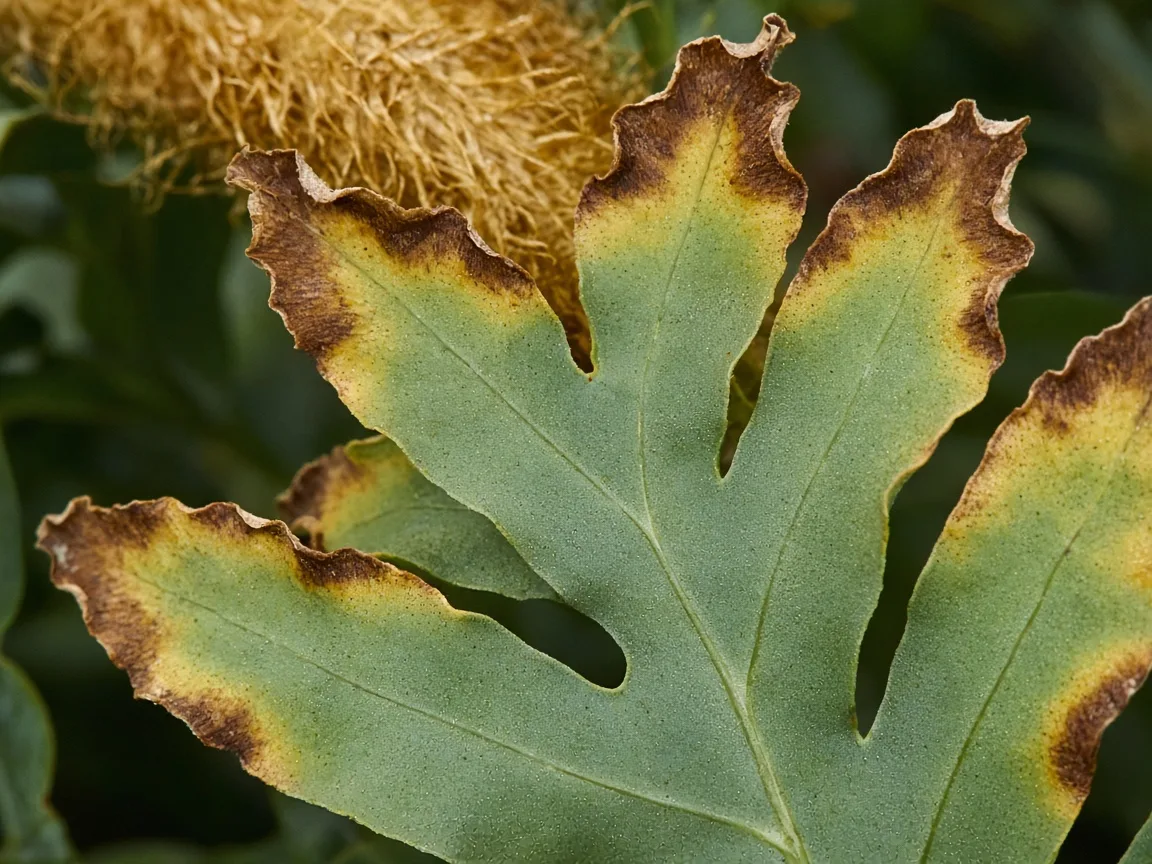
Marginal chlorosis and tan scorch along the wavy lobe edge of an older lower frond while tissue toward the midrib stays greener—mobile potassium loss on blades just above the golden rhizome line.
Typical signs:
- Yellow-tan band along the outer lobe margins of several oldest fronds on the lowest ring—the burn often starts at the lobe edge and creeps inward while the midrib zone stays greener longer
- Crisp brown marginal tissue on mature lobed blades, not soft translucent mush from rot
- Newer rhizome-tip lobes stay blue-green for weeks while lower draping fronds show repeated edge scorch
- Slow spread along the lower skirt as more old blades gain similar margin damage during warm active growth
- Firm golden rhizomes and frond bases unlike overwatered ferns with sour mix and blackened rhizomes
- Slight limpness at scorched lobe tips in advanced cases when potassium cannot support normal stomatal regulation in leaf tissue
Not potassium deficiency:
- Interveinal yellow between veins on lower fronds while margins stay relatively green—magnesium deficiency
- Pale new lobe with dark green veins at the rhizome tip—iron deficiency
- Uniform dull yellow on lowest fronds without a clear edge-first scorch band—nitrogen deficiency
- Single lobe tip crisping after you poured concentrate on dry mix—salt injury; see brown tips
- Brown patches on the sun-facing lobe face after a window move—often light stress per NC State Phlebodium culture notes, not mobile potassium redistribution
Deficiency symptoms for potassium show up first on lower leaves as flecking or mottling on the leaf margins, with prolonged deficiency resulting in necrosis along the leaf margins. Marginal and interveinal chlorosis can progress to necrosis on affected foliage. On a rhizomatous fern, “lower leaves” means the oldest lobed blades draping over the pot edge you see from across the room.
Why Blue Star Fern gets potassium deficiency
Blue Star Fern is a rhizomatous epiphyte that spreads by creeping rhizomes and adds lobed fronds at the rhizome tips indoors. NC State Extension describes Phlebodium aureum as needing partial sun, medium to high humidity, good air circulation, and a moist but not soggy organic substrate. Many containers leach mobile potassium through frequent summer watering while owners pause fertilizer all winter—or feed nitrogen-heavy formulas without enough potassium for long runs.
Blue Star Fern–specific causes:
- Leached bark–perlite mix in a shallow hanging basket — Thorough drinks through airy Blue Star Fern soil drain potassium faster than slow rhizome spread replaces it when you skip complete feed for a full season.
- Nitrogen-forward feeding without balanced K — Pushy leafy formulas keep inner fronds deep blue-green while potassium in the root zone depletes; margin scorch on the lower ring is the early warning. See Blue Star Fern fertilizer.
- Years in the same wide shallow pot — Slow spread across golden rhizomes can mask depletion until the lowest fronds scorch at the lobe edges.
- Blocked uptake on wet roots — Chronic saturation in a cachepot limits absorption even when potassium is present; fix overwatering before drenches.
- Competing ions after salt buildup — White crust on the rim can signal excess soluble salts that injure margins and disturb uptake until you flush—overlap with brown tips, not always true deficiency.
- Misread magnesium or iron problems — Mid-lobe interveinal banding is magnesium; pale new rhizome-tip veins are iron—not margin scorch on old lower lobes.
Do not diagnose potassium shortage on sour wet mix with mushy rhizomes—that is root failure until you confirm mostly firm golden rhizomes and normal dry-down per Blue Star Fern watering.
Lowest lobes along the golden rhizome carpet
Potassium deficiency on Blue Star Fern shows on the oldest lobed blades sitting just above the creeping rhizomes—a pattern that would be meaningless on a vining pothos or a single-crown snake plant. The species invests new tissue at rhizome tips while mobile potassium exits mature lower fronds first.
Walk the pot from the rim inward along the rhizome: if several lowest fronds share tan scorch along their lobed margins while the next unfurling lobe at the tip stays evenly blue-green, potassium belongs on the list. If every new lobe emerging from the rhizome looks pale with green veins, switch to iron deficiency. If lower fronds show yellow between veins without strong edge burn, read magnesium deficiency.
Because Blue Star Fern fronds are broad and sculptural, one scorched lower lobe is visible from across the room—use that blade as your diagnostic anchor before changing fertilizer, mix, or pot size.
Shallow basket leaching and the summer lobe push
Indoors you water along the pot rim to keep frond crowns dry—correct for epiphytic culture per Gardening Channel’s Blue Star Fern guidance—but frequent summer drinks through open bark-heavy mix wash mobile ions including potassium. A fern that unfurls several lobes in bright filtered light can outpace a feeding schedule suited to a dim-corner plant adding one blade a year.
The diagnostic split:
- Functional roots, credible feed gap — Top 3–4 cm dries between drinks; rhizomes firm; outer lobe margins scorch on multiple old fronds while rhizome-tip growth stays green. One measured complete feed at the rim after history review fits depletion.
- Salt injury history — Scorched margins appeared within days of heavy feed on dry mix or crust rings the pot. Flush with plain water and reduce strength before assuming deficiency.
- Stalled uptake — Mix stays dark and clings for many days; fronds limp on wet soil. Fix oxygen and dry-down before potassium drenches per overwatering.
Never pour potassium feed over exposed golden rhizomes
Blue Star Fern is grown partly for its fuzzy golden rhizomes crawling over the mix surface in hanging baskets or wide shallow pots. Gardening Channel recommends watering the soil directly and avoiding wetting the leaves when possible, and the same caution applies to fertilizer solutions.
Apply any potassium-bearing complete liquid only at the outer pot edge on already-moist mix—the same safe zone as routine watering. Pouring concentrate over exposed rhizomes or wet frond crowns risks rot and will not correct margin scorch on lower fronds when rim roots are healthy.
This rhizome-surface rule is specific to hare’s-foot ferns; it does not apply to funnel-shaped nest ferns or terrestrial rosette succulents.
Lookalike symptoms
| Pattern | Check | Likely cause |
|---|---|---|
| Edge scorch on several oldest lower fronds | Months without complete feed, firm rhizomes | Potassium deficiency (this page) |
| Yellow between veins on lower fronds | Magnesium on label, band mid-lobe | Magnesium deficiency |
| Pale new rhizome-tip lobe, green veins | Alkaline water, wet mix | Iron deficiency |
| Uniform pale lowest fronds | No nitrogen feed | Nitrogen deficiency |
| Tip burn after heavy feed | Salt crust, timing | Brown tips |
| All yellow, wet pot, soft rhizomes | Smell, rhizome softness | Overwatering |
| Crispy patches on sun-facing lobes | Window move | Brown leaves |
How to confirm
- Margin pattern on lower fronds — edge-first yellow-brown scorch on multiple lowest lobed blades, not only one physically bumped lobe.
- Age split — outer old fronds scorched, rhizome-tip unfurling lobe relatively green strengthens potassium over iron.
- Magnesium cross-check — interveinal banding mid-lobe without margin lead-in points elsewhere.
- Rhizome firmness — mushy, blackened rhizomes rule out simple starvation until rot is addressed.
- Feed and salt history — complete fertilizer during last warm season vs nitrogen-only or long pause; white rim crust after heavy doses.
- Moisture cross-check — chronic wet core in a sealed cachepot blocks uptake until roots recover.
- Growth context — stalled slow growth in winter is normal; margin scorch spreading during active unfurling is not.
First fix for Blue Star Fern
Confirm marginal scorch on multiple oldest lower fronds—not interveinal mid-lobe banding and not pale new rhizome-tip veins—before any fertilizer.
Once the pattern matches and rhizomes are firm with functional dry-down:
Apply one half-strength dose of complete balanced liquid houseplant fertilizer (with potassium in the N-P-K analysis) slowly around the outer pot rim on already-moist mix during active late-spring or summer growth, letting a small amount drain from the bottom. Follow label dilution for container plants; record the date so you can read the next unfurling lobe response.
Do not feed a waterlogged pot, a fern with mushy rhizomes, a plant you repotted within the last month, or a cold stalled specimen with no new lobes. If white salt crust is heavy, flush once with plain water over a week before the measured feed.
Step-by-step recovery
- One complete fertilizer drench at half strength at the outer rim on moist mix during warm active growth.
- Flush salts if crust rings the pot—leach with plain water, then resume with a balanced formula.
- Adjust watering so the top 3–4 cm dries between drinks per watering—uptake fails in chronic wet mix.
- Wait six to eight weeks before a second measured dose if outer scorch spreads but rhizomes stay firm—do not feed weekly on a slow fern.
- Repot into fresh bark-heavy mix if rhizomes fill the shallow pot and margin scorch persists after two measured treatments—see repotting.
- Trim fully dead marginal tissue only when lobes are mostly brown; do not strip half the plant if upper fronds still photosynthesize.
- Monitor the next unfurling lobe from the rhizome tip for clean margins without edge burn.
Mistakes to avoid
- Feeding before rhizome and moisture check — Fertilizer on rotting tissue worsens stress and will not fix scorch.
- Pouring feed over golden rhizomes — Surface rot risk outweighs any shortcut for lower-frond margins.
- Confusing magnesium, iron, and potassium — Mid-lobe vein banding is magnesium; pale new rhizome-tip veins are iron; edge scorch on old lower lobes is potassium.
- Heavy nitrogen after margin scorch appears — More leafy push without potassium deepens lower-ring burn.
- Expecting old fronds to re-green — Judge recovery by fresh rhizome-tip unfurling margins, not by lower blades darkening again.
- Repeating strong feeds on salt-crusted mix — Flush first; otherwise margins burn worse.
Recovery timeline
Correct potassium on healthy roots shows cleaner margins on the next one or two unfurling lobes within four to eight weeks during warm active growth. Older scorched lower blades rarely return to perfect blue-green; the rhizome slowly replaces them as new fronds uncurl.
Full lower-ring refresh on a large specimen may take one warm season because Blue Star Fern spreads gradually. If three successive new lobes show edge burn after two measured feeds with firm rhizomes, reassess salt injury, light, and overlapping pale leaves causes.
Prevention
- Feed with complete balanced fertilizer at quarter to half strength during active late spring and summer per the fertilizer guide—pause when winter unfurling stalls.
- Apply all feed at the outer rim, never over exposed rhizomes or wet frond crowns.
- Flush salts mid-season if you use hard tap water or feed on a schedule suited to faster tropicals.
- Refresh bark-heavy mix every two years when repotting slow-spreading rhizomes.
- Pair nutrition with adequate humidity and indirect light so fronds can use what you supply.
Related Blue Star Fern guides
- Blue Star Fern overview — species baseline and care hub
- Blue Star Fern problems — full symptom index for this fern
- Blue Star Fern fertilizer — dilute feed timing and salt mistakes
- Blue Star Fern watering — soil-line watering that pairs with nutrient uptake
- Blue Star Fern soil — airy bark mix that holds nutrients without waterlogging
- Magnesium deficiency — interveinal yellow on oldest lower fronds
- Iron deficiency — pale new rhizome-tip lobes with green veins
- Nitrogen deficiency — uniform pale older fronds
- Yellow leaves — moisture-first diagnosis when color shifts broadly
Scope note: Use this page when oldest lower fronds show edge-first scorch on firm rhizomes. Use magnesium deficiency when yellow sits between veins mid-lobe; use iron deficiency when the new rhizome-tip lobe is pale with green veins; use overwatering when rhizomes soften on wet mix regardless of margin color.
Conclusion
Brown-yellow scorch along the lobed margins of the lowest Blue Star Fern fronds is a potassium signal during warm active growth—confirm the pattern stays off the newest rhizome-tip unfurling, verify firm golden rhizomes, rule out salt burn and waterlogged mix, then apply one measured complete fertilizer drench at the pot rim on moist soil.
Related tool
Use the Fertilizer Dilution Calculator to narrow causes for potassium deficiency on this plant before changing multiple variables at once.