Brown Leaves on Blue Star Fern: Causes, Checks & Fixes
Quick answer
Brown leaves on Blue Star Fern usually mean large sections of a frond—not just crispy edges—are dying. First step: press the golden rhizomes at the soil surface; mushy brown rhizomes with a heavy wet pot point to rot, while firm rhizomes and dry papery brown on outer fronds point to thirst or low humidity.

Brown Leaves on Blue Star Fern: Causes, Checks & Fixes
This guide covers brown leaves on Blue Star Fern. See also the general Brown Leaves guide, watering, and light pages for this plant.
Brown Leaves on Blue Star Fern: Causes, Checks & Fixes
Quick answer
Brown leaves on Blue Star Fern (Phlebodium aureum) mean more than a crispy margin—whole lobed fronds or large tan-to-brown patches are dying while golden rhizomes still crawl across the pot rim. That pattern is different from brown tips, where edges crisp while most of each frond stays blue-green.
For how brown foliage develops on houseplants in general, see our brown leaves guide. On Blue Star Fern, split rhizome health from frond color first: soft brown rhizomes on a heavy wet pot point to overwatering or root rot, while firm golden rhizomes with dry papery brown on outer fronds usually mean thirst, low humidity, or one frond reaching the end of its life.
First step: press the golden rhizomes at the soil surface with a clean finger. Mushy, dark, or sour-smelling tissue means stop watering and inspect roots before any soak. Firm rhizomes with brown only on older outer fronds mean read the top 3–4 cm of mix at the pot edge and humidity at frond height before you change anything else.
When to use this page vs other Blue Star Fern guides
- Brown tips — crispy margins on mostly green fronds; humidity and water quality first
- Yellow leaves — whole-frond yellowing, often with wet roots or too much sun
- Overwatering — heavy wet pot, limp fronds, mushy rhizomes
- Underwatering — light pot, dusty top layer, stiff curled fronds
- Curling leaves — pinnae fold when air is dry or soil is too dry
- Blue Star Fern problems hub — full symptom list for this species
What brown leaves look like on Blue Star Fern
Blue Star Fern carries wavy blue-green to silvery lobed fronds from creeping, golden-scaled rhizomes—not the feathery pinnae of a Boston fern. When whole fronds or large mid-blade sections brown, you are usually looking at a root-zone, humidity, sun, or age problem—not a simple edge burn.
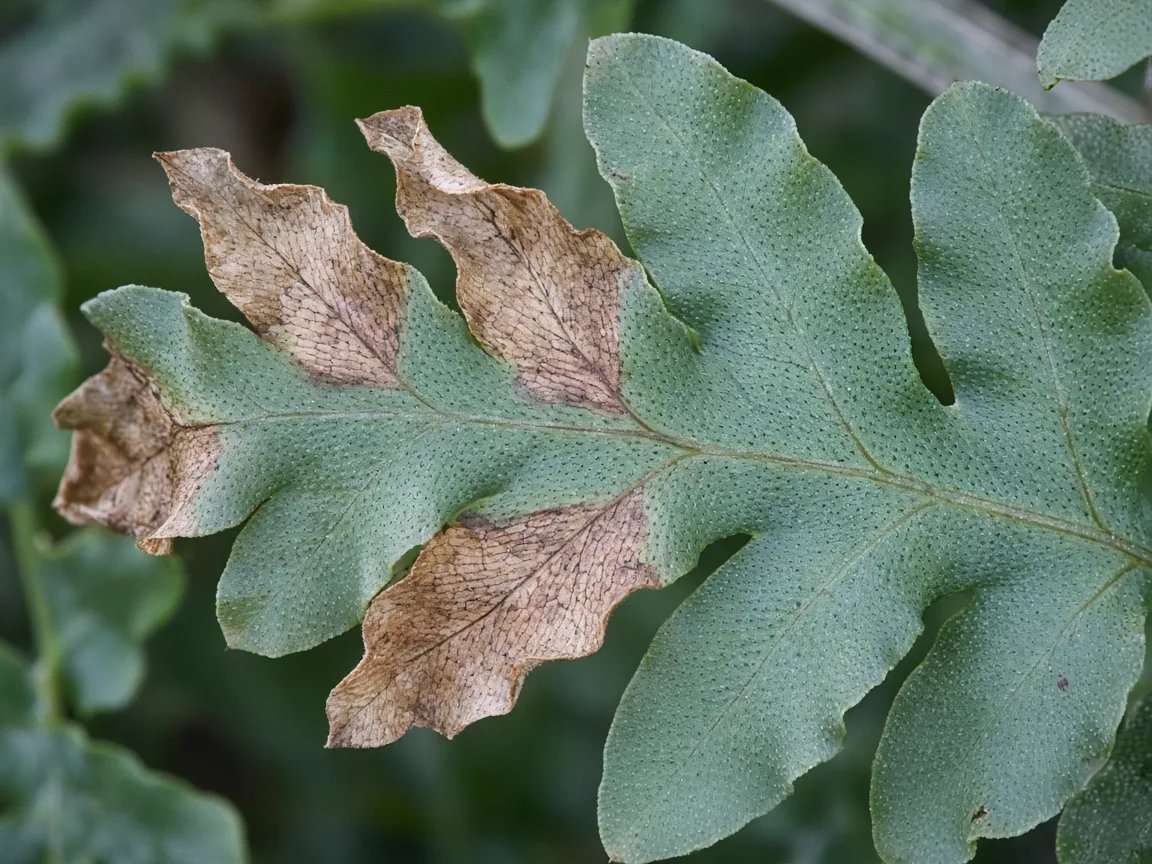
Brown leaves on Blue Star Fern—tan-brown dried lobes on an outer frond with healthy blue-green tissue still visible on younger growth for comparison.
Common patterns:
- One or two oldest outer fronds turn dull tan, then papery brown, while new lobes emerge firm from rhizome tips — often normal frond replacement on a healthy plant
- Large tan or brown patches on the frond face after a move toward sun or hot afternoon glass — direct sun scorch on the bluish waxed blades
- Lower fronds dull yellow-brown and limp, mix stays damp many days, rhizomes feel soft — wet-root stress overlapping overwatering
- Outer fronds stiff, uniformly dry brown, pot feels light, top 3–4 cm dusty — underwatering or extreme low humidity desiccation
- Brown spreading from rhizome tips into attached frond bases, sour smell at drain holes — advanced rot; margin fixes will not help
- Even brown across several fronds in a heated winter room while soil moisture looks “fine” — often dry air; NC State notes frond browning often indicates the plant needs higher humidity
What it is not: Narrow crispy edges on green fronds belong on brown tips. Solid yellowing of newer fronds under bright glass often fits yellow leaves and light stress routing—not this page alone.
Why Blue Star Fern develops brown fronds
In the wild, Phlebodium grows as a rhizomatous epiphyte on tree bark and in leaf litter—not in deep, soggy soil. Indoors, brown leaves usually mean one side of the moisture balance failed: roots could not supply water, roots failed in wet mix, the frond surface lost tissue to sun or dry air, or an old frond simply finished its life cycle.
Wet mix suffocates surface rhizomes
Extension guidance calls for a moist but not soggy substrate with good air circulation. When mix stays waterlogged in a deep pot, roots lose oxygen and stop moving water upward—even while soil feels wet. Lower fronds yellow-brown and hang limp. Because this fern stores water in golden rhizomes on the surface, owners often see brown fronds and water again, which rots the very tissue that should buffer dry spells.
Dry air and missed dry-down brown whole outer fronds
Although it tolerates drying between waterings better than many ferns, Phlebodium still transpires through thin lobes. Winter heating, AC drafts, or a frond pressed against a cold window can brown an entire outer frond while inner growth looks fine. NC State links curling to low humidity and underwatering—but when desiccation advances, you get stiff brown blades, not just curled margins.
Direct sun bleaches and kills frond patches
The blue-gray cast comes from a waxy leaf surface that reflects light—it does not make the plant sun-proof. RHS lists partial shade for a reason: behind south or west glass, fronds can show tan dead patches on the blade face while rhizomes still feel firm. That is scorch, not drought—see the light guide before you increase watering.
Reading golden rhizomes before you treat fronds
Most houseplant brown-leaf pages start with “check soil moisture.” On Blue Star Fern, rhizome firmness is equally important because the plant’s pantry sits on top of the mix.
- Trace a rhizome from the pot edge toward a frond base. Healthy tissue feels firm, with golden scales intact.
- Press where the rhizome enters the mix. Soft, dark, water-soaked tissue with sour odor means rot—route to root rot before humidity or fertilizer fixes.
- Compare frond age. Brown on the oldest outer arch with firm rhizomes and new blue-green lobes emerging often means groom the dead frond, not repot.
- Lift the shallow pot. A heavy cool pot days after watering plus brown limp lowers fits wet mix. A light pot with stiff brown outers fits dry-down—confirm with the top 3–4 cm check in the watering guide.
This sequence stops the common mistake of misting a rotting rhizome or soaking a sun-scorched plant.
Shallow pots and rhizome crawl stress
Blue Star Fern wants a wide, shallow container so creeping rhizomes can spread the way they do on bark—not a tall reservoir of wet peat around a small root ball. When rhizomes pile against dry pot walls or sit in stale water in a cachepot, frond bases brown while tips still look green for a time.
Signs of pot-shape stress:
- Golden rhizomes climb the rim but turn brown where they touch dry terracotta
- Center of the pot stays wet while edges dry—outer fronds brown unevenly
- New growth stalls because rhizomes have nowhere to run
Fix is usually better drainage and horizontal space, not more frequent shallow sprinkles. Review soil and repotting when rhizomes escape the rim or the mix has collapsed.
How to confirm the cause
Use this table after your rhizome check. Match one primary pattern before you change care.
| What you see | Most likely cause | Next step |
|---|---|---|
| Soft brown rhizomes, heavy wet pot, limp yellow-brown lowers | Overwatering / root failure | Stop watering; inspect roots (overwatering) |
| Firm rhizomes, light pot, stiff dry brown outer fronds | Underwatering | Slow soak at pot edge after top 3–4 cm is dry |
| Firm rhizomes, moist mix, several fronds evenly dull brown in winter | Low humidity | Humidifier 40–60%+ at frond height (low humidity) |
| Tan patches on frond face after sunny window | Sun scorch | Move to bright indirect light (light) |
| One oldest frond papery brown, new lobes clean | Normal senescence | Groom when fully dry |
The first fix to try
Your first action depends on the rhizome split from the quick answer—not a bundle of repotting, pruning, and fertilizer.
If rhizomes are firm and only outer fronds are dry brown: water once at the pot edge until a little drains, after the top 3–4 cm feels dry. Empty the saucer within 30 minutes. Then raise humidity at frond height if the room is below 40%.
If rhizomes are soft on wet mix: do not water. Move the pot to brighter indirect light and airflow, tip it sideways to sniff drain holes, and unpot only if mushy roots are suspected—see root rot for salvage steps.
If tan patches appeared after sun: move the plant away from direct beams first. Do not compensate with extra water on scorched tissue.
Recovery timeline and what improves
Judge recovery by new lobed fronds unfurling with blue-green color and firm golden rhizome tips—not by older brown blades greening up.
- Mild dry-down or humidity stress: one to three weeks for stable new growth after humidity or watering correction
- Sun scorch: new fronds clean within two to four weeks; scorched patches on old fronds remain dead
- Overwatering without advanced rot: several weeks as roots regrow; expect to remove some lower fronds
- Advanced rhizome rot: may take months or fail—honest limit on this species
Worsening signs: brown climbing from rhizome into multiple new fronds, sour smell spreading, or no new lobes after six weeks of corrected care.
Mistakes to avoid
- Watering because brown fronds look “thirsty” on a heavy wet pot — classic wilt paradox on saturated mix
- Misting as the main humidity fix — fronds stay wet minutes while rhizomes still desiccate in dry rooms
- Pouring water over rhizomes instead of at the pot edge — keeps surface tissue wet without oxygen
- Fertilizing stressed plants — salts on damaged lobes brown tissue further; fix environment first
- Repotting on day one unless mix is sour or roots are mushy — disturbance on wet rhizomes increases rot risk
How to prevent brown fronds next time
Align care with how Phlebodium actually grows:
- Water when the top 3–4 cm is dry, then drain fully—moist but not soggy with good air circulation
- Keep bright indirect light; avoid midday sun on the bluish fronds (Almanac indoor guidance)
- Target 40–60% humidity at frond height in heated months
- Use a shallow wide pot and airy bark-perlite mix so rhizomes crawl on the surface (RHS moist but well-drained loam)
- Groom fully brown fronds at the rhizome base so pests do not hide in dead tissue