Wilting on Begonia Rex: Causes, Checks & Fixes
Quick answer
Acute wilting on Begonia Rex means rapid turgor loss-limp stems and collapsed painted leaves within hours to a day. First step: press the top 2–3 cm of mix and lift the pot. Wet and heavy with limp foliage means stop watering and check rhizome firmness; dry and light means one thorough bottom-water with full drainage.
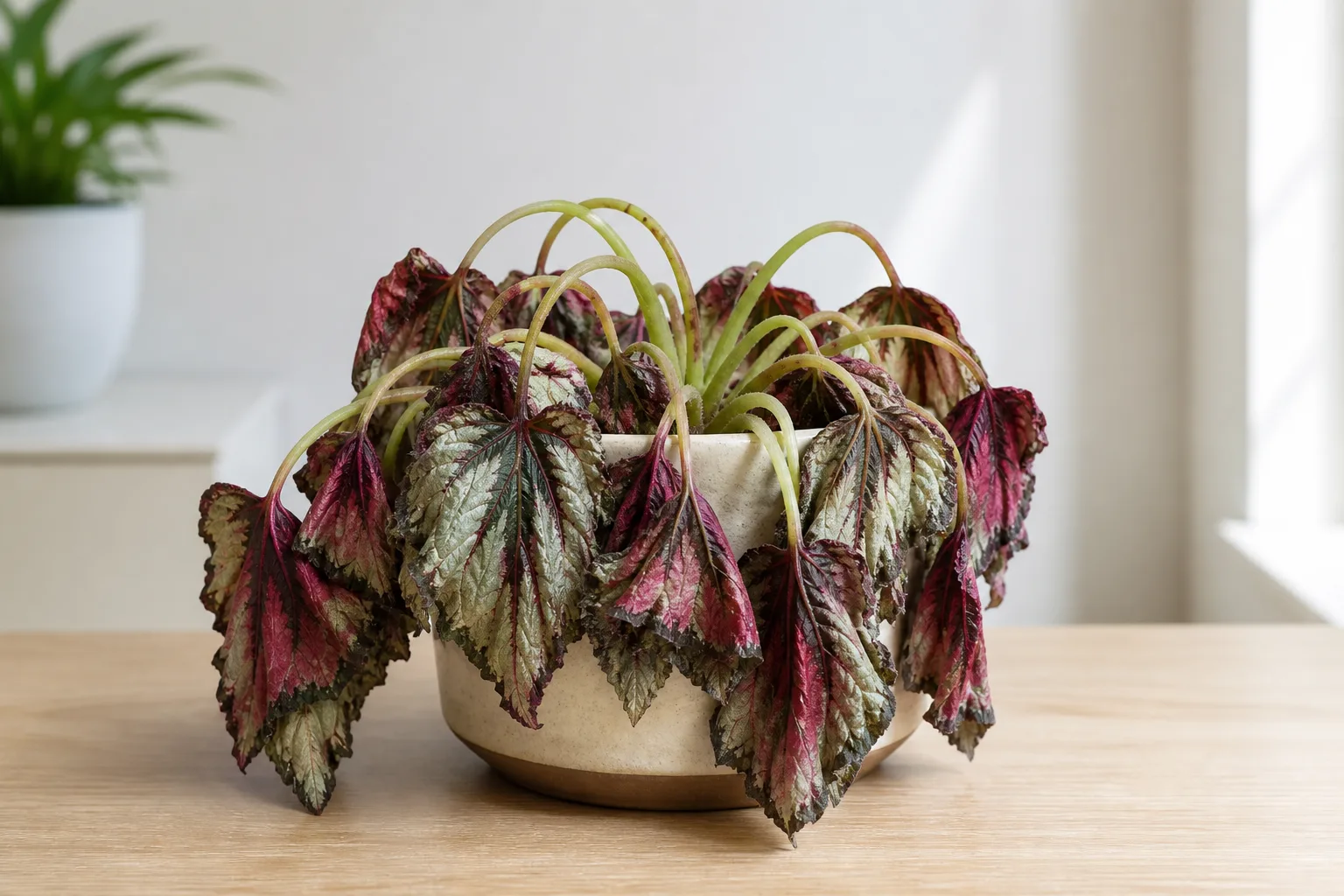
Wilting on Begonia Rex: Causes, Checks & Fixes
This guide covers wilting on Begonia Rex. See also the general Wilting guide, watering, and light pages for this plant.
Wilting on Begonia Rex: Causes, Checks & Fixes
Quick answer
Wilting on Begonia Rex (Begonia rex-cultorum) is acute turgor collapse-limp petioles, soft stems, and painted leaves that lose structure within hours to one or two days, not the gradual sag over a week that fits drooping leaves. Rex begonias carry large, thin foliage on a shallow rhizome near the soil surface, so water stress, crown rot, dry air, or cold shock show up fast once uptake fails.
First step: press your finger into the top 2–3 cm of mix and lift the pot.
- Heavy, wet pot + limp leaves → Stop watering. Inspect rhizome firmness at the crown. Wet-soil wilt means roots or rhizome tissue cannot move water-the opposite of thirst.
- Light, dry pot + collapsed rosette → One thorough bottom-water until the top of the mix moistens, then drain fully. See the underwatering guide for the full soak protocol.
Do not splash water on velvety rex leaves during recovery-wet foliage invites mildew on stressed plants. Fix moisture at the roots or stop rot at the crown first.
What wilting looks like on Begonia Rex
Wilting is the fast version of leaf failure on rex types. Common above-soil patterns:
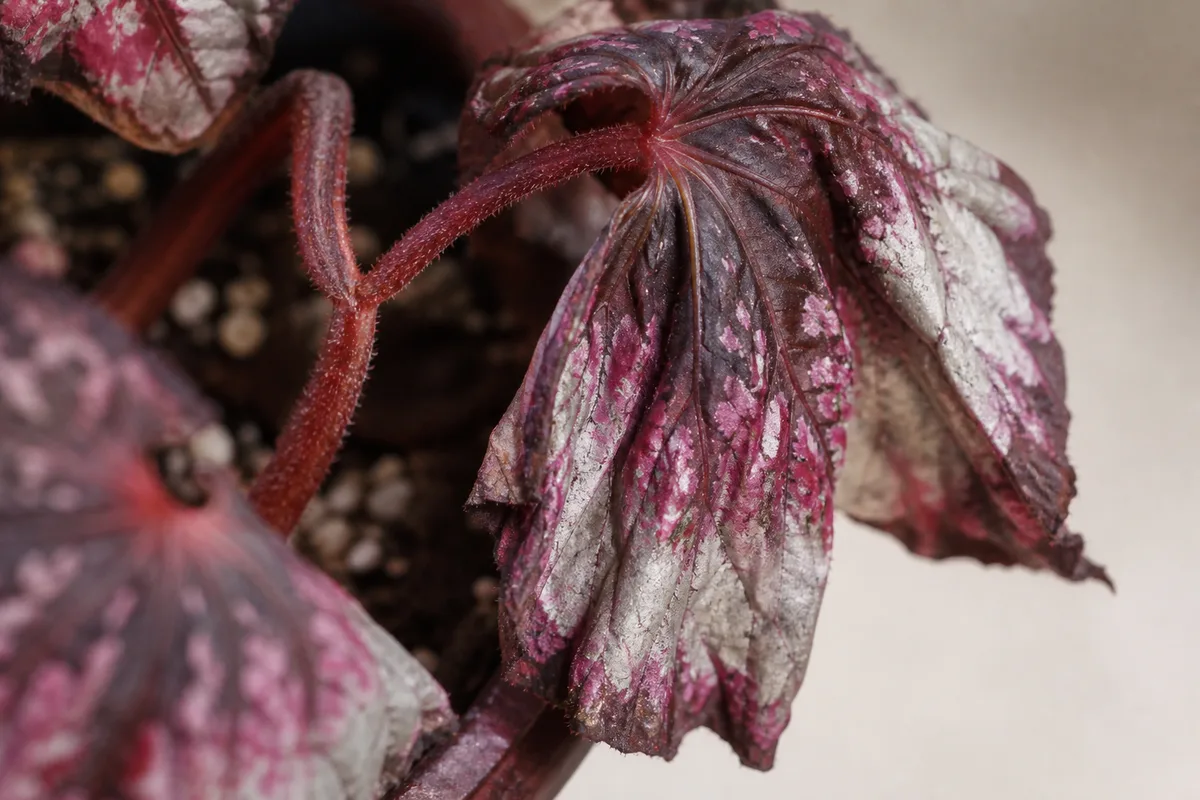
Wilting symptoms on Begonia Rex - compare with healthy tissue on the same plant.
- Sudden limp collapse of the whole rosette or one side of the plant-petioles go slack and blades hang straight down instead of at their usual angle
- Soft, thin leaf feel-tissue loses turgor within hours, often by afternoon in dry winter air
- No crisp brown edges yet (those often follow drought or low humidity after the initial wilt)
- Stems may still look green even when severely limp-color alone does not rule out rot
- Fast spread-one watering event, heat spike, or cold night can take a firm plant to collapsed within a day
Below soil, the critical split is rhizome firmness:
| Rhizome feel | Soil state | Likely wilt driver |
|---|---|---|
| Firm, tan or green | Dry, light pot | Underwatering-see underwatering |
| Firm | Moist, normal weight | Low humidity midday wilt or cold draft |
| Softening, dark, or hollow | Wet, heavy, cool mix | Crown rot / overwatering-see root rot |
| Firm | Wet after recent soak | Repot shock or heat stress with adequate moisture |
Rex begonias evolved on humid forest floors in northeastern India and southern China. Indoors their large painted leaves transpire heavily while the rhizome sits shallow-wilting is often the first alarm, not a late-stage symptom.
Wilting vs drooping on Begonia Rex
Both look like a sad rex, but speed and urgency differ:
| Symptom | Typical speed | What you feel | First fork |
|---|---|---|---|
| Wilting (this page) | Hours to 1–2 days | Acute limp collapse, fast spread | Wet vs dry pot + rhizome probe |
| Drooping leaves | Days to 1–2 weeks | Gradual lower petiole angle, color often rich | Same fork, less time pressure |
| Overwatering | Weeks of chronic damp | Yellow lower leaves, gnats, sour smell | Stays wet many days |
| Underwatering | After missed checks | Light pot, mix pulls from sides | Bone dry throughout |
If wilt appeared same day after a heavy watering or cold night near glass, stay on this page. If leaves have sagged slowly for a week with stable soil, start with drooping leaves.
Wet soil vs dry pot: the rex wilting fork
The most dangerous rex begonia mistake is watering wilted leaves sitting in wet soil. Roots damaged by saturation cannot take up water-wilted leaves with wet soil often mean rotting roots cannot take up water-leaves look thirsty while the rhizome drowns. That is the wet-soil paradox.
Wet-soil wilt signs:
- Pot feels heavy; skewer at the edge comes out dark and cool
- Mix has stayed damp many days without drying at the top
- Lower leaves may yellow; fungus gnats or sour smell suggest chronic saturation
- More water does not firm foliage within 24 hours
- Rhizome at the crown may feel soft when you brush soil aside
Dry-pot wilt signs:
- Pot lifts very light; top 2–3 cm and often deeper mix are dusty dry
- Mix may pull away from pot walls
- Rhizome stays firm when pressed
- One thorough bottom-water often stiffens petioles within hours if rot is not present
When in doubt, weight and depth beat appearance. Rex leaves hide early stress; the pot and rhizome tell the truth.
Why Begonia Rex wilts
Overwatering and crown rot (wet-soil paradox)
Rex begonias are rhizomatous- a thickened stem sits at or just above the soil line with fine roots beneath. Saturated mix collapses air spaces around shallow roots. When the rhizome or crown stays wet, tissue breaks down and uptake fails. Overwatering can cause root rot on rex types; leaves wilt because the plumbing is damaged, not because the pot lacks water. Crown rot often shows as acute wilt before obvious yellowing.
Underwatering and fast dry-down
Shallow roots and a surface rhizome dry faster than deep-rooted houseplants. A rex in Begonia Rex light guide or near a heating vent can go from fine to collapsed in 48 hours during active growth. Large painted leaves lose water quickly; the rhizome cannot supply turgor once fine root hairs desiccate.
Low-humidity midday wilt
Rex cultivars need high humidity-more than 50% for healthy foliage. Dry indoor air-especially in heated winter rooms-pulls water from large leaves faster than roots replace it. Midday wilt with firm rhizome and normal soil moisture often perks overnight when humidity rises. This is reversible environmental wilt, not rot.
Cold draft and temperature shock
Rex begonias prefer day temperatures around 70°F and about 60°F at night. Cold windows, AC blasts, or sub-55°F exposure slow root function abruptly. Soil moisture may be appropriate, but tissue collapses after a cold night. Recovery after moving to stable warmth often takes 2–5 days without other treatment.
Repot shock and root disturbance
Fresh Begonia Rex repotting guide or rhizome division can trigger temporary wilt for 3–7 days even with correct moisture. Fine root hairs break during handling; uptake lags until new roots form. If the rhizome stays firm and mix is appropriately moist-not soggy-hold steady humidity and avoid stacking fertilizer or extra water.
How to confirm the cause
Work through these six checks before you soak, mist, or repot:
- Timeline - Same-day collapse after watering or cold night = acute wilt (this page). Slow sag over a week = drooping leaves.
- Soil moisture at 2–3 cm - Dry and crumbly vs cool and clinging. Surface peat can look pale while the center stays wet.
- Pot weight - Heavy after days without watering suggests saturation; very light suggests drought.
- Rhizome firmness - Gently brush soil from the crown. Firm tan or green tissue fits drought or humidity stress. Soft, black, or hollow tissue is rot urgency-stop water and inspect roots.
- Humidity and placement - Hygrometer beside the canopy. Below ~50% RH with firm rhizome and normal soil points to low humidity. Note AC vents, radiators, and cold glass.
- Smell and roots (if unsure) - Tip the plant out. Healthy roots are white or tan and firm. Sour odor or brown slime means rot-treat that pathway, not drought.
Quick reference matrix
| Pattern | Soil / pot | Rhizome | First action |
|---|---|---|---|
| Drought wilt | Dry, light | Firm | Bottom-water once; drain fully |
| Crown / root rot wilt | Wet, sour smell | Soft, dark | Stop water; trim rot; repot if salvageable |
| Humidity wilt | Normal moisture | Firm | Humidifier; do not mist leaves |
| Cold shock wilt | Normal moisture | Firm | Move to stable 60–80°F |
| Repot wilt | Moist, not soggy | Firm | Wait 3–7 days; stable humidity |
First fix for Begonia Rex
One clear action based on what you confirmed-not a stack of treatments.
If the pot is dry and the rhizome is firm (drought wilt)
Bottom-water today. Set the pot in a tray of room-temperature water for 15–30 minutes until the top 1–2 cm of mix darkens, then lift out and drain completely for at least 15 minutes. Do not mist leaves as a substitute. Full protocol: underwatering on Begonia Rex.
If the pot is wet and the rhizome is firm (early overwatering)
Stop watering. Empty the saucer, improve airflow, and let the top third of mix dry before any next drink. Check again in 48 hours-if leaves stay limp on drying soil, inspect roots for hidden rot.
If the rhizome is soft or smells sour (rot wilt)
Stop watering immediately. Unpot, rinse soil from roots, trim all mushy tissue with clean scissors, and repot only firm sections into fresh airy mix. See root rot on Begonia Rex for salvage limits. Do not soak a rotting rhizome.
If soil is normal and RH is low (humidity wilt)
Raise ambient humidity to 50% or higher with a humidifier or pebble tray beside the plant-not mist on velvety leaves; NC State recommends avoiding misting on rex types. Hold watering steady unless the top 2–3 cm is actually dry.
If cold draft caused collapse
Move off cold glass and away from AC vents. Maintain stable warmth; avoid fertilizing or repotting until turgor returns.
Recovery timeline
Mild drought wilt - Petioles often stiffen within 6–24 hours after one proper bottom-water if the rhizome stayed firm. Judge by lifted rosette and firm new growth points, not old collapsed blades greening up-they will not.
Low-humidity wilt - Improvement over 1–2 weeks once RH stays above 50%. Midday limpness that perks overnight is a good sign.
Overwatering / early rot wilt - Dry-down and possible repot need 2–4 weeks. Wilt that worsens on moist soil after you stopped watering means hidden rot-escalate to root inspection.
Cold shock wilt - 2–5 days after stable placement without other stressors.
Worsening signs: softening rhizome spread, sour smell, yellow lower leaves on moist soil, or collapse without new buds within two weeks after correct first fix.
Lookalike symptoms to rule out
- Drooping leaves - Gradual sag over days; less time pressure, same wet-vs-dry fork
- Root rot - Soft crown, mushy rhizome; wilt is the visible alarm
- Overwatering - Chronic damp mix building over weeks before acute collapse
- Heat or direct sun - Edge burn or wilt in hot sun despite moist soil; move to bright indirect light
- Spider mites - Fine webbing and stippling on undersides; wilt is secondary to feeding damage
- Normal winter rest - Leaf drop with firm rhizome and slightly dry but not desiccated mix; water sparingly, not on a summer schedule
What not to do
Do not water reflexively when leaves look limp without checking soil moisture and rhizome firmness-watering a wilted plant whose roots are rotting in wet mix accelerates decline.
Do not mist velvety leaves to “revive” wilt-brief surface moisture does not fix roots and invites mildew on stressed foliage.
Do not fertilize a wilted rex to wake it up-salts on stressed roots add injury.
Do not stack repotting, pruning, and pesticide on the same day as wilt discovery.
Do not leave the pot in a soak tray overnight after drought recovery-rex rhizomes need drainage, not permanent saturation.
Do not assume every wilt means underwatering-the wet-soil paradox kills more rex begonias than occasional dry spells.
How to prevent wilting next time
Build routine around soil feel, pot weight, and rhizome checks-not the calendar. Rex care balances steady root-zone moisture without chronic sogginess.
- Water when the top 2–3 cm dries during active growth-UConn recommends watering when the top inch feels dry-full watering guide for the wet-soil paradox and seasonal rhythm
- Bottom-water or water at the soil edge to keep velvety leaves dry
- Keep humidity at 50% or above so leaves lose water less aggressively between drinks
- Avoid cold glass and AC blasts-stable 60–80°F supports root function
- Use shallow pots with drainage sized to the rhizome, not oversized reservoirs that stay wet too long
- Lift the pot weekly during the learning phase; weight change beats a fixed schedule
When to worry
Treat as urgent when:
- The whole rosette collapsed same day on wet soil-probe the rhizome now
- The rhizome feels soft, dark, or hollow at the soil line
- Soil smells sour or roots are brown slime on inspection
- Wilt returns within 48 hours of a good drought soak-hidden rot, not thirst
- No firm new growth emerges within two weeks after the correct first fix
If the rhizome is shriveled, brown, and brittle with no firm tissue left, recovery is unlikely-salvage healthy rhizome sections for propagation if any firm growth points remain.
Related Begonia Rex problems
- Drooping leaves - gradual sag over days, same wet-vs-dry fork
- Underwatering - dry-pot wilt branch and bottom-water protocol
- Overwatering - chronic damp mix before acute collapse
- Root rot - soft rhizome escalation
- Low humidity - midday wilt with firm rhizome
- Watering Begonia Rex - prevention rhythm and moisture checks
- Begonia Rex overview - species hub
When to use this page vs other Begonia Rex guides
- Begonia Rex watering guide - Use for routine moisture checks before assuming wilting is the main issue.
- Begonia Rex problems hub - Browse all 16 common issues on this species.
- Underwatering on Begonia Rex - Different entry point when symptoms overlap with wilting.
- Overwatering on Begonia Rex - Different entry point when symptoms overlap with wilting.
- Root Rot on Begonia Rex - Different entry point when symptoms overlap with wilting.