Begonia Rex Light: Best Window & Warning Signs
Begonia Rex Light: Best Window & Warning Signs
Begonia Rex Light: Best Window & Warning Signs
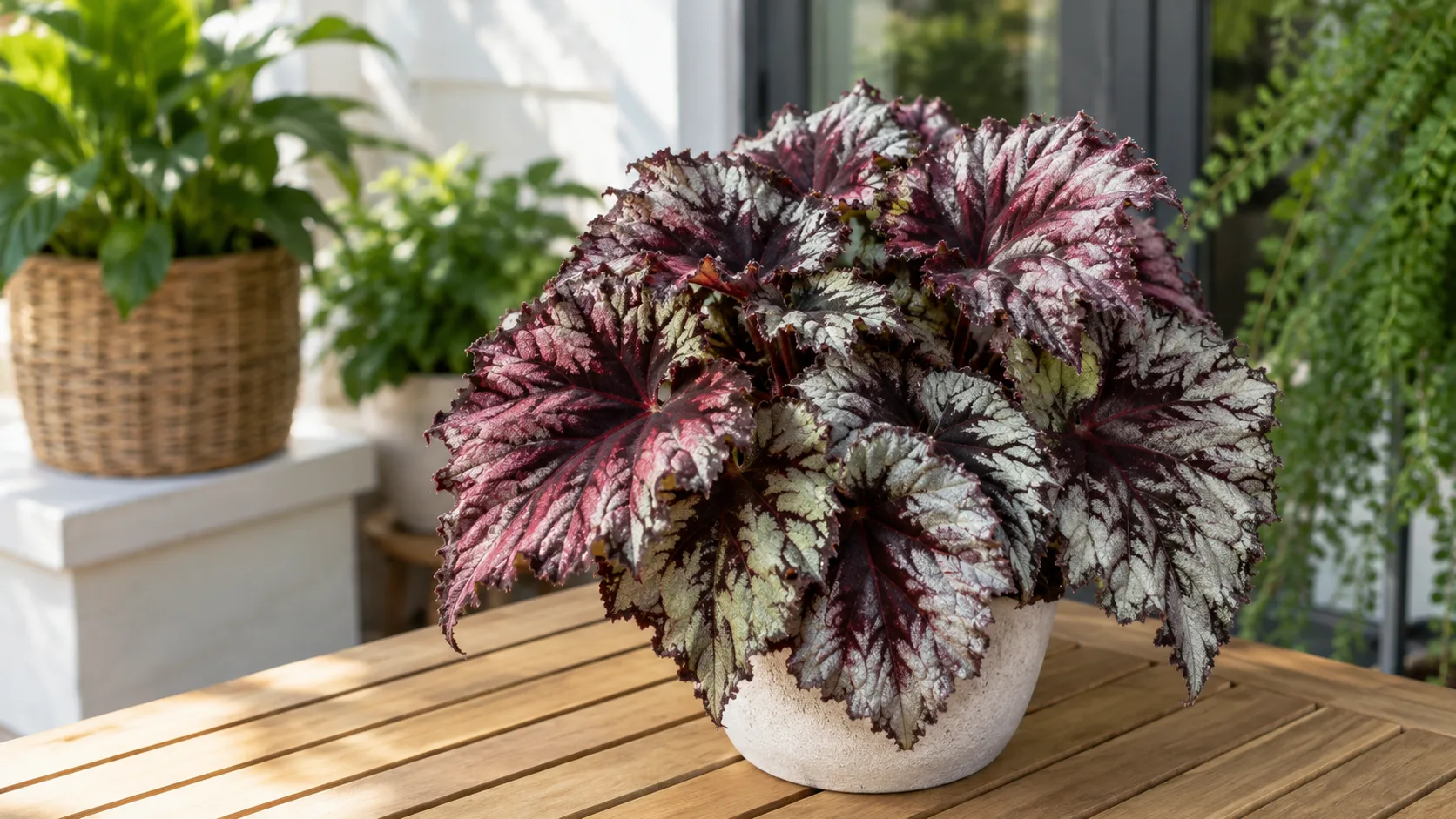
Begonia Rex needs bright, indirect light for most of the day - enough to keep its foliage patterns vivid and new growth compact, but never harsh direct sun on the leaves. In most homes, that means an east-facing window, a bright north window with an unobstructed view, or a south- or west-facing window filtered by a sheer curtain and set back from the glass. If the newest leaves are firm, well-colored, and opening at a normal pace, the light is probably right. If the plant stretches, dulls, bleaches, or crisps at the edges, the light needs adjusting before you change watering or fertilizer.
Rex begonias are grown for painted, metallic foliage - not flowers - and light is the main tool that keeps those colors sharp. Get the exposure wrong and the plant may survive for months while slowly losing the reason you bought it. This guide covers how much light Begonia Rex actually needs, the best window for your home, what direct sun it can tolerate, how to use grow lights, and every common warning sign that tells you the placement is off.
The Short Answer: Begonia Rex Light in Plain Terms
Begonia Rex performs best in bright indirect light. NC State Extension classifies rex begonias under dappled sunlight and partial shade - direct sun only part of the day, roughly two to six hours, and even then filtered rather than blazing. (NC State Extension Gardener Plant Toolbox) That does not mean a dark corner. It means the kind of bright, softened light you would find on a forest floor under a tree canopy: strong enough to read by comfortably near the window, but without hot sunbeams landing directly on the leaves for long stretches.
The practical indoor target is a spot where the plant receives bright ambient light for most daylight hours, with gentle morning sun acceptable in many cases and harsh afternoon sun avoided. University of Connecticut recommends bright but indirect light and warns that direct sun can scorch leaves while too little light produces weak, elongated growth. If your only bright window blasts afternoon sun, pull the pot back from the glass, add a sheer curtain, or move the plant to a table a few feet inside the room where the light is still bright but diffused.
Judge light by the plant, not the room. Human eyes adjust quickly to indoor brightness, so a living room that feels adequately lit to you may still be too dim for a rex begonia to hold its color. The most reliable check is new growth: compact internodes, normal leaf size, and pigments that match the cultivar’s expected pattern. University of Connecticut likewise describes rex begonias as doing well in bright but indirect light.
Why Rex Begonias Need Filtered Bright Light, Not Full Sun
Begonia Rex belongs to the rex-cultorum group - rhizomatous hybrids bred from Begonia rex and related species for showy foliage. NC State Extension notes the native range runs from Bhutan to Northern Myanmar in subtropical regions, and the plants grow as dense, herbaceous perennials reaching roughly 12 to 18 inches tall. In nature, rex-type begonias evolved under canopy cover, where light is bright but broken into patches and never carries the full heat load of open midday sun.
That origin explains the plant’s contradictory reputation. Rex begonias are often called “shade lovers,” which makes people tuck them into dim shelves. They are also sold as colorful statement plants, which makes people put them in sunny windows. Both instincts miss the target. Rex begonias want more light than true low-light plants like cast iron plant or ZZ plant, but less direct intensity than succulents or herbs sitting on a south sill. The sweet spot is filtered brightness - the understory middle ground.
Light drives two things rex growers care about most: foliage pigment and growth habit. The silver, burgundy, pink, and metallic patterns on cultivars like ‘Escargot’ or T REX™ Painter’s Palette are not decorative paint. They are real pigment combinations in the leaf tissue. When light is too weak, the plant produces more chlorophyll to capture what little energy is available, and the leaf can shift greener and duller as chlorophyll masks the other colors. When light is too strong, pigments bleach, cell tissue cooks, and the leaf loses the crisp pattern edges that make rex begonias collectible.
What Forest-Floor Light Looks Like Indoors
Forest-floor light is not darkness. Walk into a well-lit room with a large window and stand three to four feet away from the glass on a cloudy day. The space is bright enough to see clearly, but you are not squinting. That is roughly the exposure rex begonias use well. Now stand on the windowsill in direct afternoon sun. The brightness is harsher, warmer, and more directional. Rex begonias tolerate the first condition all day. They tolerate the second only in small, gentle doses.
Recreating forest-floor light indoors usually means one of three setups: an east window where morning sun is brief and soft; a filtered south or west window where a sheer curtain or a few feet of distance softens the beam; or a grow light positioned above the canopy for consistent intensity without heat. Bathrooms and kitchens can work well not because rex begonias magically love humidity rooms, but because those spaces often have bright windows and stable temperatures - as long as the actual leaf exposure stays indirect.
How Much Light Begonia Rex Needs Each Day
Rex begonias do not come with a rigid “14 hours exactly” specification the way some flowering houseplants do. What they need is enough cumulative bright indirect light to support steady rhizome activity, firm new leaves, and stable color. In practice, that means most of the daylight hours in a bright room, or roughly 10 to 14 hours of usable light when you are supplementing with LEDs in fall and winter.
Duration matters, but intensity and quality matter more. A plant six feet from a north window may receive light for 12 hours but at levels too weak to maintain compact growth. A plant one foot from an east window may receive fewer total hours yet still outperform because the photons actually reach the leaf surface at useful strength. If you are unsure, use the new-growth test weekly for three weeks before declaring the spot a success.
Seasonal shifts change the math. In late fall and winter, shorter days and weaker sun through glass often drop indoor light by a noticeable margin. Rex begonias are somewhat photoperiod-sensitive; shorter days can slow growth and, in some homes, trigger a partial rest period where the plant pushes less new foliage. Supplemental lighting for 12 to 14 hours daily can keep color steadier through winter. In spring and summer, the same window that was perfect in January may deliver too much heat and intensity in July. The plant is not being difficult - the sun angle changed.
Bright Indirect vs. Medium Light
Bright indirect light means the plant sits in a well-lit zone where no direct sunbeam hits the leaves for more than a brief morning window, or where any direct contact is soft and short. New growth stays compact, leaf patterns stay crisp, and stems do not stretch. Medium indirect light means the plant is farther from the window, blocked by outdoor obstacles, or in a bright room but not in the primary light pool. Many rex begonias will linger in medium light for a while, but colors fade, internodes lengthen, and the plant becomes more vulnerable to overwatering on Begonia Rex because it is using less energy.
The difference shows up fastest on highly variegated cultivars. A silver-heavy rex may look acceptable in medium light for a month, then slowly lose the metallic sheen as new leaves emerge greener and smaller. A burgundy-centered cultivar may hold color longer, which can mislead you into thinking the spot is fine until leggy stems make the problem obvious. If you must choose between slightly too bright with filtration and noticeably too dim, rex begonias generally recover more easily from gentle bright indirect than from chronic low light - as long as you keep direct sun off the leaves.
Best Window Placement for Begonia Rex
Window direction sets the daily light profile: how strong the sun is, how long it lasts, and how much heat builds on the leaves. Rex begonias are flexible within the bright-indirect band, but each window direction has a distinct risk profile. The best window is the one that delivers bright, stable, filtered light without cooking the foliage in summer.
Window Scorecard: North, East, South, and West
The table below summarizes how each window direction typically performs for Begonia Rex in the Northern Hemisphere. If you live in the Southern Hemisphere, reverse north and south.
| Window direction | Typical light profile | Suitability for Begonia Rex |
|---|---|---|
| East-facing | Soft direct morning sun, then bright indirect rest of day | Excellent - often the easiest year-round choice |
| North-facing | Consistent bright indirect if unobstructed; dim if shaded outside | Good in bright, open exposures; marginal if heavily blocked |
| South-facing | Strong direct sun most of the day; intense in summer | Usable only with curtain filtration or distance from glass |
| West-facing | Hot direct afternoon sun; strong late-day heat | Risky - needs filtering; better in winter than midsummer |
An east-facing window is the default recommendation for good reason. Morning sun is lower in the sky, cooler, and shorter in duration than afternoon sun. Rex begonias often handle a gentle east exposure better than any other direct light. A north-facing window can work surprisingly well if the view is open - tall trees, deep overhangs, or neighboring buildings block north light quickly. Stand at the window at noon. If the room feels clearly bright and you can see sky, north may be enough. If the window feels dim even to your eyes, plan on a grow light.
South- and west-facing windows are not automatic failures. They are high-management exposures. In winter, a south window with the plant set back two to three feet can be excellent. In summer, the same sill may scorch leaves by mid-afternoon unless a sheer curtain diffuses the beam. West windows are the most likely to cause sudden crisping because afternoon sun combines high intensity with heat buildup on the glass. If west is your only bright option, treat filtration as mandatory, not optional.
Distance, Curtains, and Rotation
Light intensity drops fast as you move away from glass. A rex begonia on a table four to five feet inside a bright room may be in a completely different light category than one on the windowsill. For most homes, keeping the pot within one to three feet of the window - but out of the harshest direct beam - is the practical target. Sheer white curtains are one of the most useful tools rex growers own. They turn a blazing south or west exposure into usable bright indirect light without sacrificing the window.
Rotate the pot a quarter turn every week or two if growth leans toward the glass. Rex begonias are not symmetrical trees, but even light prevents lopsided rhizome spread and keeps new leaves opening on all sides. Keep leaves clean. Dust on the broad, textured rex foliage blocks more light than people expect. Wipe gently with a soft, slightly damp cloth when dust builds up. Do not use leaf shine products - they can interfere with gas exchange and create a film that makes light readings even less reliable.
Can Begonia Rex Take Direct Sun?
Not harsh, sustained direct sun. Rex begonias are understory plants. Direct midday or afternoon sun through clear glass is the fastest way to bleach metallic patterns, crisp leaf edges, and stress the rhizome. Missouri Botanical Garden advises keeping rex begonias out of direct, hot sun. Most indoor growers should assume no direct sun unless they are deliberately testing a very gentle exposure and watching the newest leaves daily.
That said, “no direct sun” does not mean “no sun ever.” Many rex begonias tolerate soft morning sun for an hour or two in an east window, especially in fall and winter when intensity is lower. The leaves formed under that exposure will be adapted to it. Problems start when a plant grown in dim shop light gets moved straight to a south sill, or when summer sun angle suddenly puts a formerly safe east window into harsher contact. Acclimation is not optional for rex begonias any more than it is for ferns or calatheas.
Gentle Morning Sun and Dangerous Afternoon Rays
Morning sun is lower, cooler, and shorter. Afternoon sun is the opposite - stronger, hotter, and more likely to combine light stress with heat stress on the leaf surface. If you want to experiment with direct light, do it only in morning hours, only for a few days at a time, and only while you can observe the plant during peak exposure. Stop immediately if you see bleaching, inward curling, or dry patches forming on the sun-facing side.
South and west windows in summer are where rex begonias most often fail. Glass magnifies intensity, and the leaf sitting inches from the pane can experience conditions radically different from what you perceive standing across the room. If you love the look of your rex begonia on the windowsill, check it on a sunny July afternoon. Touch the leaf surface carefully. If it feels warm and looks slightly faded on the exposed side, move it back or filter the window before damage becomes permanent.
Low-Light Limits and What Survives vs. What Thrives
Begonia Rex can survive in medium to low indirect light longer than many colorful foliage plants, but survival is not the goal. In low light, rex begonias often stop producing their best foliage, stretch toward the brightest vector, and enter a slow decline that looks like a watering or humidity problem when the root issue is actually insufficient energy capture.
Low light does not usually kill a rex begonia quickly because the rhizome stores resources and the plant can limp along on reserves. That patience is misleading. You may have a pot that still looks “alive” six months after purchase while every new leaf is smaller, greener, and farther apart on the stem than the last. The original showy leaves from the greenhouse - grown under brighter commercial light - remain while the plant fails to replace them with equally vivid foliage. By the time you notice, the plant has been underpowered for months.
If your only available spot is dim, use a grow light. Rex begonias respond well to supplemental LEDs and often hold color better under consistent artificial light than under weak natural winter sun. Do not compensate for low light by watering more or feeding heavier. A dim plant uses less water and less fertilizer. Extra water in low light is a common path to rhizome rot, which then looks like a mysterious collapse unrelated to light.
Warning Signs of Too Much Light
Too much light shows up on rex begonia leaves before it shows up anywhere else. The foliage is thin compared to a succulent, pigmented in ways that reduce pure chlorophyll coverage, and often hairy or textured - all features that make it vulnerable to photodamage. When exposure is too strong, the plant cannot redistribute water fast enough to cool the leaf surface, and pigment cells in the exposed tissue break down.
Watch for these signs on the newest leaves and the sun-facing side of the plant. Old damage from a previous location will not heal, so always prioritize what the latest leaf tells you.
Bleached or washed-out patches, especially silver and metallic zones turning chalky white or tan. Crisp, dry brown edges that feel papery rather than soft. Inward leaf curling during the brightest hours as the plant reduces exposed surface area. Sudden collapse or wilting of otherwise firm leaves after a move to a brighter spot - a sign of shock combined with scorch. Stiff, brittle leaf texture on areas that used to be supple. Faded pattern contrast where burgundy centers or dark veining look uniformly dull, as if someone turned down the saturation.
Bleached Patches, Crisp Edges, and Curling Leaves
Bleaching is not the same as normal cultivar color variation. A healthy ‘Escargot’ spiral has deliberate silver and green contrast. A scorched leaf has random pale zones, often along the highest points of the leaf or directly facing the window. Crisp edges from underwatering on Begonia Rex are usually accompanied by dry potting mix and slight leaf droop. Crisp edges from light stress can occur even when the soil is appropriately moist because the damage is thermal and radiative, not hydraulic.
Curling is the plant’s short-term defense. If leaves curl only between 11 a.m. and 3 p.m. and relax in the evening, the window is too hot and bright for that season. If leaves stay curled continuously, suspect both light and humidity stress. Recovery from scorch is partial at best. Damaged tissue does not revert to patterned color. Your job is to prevent new leaves from repeating the injury by filtering light or moving the plant, then waiting for the next flush of growth to confirm the fix.
Warning Signs of Not Enough Light
Low-light stress is slower and quieter than scorch, which makes it easier to ignore. Rex begonias do not always collapse dramatically when underlit. They stretch, dull, and produce leaves that look like a faded photocopy of the cultivar you thought you bought.
The clearest low-light signals are leggy stems with unusually long spaces between leaves, smaller new leaves than older ones, loss of silver or burgundy intensity in favor of uniform green, leaning or reaching toward the window, and slow leaf opening where new foliage takes weeks to unfurl. You may also see older leaves yellowing and dropping because the plant cannot support as much biomass on limited light income. Flowering, already insignificant on rex begonias, becomes even rarer - though foliage growers should treat bloom absence as a secondary clue, not the main diagnosis.
Leggy Stems and Faded Foliage Patterns
Leggy growth is etiolation - the plant allocating cell elongation toward light instead of compact structure. A rex begonia that should be dense and bushy begins to look like it is climbing toward the window on thin stems. Pinching helps cosmetically, but pinching without adding light fixes shape temporarily while the underlying problem remains. Faded patterns follow the same biology: more chlorophyll, less visible anthocyanin or structural pigmentation, and a flattening of the metallic sheen that makes rex cultivars distinctive.
If you suspect low light, move the plant closer to the window or add a grow light before Begonia Rex repotting guide, fertilizing, or increasing humidity. Those other interventions do not substitute for photons. Give any change two to three weeks of observation. Rex begonias are not instant responders. The leaf that proves the new spot is working is the one that was a tiny bump in the rhizome when you moved the pot.
Grow Lights for Begonia Rex Indoors
Grow lights are not a last resort for rex begonias. They are a practical way to stabilize color in dim apartments, north offices, and winter rooms where window light alone is inconsistent. Rex begonias are excellent LED candidates because they want brightness without heat.
Use a full-spectrum LED grow light or a high-quality full-spectrum shop light. Position the fixture 12 to 18 inches (30 to 45 cm) above the foliage as a starting point. Run it 12 to 14 hours per day on a timer so the plant gets predictable day length. If leaves look bleached or feel warm under the light, raise the fixture. If growth stays leggy and dull, lower it slightly or extend duration by an hour before making bigger changes.
LED Distance, Hours, and Timers
Distance and duration interact. A light too close can bleach leaves even in eight hours. A light too far may need 14 hours to deliver the same total useful exposure. Timers remove guesswork and prevent the common mistake of leaving lights on 24 hours. Rex begonias, like most houseplants, need a dark period for normal metabolism even if they are not strict short-day plants.
Choose lights in the roughly 3000K to 6500K range labeled for plant growth or general full-spectrum use. Fancy purple “blurple” panels work, but full-white spectrum LEDs are easier to live with in living spaces and show foliage color more naturally. If you are growing several rex begonias, one panel above a shelf often beats multiple small stick lights that create uneven hotspots. Check the canopy weekly. The leaves in the center of the beam should look vivid and firm, not pale or curled.
How to Move and Acclimate Without Stress
Rex begonias hate sudden light jumps in both directions. A plant moved from a bright greenhouse to a dim living room may drop leaves. A plant moved from a dim shelf to a sunny window may scorch in days. Treat light changes like temperature changes - incremental and observable.
When increasing light, move the pot closer to the window by a few inches every three to five days, or add filtration first and then reduce it gradually. When decreasing light, reverse the process. After any move, wait at least two weeks before also changing pot size, fertilizer, or Begonia Rex watering guide. Rex begonias respond to stacked stressors by dropping foliage and stalling rhizome growth, which looks like a mysterious “sulk” when it is actually multiple simultaneous changes.
If you already scorched a plant, move it immediately to bright indirect light - not deep shade. Deep shade after scorch slows recovery. Remove only leaves that are fully dead and papery. Keep the soil slightly drier than usual until new growth appears, because the damaged canopy is transpiring less and the rhizome needs time to redirect energy. Do not fertilize a scorched plant until you see firm new leaves opening.
Light and watering are linked. Brighter light increases water use. Dim light reduces it. When you fix light, adjust watering in the same week or you risk rot in low light or chronic drought stress in high light. Humidity matters for leaf edge quality, but humidity cannot replace adequate brightness. A humid bathroom with a dark corner will still fade a rex begonia over time.
Conclusion
Begonia Rex light care comes down to one principle: bright enough to keep new foliage vivid and compact, filtered enough to keep direct sun off the leaves. East windows and filtered bright exposures are the safest defaults. South and west windows work only with distance, curtains, and seasonal adjustments. Low light slowly steals the plant’s reason for being - the color - while too much light damages leaves faster than roots can replace them.
Use the newest leaves as your dashboard. Firm, well-patterned growth means the current placement is working. Bleaching, crisping, curling, stretching, and dulling mean light should be your first variable, not your last. When windows are not enough, a full-spectrum LED on a 12- to 14-hour timer is a legitimate primary light source, not a compromise. Get the exposure right, align watering with the new brightness, and rex begonias become far less mysterious - because the plant will tell you, leaf by leaf, whether it has what it needs.
When to use this page vs other Begonia Rex guides
- Begonia Rex overview - Start here for whole-plant context before deep-diving this topic.
- Begonia Rex problems hub - Jump to symptom-specific fix guides when this care topic does not resolve the issue.
- Not Enough Light on Begonia Rex - Escalate here when light adjustments are not enough.
- Leggy Growth on Begonia Rex - Escalate here when light adjustments are not enough.
Related Begonia Rex guides
- Begonia Rex overview
- Begonia Rex watering
- Begonia Rex soil
- Begonia Rex propagation
- Begonia Rex fertilizer
- Begonia Rex repotting
- Not Enough Light on Begonia Rex
- Leggy Growth on Begonia Rex
- Begonia Rex problems
Related tool
Try the Plant Problem Diagnosis Tool with begonia-rex pre-selected to estimate needs for your setup.