Low Humidity on Begonia Rex: Causes, Checks & Fixes
Quick answer
Begonia Rex needs roughly 50–70% relative humidity indoors; winter heating often drops rooms to 25–35% and crisps leaf edges within weeks. First step: place a humidifier beside the plant and aim for at least 50% RH-never mist rex leaves.
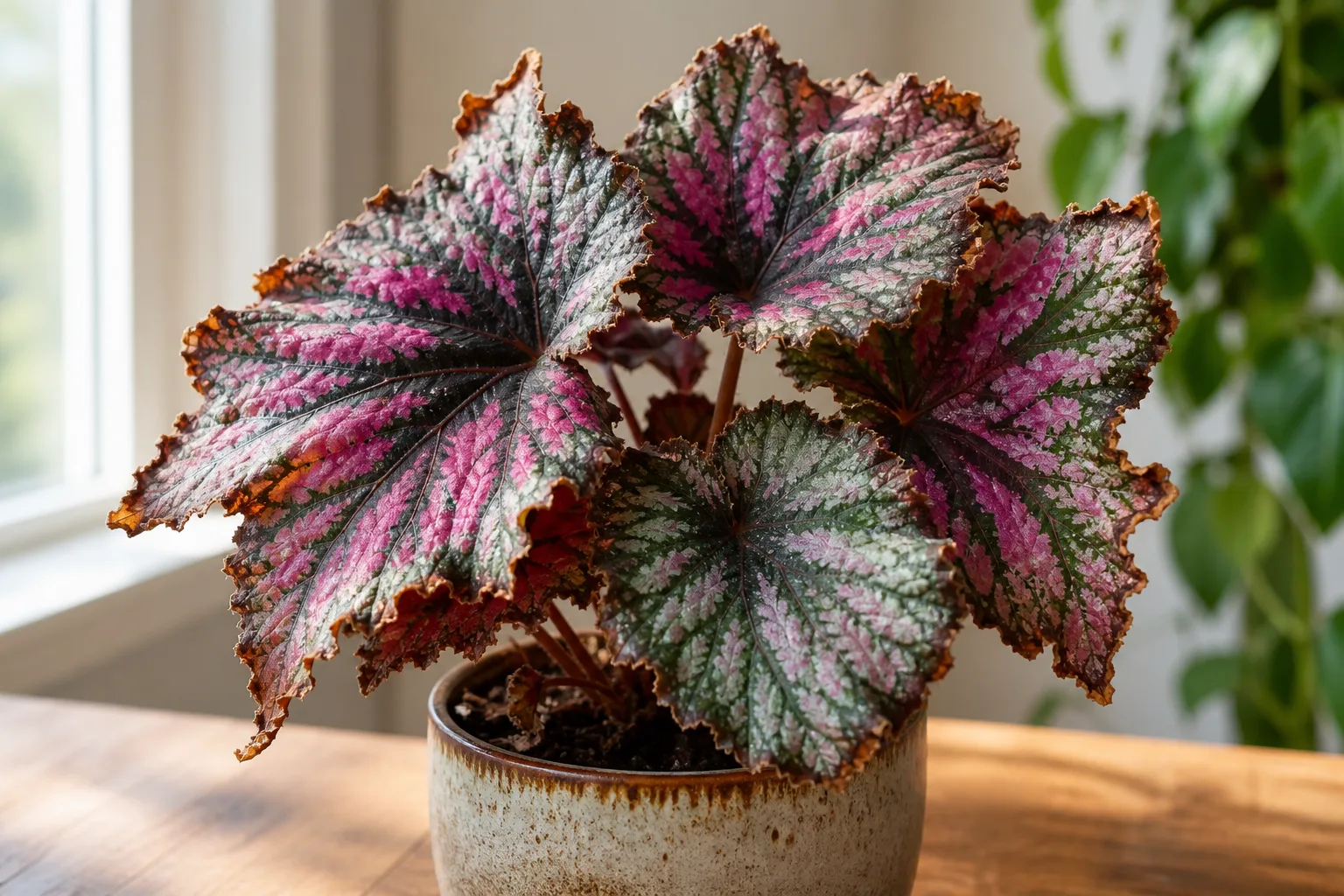
Low Humidity on Begonia Rex: Causes, Checks & Fixes
This guide covers low humidity on Begonia Rex. See also the general Low Humidity guide, watering, and light pages for this plant.
Low Humidity on Begonia Rex: Causes, Checks & Fixes
Quick answer
Begonia Rex (Begonia rex-cultorum) is a humidity-sensitive rhizomatous foliage plant that evolved under forest canopy in humid subtropical Asia. Most cultivars need 50–70% relative humidity indoors and show damage when winter heating pulls room air toward 25–35% RH. The classic sign is uniform brown, crispy leaf margins on otherwise firm patterned foliage-often spreading across several leaves at once while soil moisture looks normal.
First step: run a small humidifier beside the plant and hold ambient RH at or above 50%. Do not mist leaves. Rex begonias need humid air around the canopy but a relatively dry rhizome crown at the soil surface-two different zones. For full care context, see the Begonia Rex overview and its humidity guidance. If you landed here from a search for brown leaf edges only, the brown tips guide covers salt, tap water, and watering chemistry when humidity is already adequate-this page is the environmental dry-air hub.
What low humidity looks like on Begonia Rex
On rex begonias, dry air damage shows up on the leaf margins first, not as random spots in the leaf center. Patterned cultivars like Escargot or Fireworks develop tan-to-brown crisp edges that follow the leaf outline while the metallic center may still look healthy for a while. Thin-leafed hybrids often curl slightly at the tips before margins fully brown.
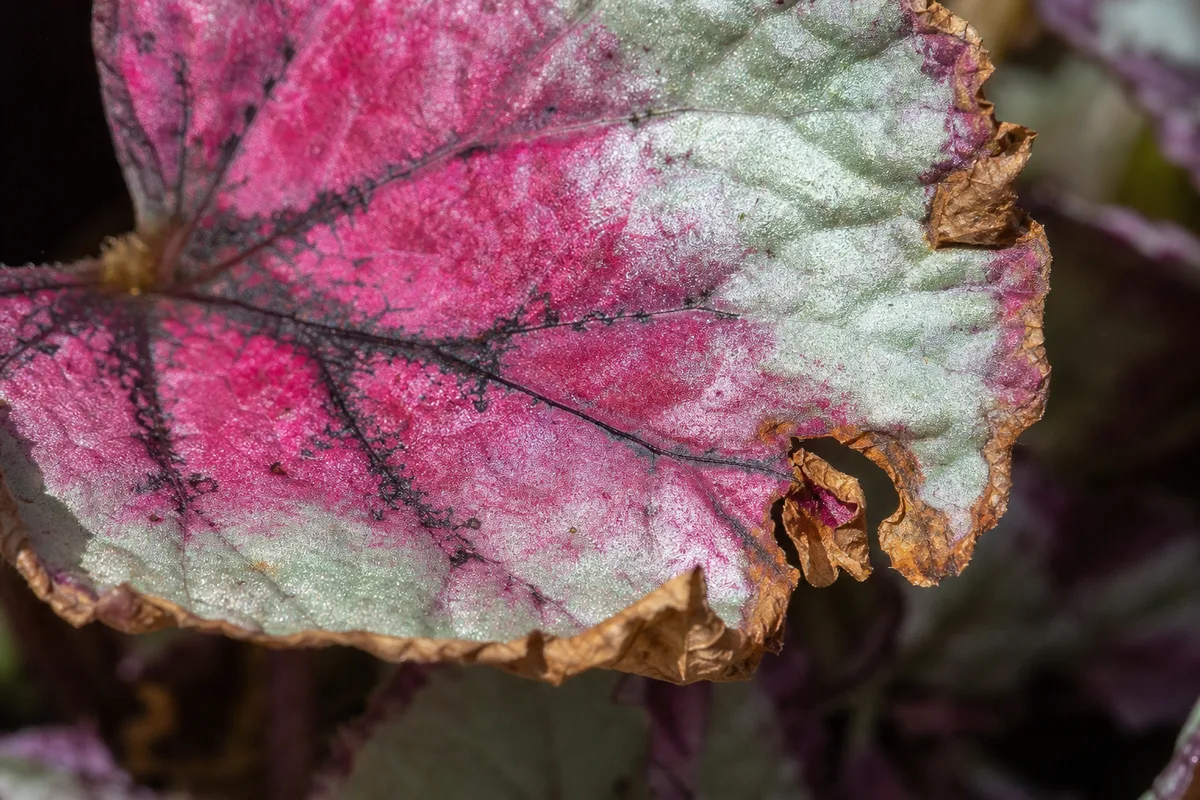
Low Humidity symptoms on Begonia Rex - compare with healthy tissue on the same plant.
Cultivar texture matters. NYBG notes that rex hybrids with thin or silky leaf texture often need humidity toward the upper end of the range-sometimes approaching 80%-while thicker, more leathery cultivars may tolerate the low 50s longer before margins crisp. Judge by your plant’s leaf feel, not a single number for every rex on the shelf.
Other common patterns:
- Multiple leaves affected at once - damage appears on several mature leaves within the same week, often after heating season starts or the plant moves near a radiator.
- Accelerated leaf drop in winter - older leaves yellow and fall while the rhizome remains firm; this overlaps normal semi-dormancy but worsens when RH stays low for weeks.
- Stunted or small new leaves - emerging foliage stays smaller than earlier growth and may show edge burn immediately if humidity crashed during active growth.
- Spider mite overlap - dry winter air favors spider mites on rex foliage; check leaf undersides for stippling and fine webbing if margins crisp and humidity reads below 40%.
If only one side of a leaf shows bleached or scorched patches, suspect direct sun rather than humidity alone. If the whole plant wilts with dry, lightweight soil, see underwatering before raising humidity.
Why rex begonias need more humidity than most houseplants
Rex begonias are not drought-tolerant succulents or tough-leaved pothos. They are rhizomatous forest-floor plants with large, thin, often hairy leaves built to transpire in humid air. Missouri Botanical Garden notes rex begonias require more than 50% humidity, with dry winter indoor air commonly producing brown, crispy edges.
That biology explains why rex begonias fail faster than ZZ plants or snake plants in the same dry office:
- High leaf surface area - showy patterned leaves lose water to dry air quickly through stomata.
- Shallow rhizome habit - the crown must stay dry, so you cannot compensate for dry air by keeping soil soggy without risking crown rot.
- Forest-origin light and moisture - NC State Extension describes native range from Bhutan to northern Myanmar on subtropical forested slopes, where ambient humidity stays high even when soil drains freely.
Humid air is not the same as wet soil. UConn’s rex begonia factsheet describes evenly moist root-zone conditions while still advising you to wait until the top inch of mix feels dry before watering again. Rex types need moisture in the air around leaves and brief dry-down at the crown-not a permanently saturated pot to “make up” for dry winter rooms.
Winter is the danger season in most homes. Forced-air heat, radiators, and wood stoves drop RH sharply while rex growth may slow but foliage still transpires. A plant that looked perfect in summer can crisp within three to four weeks of January indoor air unless you add humidity or move it to a brighter bathroom with stable moisture.
Lookalike symptoms to rule out
| Symptom pattern | Soil / pot | Location on plant | Most likely cause | First fix |
|---|---|---|---|---|
| Even brown crispy margins on many leaves | Normal moisture; firm rhizome | Margins on multiple leaves | Low humidity | Humidifier to 50–70% RH |
| Crispy edges + light dry pot + wilt | Dry top 2–3 cm; pot light | Whole leaves droop | Underwatering | Water when top inch dries |
| Brown margins + white crust on soil | Any moisture | Margins; older leaves first | Salt / fertilizer burn | Flush pot; reduce feed |
| Bleached or scorched patches | Any moisture | Sun-facing side only | Direct sun scorch | Move to bright indirect light |
| Stippling + fine webbing | Often dry air too | Leaf undersides | Spider mites | Rinse undersides; raise RH |
| Lower yellow leaves, wet soil | Wet mix; heavy pot | Bottom leaves | Overwatering | Stop water; check rhizome |
If margins match low humidity but you also see wet soil and a soft rhizome, humidity is not the primary problem-inspect for rot before adding a pebble tray that keeps the pot base damp.
How to confirm low humidity
Work through these checks in order:
- Hygrometer reading - Place a digital hygrometer at canopy height beside the pot, not across the room. NYBG recommends a simple hygrometer near the plant to monitor air moisture. Below 45% RH with crisping margins strongly supports low humidity on rex begonias.
- Season and heat context - Did symptoms start or worsen after heating season, a move near a vent, or running a dehumidifier? Dry-air damage often tracks environmental change, not sudden watering mistakes.
- Soil moisture at depth - Stick a finger or skewer into the top 2–3 cm. If the mix is appropriately dry and the pot weight is normal per the watering guide, underwatering is less likely as the sole cause of widespread margin crisping.
- Rhizome firmness - A firm rhizome at the soil surface with crispy leaf edges fits dry air. Mushy crown tissue points to overwatering or rot-different fix path.
- Pattern on the leaf - Even margin burn on several leaves at once fits humidity. One-sided scorch fits light. Spotty center lesions fit disease or pest-inspect undersides.
- Compare to other plants - If only the rex crisped while a nearby pothos looks fine, that matches rex’s higher humidity demand, not a whole-room watering failure.
When RH reads above 55% and margins still crisp, look at tap-water mineral damage or salt buildup before assuming humidity alone-flush the pot and consider filtered water, as noted on the brown tips guide.
First fix for Begonia Rex
Run a small humidifier beside the plant and target 50–70% RH at canopy height.
Place the humidifier 1–3 feet from the foliage-not directly under leaves where condensation can drip onto the crown. Run it consistently during waking hours in dry months rather than short bursts. Clean the tank weekly to avoid blowing minerals or microbes onto rex leaves.
This is the single most reliable fix because it raises ambient humidity without wetting foliage. NC State Extension lists humidifiers, pebble trays, bathrooms, and kitchens as practical options for rex types but specifically warns to avoid misting and overwatering.
After the humidifier is running, recheck the hygrometer after 24 hours. Hold one change at a time so you can read the plant’s response over the next two weeks.
Step-by-step recovery
Once the humidifier is in place:
- Move away from heat vents and cold window drafts - Radiators and AC blasts drop local RH and stress rex leaves even when a room average looks acceptable.
- Add a pebble tray as secondary support - Fill a shallow tray with pebbles and water so the pot sits above the water line. NC State and NYBG both recommend trays of moistened pebbles for rex cultorum group begonias. Never let the pot base soak.
- Group humidity-loving plants - A cluster of ferns or other rex begonias creates a modest microclimate; it helps but rarely replaces a humidifier in a dry heated room.
- Consider a bright bathroom or kitchen - NC State notes rex begonias do well in bathrooms or kitchens with increased humidity if light is still bright and indirect.
- Trim fully dead leaves only - Remove brown leaves at the petiole base with clean snips. Partial margin damage can stay until replaced by new growth.
- Hold fertilizer - Do not feed a humidity-stressed rex until new leaves emerge clean. Fertilizer on dry, stressed tissue can burn margins further.
- Monitor for spider mites - Dry air weakens rex foliage and invites mites; rinse undersides gently if stippling appears while you raise RH.
Terrariums and grow cabinets can stabilize humidity for prized thin-leaf cultivars, but NYBG stresses good air circulation so leaves do not stay constantly damp-powdery mildew and botrytis thrive in stagnant humid air. Use ventilated enclosures, space plants apart, and avoid letting condensation drip onto velvety rex foliage overnight.
Recovery timeline
Margin damage on existing leaves does not heal-brown tissue stays brown. Judge progress by new growth:
- 3–7 days - Humidifier should lift RH; further crisping on old leaves usually stops if the reading holds above 50%.
- 2–3 weeks - First new leaf with clean edges is the main success signal.
- 4–8 weeks - A full flush of unblemished foliage may replace much of the winter-damaged canopy if light and watering stay stable.
Editorial recovery note (January 2026, temperate indoor grow): A rex cultivar on a shelf 18 inches from a forced-air heat vent showed 32% RH at canopy height on a digital hygrometer while soil moisture at the top inch was normal and the rhizome stayed firm. Margins on six mature leaves crisped within ten days. After relocating off the vent and running a small cool-mist humidifier four to six hours daily, RH stabilized at 54–58% beside the pot within 48 hours; no new margin burn appeared on existing leaves after day five. The first unblemished new leaf emerged at day 19-consistent with the two-to-three-week window above. Old brown edges did not re-green.
Severe winter decline with a firm rhizome is still recoverable-reduce watering slightly if growth paused, add humidity and supplemental light, and wait for spring bud break. Soft, collapsing rhizomes are not a humidity-only problem.
What not to do
Do not mist rex leaves to fix dry air. NC State Extension says to avoid misting rex begonias to prevent disease; NYBG notes misting may leave water on leaves and cause spots. Rex needs humid air, not wet foliage.
Do not overwater because leaves look crispy. Wet soil plus dry-looking edges is a classic split signal-air is dry but you may already be watering enough. Soggy mix rots the rhizome while margins still crisp.
Do not stack repotting, heavy pruning, and fertilizer on the same day you add a humidifier. One environmental correction at a time makes diagnosis readable.
Do not let pebble-tray water touch the pot base - standing moisture at the crown invites rot on rhizomatous begonias.
Do not assume a whole-room humidifier reading applies at the plant - measure at canopy height; shelves near heat vents can sit 10–15% RH below the rest of the room.
How to prevent low humidity next time
Build a seasonal RH plan before heating season:
- Monitor weekly with a hygrometer at canopy height from October through March in temperate climates.
- Run a humidifier proactively when RH drops below 50%, not after margins have already crisped on half the plant.
- Keep rex away from radiator lines and forced-air vents; even a few hours of hot dry blast weekly adds edge damage over a month.
- Maintain bright indirect light in winter - low light plus low humidity together produce pale, small leaves. See not enough light if new growth is weak.
- Match watering to slower winter drying per the watering guide-humidity fixes air; it does not replace correct soil moisture.
In summer, natural humidity often rises and you may reduce humidifier runtime. Still check cultivars with thin silky leaves-NYBG notes some rex hybrids may need as much as 80% humidity.
When to worry
Escalate if the rhizome softens, soil stays wet and smells sour, or damage spreads to leaf centers with water-soaked spots-that suggests bacterial or fungal disease, not dry air alone. Act quickly if spider mites coat new growth despite higher RH.
Low urgency: stable firm rhizome, crispy margins on older leaves only, and RH now holding 50%+ with a humidifier. Trim worst leaves for aesthetics and wait for clean new foliage.
If humidity is adequate above 55% and margins still crisp, investigate salt burn, harsh tap water, or light stress on the brown tips page before buying a second humidifier.
Related Begonia Rex guides
- Begonia Rex overview - humidity, light, and rhizome care hub
- Brown tips - when edge damage is the main symptom entry point
- Watering - distinguish dry air from dry soil
- Underwatering - wilt and crisp leaves with dry mix
- Not enough light - pale small leaves that overlap humidity stress