Crispy Anacharis Leaves (Aquarium Elodea): Causes & Fixes
Quick answer
Crispy leaves on Anacharis / Elodea usually mean stems or whorls sat above the waterline long enough to dry out-common on floating mats, pond edges, or stems left out during shipping. First step: push every stem fully underwater, trim papery dried whorls, and keep new growth submerged.
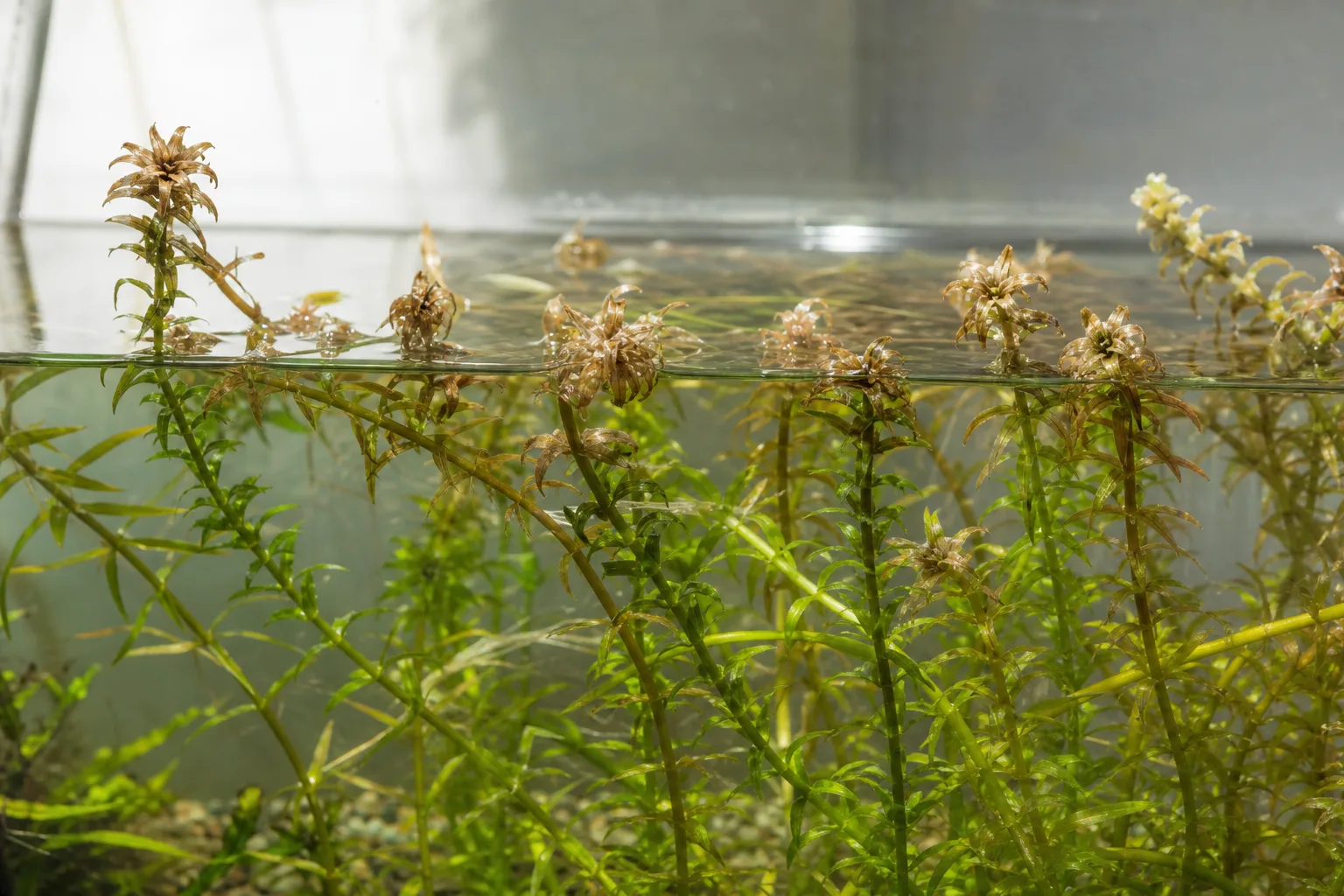
Crispy Leaves on Anacharis / Elodea: Causes, Checks & Fixes
This guide covers crispy leaves on Anacharis / Elodea. See also the general Crispy Leaves guide, watering, and light pages for this plant.
Crispy Leaves on Anacharis / Elodea: Causes, Checks & Fixes
Quick answer
Crispy leaves on Anacharis (Egeria densa) almost always mean stems or whorls dried out in air-not underwater drought, soil dryness, or a houseplant watering mistake.
First step: push every stem fully underwater and trim papery, brittle whorls. Desiccated tissue will not rehydrate; remove it so submerged nodes can push new growth.
This guide covers submerged aquarium, turtle-tub, and pond-tub culture only. For translucent mush after planting, see transplant shock and brown leaves. For bleached upper whorls under strong light, see sunburn. For rapid melt after ich meds, see chemical damage. For baseline care, start with the Anacharis overview.
Why Anacharis leaves turn crispy (it’s usually the waterline)
Anacharis is a rooted submersed perennial built for life under water. Its leaves grow in whorls of four to six along slender stems, each leaf only about two cell layers thick. That thin structure photosynthesizes efficiently underwater but loses water fast in dry air.
When stems ride above the surface-on a floating mat, against a filter outflow, at a pond edge, or in an open bag during shipping-the exposed whorls desiccate. They turn papery, brown, and brittle: crispy, not mushy. The damage often appears as a sharp band at the waterline, with green submerged tissue below and dried whorls above.
This is different from melt, where emersed-farm leaves break down after planting because their waxy aerial structure cannot function submerged. Melt looks translucent and soft; crispiness is dry and stiff. It is also different from light burn, which bleaches or yellows submerged upper whorls still in water, and from copper damage, which liquefies tissue fast. Each has a different first fix-this page focuses on air-drying at or above the waterline.
What you’ll see: crispy whorls, dried tips, and floating mat patterns
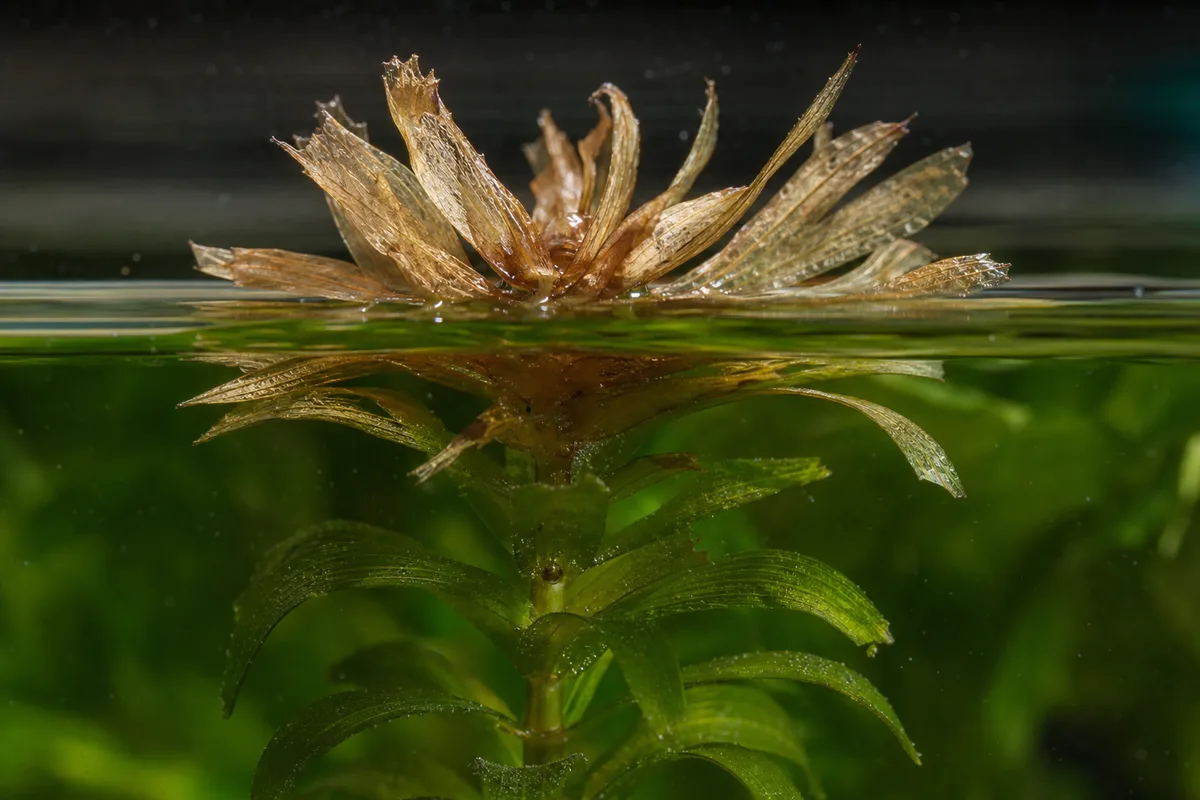
Crispy Leaves symptoms on Anacharis / Elodea - compare with healthy tissue on the same plant.
Texture and color
- Papery, brittle whorls that crack when bent-often tan to dark brown
- Sharp waterline edge where submerged green meets dried tissue above
- Floating mat tops with dry outer whorls while trailing submerged roots stay healthy
- Stem tips left in filter splash or breeding-box air gaps
Healthy submerged Anacharis whorls feel firm and slippery, bright green (sometimes darker below the surface per USGS NAS), with minutely serrated edges visible under magnification.
Common placement patterns
| Location | What happened | What stays healthy |
|---|---|---|
| Floating mat surface | Top whorls dried in room air or direct window light | Submerged trailing stems and roots |
| Shallow planting / goldfish tug | Stem pulled so upper whorls clear the water | Lower buried nodes if not rotted |
| Filter outflow splash zone | Constant mist then air exposure crisps tips | Mid-stem sections deep in tank |
| Shipping / counter acclimation | Bunch left out of water during drip acclimation | Lower stems if re-submerged quickly |
| Outdoor tub rim | Stems pile against edge above water | Submerged mat center |
Crispiness vs melt vs light burn vs copper
| Symptom | Texture | Position | Likely cause |
|---|---|---|---|
| Crispy brown whorls | Dry, papery, stiff | At or above waterline | Emergent desiccation |
| Translucent mush | Soft, dissolving | Whole stem or after planting | Melt, ammonia, or copper |
| Bleached/yellow patches | Firm leaf, color loss | Upper submerged whorls | Excess PAR / photoperiod |
| Rapid stem collapse | Mushy, no dry edge | After medication dose | Copper or glutaraldehyde |
Use this table before changing fertilizer, light, or medications-you can waste weeks treating “nutrients” when the real issue is a stem sitting half out of water.
Confirm the cause: aquarium checks in order
Work through this checklist top to bottom. Stop when you find a clear match.
1. Waterline and stem position
- Measure effective water level-did a water change, evaporation, or turtle basking platform drop it?
- Trace every stem: any whorl above the meniscus?
- Check floating mats: do piled stems form a dry “raft” on top?
- Inspect filter outflow, lily-pipe spray, and breeding-box lids that hold stems in air gaps
Confirms desiccation when damage tracks air exposure and submerged tissue below stays firm and green.
2. Recent handling and shipping
- Was the bunch unwrapped on a counter during drip acclimation?
- Did rubber bands or lead weights compress stems in dry air?
- Any stem segments left on the tank rim while trimming?
Commercial Anacharis is often grown for the aquarium trade before sale. Brief air exposure during unpacking is enough to crisp thin whorls-even when the stem will later adapt submerged. Re-submerge immediately; do not wait.
3. Rule out lookalikes
- Melt: pinch a “crispy” whorl-if it dissolves, read brown leaves or transplant shock
- Light burn: damage on submerged top whorls under high PAR-see sunburn and the light guide
- Copper / algicide: sudden mush after ich treatment-stop dosing and see chemical damage; Anacharis is extremely sensitive to copper
- Nutrient stress: yellowing with intact texture underwater-see nitrogen deficiency and pale leaves
Log photoperiod, PAR if known, recent meds, and whether stems are floating or planted before stacking fixes.
First fix for Anacharis: re-submerge, trim, stabilize
One action first: get every stem fully underwater.
- Re-submerge floating or emergent sections. Push stems below the surface; lower water level is not the fix-raising submersion is.
- Trim dry, papery whorls with sharp scissors. Cut back to firm green tissue or the nearest healthy node. Do not peel crispy leaves-they tear the stem.
- Remove trimmed debris from the tank so it does not foul water.
- Anchor if needed: plant bare stem nodes 1–2 inches into substrate or let float until roots form-see propagation.
Make one environmental correction after that (for example, redirect filter outflow or thin a floating mat). Wait one week before changing light or fertilizer. Anacharis responds quickly when the waterline issue is solved.
Do not apply houseplant logic-there is no soil to dry out. Do not dose extra fertilizer on dried stems. Do not assume crispy tissue will green up underwater; it will not.
Recovery timeline in the tank
| Severity | What you did | What to expect |
|---|---|---|
| Few dry whorls on float tips | Trimmed, re-submerged | New whorls at nodes within 3–7 days |
| Half a stem band-dried at waterline | Trimmed to green, stable params | Fresh side shoots in 1–2 weeks |
| Entire floating mat dried on top | Removed dead mat, kept submerged roots | Regrowth from nodes in 2–3 weeks in moderate light |
| Stems hours out of water during shipping | Re-submerged same day | Surviving nodes sprout in 1–2 weeks; total loss if stems browned through |
Judge success by new firm whorls, not old crispy tissue. Anacharis is a fast column feeder that can replace trimmed length within a few weeks in a healthy tank.
Worsening signs: crispy damage marching down submerged stems, stems turning mushy, or no new nodes after two weeks with stable water parameters-re-check for melt, copper, or ammonia.
Mistakes that make crispiness worse
- Leaving dry whorls attached - they decay and invite algae on the stem below
- Stacking light, CO₂, and fertilizer changes the same week you re-submerge - you cannot read cause and effect
- Drying stems “to rest” during quarantine - Anacharis is not a terrestrial plant; air storage crisps it within hours on a warm counter
- Piling floating stems too thick - the top layer dries while the bottom suffocates; thin mats per the overview floating section
- Using copper-based ich meds on a tank with Anacharis - causes melt, not crispiness, but kills the plant fast
- Checking soil moisture or pot drainage - irrelevant; wastes time while emergent stems keep drying
Prevention: floating mats, pond edges, and emersed farm stock
- Display tanks: trim floating stems weekly so tips do not stack above the rim; aim for 7–10 hour photoperiod per the light guide
- After shipping: float stems in water immediately; acclimate temperature in the bag, then release submerged-never leave bunches on the counter
- Outdoor tubs: Egeria densa forms dense surface canopies in ponds; skim or trim mats before outer stems dry at edges-check local legality before outdoor release (see overview)
- Planted stems: bury only bare nodes 1–2 inches deep so goldfish and current cannot pull whorls into the air gap
- Breeding boxes / turtle tubs: route stems away from dry basking zones and lid gaps
Healthy submerged Anacharis pearling at the surface is fine-the leaves stay in water while gas exchange happens. Problems start when whorls sit in air.
When to escalate
- Same-day: most of a mat dried out, or stems were out of water for hours during setup
- This week: re-submerge and trim failed; submerged tissue turns mushy; you dosed copper or glutaraldehyde recently
- After two weeks: no new whorls on trimmed nodes-test ammonia/nitrite, review watering parameters, and consider replacing with fresh submerged-grown stock
Replace rather than chase when stems are brown and brittle through multiple nodes with no green band left.
What to read next on Anacharis care
- Anacharis overview - melt, floating vs planted, legality
- Light requirements - PAR targets and photoperiod
- Water parameters - temperature, pH, and stability
- Propagation - trim points and floating establishment
- Brown leaves - melt and diatoms vs crispiness
- Sunburn - submerged light burn
- Chemical damage - copper and algicide melt
When to use this page vs other Anacharis / Elodea guides
- Anacharis / Elodea watering guide - Use for routine moisture checks before assuming crispy leaves is the main issue.
- Anacharis / Elodea problems hub - Browse all 34 common issues on this species.
- Brown Tips on Anacharis / Elodea - Different entry point when symptoms overlap with crispy leaves.
- Brown Leaves on Anacharis / Elodea - Different entry point when symptoms overlap with crispy leaves.