Thrips on Zinnia: Causes, Checks & Fixes
Quick answer
Zinnia blooms that looked fine in the bud but open streaked, bleached, or twisted usually mean thrips were feeding inside the composite head for days. First step: shake an opening bloom over white paper to confirm slender insects, remove the worst damaged flowers, then treat remaining buds and leaf undersides in early evening.
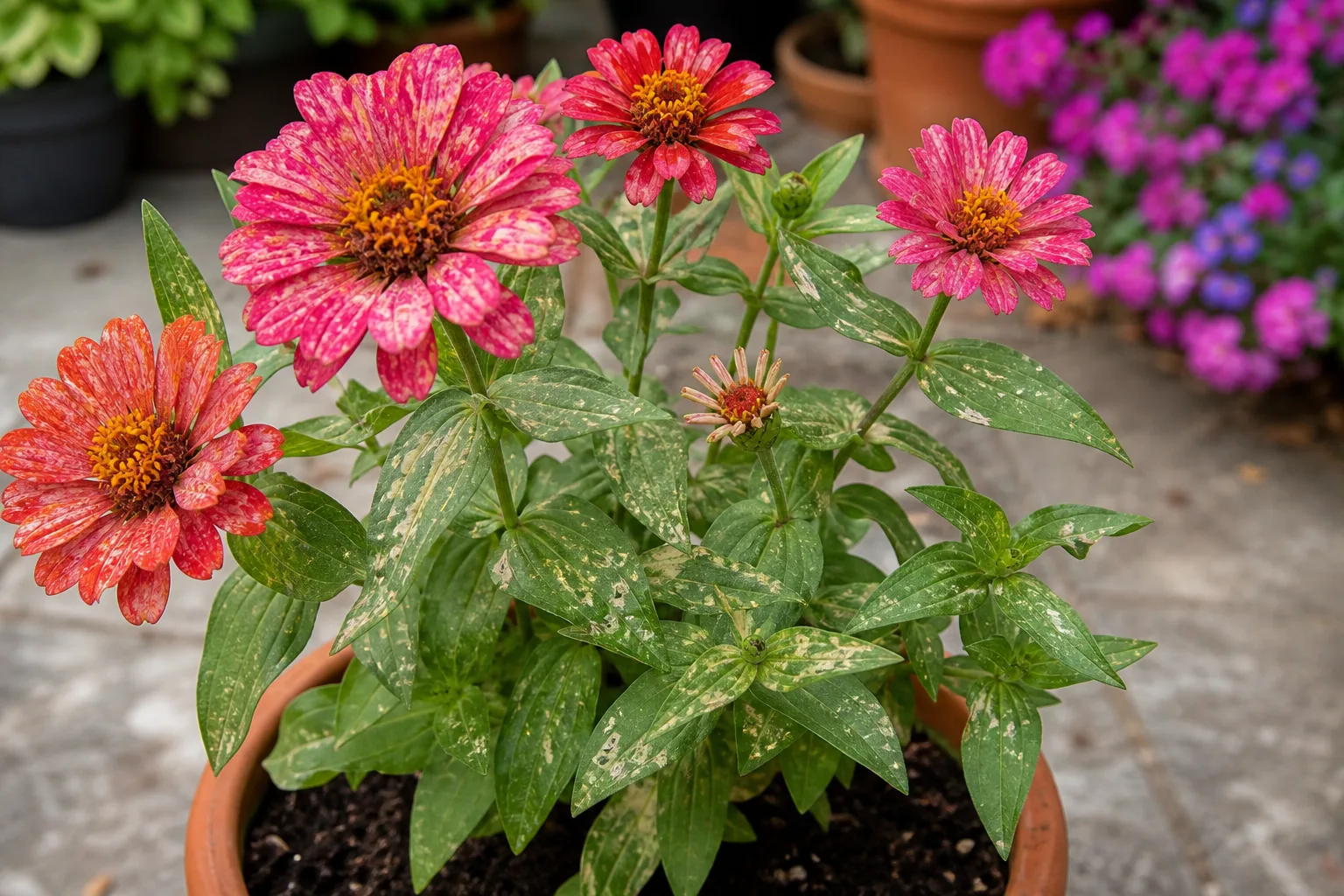
Thrips on Zinnia: Causes, Checks & Fixes
This guide covers thrips on Zinnia. See also the general Thrips guide, watering, and light pages for this plant.
Thrips on Zinnia: Causes, Checks & Fixes
Quick answer
You checked your zinnia bed yesterday and the buds looked tight and green. Today those same flowers open with silvery streaks, bleached patches, or ruffled edges-and the damage feels sudden even though thrips were feeding inside the composite head for days before petals unfurled. On Zinnia elegans, western flower thrips and related species are the usual culprits in hot dry weather.
First step: shake an opening bloom over white paper and watch for fast-moving slender flecks one to two millimeters long. If you see them, remove the worst damaged flowers and buds, then treat remaining buds and leaf undersides with insecticidal soap or spinosad in early evening. Do not spray blindly on day one-drought bronzing, powdery mildew on crowded zinnia beds, and old petal senescence can look superficially similar until you confirm live thrips.
Which thrips species hit Zinnia
On outdoor zinnia beds, western flower thrips (Frankliniella occidentalis) is the species most often tied to silvery petal scarring and tospovirus spread on ornamentals. Onion thrips (Thrips tabaci) also feeds on many garden flowers and can scar petals, but home gardeners rarely need to ID thrips to species-the bloom tap test, bud inspection, and treatment steps are the same.
What does matter for zinnias: western flower thrips vectors impatiens necrotic spot virus (INSV) and tomato spotted wilt virus (TSWV), and thrips pupate in soil or plant litter while eggs and nymphs hide inside tight composite buds. That is why one surface spray on open petals rarely clears a row-you need repeated coverage on bud scales across two to three generations.
What thrips look like on Zinnia
Zinnias belong to the Asteraceae-the same composite family as marigolds and chrysanthemums-and thrips commonly concentrate in their dense flower heads. On zinnias, active damage usually reads as:
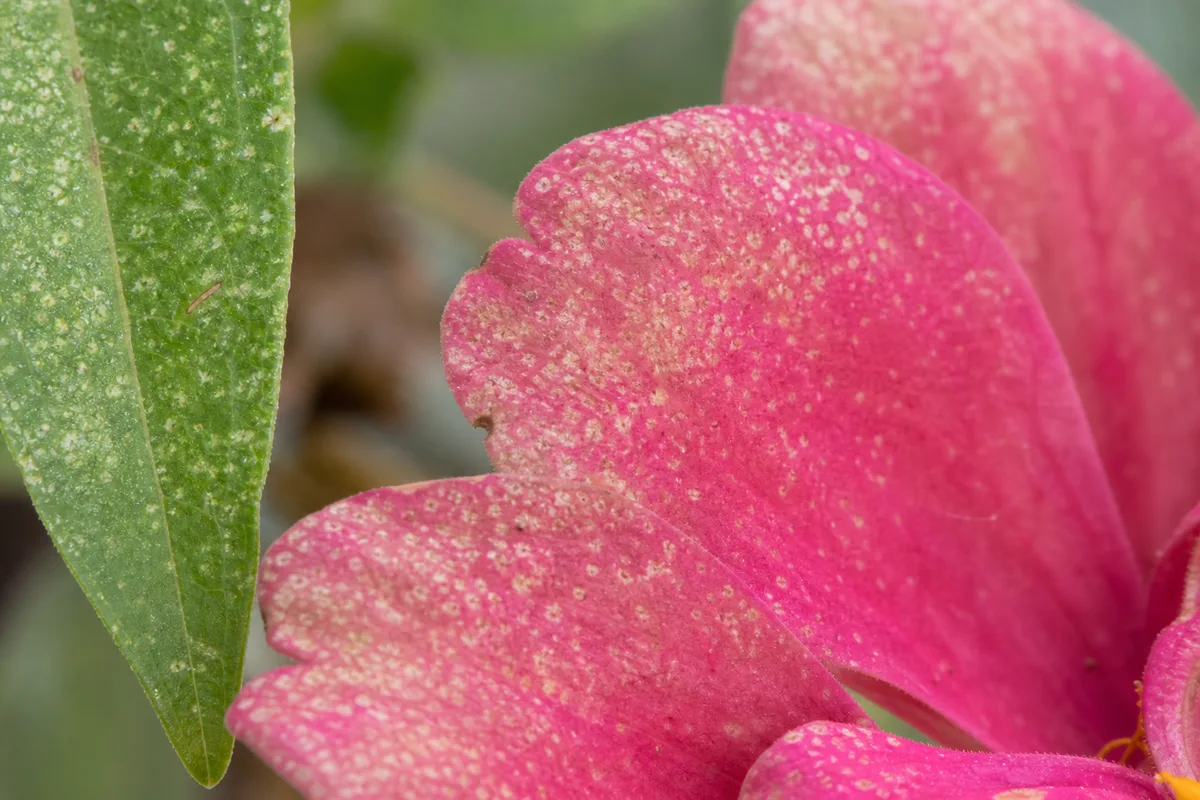
Thrips symptoms on Zinnia - compare with healthy tissue on the same plant.
- Silvery streaks or speckling on ray petals and sometimes on young leaves, where feeding collapsed individual surface cells
- Bleached, streaked, or scarred petals on blooms that opened after thrips fed inside the bud
- Tiny black fecal specks on petals and foliage near feeding sites
- Distorted or ruffled flower edges when thrips fed on developing tissue before cells could expand normally
- Premature petal drop or faded color on heavily hit blooms while neighboring buds still look tight and green
The insects themselves are slender, pale yellow to dark brown, and roughly one millimeter long-easy to miss until you tap a bloom. Hold white paper under a flower, shake or tap the head sharply, and watch for quick-moving flecks.
What zinnia thrips damage is not:
- Uniform pale stippling on upper leaves with webbing - spider mites on zinnias in the same hot dry window; confirm with a stem tap test
- Sticky shiny residue on shoot tips - aphids on zinnias; soft-bodied clusters and ant traffic
- Dry white powder on leaf faces - powdery mildew in humid crowded beds
- Irregular chewed holes - caterpillars, slugs, or beetles overnight
- Dark brown leaf spots with defined edges - Alternaria or Cercospora leaf spot, not silvery streaking
Why Zinnia gets thrips
Zinnias are sun-loving fast annuals that push constant new buds through summer-the soft developing petals and tight bud scales thrips prefer. Several habits raise risk on this plant:
Hot dry spells after drought stress. Zinnias in containers and raised beds dry quickly when the top 3 cm (about 1 inch) of mix goes parched every afternoon. Stressed plants with open, pollen-rich composite heads attract thrips from nearby weeds and garden beds during warm weather.
Bud-heavy growth in Zinnia light guide. Zinnias in six or more hours of direct sun produce waves of buds. Thrips hide inside unopened heads where sprays and predators reach them less easily; damage appears only when each bloom opens. See the zinnia overview for how tall cutting types and dwarf bedding lines both push dense composite heads through peak summer.
Crowded rows and mixed composite beds. Direct-sown zinnias thinned late, or packs planted too tight at 20–30 cm (8–12 inches), let thrips walk from marigold, cosmos, or chrysanthemum neighbors onto zinnia flowers without crossing open ground.
Overhead watering and wet petals. Zinnias already dislike wet foliage-soggy petals from evening overhead sprinklers weaken tissue and do not control thrips, while dense humid pockets at the base of crowded stems favor other problems that complicate diagnosis. The zinnia watering guide covers base-level irrigation that keeps foliage dry in full sun.
Virus vector pressure. Western flower thrips can transmit tomato spotted wilt virus and impatiens necrotic spot virus. Zinnias are not the primary crop host, but mosaic mottling after heavy thrips feeding warrants removing affected plants and cross-checking mosaic virus on zinnia rather than repeated cosmetic sprays.
Zinnias are not uniquely susceptible, but their showy blooms make silvery petal scarring obvious the moment a flower opens-often the first sign gardeners notice.
How to confirm the cause
Work through these checks in order:
- Bloom tap test - Shake or tap a suspect flower over white paper. Fast-moving slender insects confirm thrips. Static debris alone does not.
- Bud inspection - Peel back a few tight bud scales gently with a fingernail or open a bud that should have color but looks dull. Larvae and adults often sit deep in composite florets.
- Pattern on petals vs leaves - Silvery streaking concentrated on petals and bud scales strongly supports thrips. Even stippling across upper leaves without petal scarring suggests spider mites instead.
- Fecal specks - Pinhead black deposits on petals or young leaves near streaks are classic thrips sign; wipe them-they do not brush off like sooty mold.
- Neighbor scan - Check marigolds, cosmos, and other composites in the same bed. Shared streaked blooms mean a bed-wide issue, not one sick plant.
- Soil moisture - Stick a finger 3 cm (about 1 inch) into the mix. Severe drought alone bronzes leaves but does not produce black thrips frass on petals.
- Honeydew check - Sticky tips with soft green or black insects on shoots point to aphids, not thrips.
If blooms open clean on repeated tap tests over a week, old scarred petals may be from a past outbreak that already crashed-focus on watering and scouting new buds rather than repeated chemical cycles.
Symptom lookalike comparison
| Sign on zinnia | Likely cause | Quick check |
|---|---|---|
| Silvery petal streaks + black frass specks | Thrips | Bloom tap test over white paper |
| Even leaf stippling + fine webbing | Spider mites | Webbing at stem joints; stem tap test |
| Sticky shoot tips + soft insect clusters | Aphids | Pear-shaped insects on new growth |
| Dry white flour-like patches on leaves | Powdery mildew | Humid crowded bed; no moving insects |
| Dark brown spots with defined edges on leaves | Alternaria or Cercospora leaf spot | Lesions on foliage, not silvery petals |
| Mosaic mottling + distortion after thrips flare | Mosaic virus | Pattern on multiple stems; may follow thrips |
| Uniform outer-petal fade on old blooms only | Natural petal aging | Fresh inner buds open clean |
First fix for Zinnia
Remove the worst damaged flowers and buds, then spray remaining buds and leaf undersides with insecticidal soap or spinosad in early evening.
Deadheading heavily streaked blooms cuts the current feeding population and removes tissue larvae already inhabit. Hold stems steady and coat bud scales, petal bases, and leaf undersides where thrips hide-surface-only sprays on open petals miss most insects inside tight heads.
Apply when bees are less active on open zinnia flowers. Zinnias attract pollinators; evening treatment reduces contact risk while product dries overnight. Repeat every five to seven days for two to three cycles to catch newly emerged adults from soil pupation-UF/IFAS recommends three consecutive applications at that interval when pressure is high.
Do not fertilize a thrips-hit zinnia on day one hoping to push replacement blooms. Nitrogen-rich soft growth is easier thrips fodder. Do not overhead soak flowers at dusk; wet zinnia petals invite Botrytis and powdery mildew unrelated to thrips control.
Spinosad and insecticidal soap on ornamental zinnias
For early infestations, insecticidal soap applied thoroughly to buds, petal bases, and leaf undersides is often enough when you repeat on label timing. Insecticidal soap can burn foliage on heat-stressed zinnias in direct afternoon sun-apply early morning or evening when plants are not wilting.
If streaked blooms keep opening after two full soap cycles spaced five to seven days apart, step up to a spinosad product labeled for thrips on ornamentals. Spinosad is generally more effective against thrips than soap alone and can reach thrips tucked under bud scales when coverage is thorough. Spinosad can harm bees and some natural enemies for about one day after application-treat at dusk, coat tight buds rather than open faces, and avoid spraying during peak pollinator hours on shared vegetable beds.
Commercial growers rotate products because western flower thrips develops insecticide resistance easily. Home gardeners should exhaust deadheading, soap, and monitoring before reaching for broad-spectrum sprays.
Step-by-step recovery
After deadheading and the first targeted spray:
- Repeat treatment on label intervals for at least two full generations-often two to three weeks of scheduled sprays when coverage is thorough.
- Continue removing streaked blooms as they open so remaining insects have fewer harbors while you break the cycle.
- Water at the base when the top 3 cm (about 1 inch) of mix dries. Even moisture reduces drought stress that keeps zinnias vulnerable during heat waves-see zinnia watering for the container vs in-ground dry-down check.
- Knock down lightly with a morning water rinse on foliage only if product label allows and plants are not in peak afternoon heat stress-physical disruption helps between soap applications but does not replace bud coverage.
- Set blue or yellow sticky traps near bed edges to monitor adult movement-not a standalone control, but useful to see whether populations fall after treatment. Blue and yellow sticky cards both catch western flower thrips; place traps at canopy height along bed margins during hot dry stretches.
- Rogue virus-suspect plants showing mosaic mottling, ring spots, or severe stunted distortion after heavy thrips exposure. Do not compost that tissue near clean zinnia rows-see mosaic virus on zinnia for symptom overlap.
- Preserve predators on in-ground beds. Lady beetles, lacewings, and minute pirate bugs eat thrips when broad-spectrum sprays have not removed them.
Recovery timeline
Clean newly opening buds often appear within seven to fourteen days once active thrips are controlled and drought stress is corrected. A full spray course with label-interval repeats typically takes two to three weeks because thrips pupate in soil and emerge on staggered cycles.
Already scarred open petals do not smooth out-watch for unstreaked new blooms and leaves without fresh silvering. Fast zinnia varieties can produce another flush from side buds within two weeks on healthy plants. Late-season specimens with most buds already scarred may not have enough runway for a full recovery display before heat or frost ends the run.
Mistakes to avoid
Do not treat every streaked zinnia petal with spray before a bloom tap test confirms live thrips.
Do not spray only open flower faces-most thrips sit inside buds and under bud scales.
Do not stop after one application. Thrips life cycles require repeated coverage on label timing.
Do not apply spinosad or soap during peak bee activity on open zinnia blooms when avoidable-shift to evening.
Do not overhead irrigate on a fixed calendar; wet zinnia foliage and flowers invite fungal problems that mimic stress damage.
Do not compost heavily infested or virus-suspect flower heads near clean direct-sown rows.
Do not increase nitrogen feeding during an active infestation-soft new tissue feeds thrips faster.
Zinnia care cross-check
Thrips recovery on zinnias depends on culture alongside sprays:
- Light - Full sun (six or more hours direct) keeps zinnias pushing clean buds. Shade-weakened plants recover slowly even after pests are gone.
- Water - Deep base watering when the top 3 cm (about 1 inch) dries; avoid letting containers bake dry every afternoon during thrips-prone heat waves.
- Spacing - Thin or transplant to roughly 20–30 cm (8–12 inches) so air moves through stems and you can inspect inner buds.
- Deadheading - Remove spent blooms every two to three days during peak season; this also drops infested tissue before larvae spread.
- Feeding - Hold nitrogen-heavy fertilizer until new buds open clean for two weeks. Resume balanced or bloom-oriented feeding once tap tests stay clear.
How to prevent thrips on Zinnia
Scout bud tips every three to five days during hot dry stretches-exactly when thrips reproduction outpaces predators and drought stress peaks.
Deadhead regularly so old infested blooms do not harbor the next generation. Composite heads hold many hiding florets.
Water at the base in morning when possible so petals and leaves dry quickly in full sun.
Space at sowing or transplant so stems do not touch by midseason. Good airflow helps foliage dry after dew and reduces confusion with humidity-driven diseases.
Quarantine new nursery packs for seven to ten days before adding them to mixed annual beds. Thrips often ride in on purchased composites.
Use sticky traps at bed margins during peak season to catch population spikes early-not as sole control, but as a scouting signal.
Preserve beneficial insects. Minute pirate bugs, lacewings, and lady beetles reduce thrips outdoors when broad-spectrum sprays have not wiped them out.
Choose open breezy bed sites over tight corners against heat-reflecting walls when possible-or accept that container zinnias in those microclimates need more frequent bud checks.
When to worry
Treat as urgent when most buds in a row open streaked within a week, black fecal specks coat new growth across multiple plants, or leaves show virus-like mosaic mottling after heavy thrips pressure. Tomato spotted wilt and other viruses affect zinnias spread by sucking insects-remove and bag affected plants to protect neighbors.
Pull individual plants that are mostly budless and scarred if the rest of the row is still clean-isolation beats saving one heavily infested specimen that reinfects composites nearby.
Natural thrips crashes happen when weather turns cooler and wetter; if tap tests go clean without further sprays, maintain watering and monitor new buds-do not keep treating a resolved problem.
Late-season zinnias with nearly every open bloom scarred may not warrant a long chemical campaign on an annual nearing end of display-focus on clean fall sowings next cycle instead.
If streaked blooms return across the same bed after three full label-interval spray cycles with thorough bud coverage, contact your local cooperative extension office for help identifying resistant western flower thrips populations and bed-wide sanitation options.
Related zinnia problems
| Symptom pattern | Open this page |
|---|---|
| Stippling + webbing on upper leaves | Spider mites |
| Sticky honeydew + soft insects on tips | Aphids |
| Mottled leaves, color break, stunted distortion | Mosaic virus |
| Dry white patches on crowded foliage | Powdery mildew |
| Afternoon wilt, dry soil, no petal scarring | Underwatering or heat stress |
| Baseline culture and bed care | Overview · Watering · All problems |
Scout unopened zinnia buds every three to five days during hot dry stretches-that is when thrips inside composite heads do the most damage before the next flush opens streaked.
When to use this page vs other Zinnia guides
- Zinnia watering guide - Use for routine moisture checks before assuming thrips is the main issue.
- Zinnia problems hub - Browse all 38 common issues on this species.
- Yellow Leaves on Zinnia - Different entry point when symptoms overlap with thrips.