Overwatering on Syngonium: Causes, Checks & Fixes
Quick answer
If your Syngonium has limp arrowhead leaves but the pot still feels heavy and the top inch of mix is damp, you are likely overwatering-not underwatering. Stop watering immediately and check stem firmness at the soil line before you pour again.
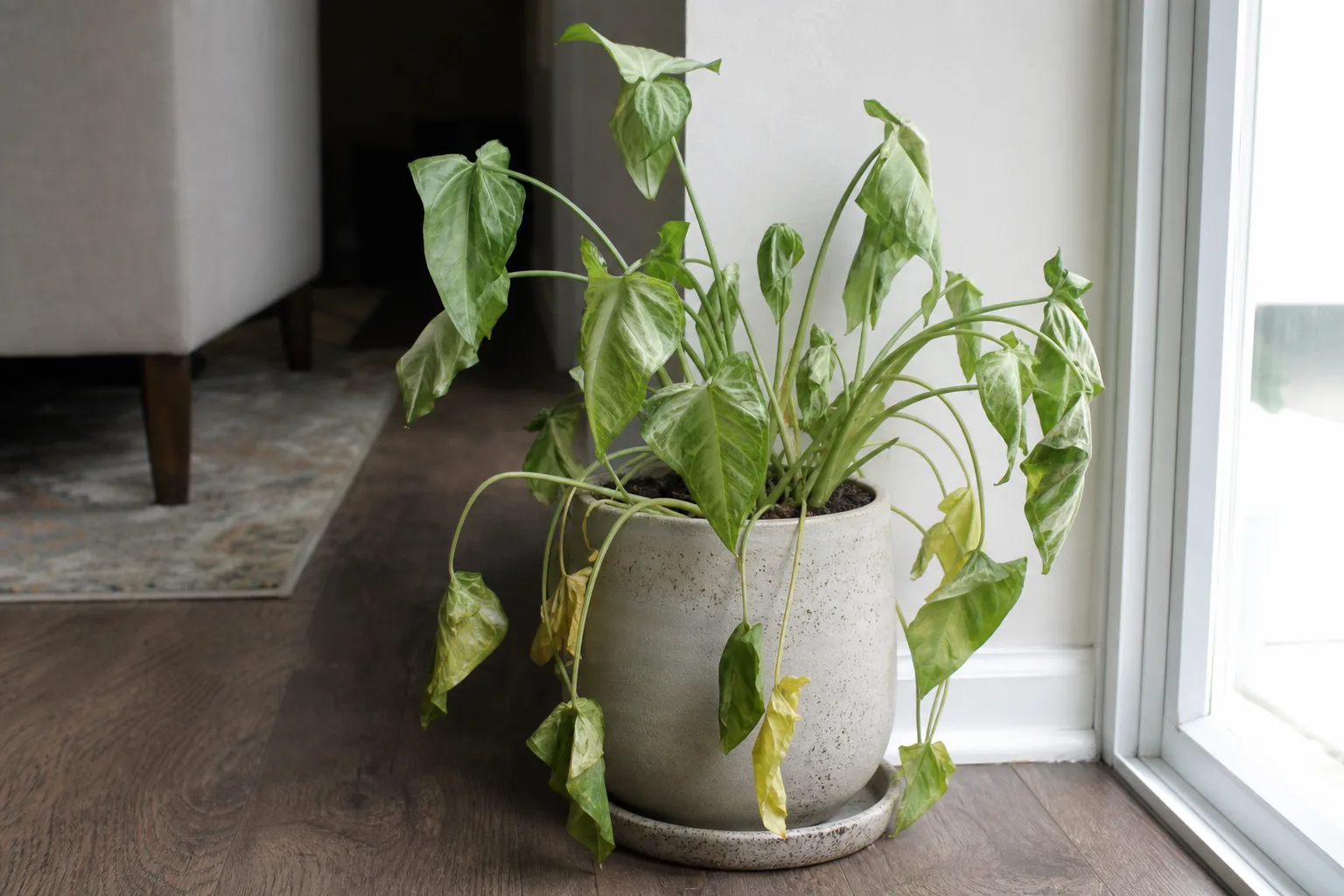
Overwatering on Syngonium: Causes, Checks & Fixes
This guide covers overwatering on Syngonium. See also the general Overwatering guide, watering, and light pages for this plant.
Overwatering on Syngonium: Causes, Checks & Fixes
Quick answer
Your arrowhead leaves are limp, but when you poke the soil the top inch is still damp and the pot feels heavy. That combination is the wet-soil wilt paradox on Syngonium podophyllum: the plant looks thirsty while the root zone is drowning.
First step: stop watering and lift the pot. A heavy container with cool, clinging mix means pause-not another drink. Damaged aroid roots cannot absorb the oxygen they need when soil stays saturated, so leaves wilt even though water is present. If petioles stay firm at the soil line, a dry-down reset may be enough. If they soften or the mix smells sour, unpot and inspect roots the same day.
This page is early-intervention triage for soggy syngonium. For full wilt routing between thirst and rot, see our wilting guide. For advanced crown failure and propagation salvage, see root rot on Syngonium.
What overwatering looks like on Syngonium
Overwatering on syngonium rarely announces itself as a single dramatic event. It builds from small habits-watering on Tuesday because you always do, letting a decorative pot hold runoff, keeping a large peat-heavy mix in a dim corner-until roots lose function and foliage responds.
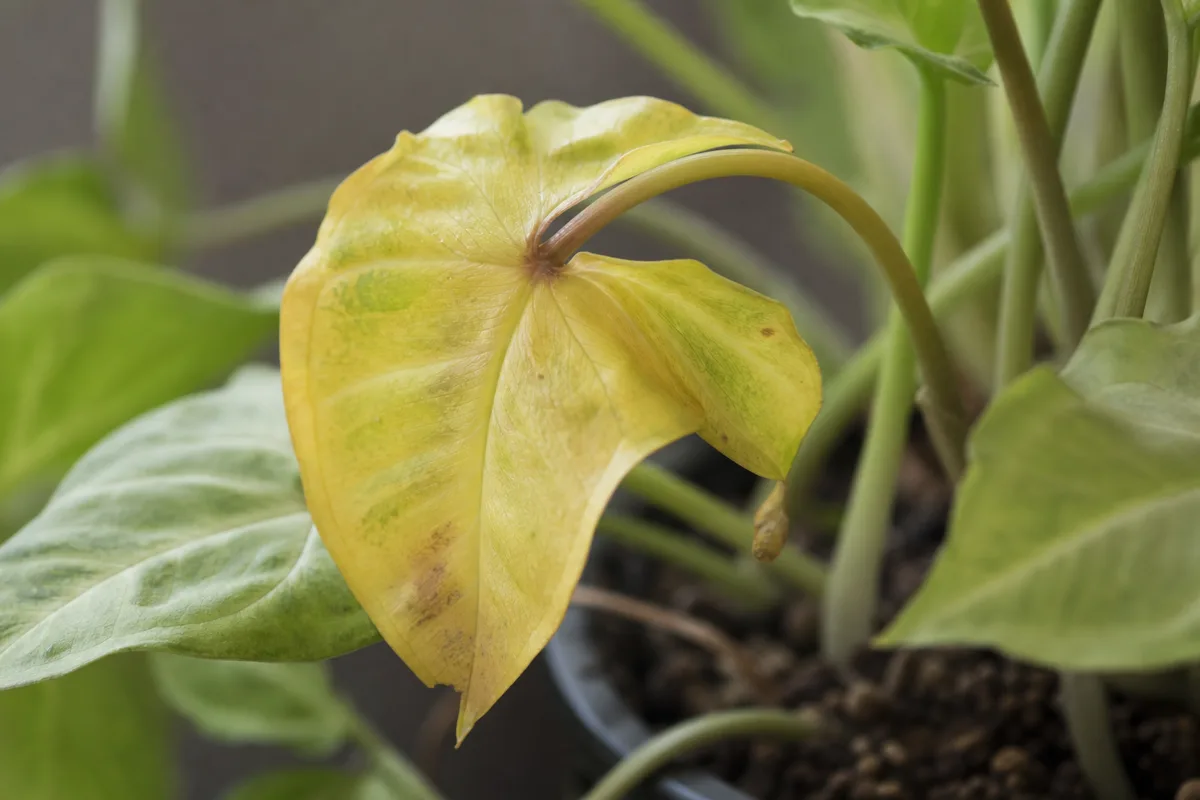
Overwatering symptoms on Syngonium - compare with healthy tissue on the same plant.
Typical early signs:
- Yellowing lower arrow-shaped leaves while upper growth still looks green
- Limp petioles and drooping juvenile foliage despite moist mix
- Pot stays heavy for seven to ten days or longer after the last watering
- Top inch feels cool and damp; skewer pulled from depth comes out wet
- New leaves emerge small, stall, or blacken at the tips
- Fungus gnats hover when the surface rarely dries
Advanced warning signs:
- Petioles collapse or feel mushy where they enter the soil
- Sour, musty, or rotten smell from drainage holes
- Brown or blackening at the stem base while mix is wet
- White root tips absent when you tip the plant out-roots look brown, slimy, or hollow
Juvenile syngonium leaves on long petioles make the plant look dramatically stressed from modest root decline. Do not judge severity from leaf posture alone-confirm with pot weight, moisture depth, and stem firmness at the crown.
Overwatering vs. root rot vs. underwatering - read the pot before you pour
The same limp arrowhead canopy can mean opposite problems. Use pot evidence before you act.
| What you find | Likely cause | First move |
|---|---|---|
| Light pot, dry top 1–2 inches, firm petioles at soil line | Underwatering | Soak thoroughly, drain fully |
| Heavy pot, wet mix, yellow lower leaves, firm stems (early) | Overwatering | Stop watering; dry-down reset |
| Heavy pot, wet mix, soft stems, sour smell, mushy roots | Root rot | Unpot, trim, repot into airy mix |
| Normal moisture, firm stems, wilt on hot afternoons only | Heat or light stress | Stabilize placement; see wilting guide |
Overwatering is chronic or repeated excess moisture before widespread tissue death. Root rot is the advanced stage when roots have already decayed-often after weeks of wet soil in low light. This overwatering page covers catching the problem early; escalate to the root rot guide when more than a third of roots are mushy or the crown softens.
Why Syngonium is sensitive to overwatering
The wet-soil wilt paradox
Syngonium podophyllum is a tropical climbing aroid with thin juvenile arrow leaves on long petioles. When fine roots suffocate in waterlogged mix, they stop moving water efficiently. Leaves lose turgor and fold over-exactly like a dry plant. Many growers see limp foliage and water again, which deepens the damage. Our watering guide explains the full dry-down cycle; the rule here is simple: wet soil plus limp leaves means stop watering, not soak.
Cool winter light and slow uptake
Syngonium grows in moist shady tropical forests in nature, but indoors it still needs oxygen at the roots between drinks. From fall through late winter, shorter days and cooler rooms slow growth sharply. The same weekly watering that worked in July can leave mix saturated for two to four weeks in January. Reduce watering from fall to late winter and expect much longer dry-down intervals-often 14 to 28 days between drinks in a north room, per our watering rhythm guide.
Oversized pots, dense peat, and cachepot standing water
A pot much larger than the root ball holds a wet outer ring of soil the roots never reach. Dense peat-based mix compacts over time and stays anaerobic at the core even when the surface looks merely damp. Decorative cachepots without drainage trap saucer runoff and keep the bottom third of the root zone submerged. All three patterns show up constantly on store-bought syngonium kept wet in low light.
Fine fibrous aroid roots and oxygen need
Aroid roots respire in air-filled pore spaces. When those spaces stay filled with water-especially in cool, dim conditions-roots switch from healthy function to stressed tissue. Roots growing in waterlogged soil may die because they cannot absorb the oxygen needed to function normally. Syngonium’s fibrous root mass is efficient in airy mix but vulnerable in heavy, always-wet soil.
How to confirm the cause
Work through these checks in order:
- Pot weight - Lift the container. Heavy and waterlogged means overwatering is likely; light and dusty means look elsewhere.
- Surface and depth moisture - Stick a finger into the top inch. For routine care, water only when the top 1 to 2 inches feel dry, matching our watering guide. If the top is damp but you watered more than a week ago in winter, you are still too wet.
- Skewer or chopstick test - Insert to the bottom third. Cool, clinging residue confirms saturation at depth even when the surface looks lighter.
- Petiole firmness - Gently squeeze where stems meet soil. Firm tissue supports a dry-down path; soft, collapsing tissue means unpot now.
- Yellowing pattern - Lower yellow leaves with wet soil strongly suggest root-zone failure, not drought. See also yellow leaves on Syngonium for cultivar and light crossover.
- Smell and drainage - Sour odor, blocked holes, or standing water in a saucer confirm chronic saturation.
- Root spot-check - Slide the root ball partly out. Healthy aroid roots are pale and firm; rotted roots are dark, mushy, and may smell.
If wet soil, yellowing lowers, and soft stems align, treat it as a root-zone emergency. If the pot is light, mix is dry, and stems are firm, read our underwatering guide instead.
First fix for Syngonium
Stop watering immediately. Do not pour because leaves look limp. Move the plant to brighter filtered light-not direct sun, which burns arrowhead foliage-and improve airflow so the mix can dry. Empty any saucer or cachepot runoff.
If petioles remain firm and no sour smell is present, a dry-down reset alone may be enough. If stems soften at the base or roots feel mushy when you tip the plant out, proceed to the unpot-and-trim path below rather than waiting.
Step-by-step recovery
Dry-down path (early overwatering)
Use this when mix is wet but stems are still firm, smell is neutral, and a spot-check shows mostly firm roots with only minor browning.
- Stop all watering and remove standing water from saucers and outer pots.
- Move to Syngonium light guide so transpiration helps the mix dry faster.
- Loosen the top quarter-inch of compacted surface gently if it has crusted-do not dig deep and disturb roots.
- Wait until the top 1 to 2 inches feel dry before considering another drink.
- When you resume, water lightly and drain fully; compare pot weight to your memory of “just watered” heaviness.
- Hold fertilizer until new growth shows the root system is functioning again.
Unpot, trim, and repot path (sour mix or mushy roots)
Use this when soil smells sour, petioles collapse at the soil line, or more than a few roots are soft and brown.
- Unpot and rinse away saturated old mix so you can see firm versus mushy tissue.
- Trim all brown, soft, or hollow roots back to firm white tissue with clean shears; sterilize tools between cuts.
- Optionally rinse remaining roots with clean water; let the plant air in bright indirect light for several hours.
- Repot into fresh, airy aroid mix-roughly 40% potting base, 30% perlite, 20% orchid bark, 10% worm castings, per our soil guide. Use a pot only slightly larger than the trimmed root mass with clear drainage holes.
- Water lightly once after repotting, then let the top inch dry before the next drink.
- Remove leaves that stay collapsed and yellow after root work-they will not rehydrate and can harbor rot.
- If the crown is too far gone, salvage firm stem sections with nodes for cuttings-details in our root rot guide.
For repotting technique and timing, see our repotting guide.
Case note: recovery after winter calendar watering
A 6-inch syngonium in standard peat-perlite mix sat in a dim north bedroom and was watered every Sunday through December without checking dryness. By mid-month the pot stayed heavy eight days after each drink, lower leaves yellowed, and petioles began softening at the soil line. After unpotting, roughly one-third of roots were mushy and the mix smelled sour. Trimming bad tissue, air-drying the root ball for six hours, and repotting into bark-heavy mix with extra perlite stopped further decline. Under brighter filtered light, the first firm new arrow leaf unfurled in about twelve days. Progress was judged on new growth and firm stems-not on older yellow leaves, which were removed.
Recovery timeline and what to expect
Early overwatering caught before root death often stabilizes within three to seven days once watering stops and the mix begins drying. Petioles may still look limp during this window; firmness at the soil line is the better signal than leaf posture.
After root trimming and repotting, expect one to three weeks before a new arrow leaf unfurls. Old wilted and yellow foliage may never fully recover even when the plant survives-judge success by white root tips and firm new growth, not by older collapsed blades.
If no new tips appear after four weeks in warm spring light with correct dry-down, re-inspect roots or escalate to the root rot recovery sequence.
Causes to rule out
Thirst wilt - Light pot, dry mix throughout, firm stems. Soak once and see improvement within hours. Misdiagnosing this as overwatering starves a healthy plant.
Heat wilt - Firm stems, normal moisture, temporary afternoon droop after a hot window move. Stabilize light; do not change watering rhythm.
Low light alone - Stretched petioles and pale smaller leaves over weeks, not sudden wet-soil collapse. Soil moisture is usually normal.
Bacterial soft rot - Localized dark wet patches on leaves or stems with odor, rather than uniform limpness from saturated mix.
Normal lower-leaf aging - One oldest leaf yellows and drops while the rest of the plant stays upright with normal moisture-not a sudden heavy-pot pattern.
What not to do
Do not water on a calendar regardless of soil dryness. Do not assume limp arrowhead leaves always mean thirst-check weight first.
Do not use heavy moisture-control mix without perlite and bark. Dense peat in oversized plastic pots is a common syngonium trap.
Do not mist heavily to fix a wet root problem. Surface moisture does not heal oxygen-starved roots and can worsen fungus gnat pressure on constantly damp mix.
Do not move a soggy plant into direct sun to dry it faster. Use bright indirect light only.
Do not fertilize a stressed, waterlogged plant to perk it up. Feed only after watering rhythm and roots stabilize during active growth.
Keep away from pets when handling trimmed tissue-Syngonium is toxic to cats and dogs. Wear gloves if you have sensitive skin when pruning rotted roots.
How to prevent overwatering next time
Learn your pot’s dry-down speed in its actual room rather than following a generic weekly schedule. A syngonium in a bright kitchen may need water every five to ten days in summer; the same plant in a cool north bedroom may need only every fourteen to twenty-eight days in winter.
Before every watering:
- Lift the pot and compare weight to your memory of “just watered” heaviness
- Check whether the top 1 to 2 inches of mix are dry
- Confirm growth season-reduce frequency from fall through late winter
Use pots with drainage holes and empty cachepots and saucers after each drink. If mix stays wet more than seven to ten days after watering, improve light, lighten the mix per our soil guide, or downsize the container.
Match mix and pot to root mass. Repot every one to two years before soil collapses into a soggy block-see repotting Syngonium for the one-size-up workflow.
When to escalate to root rot recovery
Stay on this page for early soggy soil with firm stems and no sour smell. Move to the root rot guide when:
- More than a third of roots are mushy after inspection
- Petioles collapse at the crown and stems blacken at the base
- Sour smell persists after a dry-down attempt
- Yellowing climbs the plant rapidly while soil stays wet
For persistent wilt routing between thirst, overwatering, and rot, use the wilting guide as your decision hub.
Conclusion
Overwatering on syngonium is a drainage and rhythm problem disguised as a thirst problem. When arrowhead leaves hang limp but the pot is heavy and damp, your first move is always to stop watering and read the roots-not the foliage. Catch it early with a dry-down reset; escalate to trim and repot when smell and stem softness say the roots have already failed.
Written by sai-ananth and reviewed by the LeafyPixels Review Board. Guidance is checked against extension and botanical garden references and LeafyPixels syngonium care data before publication.
When to use this page vs other Syngonium guides
- Syngonium watering guide - Use for routine moisture checks before assuming overwatering is the main issue.
- Syngonium problems hub - Browse all 17 common issues on this species.
- Root Rot on Syngonium - Different entry point when symptoms overlap with overwatering.
- Yellow Leaves on Syngonium - Different entry point when symptoms overlap with overwatering.
- Wilting on Syngonium - Different entry point when symptoms overlap with overwatering.