Yellow Leaves on Syngonium: Causes, Checks & Fixes
Quick answer
On Syngonium, yellow leaves are usually caused by root-zone moisture imbalance first, then low light, with pests, cold stress, and natural lower-leaf aging as lookalikes. First, check moisture 2-3 inches deep and pot weight before you water again.
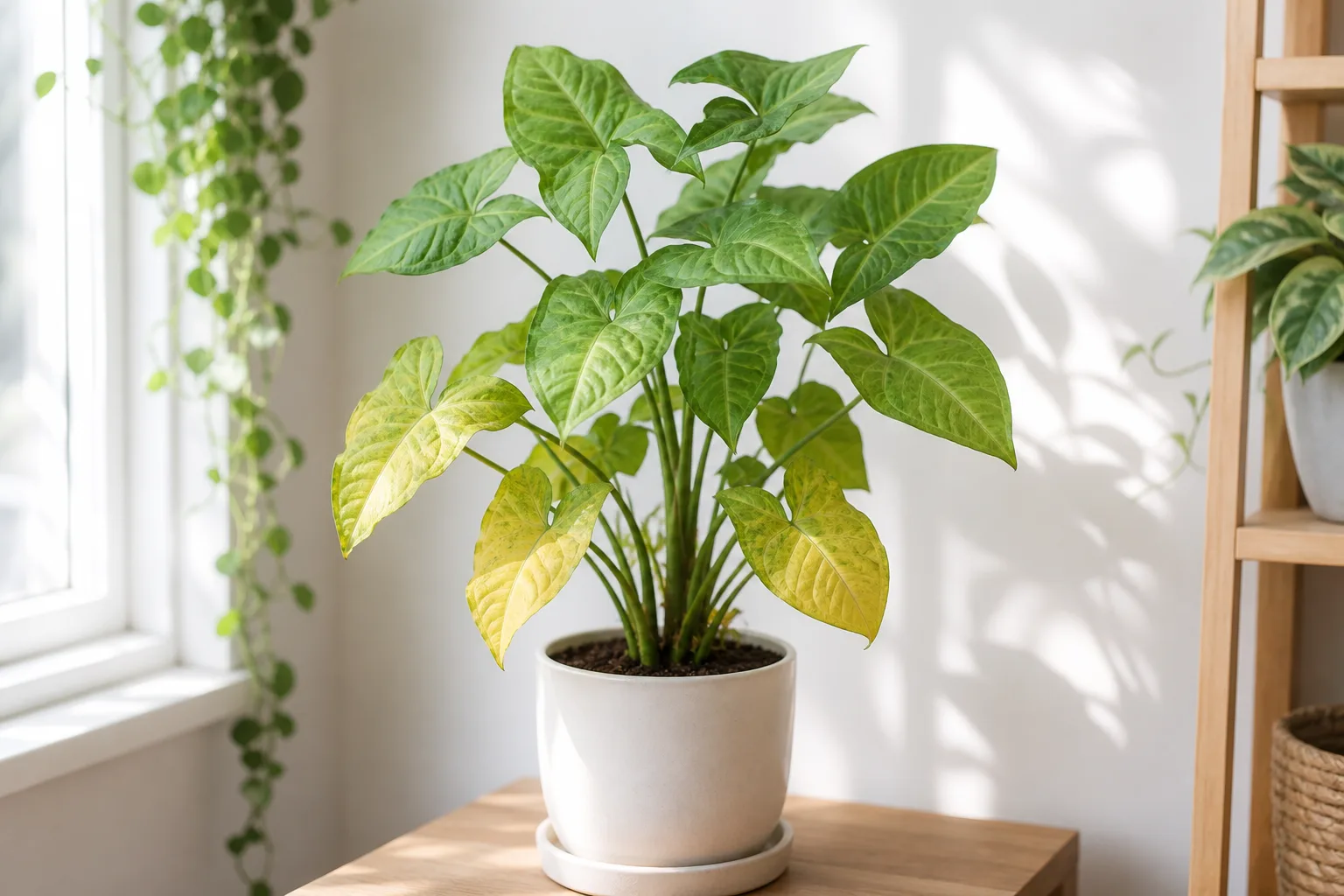
Yellow Leaves on Syngonium: Causes, Checks & Fixes
This guide covers yellow leaves on Syngonium. See also the general Yellow Leaves guide, watering, and light pages for this plant.
Yellow Leaves on Syngonium: Causes, Checks & Fixes
Quick answer
Yellow leaves on Syngonium are usually a moisture-and-light diagnosis, not a fertilizer emergency. Most cases come from one of three patterns: wet mix staying saturated too long, mix drying too far too often, or light that is too weak for sustained growth (especially in variegated and pink cultivars). Start with moisture at depth and pot weight before changing anything else. Excess water can reduce root-zone oxygen and cause yellowing with wilt, while drought stress causes yellowing with a very light pot and dry core (University of Maryland Extension, UConn Extension).
What yellow leaves look like on Syngonium
Natural lower-leaf aging
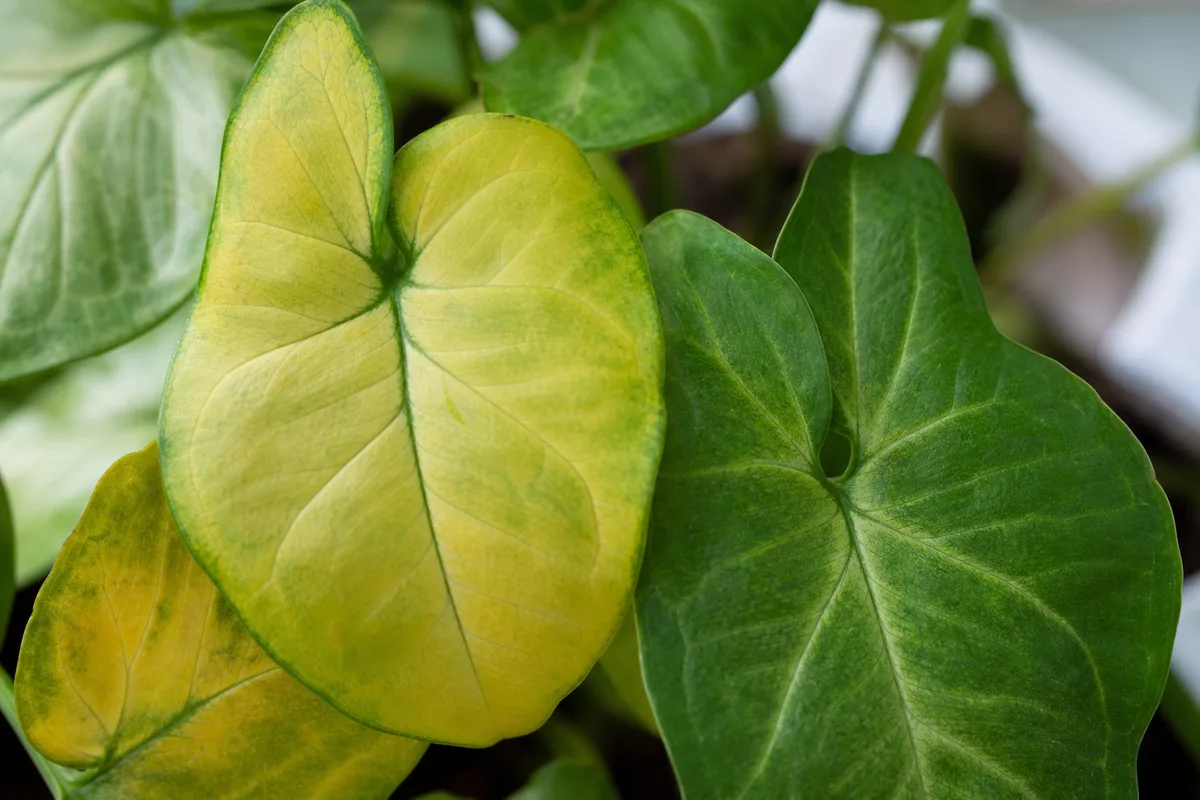
Yellow Leaves symptoms on Syngonium - compare with healthy tissue on the same plant.
Syngonium vines naturally retire older, lower juvenile leaves over time. If yellowing is limited to one older leaf at a time and new growth is still firm and normally colored, this is usually routine senescence rather than a care failure.
Wet-soil stress pattern
Wet-soil yellowing often starts low, then spreads if watering continues too soon. Leaves and petioles lose firmness, the pot stays heavy for days, and the top may look dry while the lower root zone remains wet. In more advanced cases, roots turn soft and brown, and the mix develops a sour smell (University of Florida EPI).
Dry-soil stress pattern
When the pot is very light and moisture is absent deeper in the root zone, Syngonium leaves can yellow with a thinner, papery texture and slight edge curl. Plants often rebound after a thorough soak-and-drain, which helps distinguish drought stress from chronic saturation.
Light mismatch pattern (especially variegated and pink cultivars)
Syngonium tolerates medium light, but stable growth and color are strongest in Syngonium light guide (Missouri Botanical Garden). In dim placements, variegated and pink forms often fade first, then yellow, with smaller leaves and longer internodes.
Pest-driven yellowing pattern
Pest pressure usually appears as patchy yellowing, stippling, or dull foliage rather than uniform bottom-up yellowing. Check leaf undersides and nodes for mealybugs or spider mites, both documented issues on Syngonium (NC State Extension Plant Toolbox).
Why Syngonium gets yellow leaves
1) Overwatering and low oxygen in the root zone
Excess moisture in container media displaces pore air and reduces oxygen at the roots, damaging fine roots and limiting water uptake (University of Maryland Extension, UConn Extension). This is the wet-soil wilt paradox: the plant wilts because roots are impaired even though the mix is still wet. If this persists, root rot risk rises and yellowing spreads.
2) underwatering on Syngonium and repeated dry-down stress
Letting the root ball dry excessively and repeatedly can damage fine root hairs and trigger yellowing, especially after hard dry-down then heavy rewatering. This often shows as a light pot, dry lower root zone, leaf thinning, and temporary droop.
3) Insufficient light for sustained growth
Syngonium is adaptable but still grows best with strong filtered light (Missouri Botanical Garden). In deeper shade, water use slows, so an unchanged watering schedule can become accidental overwatering.
4) Pests on stressed plants
Syngonium can develop mealybugs and spider mites, particularly when plants are already stressed (NC State Extension Plant Toolbox, Mississippi State Extension). Spider mites can create stippling and progressive yellowing, while mealybugs gather at leaf nodes and petiole joints.
5) Cold stress, salts, and root-zone irritation
Cold drafts, sudden temperature drops, and fertilizer salt accumulation can also contribute to yellowing by stressing roots and reducing uptake efficiency (Clemson HGIC). This is more likely when soil remains wet, plants are rootbound, or fertilizer is applied to already stressed roots.
6) Normal senescence
A slowly yellowing older leaf with healthy new growth is not an emergency. Pattern matters more than one yellow leaf.
How to confirm the cause (before you fix)
Use this sequence to avoid treating the wrong problem.
Check 1: Moisture at root depth
Insert a finger or skewer about 5-7 cm (2-3 inches) into the mix near the edge. If the lower zone is still cool and damp and the pot is heavy, pause watering. If the lower zone is dry and the pot is very light, drought stress is more likely.
Check 2: Pot weight and drainage behavior
Lift the pot right after a thorough watering, then daily after that. Pot weight is a practical moisture signal for home growers (University of Maryland Extension). Confirm water exits drainage holes and remove water from saucers or cachepots so roots are not sitting in hidden runoff (UConn Extension).
Check 3: Newest growth quality
If new leaves are firm and correctly colored while only lower leaves yellow, aging may be part of the pattern. If new growth is small, pale, or weak, evaluate moisture, light, and pests together.
Check 4: Pest signs on undersides and nodes
Inspect leaf undersides, petioles, and node creases for fine webbing, stippling, or cottony masses. Many houseplant pests stay on undersides, so top-leaf checks alone miss early infestations (Mississippi State Extension).
Check 5: Root condition when decline is ongoing
If yellowing is spreading despite adjustments, unpot and inspect roots. Healthy roots are firm and pale; rotting roots are dark, mushy, and often foul-smelling (University of Florida EPI).
Lookalike quick matrix
- Overwatering: heavy pot for days, wet lower mix, soft petioles, lower leaves yellow first.
- Underwatering: very light pot, dry lower mix, thinner leaves, temporary rebound after watering.
- Low light: slower growth, pale smaller leaves, wider spacing, watering needs drop.
- Pests: stippling, patchy yellowing, webbing or cottony clusters on undersides/nodes.
- Natural aging: one older lower leaf at a time, healthy new growth.
- Cold/salt stress: yellowing after drafts, hard water/fertilizer buildup, or stressed roots.
The first fix to try
If soil is wet: pause watering first and shift to brighter indirect light to improve dry-down. Do not fertilize while roots are stressed. Do not repot on day one unless decline is progressing.
If soil is dry: water thoroughly until runoff appears, let excess drain, then return to a dry-down workflow instead of fixed weekly watering.
If pests are present: isolate the plant, rinse foliage including undersides, then reassess in 3-4 days before escalating treatment.
Step-by-step recovery
- Stabilize moisture first: keep a moist-to-dry cycle, not constant saturation.
- Correct environment: use bright indirect light and avoid cold drafts.
- Fix drainage limits: if mix stays wet too long, move to a more aerated aroid blend and a pot with drainage.
- Inspect and trim roots only when needed: remove only mushy, decayed roots with sterile tools.
- Trim fully yellow leaves: fully chlorotic leaves rarely recover.
- Delay fertilizer: resume light feeding only after new growth is healthy.
For advanced wet-soil decline, follow the full rescue path in Syngonium root rot guide and the moisture reset workflow in Syngonium overwatering guide.
Recovery timeline
Minor moisture or light mismatches often stabilize in 7-14 days: yellowing slows and new leaves emerge firmer. If roots were damaged, recovery often takes 3-6 weeks. Existing yellow leaves may still drop; judge progress by healthier new growth, steadier turgor, and no spread to fresh leaves.
When to worry
Escalate quickly if you see fast spread, foul soil odor, crown softness, or repeated wilt with wet media. Those signs can indicate advancing root or crown issues that need urgent root inspection and likely Syngonium repotting guide. If yellowing is mostly in pale, stretched growth, review Syngonium low light signs as the primary cause.
Mistakes to avoid
- Watering on a fixed weekly calendar without checking soil depth and pot weight.
- Fertilizing a stressed plant with wet media.
- Repotting, pruning, and treating pests all on the same day.
- Ignoring hidden standing water in outer pots.
- Assuming every yellow leaf means root rot.
If pets may chew leaves, remember arrowhead vine is listed as toxic to cats and dogs because of insoluble calcium oxalate crystals (ASPCA).
How to prevent yellow leaves next time
Keep Syngonium in bright indirect light, water by root-zone dryness and pot weight, and reduce frequency during slower seasonal growth. Use a draining mix, empty saucers/cachepots after watering, and check leaf undersides regularly for early pests. For long-term care rhythm and seasonal adjustments, use Syngonium watering guide and Syngonium overview.
When to use this page vs other Syngonium guides
- Syngonium watering guide - Use for routine moisture checks before assuming yellow leaves is the main issue.
- Syngonium problems hub - Browse all 17 common issues on this species.
- Overwatering on Syngonium - Different entry point when symptoms overlap with yellow leaves.
- Underwatering on Syngonium - Different entry point when symptoms overlap with yellow leaves.
- Not Enough Light on Syngonium - Different entry point when symptoms overlap with yellow leaves.