Leggy Growth on Schefflera: Causes, Checks & Fixes
Quick answer
Leggy Schefflera shows long gaps between whorled leaf sets and stems leaning toward the window. Fix bright filtered light first-old stretched internodes will not shorten-then prune bare stems above a node once new compact whorls appear.
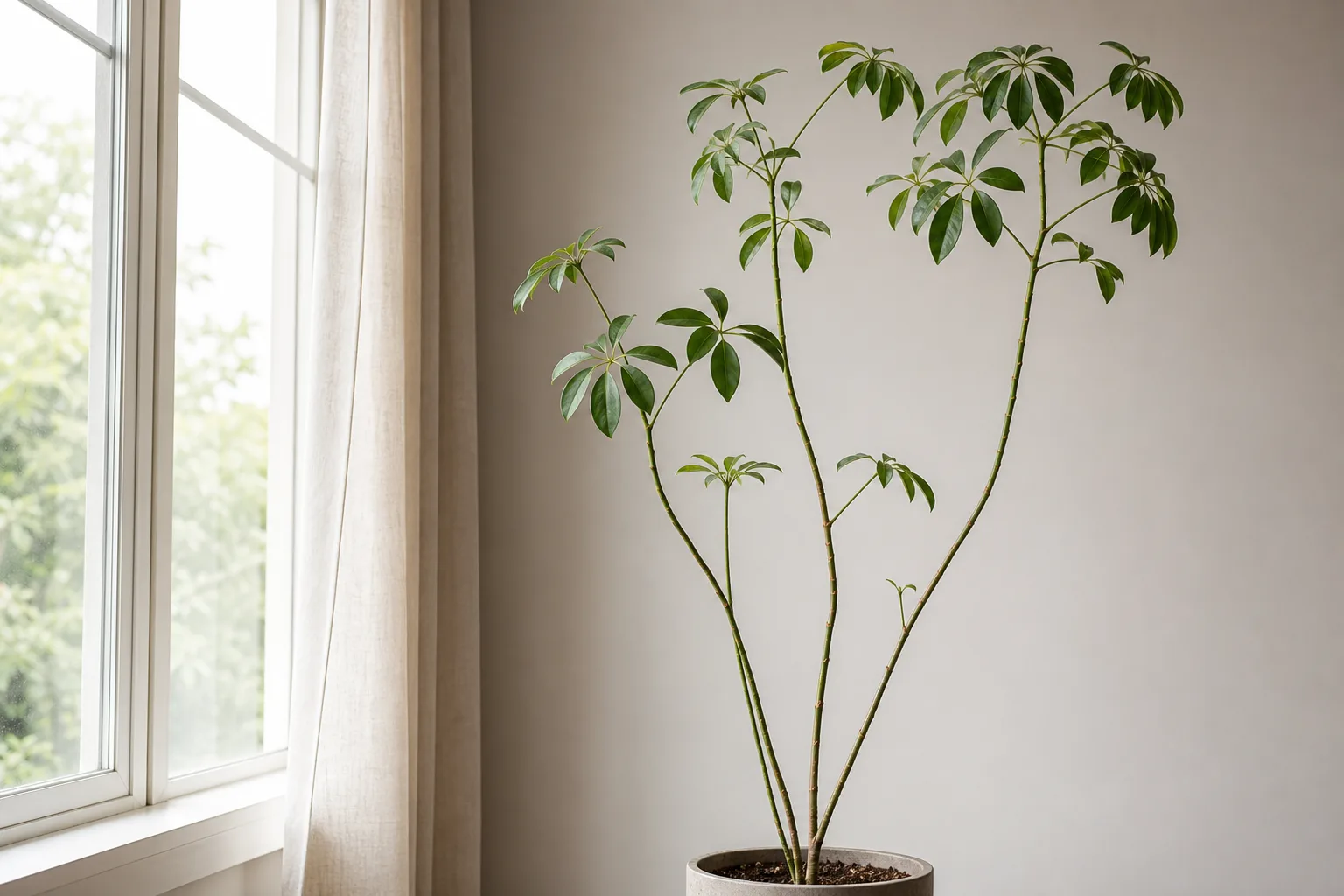
Leggy Growth on Schefflera: Causes, Checks & Fixes
This guide covers leggy growth on Schefflera. See also the general Leggy Growth guide, watering, and light pages for this plant.
Leggy Growth on Schefflera: Causes, Checks & Fixes
Quick answer
Leggy growth on Schefflera (Schefflera arboricola, dwarf umbrella tree) is etiolation: the plant extends stems between whorled leaf sets to reach brighter light-the same leggy stretch indoor plants develop when light is too low. Long internodes, thin pale petioles, sparse lower canopy, and a one-sided lean toward the window are the classic pattern-not random yellowing or pest damage.
First step: move the pot to bright light at east, west, or southern windows in curtain filtered sun before you prune heavily. Old stretched internodes will not compact backward; recovery shows up only on new whorls. Once three to four weeks of improved light produce firmer, closer-spaced leaf sets, trim the longest bare stems just above a node to encourage side shoots.
This page focuses on recognizing stretch, fixing light order, and pruning for bushiness. For the full low-light placement workflow-hand-shadow test, acclimation steps, grow-light setup, and wet-soil overlap-see not enough light on Schefflera. For proactive window choice, see the Schefflera light guide. For cut placement and one-third limits, see Schefflera pruning.
What leggy growth looks like on Schefflera
On Schefflera, legginess is a structural change in whorl spacing, not a single damaged leaflet. Each node carries a full umbrella of seven to nine glossy leaflets. When light is insufficient, the plant lengthens the stem between those whorls instead of building compact side branches.
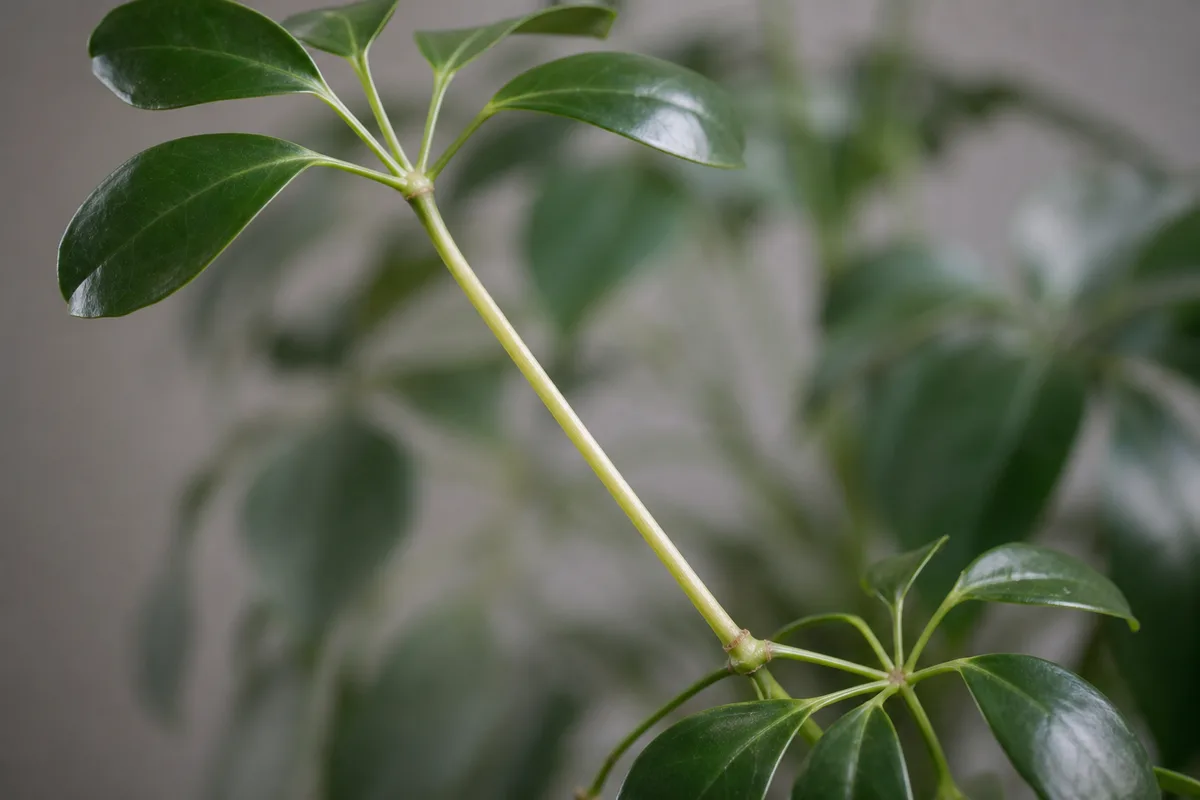
Leggy Growth symptoms on Schefflera - compare with healthy tissue on the same plant.
Typical signs include:
- Long internodes between whorled leaf sets-the primary metric for etiolation on this species
- Stems leaning toward the brightest window with thicker growth on the lit side of the pot
- Small, pale, or dull new leaflets on the most recent whorl compared with older sets near the top
- Sparse lower canopy where dropped whorls left bare woody stems
- Top-heavy silhouette with one or two long upright stems and little foliage below
- Thin weak petioles holding leaflets that look flat instead of glossy
Schefflera tolerates moderate light longer than crotons or fiddle-leaf figs, which is why stretch develops gradually on interior shelves. By the time a plant looks like a bare pole with umbrellas at the tips, etiolation has been building for weeks or months.
Variegated cultivars such as ‘Gold Capella’ and ‘Trinette’ often show stretch sooner than all-green plants-white tissue carries less chlorophyll, so variegation fades and internodes lengthen in the same dim corner where a green plant still looks merely sparse.
Why Schefflera gets leggy growth
Insufficient light (primary cause)
Low photon supply triggers stem elongation-the same etiolation mechanism extension guides describe when indoor plants stretch toward a brighter zone. Schefflera arboricola is native to Taiwan and Hainan Province, where it grows in bright filtered understory-not deep indoor shade. Without enough brightness at the whorl level, the plant prioritizes reaching light over building compact lateral shoots.
Missouri Botanical Garden recommends bright light at east, west or southern windows in curtain filtered sun (3-4 hours per day) indoors. Interior walls more than six feet from glass rarely keep internodes short year-round.
One-sided exposure and seasonal short days
Upright whorled growth magnifies one-sided lean. A pot that never rotates puts all new stretch on the window side while the back stays bare. Short winter days can add modest internode length even when the pot never moved-a seasonal echo of etiolation rather than a sudden care failure.
Wet soil in dim corners (overwatering mimic)
Leggy stems with yellow lower whorls on soil that stays damp for weeks often trace to low light plus slow water use, not a mysterious disease-extension experts link leggy Schefflera that may have been overwatered and does not get enough light. Schefflera transpires less in dim corners, so roots sit in oxygen-poor mix longer while stems still stretch. That overlap can look like overwatering alone-see overwatering on Schefflera when sour smell or soft tissue at the base appears.
Leggy growth vs not enough light - which guide to read
Both pages address low light on Schefflera, but they serve different search intent:
| Your main question | Start here | Why |
|---|---|---|
| Long bare stems, wide whorl gaps, want pruning steps | This page (leggy growth) | Focuses on etiolation recognition, light-before-prune order, and restoring bushiness |
| Yellow leaves, wet soil in a dim corner, window placement | Not enough light | Full placement audit, acclimation, grow-light setup, and wet-soil overlap |
| No new whorls for months but stems not stretched | Slow growth | Rate problem without dramatic internode lengthening |
| Bleached crispy patches on window-facing leaflets | Schefflera light guide | Too much direct intensity, not deficiency |
If symptoms span multiple columns, fix bright filtered light first-then follow the linked guide for the secondary pattern.
How to confirm the cause
Work through these whorl-focused checks before Schefflera repotting guide or heavy pruning:
- Internode spacing - Compare the gap between the two newest whorls to a compact stem section or a nursery photo. Leggy Schefflera often shows gaps two to three times longer than healthy compact growth on the same plant.
- Light at the whorl, not the room - Stand at the pot at midday. A soft diffuse shadow on the leaflets means usable indirect light; no shadow at whorl height confirms dim placement. Full hand-shadow protocol lives in not enough light on Schefflera.
- Growth direction - Stems thickening and leaning toward one window confirm light chasing. Rotate the pot a quarter turn weekly during recovery.
- New vs old tissue - Pale small leaflets on the terminal whorl with firm roots and moist (not sour) soil point to etiolation, not advanced root rot.
- Soil moisture rhythm - If the top 2 inches stay damp two weeks after watering while stems stretch, metabolism is too slow for your schedule-often because light is low. Do not add water to compensate for shade.
- Season check - Modest extra stretch in December on a north-facing sill differs from year-round interior-shelf etiolation. Winter pause without new bare stem length may be normal slow growth instead.
If the pot is light, mix is dry throughout, and leaflets wrinkle evenly, underwatering may explain wilt better than legginess-see underwatering on Schefflera before moving farther from the window.
First fix: increase bright filtered light before heavy pruning
Move the pot to the brightest filtered location you can sustain-that is the single first action for leggy Schefflera.
Practical targets:
- East windowsill - gentle morning sun, then bright indirect light the rest of the day
- One to three feet back from south or west glass with a sheer curtain filtering midday beams
- Full-spectrum grow light 12 to 18 inches above the canopy for 10 to 12 hours daily when natural windows are insufficient
Make one change: placement. Do not simultaneously repot, fertilize, or remove half the canopy. Schefflera drops leaves when stressed; stacking variables hides whether light was the real issue.
If the plant lived in deep shade for months, acclimate over seven to fourteen days rather than jumping onto unfiltered south or west glass. Start behind a sheer curtain and move closer every few days while watching for bleach or crispy edges on sun-exposed leaflets. Detailed acclimation steps are in not enough light on Schefflera.
Do not prune aggressively on day one in a dim room. Removing foliage reduces the photosynthetic surface area a stretching plant needs once light improves.
Pruning stretched stems after light improves
Pruning reshapes a leggy umbrella plant only after brightness is adequate-otherwise new shoots stretch again.
When to cut: Wait three to four weeks in improved light. If new whorls emerge closer together, glossier, and firmer than the most recent pale growth, bare stems are ready for shaping.
Where to cut: Make each cut 6–10 mm above a visible node-the slight swelling where a whorl attaches. Angle the blade slightly. Removing the terminal tip breaks apical dominance and encourages lateral shoots from nodes below. Prune to control size and improve bushiness once light is adequate. Limit removal to one-third of total foliage per session; split major reshapes across two sessions several weeks apart during active growth.
What to remove first: Longest bare stems with no live whorls, then stems with only one small leaf set at the tip. Leave enough healthy foliage elsewhere to support recovery.
What pruning cannot fix: Elongated internodes on uncut stem sections, dropped lower whorls, and tissue damaged by secondary root stress. Those remain as history while new compact growth carries the plant forward. Full technique, sanitizing tools, and seasonal timing are in Schefflera pruning.
Recovery timeline
Weeks one to two: The plant may look unchanged or drop a few leaves from the move. Old stretched internodes will not shorten-this is permanent etiolation anatomy. Watch for firmness in new tip whorls and slightly faster soil dry-down as first positive signs.
Weeks three to six: New whorled leaf sets should emerge closer together, glossier, and greener than the most recent pale growth. Internode length on fresh stem sections is the metric that matters-not whether old bare poles fill in spontaneously.
Two to three months: Canopy density improves as side shoots develop from pruned nodes. Rotate weekly so new growth fills around the stem instead of only on the window side.
What will not recover: Long bare internodes on stems you do not cut back, dropped whorls on lower sections, and any tissue damaged by chronic wet soil in dim corners.
Worsening signs: Continued yellowing with sour wet soil, soft stems at the soil line, mass leaf drop after acclimation, or new whorls that stay tiny and pale after six weeks in bright filtered light. Recheck distance from glass, consider a grow light, and inspect roots if the base softens-see root rot on Schefflera.
Lookalike symptoms
- Not enough light (broader syndrome) - Stretch plus yellow lower whorls, wet soil, months without growth. Full diagnostic path: not enough light.
- Slow growth - No new whorls for months during warm weather without dramatic internode lengthening. See slow growth on Schefflera.
- Overwatering / root stress - Yellow lower whorls with sour wet mix in the same dim corner. Fix light and dry-down together; see overwatering.
- Too much direct sun - Bleached or crispy patches on window-facing leaflets after a sudden unfiltered move. Pull back or filter; excess intensity, not deficiency.
- Normal winter slowdown - Slower whorl production in short days without new bare stem between existing whorls. Supplement light or wait for longer days.
What not to do
Do not prune heavily before fixing light-too low a light can cause Schefflera to become leggy and floppy, and new shoots in shade stretch again. Avoid moving straight from a dark corner to unfiltered south or west sun; Schefflera burns and may drop half the canopy from shock. Do not fertilize pale stretched growth to force bushiness; without photons, nutrients cannot build compact whorls.
Skip repotting on day one unless mix is failing or roots are mushy. Do not compensate for shade with extra water-stagnant moisture and dim placement compound on this species. Do not assume old internodes will shrink after a light move; only new growth or a cut-back stem carries compact spacing.
How to prevent leggy growth next time
Place Schefflera where bright filtered light reaches all whorls, not only where the tree looks good decoratively. East windows, filtered south or west rooms, and grow-light stations beat interior walls far from glass.
Rotate the pot weekly. Re-check exposure at the spring equinox when sun angle intensifies on formerly safe sills. Wipe dust from leaflets monthly so lower whorls intercept usable light. In dark homes, run a grow light on a timer through winter rather than accepting etiolation until February.
The prevention checkpoint that matters: firm glossy whorls on short new internodes and a canopy that stays evenly filled when you rotate the pot-not a pole with umbrellas only at the tips.
Conclusion
Leggy Schefflera is etiolation before it is a pruning project. The plant tells you with stretched whorl gaps, window-leaning stems, and a top-heavy silhouette. Confirm spacing at the nodes, move to bright filtered light as the first fix, wait for compact new whorls, then cut bare stems above nodes to restore bushiness. Old stretched internodes never shorten-judge success by fresh growth spacing, not by bare poles filling in. When yellow leaves and wet soil overlap with stretch, read not enough light on Schefflera and overwatering in the same week.
This page was reviewed by the LeafyPixels Review Board against Missouri Botanical Garden, NC State Extension, UMD Extension, and Ask Extension Schefflera references, and our not enough light, light, and pruning guides before publication. Author: sai-ananth. Reviewed: 2026-06-16.
Related guides
- Not enough light - full low-light placement and acclimation workflow
- Schefflera light - best windows, grow lights, and warning signs
- Schefflera pruning - node cuts, one-third rule, and recovery timing
- Slow growth - stalled whorls without dramatic stretch
- Overwatering - wet soil overlap in dim corners
- Overview - full indoor care hub
When to use this page vs other Schefflera guides
- Schefflera watering guide - Use for routine moisture checks before assuming leggy growth is the main issue.
- Schefflera problems hub - Browse all 18 common issues on this species.
- Not Enough Light on Schefflera - Different entry point when symptoms overlap with leggy growth.
- Slow Growth on Schefflera - Different entry point when symptoms overlap with leggy growth.
- Leaf Drop on Schefflera - Different entry point when symptoms overlap with leggy growth.